Master the molecules that run every living cell
From the enzymology of DNA replication to the precision of CRISPR base editing, Molecular Mastery gives you the mechanistic depth and laboratory fluency that textbooks gesture at but rarely deliver — built for students who want to think, talk, and reason like real scientists.
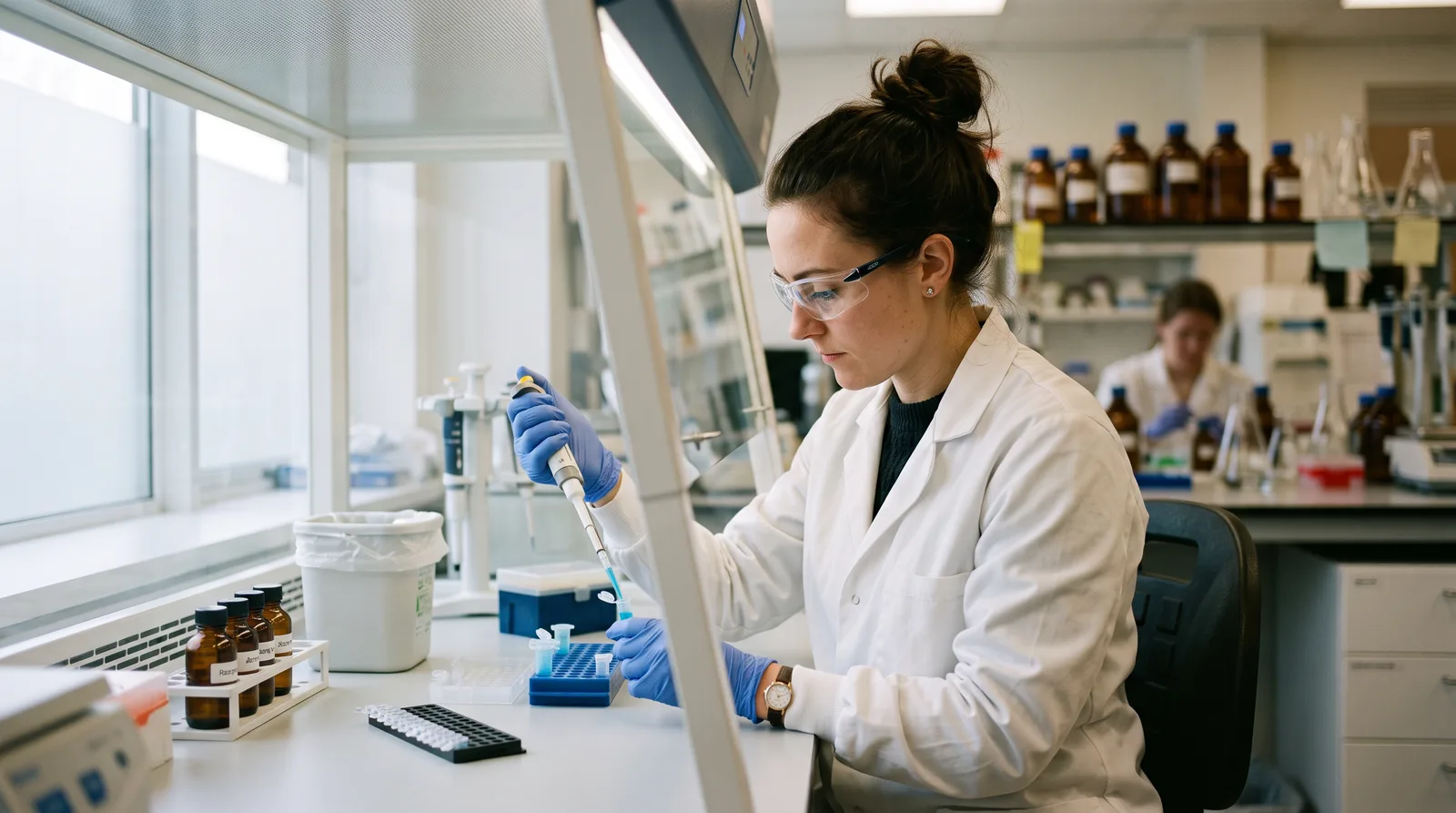
"I'm not here to hand you the answer — I'm here to make sure you can derive it yourself, every single time."
— Tracy Burke
What you'll learn
What you'll be able to do
- Explain the molecular mechanisms of DNA replication, transcription, and translation with enzyme-level precision
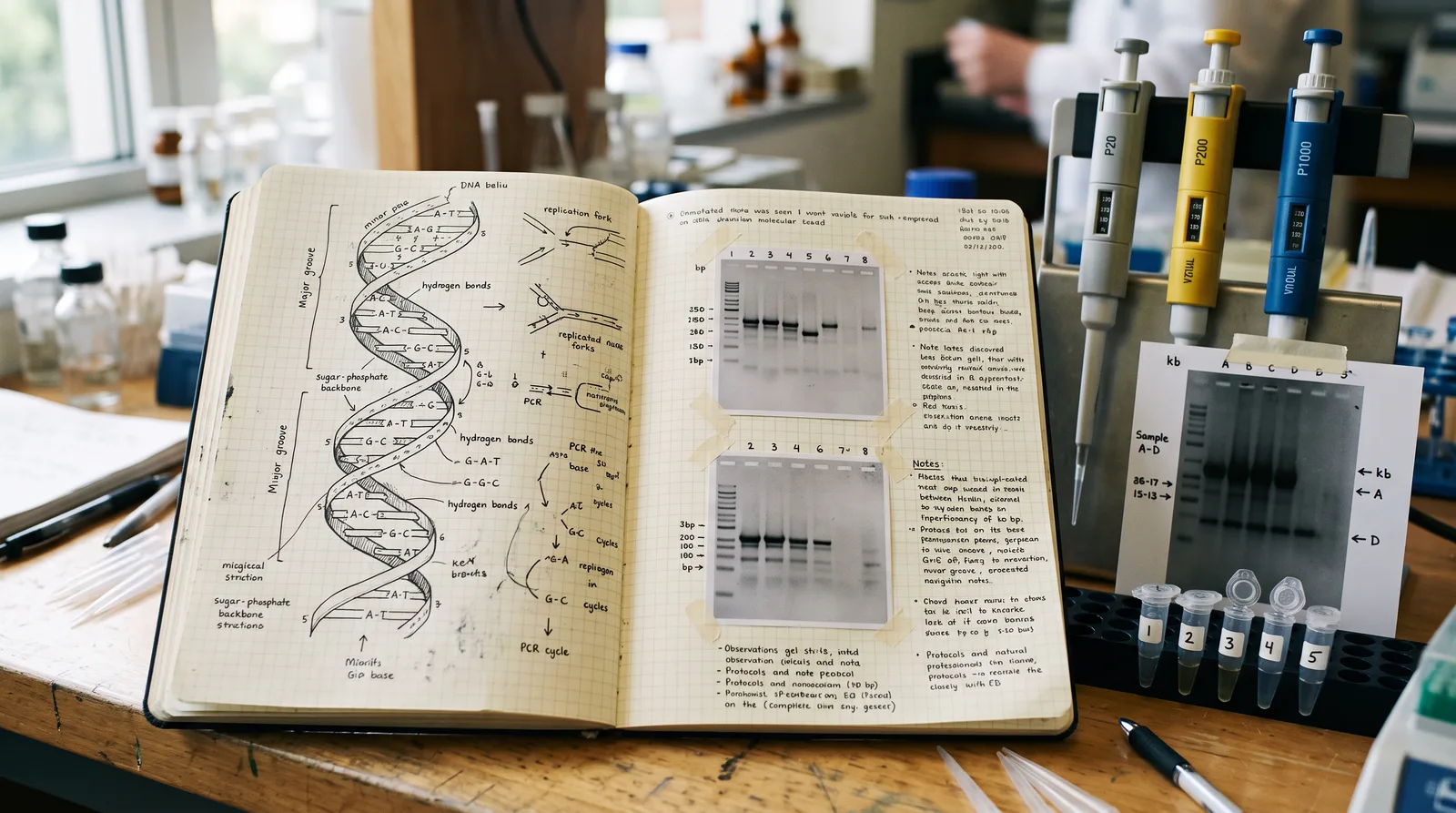
- Interpret gel electrophoresis, Western blot, and PCR results as used in real laboratory settings
- Analyze how mutations, epigenetic marks, and regulatory proteins control gene expression
- Describe the CRISPR-Cas9 editing system and evaluate its experimental and therapeutic applications
- Read and critically assess primary research papers in molecular and cell biology
- Design a basic experimental workflow — including controls, assays, and data analysis — for a molecular biology research question
How it works
A school that adapts to you
This isn't a set of static videos. Every lesson is generated live and tuned to where you actually are.
We learn your level
A quick placement check tailors your starting point so you're never bored or lost.
Lessons adapt as you go
Each lesson is written for your pace and your goal, adjusting as your skills grow.
Your AI coach keeps you moving
Checkpoints, feedback, and gentle nudges turn progress into a real result.
The curriculum
What's inside your school
6 modules · 30 lessons

The Molecular Blueprint: DNA Structure & Replication
Establishes the chemical architecture of DNA and dissects every enzymatic step of replication with precision.
- 1.1DNA Structure: From Nucleotides to the Double HelixIncluded
- 1.2Replication Machinery: Enzymes, Origins, and the Replication ForkIncluded
- 1.3Leading vs. Lagging Strand SynthesisIncluded
- 1.4Proofreading, Repair, and Replication FidelityIncluded
- 1.5Telomeres, Telomerase, and the End-Replication ProblemIncluded
From Gene to Protein: Transcription & Translation
Traces the complete flow of genetic information from RNA synthesis through ribosomal protein assembly, with mechanistic detail at each step.
- 2.1Transcription Initiation: Promoters, RNA Polymerase, and Transcription FactorsIncluded
- 2.2Elongation, Termination, and Pre-mRNA ProcessingIncluded
- 2.3The Genetic Code and tRNA DecodingIncluded
- 2.4Translation: Ribosome Assembly, Elongation, and TerminationIncluded
- 2.5Post-Translational Modifications and Protein FoldingIncluded
Controlling the Message: Gene Regulation & Epigenetics
Analyzes the molecular switches — from transcription factors to chromatin remodeling — that determine when and where genes are expressed.
- 3.1Transcription Factors: Activators, Repressors, and DNA-Binding DomainsIncluded
- 3.2Chromatin Structure: Histones, Nucleosomes, and AccessibilityIncluded
- 3.3Epigenetic Marks: DNA Methylation and Histone ModificationsIncluded
- 3.4RNA-Based Regulation: miRNA, siRNA, and the RNAi PathwayIncluded
- 3.5Mutations and Their Consequences for Gene ExpressionIncluded
Core Laboratory Techniques
Builds practical fluency in the essential molecular biology methods used to generate, separate, and detect nucleic acids and proteins.
- 4.1PCR: Principles, Design, and VariantsIncluded
- 4.2Gel Electrophoresis: Running and Interpreting Agarose and PAGE GelsIncluded
- 4.3Western Blotting: From SDS-PAGE to Antibody DetectionIncluded
- 4.4Cloning, Restriction Enzymes, and Recombinant DNA FundamentalsIncluded
- 4.5DNA Sequencing: Sanger, Next-Generation, and Sequence AnalysisIncluded
Genome Editing and Modern Molecular Tools
Examines CRISPR-Cas9 and related technologies in mechanistic detail and evaluates their experimental and therapeutic applications.
- 5.1CRISPR-Cas9 Mechanism: Guide RNA, PAM Recognition, and DNA CleavageIncluded
- 5.2DNA Repair Pathways: NHEJ vs. HDR and Editing OutcomesIncluded
- 5.3CRISPR Variants: Base Editing, Prime Editing, and CRISPRi/aIncluded
- 5.4Therapeutic and Agricultural Applications of CRISPRIncluded
- 5.5Ethical, Regulatory, and Off-Target ConsiderationsIncluded
Thinking Like a Scientist: Research Literacy & Experimental Design
Develops the critical thinking, literature skills, and experimental-design competencies needed to produce and evaluate original molecular research.
- 6.1Anatomy of a Primary Research PaperIncluded
- 6.2Evaluating Data Figures and Statistical ReasoningIncluded
- 6.3Formulating a Research Question and HypothesisIncluded
- 6.4Designing Controls, Choosing Assays, and Anticipating ArtifactsIncluded
- 6.5Putting It Together: Planning and Presenting a Complete Experimental WorkflowIncluded
Who it's for
Is this you?

Pre-med undergraduates
Needs the enzyme-level mechanistic depth that high MCAT scores and medical school interviews demand, far beyond what introductory courses provide.

Graduate school applicants
Wants to walk into admissions interviews able to discuss primary literature and experimental design with genuine authority, not rehearsed talking points.

Early-career lab researchers
Runs PCR and Western blots daily but wants the mechanistic understanding behind each technique to troubleshoot intelligently and impress their PI.

Upper-division bio students
Has covered the central dogma in introductory courses but craves the rigorous, step-by-step mechanistic treatment that transforms familiarity into real expertise.

CRISPR-curious scientists
Follows the headlines on gene editing and wants to move past the pop-science narrative into the actual guide RNA design, repair pathway logic, and ethical landscape.

Career-changers entering biotech
Transitioning into a molecular biology or biotech role and needs a rigorous, credible foundation in core concepts and laboratory techniques to hit the ground running.
Questions
Frequently asked
Your teacher
A note from your teacher

Tracy Burke
If you've made it to the upper division of a biology degree — or you're staring down a graduate school application, an MCAT prep schedule, or your first real research rotation — you already know the feeling I'm describing. You can write the words "semi-conservative replication" or "histone acetylation promotes transcription." You've seen the diagrams. You may have even gotten the points on the exam. And yet, if someone asked you to explain, from first principles, why the lagging strand requires a new primer at every Okazaki fragment, or how a H3K4me3 mark physically changes the accessibility of a promoter — you'd feel the answer just out of reach. That gap, between surface familiarity and genuine mechanistic understanding, is exactly what this school exists to close.
I designed Molecular Mastery because I kept encountering the same problem: brilliant students who had been taught that rather than why. Molecular biology, taught properly, is not a collection of facts to memorize — it is a set of physical and chemical logic problems with extraordinarily elegant solutions. When you understand the mechanism, you don't need to memorize the outcome. You can derive it. That is the intellectual standard I hold throughout this curriculum, and I will hold you to it too — not to be harsh, but because you are capable of it, and because the real world of research and medicine will demand exactly that.
Here is what you will be able to do by the time you finish. You'll be able to sit across from a graduate admissions committee and walk them through the molecular consequences of a specific mutation in a transcription factor's zinc-finger domain. You'll be able to look at a gel image in a paper's supplementary figures and spot why the authors' interpretation might be incomplete. You'll be able to design a CRISPR knock-in experiment — including the guide RNA, the HDR template, the appropriate controls, and the assay you'll use to confirm on-target editing without off-target indels — and explain every decision you made. These are not hypothetical skills. They are the ones that open doors.
I also want to address the concern I hear most often: "I'm not sure I'm a 'science person' at this level." Mechanistic molecular biology can feel intimidating precisely because it is taught, in most courses, as though it were reserved for the elect. It is not. It requires rigor and patience — two things you already have, or you wouldn't be here — and a willingness to sit with a mechanism until it clicks. The Socratic structure of this school is designed to make that happen: I don't tell you answers before you've had the chance to reason toward them, and I explain the same principle from multiple angles until the model is genuinely yours.
This is not a school that hands you a cheat sheet before your next exam and wishes you luck. It is a school that changes how you read a paper, how you think about a result, and how you talk about biology. I hope you'll join me in the work.
— Tracy Burke
Start your journey today
Get instant access — learn at your own pace with an AI coach in your corner.
$59/mo
Recurring billing · cancel anytime
Enrolling a child? Sign up as a parent — you'll add your student right here after.
Secure checkout · Instant access
- 6 modules, 30 lessons
- AI-adaptive lessons tuned to your level
- Quizzes & checkpoints to lock in progress
- Your own AI learning coach
- Learn on any device, at your pace
- Full access for as long as you're subscribed