
Become a certified motor mechanic — from first spanner to EV diagnostics
A comprehensive 12-month certified diploma program that takes you from workshop fundamentals all the way to EV, hybrid, and ADAS diagnostics — turning beginners and apprentices into job-ready, industry-certified motor mechanics.

"I teach the why behind every task — because a technician who understands principles can diagnose anything, not just the faults they've seen before."— Enstay
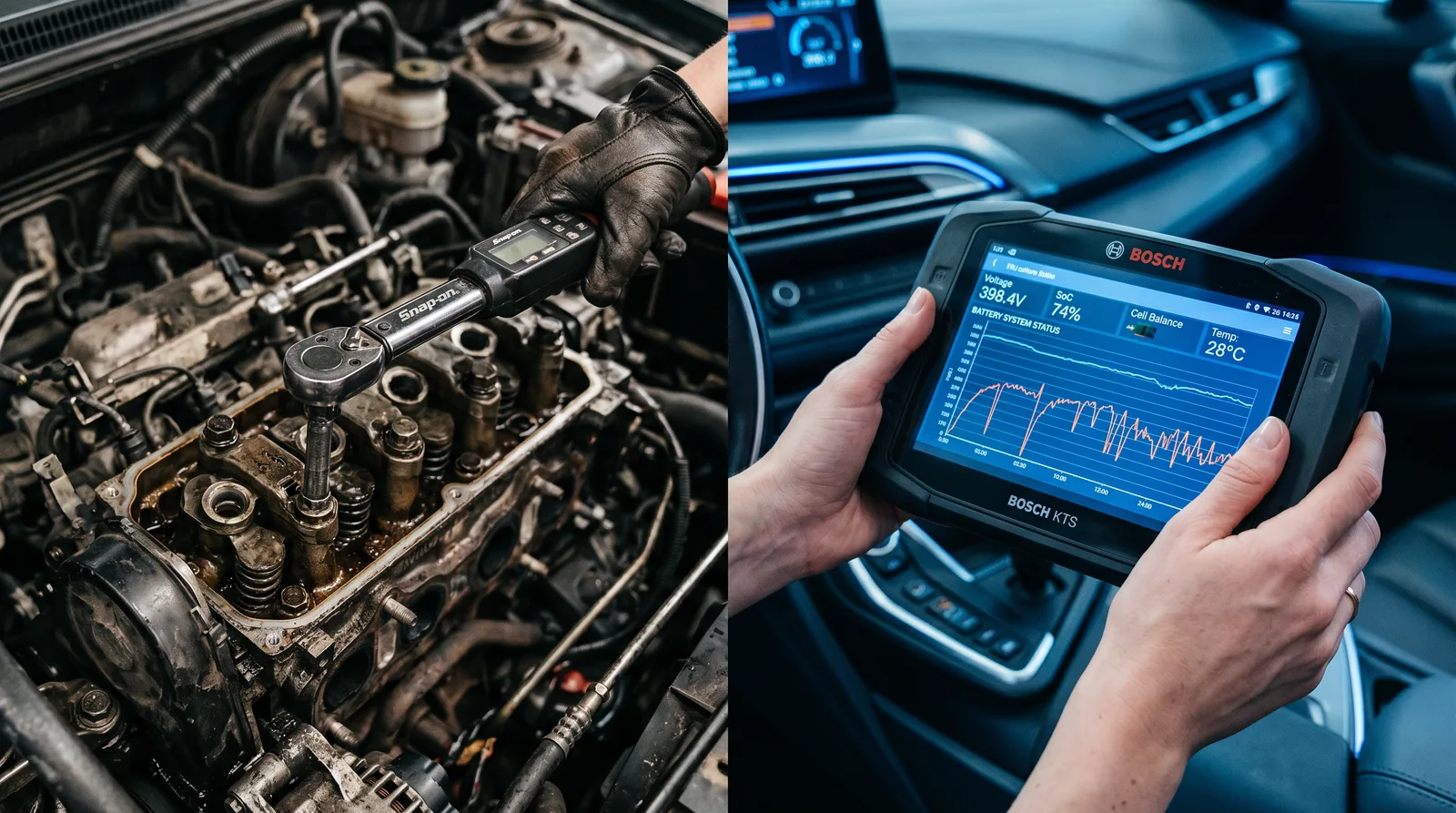
What you'll learn
What you'll be able to do
- Safely set up, maintain, and operate a professional workshop environment, including correct tool selection and hazard management
- Perform full vehicle servicing schedules — oil, filters, fluids, brakes, and tyres — to manufacturer specifications
- Diagnose and recondition engines and drivetrain components, including clutch, gearbox, differentials, and driveshafts
- Inspect, repair, and align chassis systems including suspension, steering geometry, and brake hydraulics
- Wire-trace, test, and repair automotive electrical systems and HVAC circuits using industry-standard diagnostic equipment
- Safely diagnose, service, and repair high-voltage EV and hybrid systems and calibrate Advanced Driver Assistance Systems (ADAS)
How it works
A school that adapts to you
This isn't a set of static videos. Every lesson is generated live and tuned to where you actually are.
We learn your level
A quick placement check tailors your starting point so you're never bored or lost.
Lessons adapt as you go
Each lesson is written for your pace and your goal, adjusting as your skills grow.
Your AI coach keeps you moving
Checkpoints, feedback, and gentle nudges turn progress into a real result.
The curriculum
What's inside your school
50 modules · 239 lessons

Workshop Safety and Tools Handling
Lay the groundwork for a safe, professional, and efficient workshop career. In this foundational module, you'll learn the essential safety protocols, regulations, and best practices that govern modern automotive workshops — from hazard identification and personal protective equipment (PPE) to fire safety and correct chemical handling. Alongside safety fundamentals, you'll gain hands-on familiarity with a comprehensive range of workshop tools and equipment, including hand tools, power tools, lifting devices, and precision measuring instruments. You'll discover how to select the right tool for every job, use it correctly, and maintain it to a professional standard. By the end of this module, you'll be equipped with the confidence and competence to work safely and effectively in any workshop environment — a critical foundation for everything that follows in your motor mechanics career.
- 1.1Introduction to Motor Mechanics Diploma courseIncluded
- 1.2Workshop Safety Principles & Hazard ManagementIncluded
- 1.3UK Workshop Safety RegulationsIncluded
- 1.4US Workshop Safety Regulations & OSHA StandardsIncluded
- 1.5Manual Tools — Selection, Use & MaintenanceIncluded
- 1.6Safe Manual Handling & First Aid in Workshop EmergenciesIncluded
Vehicle Servicing & Safety Checks
- 2.1High Voltage AwarenessIncluded
- 2.2Best Practice Vehicle ServicingIncluded
- 2.3Best Practice Vehicle Safety ChecksIncluded
Cooling System Servicing
- 3.1Understanding Engine CoolantsIncluded
- 3.2Engine Coolant TestingIncluded
- 3.3Best Practice Coolant Drain & FlushIncluded
- 3.4Drive Belt DiagnosisIncluded
- 3.5Engine Coolant Temperature Sensor DiagnosticsIncluded
Engine Oil Essentials
- 4.1Oil Filtration PrinciplesIncluded
- 4.2Engine Oil Viscosity & Performance ClassificationIncluded
- 4.3Engine Oil - Bases, Additives & CompositionIncluded
- 4.4Engine Oil - Synthetic vs. MineralIncluded
- 4.5Engine Oil SelectionIncluded
Transmission Servicing
- 5.1VW-Audi DSG ServiceIncluded
- 5.26 Speed Hydramatic Service RWDIncluded
- 5.3Mercedes Benz 722.9 Transmission ServiceIncluded
- 5.4ZF 4HP 16 Transmission Service CheckIncluded
Engine Mechanical Essentials
- 6.14 Stroke Engine PrinciplesIncluded
- 6.2Relative Compression TestingIncluded
- 6.3Gasoline Engine Mechanical ChecksIncluded
- 6.4Best Practice Head & Gasket Leak TestingIncluded
- 6.5Understanding Valve TimingIncluded
- 6.6VVT Cam Phasing TypeIncluded
- 6.7VVT Cam Changing TypeIncluded
- 6.8Valve Adjustment - Shim TypeIncluded
- 6.9Valve Adjustment - Rocker TypeIncluded
Cooling System Principles
- 7.1Cooling System PrinciplesIncluded
- 7.2Drive Belt SystemsIncluded
- 7.3Cooling System DiagnosisIncluded
- 7.4Cooling Fans - Relay ControlledIncluded
- 7.5Thermostats - ECM ControlledIncluded
- 7.6Investigating Stray Current CorrosionIncluded
Forced Induction Fundamentals
- 8.1Forced Induction - System PrinciplesIncluded
- 8.2Turbocharger Components - BearingsIncluded
- 8.3Twin Scroll Turbocharging - System PrinciplesIncluded
- 8.4Twin Charge SystemsIncluded
- 8.5Understanding Turbo Surge & FlutterIncluded
- 8.648 Volt Electric Turbocharger TechnologyIncluded
Engine Management Essentials
- 9.1Port Fuel Injection Delivery SystemIncluded
- 9.2Gasoline Injection Fuel ControlIncluded
- 9.3Introducing Gasoline Direct Injection (GDI)Included
- 9.4Dual Injection Fuel SystemsIncluded
- 9.5Understanding Fuel TrimsIncluded
- 9.6Understanding Gasoline Scan Tool DataIncluded
- 9.7Throttle Actuator Control SystemsIncluded
- 9.8Cylinder Deactivation OHV TypeIncluded
- 9.9Intake Runner Control SystemsIncluded
- 9.10Intake Runner Control - Solenoid Type DiagnosisIncluded
Understanding Engine Sensors
- 10.1Gasoline Injection SensorsIncluded
- 10.2Narrow Band Oxygen SensorsIncluded
- 10.3Wide Band Oxygen SensorsIncluded
- 10.4Mass Air Flow Sensor - Hot Film TypeIncluded
- 10.5Mass Air Flow Sensor 8 Wire TypeIncluded
- 10.62 Wire Sensors & CircuitsIncluded
- 10.7Pullup & Pulldown CircuitsIncluded
- 10.8Accelerator Pedal Position SensorIncluded
- 10.9Throttle Position SensorsIncluded
Mastering Ignition Systems
- 11.1Kettering Type Ignition SystemIncluded
- 11.2Spark PlugsIncluded
- 11.3Spark Timing & Dwell ControlIncluded
- 11.4Spark Plug & Lead DiagnosisIncluded
- 11.5Magneto & CDIIncluded
- 11.6Electronic Switching Ignition SystemsIncluded
- 11.7COP & Wasted SparkIncluded
- 11.8Ignition Coil Pack DiagnosisIncluded
Gasoline Fuel Delivery Essentials
- 12.1Fuel Delivery System Mechanical ChecksIncluded
- 12.2Fuel Delivery System Electrical ChecksIncluded
- 12.3Oscilloscope Injector DiagnosisIncluded
- 12.4Fuel Pump Control Module ChecksIncluded
- 12.5Fuel Pressure Regulator PerformanceIncluded
- 12.6Introducing Ethanol FuelIncluded
- 12.7E85 & Flex Fuel VehiclesIncluded
Emission Control Fundamentals
- 13.1Vehicle Emission PrinciplesIncluded
- 13.2Exhaust Gas RecirculationIncluded
- 13.3Vented Evaporative SystemsIncluded
- 13.4Gasoline Exhaust Emission DiagnosticsIncluded
- 13.52 Way Catalytic ConverterIncluded
- 13.63 Way Catalytic ConverterIncluded
- 13.7Catalytic Converter EfficiencyIncluded
- 13.8Catalyst Efficiency DiagnosticsIncluded
Understanding Diesel Systems
- 14.1Diesel Unit InjectionIncluded
- 14.2Hydraulic Electric Unit Injection (HEUI)Included
- 14.3Diesel Fuel Delivery - Low Pressure SupplyIncluded
- 14.4Diesel Fuel Delivery - High Pressure SupplyIncluded
- 14.5Two Stroke Diesel Engine PrinciplesIncluded
- 14.6Diesel Engine Mechanical ChecksIncluded
- 14.7Glow Plug OperationIncluded
- 14.8Indirect Glow Plug System - Testing ProceduresIncluded
- 14.9Direct Glow Plug System - Testing ProceduresIncluded
Common Rail Diesel Explained
- 15.1Introducing Common Rail Diesel (CRD)Included
- 15.2CRD Fuel DeliveryIncluded
- 15.3CRD Electronic ControlsIncluded
- 15.4CRD Injector CodingIncluded
- 15.5CRD Intake & Exhaust SystemsIncluded
- 15.6CRD Injector Leak Back TestingIncluded
Diesel Emissions Technology
- 16.1Vehicle Emission PrinciplesIncluded
- 16.2Exhaust Gas RecirculationIncluded
- 16.3NOx Type Catalytic ConverterIncluded
- 16.4DPF Diesel Particulate FilterIncluded
- 16.5DPF RegenerationIncluded
- 16.6DPF Flow DiagnosticsIncluded
- 16.7Selective Catalyst ReductionIncluded
Complete Clutch Essentials
- 17.1Clutch System PrinciplesIncluded
- 17.2Multiplate Clutch SystemsIncluded
- 17.3Dual Mass Flywheel PrinciplesIncluded
- 17.4Conventional Clutch DiagnosticsIncluded
Manual Transmissions Explained
- 18.1Manual Transmission OperationIncluded
- 18.2Understanding Manual TransaxlesIncluded
Dual Clutch Transmission Essentials
- 19.1Introducing DCTIncluded
Mastering Automatic Transmissions
- 20.1Automatic Transmission FluidsIncluded
- 20.2Torque Converter OperationIncluded
- 20.3Planetary Gear SetsIncluded
- 20.4Automatic Transmission OperationIncluded
- 20.5Automatic Transmission HydraulicsIncluded
- 20.6Electronic Transmission ControlIncluded
CVT Fundamentals
- 21.1Continuously Variable Transmission OverviewIncluded
Introducing Transfer Cases
- 22.1Transfer Case OverviewIncluded
Understanding Final Drives
- 23.1Understanding Final DrivesIncluded
- 23.2Limited Slip DifferentialsIncluded
- 23.3Driveshaft, Universal & Constant Velocity Joint OperationIncluded
Tyre & Rim Essentials
- 24.1Tyre TechnologyIncluded
- 24.2Tread & Rim TechnologyIncluded
- 24.3Run Flat TyresIncluded
- 24.4Tyre Pressure MonitoringIncluded
Best Practice Tyre Fitment
- 25.1Best Practice Standard Wheel BalancingIncluded
- 25.2Best Practice Standard Tyre Strip & FitIncluded
- 25.3Best Practice Low Profile/Run Flat Tyre Strip & FitIncluded
Introducing Suspension Components
- 26.1Suspension Components - SpringsIncluded
- 26.2Suspension Components - ShocksIncluded
- 26.3Suspension Components - LinkagesIncluded
- 26.4Suspension Components - Anti RollIncluded
- 26.5Suspension Components - BushesIncluded
- 26.6Suspension System PrinciplesIncluded
Understanding Suspension Systems
- 27.1Macpherson Strut - System Components & OperationIncluded
- 27.2Macpherson Strut - Inspection ProceduresIncluded
- 27.3Torsion Bar - System Components & OperationIncluded
- 27.4Torsion Bar - Inspection ProceduresIncluded
- 27.5Double Wishbone - System Components & OperationIncluded
- 27.6Double Wishbone - Inspection ProceduresIncluded
Advanced Suspension Technology
- 28.1Air Suspension OverviewIncluded
- 28.2Active ShocksIncluded
- 28.3Electronic - Kinetic Dynamic Suspension (E-KDSS)Included
Complete Steering Systems
- 29.1Manual Steering PrinciplesIncluded
- 29.2Hydraulic Power SteeringIncluded
- 29.3Electro-Hydraulic Power SteeringIncluded
- 29.4Electric Power SteeringIncluded
- 29.5Electric Power Steering (EPS) DiagnosisIncluded
Mastering Wheel Alignments
- 30.1Understanding Steering AnglesIncluded
Braking System Essentials
- 31.1Automotive Braking PrinciplesIncluded
- 31.2Understanding Brake FluidIncluded
- 31.3Brake Master Cylinder OperationIncluded
- 31.4Disc Brake SystemsIncluded
- 31.5Drum Brake Systems - Components & OperationIncluded
- 31.6Drum Brake Systems - Configurations & MaintenanceIncluded
Advanced Braking Systems
- 32.1Hydraulic Pressure Control & Safety ValvesIncluded
- 32.2Brake Boosters – Vacuum SuspendedIncluded
ABS Operation & Testing
- 33.1Anti-Lock BrakesIncluded
- 33.2Wheel Speed Sensor Operation & TestingIncluded
- 33.3Wheel Speed Sensor Circuit FaultIncluded
- 33.4ABS Pump Motor Circuit DiagnosisIncluded
Park Brake Technology
- 34.1Calliper Type Electric Park BrakesIncluded
- 34.2Cable Actuated Electric Park BrakesIncluded
- 34.3Cable Actuated Electric Park Brake AdjustmentIncluded
Mastering Electrical Principles
- 35.1Electron Theory, Conductivity & Ohm's LawIncluded
- 35.2Understanding Electrical Principles – Water AnalogyIncluded
- 35.3Practical Uses for Ohms LawIncluded
- 35.45 Elements That Every Circuit Must HaveIncluded
- 35.5Understanding Circuit ProtectionIncluded
- 35.6Series & Parallel CircuitsIncluded
Essential Multimeter Skills
- 36.1Fundamental Multimeter FunctionsIncluded
- 36.2Measuring Amps, Volts & ResistanceIncluded
- 36.3Understanding Duty Cycle & Pulse Width ModulationIncluded
- 36.4Testing Diodes & ContinuityIncluded
Advanced Multimeter Skills
- 37.1Getting the Most from a MultimeterIncluded
- 37.2Advanced Multimeter Functions - Practical ApplicationsIncluded
Diagnosing Circuit Faults
- 38.1Open & Short CircuitsIncluded
- 38.2Terminal Tension & Back ProbingIncluded
- 38.3Wiring Repairs Best PracticesIncluded
- 38.4Locating Harness FaultsIncluded
- 38.5What is Voltage Drop?Included
- 38.6Single Circuit Voltage Drop ChecksIncluded
- 38.7Using Voltage Drop as a Diagnostic ToolIncluded
Wiring Harness Fundamentals
- 39.1Automotive Cable SelectionIncluded
- 39.2Automotive Cable Size CalculationsIncluded
- 39.3Automotive Cable CrimpingIncluded
- 39.4Deutsch ConnectorsIncluded
- 39.5Understanding Automotive SolderingIncluded
- 39.6Automotive Soldering - Best PracticesIncluded
Automotive Relays Explained
- 40.1Automotive RelaysIncluded
- 40.2Relay CircuitsIncluded
- 40.3Monitored Relay CircuitsIncluded
Vehicle Lighting Technology
- 41.1Introduction to Automotive LightingIncluded
- 41.2Incandescent and Halogen Lighting TechnologyIncluded
- 41.3High Intensity Discharge Lighting TechnologyIncluded
- 41.4LED Lighting TechnologyIncluded
- 41.5Laser Lighting TechnologyIncluded
Understanding Sensors
- 42.1Electronic ComponentsIncluded
- 42.2Piezo Resistive Sensors ExplainedIncluded
- 42.3Piezo Electric Sensors ExplainedIncluded
- 42.4Capacitive SensingIncluded
- 42.5Ultrasonic Sensor TechnologyIncluded
Mastering Control Modules
- 43.1Circuit Operation & Voltage DividersIncluded
- 43.2Pullup & Pulldown CircuitsIncluded
- 43.3Control Module Logic & ProgrammingIncluded
- 43.4J2534 Pass-Thru CommunicationIncluded
Electrical Waveforms Explained
- 44.1Oscilloscope EssentialsIncluded
- 44.2Current Limiting TechnologyIncluded
- 44.3Pulse Width Modulation ExplainedIncluded
- 44.4Interpreting Position Sensor WaveformsIncluded
- 44.5Interpreting Pressure Sensor WaveformsIncluded
- 44.6Interpreting Primary Ignition WaveformsIncluded
Advanced Oscilloscope Techniques
- 45.1Relative Compression TestingIncluded
Testing & Charging Batteries
- 46.1Batteries - Lead FloodedIncluded
- 46.2Lithium Battery TechnologyIncluded
- 46.3Battery Test, Maintenance & RechargeIncluded
- 46.4Locating Parasitic DrainIncluded
- 46.5Smart Battery Charger TechnologyIncluded
Understanding Charging Systems
- 47.1Alternators ExplainedIncluded
- 47.2Alternators - Current RectificationIncluded
- 47.3Alternators - Voltage RegulationIncluded
- 47.4Best Practice Alternator Testing GuideIncluded
Smart Charging Technology
- 48.1Charging Systems ECM ControlledIncluded
- 48.2ECM Controlled Charging DiagnosisIncluded
Mastering Starter Systems
- 49.1Starter Motors ExplainedIncluded
- 49.2Direct Current MotorsIncluded
- 49.3Starter Circuit Voltage Drop TestingIncluded
- 49.4Start Stop Battery TechnologyIncluded
- 49.5Start Stop OperationIncluded
Modern Vehicle Networks
- 50.1Low Speed BUSIncluded
- 50.2CAN High Speed BUSIncluded
- 50.3Understanding FlexRayIncluded
- 50.4MOST BUSIncluded
- 50.5LIN BUSIncluded
Who it's for
Is this you?

First-year apprentices
Gives you the structured foundation your apprenticeship needs — safety, tools, and workshop fundamentals done right from day one.

Trade school students
Bridges the gap between classroom theory and real workshop practice with step-by-step, scenario-based instruction across every system.

Career changers
Takes you from zero mechanical background to a certified diploma with a logical, building-block curriculum that assumes nothing.

Working technicians
Fills in the gaps — especially in automotive electrical, advanced diagnostics, EV, hybrid, and ADAS — and backs your experience with formal certification.

EV & hybrid upskilers
Delivers dedicated, in-depth coverage of high-voltage safety, HV battery systems, charging infrastructure, and hybrid-specific service for technicians ready to work on modern vehicles.

DIY enthusiasts going pro
Turns serious home-workshop knowledge into trade-standard competency, with the theory, terminology, and certification to work professionally.
Questions
Frequently asked
Your teacher
A note from your teacher

Enstay
If you're reading this, you're probably somewhere I recognise. Maybe you're at the start of your apprenticeship, staring at an engine bay wondering where to even begin. Maybe you've been in workshops for a few years but you're working on gut feel, filling in the gaps as you go, and you know there are holes in your knowledge you haven't fully faced yet. Or maybe you're a trade school student who's been taught the theory in a classroom and needs the full picture connected — the kind of practical, methodical understanding that actually transfers to a job.
I built Motor Mechanics Pro because the automotive trade has changed faster than most training programs have kept up with. A fully job-ready mechanic today isn't just someone who can service a petrol engine and bleed brakes. They need to understand CAN Bus multiplexing, read oscilloscope traces for sensor faults, know how to safely isolate a high-voltage EV battery, and recalibrate an ADAS forward-facing camera after a wheel alignment. Those aren't future skills — they're current workshop requirements. And yet most training pathways still treat them as electives or afterthoughts.
This program covers all of it in sequence, the way a master technician thinks about it. We start with workshop safety and tool selection — not because it's a box to tick, but because your safety and the precision of your work depend on getting that foundation right. We move through vehicle servicing, engine reconditioning, the full drivetrain, suspension and four-wheel alignment geometry, brake hydraulics, ABS, ESC, automotive electrical theory, HVAC, and advanced diagnostics before we get to EV, hybrid, and ADAS. That order is deliberate. Everything builds. Nothing is floating.
The biggest objection I hear is this: "I can just pick it up on the job." And to an extent, that's true — until it isn't. The technicians who get stuck are the ones who learned procedures without understanding principles. They can follow a service schedule, but they can't diagnose a fault they haven't seen before. This program teaches you the why behind every task, so that when you're facing a vehicle that doesn't behave the way the textbook says it should — and they always do eventually — you have a diagnostic process, not just a memory.
Twelve months. Eighteen modules. One certification that covers the full breadth of the modern trade. If you want to work in a workshop that handles everything from a routine logbook service to an EV drivetrain fault, this is the structured path to get there. Come and do the work properly.
— Enstay
Start your journey today
Join get instant access — learn at your own pace with an AI coach in your corner.
$47/mo
Recurring billing · cancel anytime
Enrolling a child? Sign up as a parent — you'll add your student right here after.
Secure checkout · Instant access
- 50 modules, 239 lessons
- AI-adaptive lessons tuned to your level
- Quizzes & checkpoints to lock in progress
- Your own AI learning coach
- Learn on any device, at your pace
- Full access for as long as you're subscribed