Finally understand math — not just memorize it
Ms. Sincere walks every 6th–8th grader through the full Common Core curriculum using counters, number lines, and visual models first — so the "why" clicks before the algorithm ever does. Perfect for homeschool families and students filling in the gaps.

I never hand a student an algorithm before they've understood why it works — that's the whole thing.
— Celia Britton
What you'll learn
What you'll be able to do
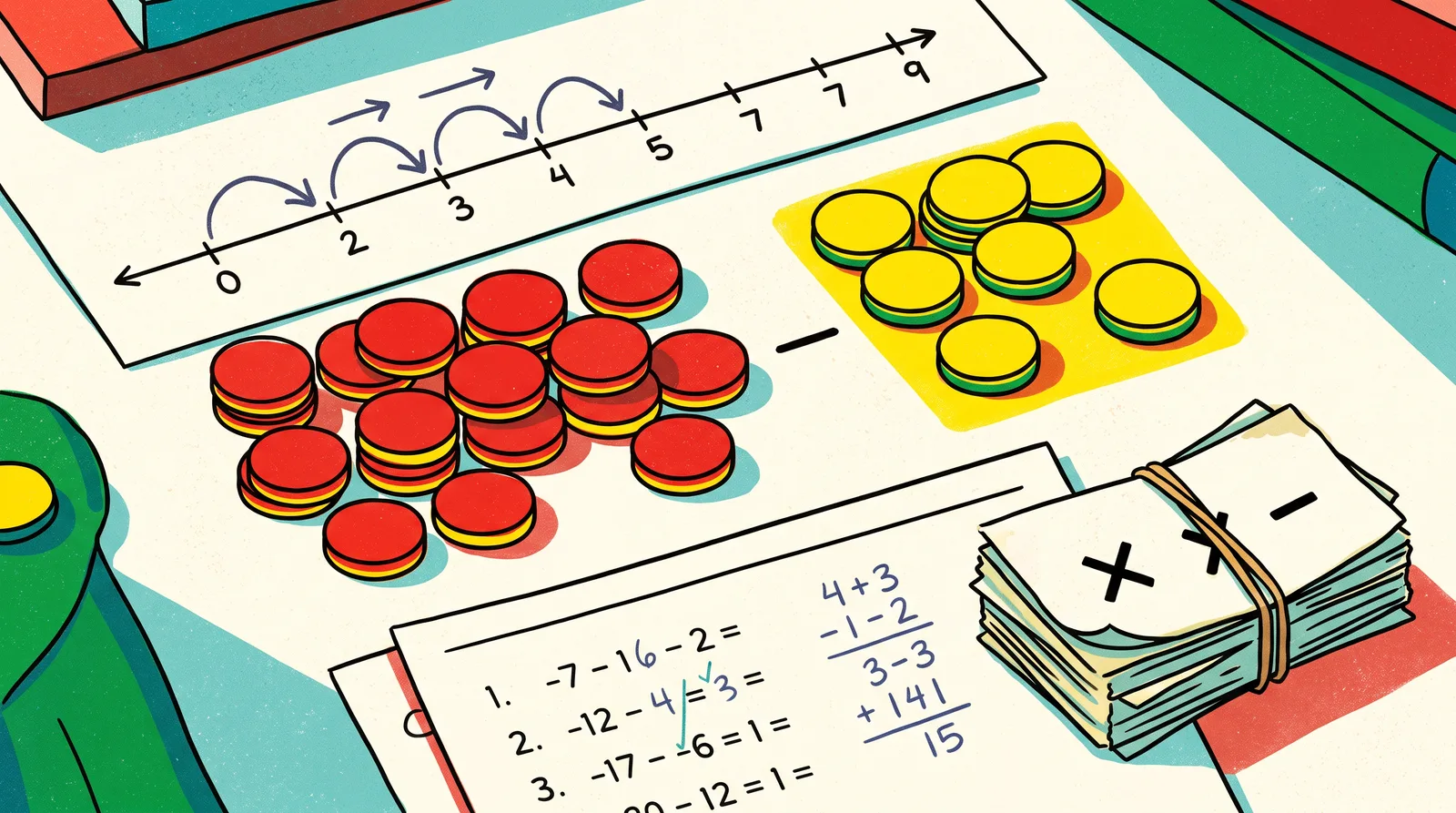
- Use physical counters and number lines to model integer addition, subtraction, multiplication, and division before applying the standard algorithm
- Master all Common Core grade 6–8 domains — ratios, expressions, equations, geometry, statistics, and functions — in a logical, scaffolded sequence
- Identify and fill specific grade-level math gaps using targeted quizzes and a personal gradebook that tracks mastery by standard
- Solve real-world ratio, percent, and proportional reasoning problems with confidence using pictorial models and cross-curricular examples
- Understand and graph linear relationships and intro functions by connecting tables, equations, and visual coordinate-plane pictures
- Demonstrate fluency with grade 6–8 Common Core standards through self-checking flashcards, interactive games, and standards-aligned worksheets
How it works
A school that adapts to you
This isn't a set of static videos. Every lesson is generated live and tuned to where you actually are.
We learn your level
A quick placement check tailors your starting point so you're never bored or lost.
Lessons adapt as you go
Each lesson is written for your pace and your goal, adjusting as your skills grow.
Your AI coach keeps you moving
Checkpoints, feedback, and gentle nudges turn progress into a real result.
The curriculum
What's inside your school
6 modules · 30 lessons

Ratios, Rates & Proportional Reasoning (Grade 6)
Students build ratio and rate concepts using visual models, tape diagrams, and double number lines before applying cross-multiplication and unit-rate algorithms.
- 1.1What Is a Ratio? Concrete & Pictorial IntroIncluded
- 1.2Unit Rates & the Rate TableIncluded
- 1.3Equivalent Ratios & Tape DiagramsIncluded
- 1.4Percents Using Double Number LinesIncluded
- 1.5Proportions & the Cross-Multiplication AlgorithmIncluded
The Number System: Integers & Rational Numbers (Grades 6–7)
Students build true understanding of integers and rational number operations by moving from counters and number lines to standard algorithms.
- 2.1Integers on the Number LineIncluded
- 2.2Adding Integers with Counters & Number LinesIncluded
- 2.3Subtracting Integers: Counters, Number Lines & AlgorithmIncluded
- 2.4Multiplying & Dividing Integers: Patterns to AlgorithmIncluded
- 2.5Rational Number Operations (Fractions & Decimals)Included
Expressions & Equations (Grades 6–7)
Students transition from arithmetic to algebra by modeling expressions and equations with algebra tiles before writing and solving them abstractly.
- 3.1Variables, Expressions & the Algebra Tile ModelIncluded
- 3.2Writing & Evaluating ExpressionsIncluded
- 3.3Properties of Operations & Combining Like TermsIncluded
- 3.4Solving One-Step Equations with Tiles & Balance ModelsIncluded
- 3.5Solving Two-Step & Multi-Step EquationsIncluded
Ratios to Functions: Proportional Relationships & Linear Equations (Grades 7–8)
Students connect ratio reasoning to proportional relationships, slope, and ultimately linear equations and intro functions.
- 4.1Proportional Relationships: Tables, Graphs & EquationsIncluded
- 4.2Slope: Concrete Rise-Over-Run on the Coordinate PlaneIncluded
- 4.3Slope-Intercept Form & Graphing Linear EquationsIncluded
- 4.4Systems of Equations: Graphing & SubstitutionIncluded
- 4.5Introduction to Functions: Inputs, Outputs & Function NotationIncluded
Geometry: Area, Surface Area, Volume & Transformations (Grades 6–8)
Students explore geometric concepts hands-on — composing and decomposing shapes, building nets, and performing transformations on the coordinate plane.
- 5.1Area of Polygons: Decompose & ComposeIncluded
- 5.2Surface Area with NetsIncluded
- 5.3Volume of Prisms & PyramidsIncluded
- 5.4The Pythagorean Theorem: Pictorial Proof to CalculationIncluded
- 5.5Transformations on the Coordinate PlaneIncluded
Statistics, Probability & Data (Grades 6–8)
Students collect, display, and analyze data using visual displays and move toward understanding variability, distributions, and basic probability.
- 6.1Statistical Questions & Data DisplaysIncluded
- 6.2Measures of Center & VariabilityIncluded
- 6.3Comparing Data Sets with Visual ModelsIncluded
- 6.4Probability: Theoretical vs. ExperimentalIncluded
- 6.5Scatter Plots, Trend Lines & Bivariate DataIncluded
Who it's for
Is this you?

Homeschool parents
Needs a complete, structured 6th–8th grade math program they can hand a middle schooler with confidence — no extra planning required.

Gap-filling students
A middle schooler who lost ground in math and needs targeted, standard-by-standard support to catch up before it's too late.

Visual learners
A student who tunes out when math is just rules to memorize, but finally clicks when they can see it on a number line or draw it out first.

Co-op & micro-school teachers
Runs a small group of middle schoolers and wants a standards-aligned, ready-to-teach curriculum with built-in assessments and games.

Pre-algebra preppers
Wants to make sure their student has a rock-solid foundation in ratios, integers, and equations before high school algebra begins.

Returning-to-school families
Transitioning a child back to traditional school and needs to quickly identify and close specific Common Core gaps using a structured, gradebook-tracked plan.
Questions
Frequently asked
Your teacher
A note from your teacher

Celia Britton
Hey there — I'm so glad you found this page, and I want to talk to you for a second before you scroll any further.
If you're a parent watching your middle schooler hit a wall in math — staring at their homework, saying "I just don't get it," or quietly deciding they're "bad at math" — I want you to know that's not a personality trait. That's a gap. And gaps can be filled. I've seen it happen over and over, and it's exactly why I built this curriculum the way I did.
Here's what I know about middle school math: the procedures come fast and the foundation underneath them is almost never explained. Kids are handed an algorithm for adding integers, told to memorize the steps, and then left to wonder why any of it works. When the next concept builds on that shaky foundation — and in middle school, everything builds on everything — it starts to collapse. My answer to that is the concrete–pictorial–abstract sequence. We start with counters you can physically move around for integer operations. We draw tape diagrams and double number lines before we write a single proportion. We use algebra tiles and balance models before we solve an equation symbolically. By the time my students see the algorithm, they've already understood why it's true — and that understanding doesn't fall apart under pressure the way memorization does.
This curriculum covers every Common Core domain your 6th, 7th, or 8th grader needs: ratios and proportional reasoning, the full number system, expressions and equations, linear relationships right up through intro functions, geometry from area through the Pythagorean Theorem, and statistics and probability. Each unit was designed to flow into the next one logically, so there are no surprise jumps and no assumed knowledge that wasn't taught. And it comes with everything a homeschool family needs to run a real math program — videos, worksheets, games, flashcards, quizzes, and a gradebook that tracks mastery by individual standard, so you always know exactly where your student stands.
I teach the way I wish someone had taught me: patiently, visually, one step at a time, with a "we can figure this out" energy that I genuinely mean. Whether your child is starting 6th grade fresh, catching up after a hard year, or bridging into 8th-grade algebra, this is the place to do it. I'd love to be their math teacher. Let's get to work.
— Celia Britton
Start your journey today
Get instant access — learn at your own pace with an AI coach in your corner.
$29/mo
Recurring billing · cancel anytime
You'll add your student right after signing up.
Secure checkout · Instant access
- 6 modules, 30 lessons
- AI-adaptive lessons tuned to your level
- Quizzes & checkpoints to lock in progress
- Your own AI learning coach
- Learn on any device, at your pace
- Full access for as long as you're subscribed