Master every science, ace the eAssessment
A rigorous 12-month Integrated Sciences course for MYP Year 5 students that builds genuine scientific understanding across Biology, Chemistry, Physics, and Earth Science — and sharpens every skill needed to excel in the IB Integrated MYP eAssessment.

"The eAssessment has a grammar — learn it alongside the science, and the highest band becomes a matter of thinking clearly, not guessing."— Geoffrey Mitchell
What you'll learn
What you'll be able to do
- Design and carry out a full MYP scientific investigation — from hypothesis through variables, data collection, and a rigorous evaluation of results.
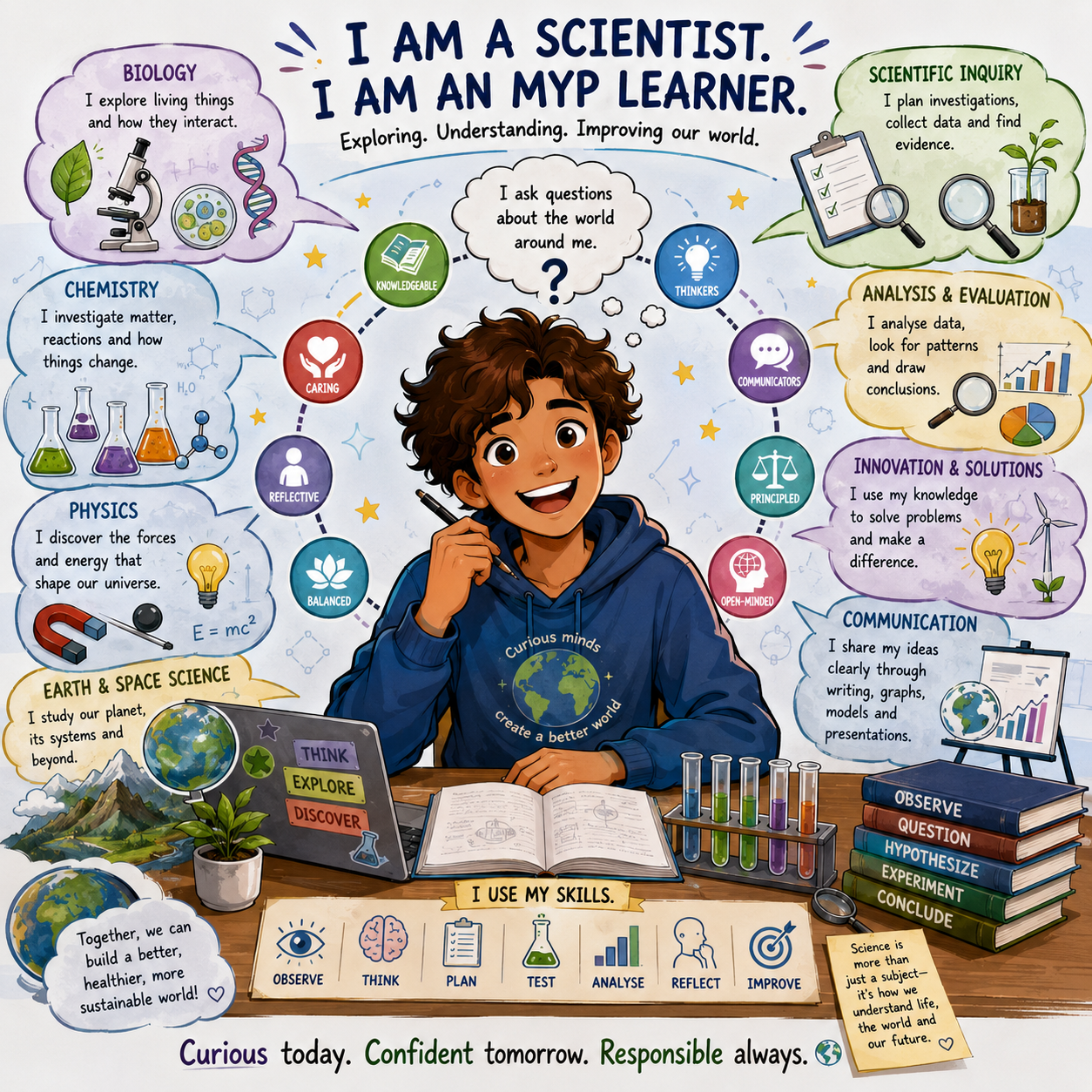
- Demonstrate deep conceptual understanding across all four disciplines: Biology, Chemistry, Physics, and Earth & Environmental Science.
- Decode and confidently answer every command term used in MYP eAssessment questions (analyse, evaluate, deduce, justify, and more).
- Process and interpret experimental data using appropriate graphs, statistical measures, and error analysis aligned with MYP Criterion C standards.
- Apply cross-disciplinary thinking to real-world scenarios — connecting biological processes to chemical reactions, energy systems, and environmental impacts.
- Construct well-structured scientific arguments and extended responses that satisfy all four MYP Integrated Sciences assessment criteria at the highest band.
How it works
A school that adapts to your learning and builds confidence
This isn't a set of static videos. Every lesson is generated live and tuned to where you actually are.
We learn your level
A quick placement check tailors your starting point so you're never bored or lost.
Lessons adapt as you go
Each lesson is written for your pace and your goal, adjusting as your skills grow.
Your AI coach keeps you moving
Checkpoints, feedback, and gentle nudges turn progress into a real result.
The curriculum
What's inside your school
6 modules · 25 lessons
Scientific Thinking & MYP Inquiry Foundations
This foundational module launches the course by equipping students with the meta-skills they need to succeed across every subsequent module. Before diving into disciplinary content, students decode exactly how MYP Integrated Sciences is assessed, learn to read command terms with precision, and practise the full investigation cycle — from forming a focused research question through to writing a rigorous evaluation. Establishing these skills first ensures that every lab and activity throughout the year is approached with assessment-literacy built in. This module directly targets all four MYP criteria and underpins every target outcome.
- 1.1MYP Command Terms & Assessment Criteria DecodedIncluded
- 1.2Designing a Rigorous MYP InvestigationIncluded
- 1.3Data Collection, Processing & Error AnalysisIncluded
- 1.4Evaluating Results & Constructing Scientific ArgumentsIncluded
Biology — Cells, Genetics & Life Processes
This module builds deep conceptual understanding across the core biological topics assessed in MYP Integrated Sciences, with particular emphasis on how biological structures relate to function at every level — from molecules inside a cell to organ systems in the whole organism. Students move from the microscopic (cell ultrastructure and membrane dynamics) through molecular genetics and heredity to the integrated physiology of the human body. Each lesson embeds MYP inquiry and assessment skills within authentic biological contexts, reinforcing the investigation framework established in Module 1.
- 2.1Cell Structure, Function & MicroscopyIncluded
- 2.2Transport Across MembranesIncluded
- 2.3Genetics, Heredity & BiotechnologyIncluded
- 2.4Human Body Systems — Integration & HomeostasisIncluded
Chemistry — Matter, Reactions & Energy
This module develops rigorous chemical understanding across atomic theory, bonding, reaction types, quantitative chemistry, and energy changes. Students move from the sub-atomic scale (electron configuration and the periodic table) through to the macroscopic world of measurable reactions and calculations. A consistent emphasis is placed on explaining observations at the particle level — the hallmark of high-band Criterion A responses in Chemistry. Quantitative skills (mole calculations, stoichiometry, concentration) are developed progressively and connected back to Criterion C data-processing skills. pH, acids, and bases also link forward to environmental science and biochemistry.
- 3.1Atomic Structure, the Periodic Table & Chemical BondingIncluded
- 3.2Chemical Reactions — Types, Evidence & RatesIncluded
- 3.3Stoichiometry & Quantitative ChemistryIncluded
- 3.4Acids, Bases & Energy Changes in ReactionsIncluded
Physics — Forces, Energy & Waves
This module develops conceptual and quantitative understanding across the core physics topics in the MYP Integrated Sciences syllabus: mechanics, energy, electricity and magnetism, and waves. Students learn to apply physics principles both mathematically and conceptually, using equations correctly with appropriate units and significant figures while always grounding calculations in physical meaning. Practical investigations are central to each lesson, and the module explicitly links to chemistry (energy), biology (nerve impulses, hearing, sight), and environmental science (renewable energy, electromagnetic radiation) to build cross-disciplinary fluency.
- 4.1Forces, Motion & Newton's LawsIncluded
- 4.2Energy — Transformations, Conservation & EfficiencyIncluded
- 4.3Electricity, Magnetism & Electromagnetic InductionIncluded
- 4.4Waves — Properties, Behaviour & ApplicationsIncluded
Earth & Environmental Science — Systems, Resources & Change
This module develops students' understanding of Earth as a set of interconnected systems — geosphere, atmosphere, hydrosphere, and biosphere — and the ways human activity is disrupting these systems at local and global scales. Students examine the rock cycle, climate science, ecosystem dynamics, and resource sustainability, always connecting physical and chemical processes to biological and social dimensions. The module is strongly oriented toward Criterion D (reflecting on the impact of science on society and the environment) while also embedding Criterion A and C skills through data analysis of real climate and ecological datasets.
- 5.1Earth Systems & the Rock CycleIncluded
- 5.2Climate Science — The Greenhouse Effect & Global WarmingIncluded
- 5.3Ecosystems, Biodiversity & Human ImpactIncluded
- 5.4Resource Management & SustainabilityIncluded
Cross-Disciplinary Connections & eAssessment Mastery
This capstone module weaves together the scientific content from all four disciplines and brings every assessment skill to examination readiness. Students first explicitly map the cross-disciplinary connections that run through the course, then engage in structured, timed practice of both eAssessment paper formats under conditions that mirror the real examination. A full simulation builds stamina and confidence, and a final personalised revision lesson targets individual gaps identified through formative assessment data. The module closes with a reflective lesson on the nature of science, completing the Criterion D arc of the course and leaving students with a coherent identity as scientific thinkers.
- 6.1Cross-Disciplinary Themes — Connecting the SciencesIncluded
- 6.2eAssessment Paper Practice — Criterion A & BIncluded
- 6.3eAssessment Paper Practice — Criterion C & DIncluded
- 6.4Full eAssessment Simulation & Personalised RevisionIncluded
- 6.5The Nature of Science & Reflections on Scientific ImpactIncluded
Who it's for
Is this you?

The eAssessment-focused student
A Grade 10 student who understands science conceptually but wants a structured, criteria-aligned programme to translate that knowledge into top-band eAssessment responses.

The science-anxious learner
A student who finds Chemistry or Physics intimidating and needs clear, jargon-free explanations that build genuine understanding one rigorous step at a time.

The self-directed high achiever
An independent learner aiming for the highest MYP band who wants to go beyond classroom notes and engage with deeply structured content, command-term mastery, and full exam simulation.

The MYP Science teacher
An educator looking for a coherent, syllabus-mapped Year 5 resource that models strong MYP pedagogy and supports lesson planning across all four Integrated Sciences disciplines.

The school coordinator
An MYP coordinator who needs a reliable, criteria-referenced eAssessment preparation pathway they can confidently recommend to Grade 10 students and families.

The late-stage exam preparer
A student with limited time before the eAssessment who needs to rapidly master command terms, plug conceptual gaps across all four disciplines, and practise with realistic exam papers.
Questions
Frequently asked
Your teacher
A note from your teacher
Geoffrey Mitchell
If you're a Grade 10 student staring down the MYP eAssessment, you already know the uncomfortable truth: science class and eAssessment success are not automatically the same thing. You can understand what osmosis is and still lose marks on a Criterion C question because you didn't structure your data processing correctly. You can know Newton's Laws cold and still fumble an "evaluate" question because nobody ever showed you what "evaluate" actually means in an MYP context. That gap — between knowing science and performing in MYP science — is exactly what this course is built to close.
I designed MYP Sciences Mastery because I kept seeing intelligent, curious students underscore themselves. Not because they lacked ability, but because the eAssessment has a very specific grammar — command terms, criteria, structured arguments — and most science teaching (understandably) focuses on the concepts, not the exam's language. This course does both. We go deep on the science: you'll explore cell transport and genetic inheritance, work through stoichiometric calculations, reason about electromagnetic induction, and analyse real climate data. But at every turn, we ask: how would you express this understanding in an eAssessment response?
The course is structured the way scientific understanding actually builds. We start with the thinking skills — investigation design, data processing, error analysis, scientific argumentation — because those skills are the foundation every discipline unit rests on. Then we move through Biology, Chemistry, Physics, and Earth & Environmental Science in units that are conceptually rigorous and honest about complexity. I won't simplify a concept to the point of distortion; I'd rather ask you a good question and let you reason your way to clarity.
The final stretch of this course is where everything connects. Cross-disciplinary themes show you how a biological process like photosynthesis, a chemical concept like energy transfer, and an environmental issue like climate change are actually one conversation. And then we practise — properly. Full Criterion A–D paper practice, a complete eAssessment simulation, and reflection on the Nature of Science itself. Because the goal was never just a score. The goal is for you to leave this course thinking more carefully, arguing more precisely, and feeling genuinely confident in your scientific mind.
Whether you're a student who wants to reach the highest band, a teacher looking for a structured Year 5 resource, or a coordinator building a preparation pathway for your cohort — I'm glad you're here. Let's think this through together. You get to learn and benefit from over 25 years of teaching and over 10 years of being the principal examiner for MYP assessments.
— Geoffrey Mitchell
Start your journey today
Join get instant access — learn at your own pace with an AI coach in your corner.
$20/mo
Recurring billing · cancel anytime
Secure checkout · Instant access
- 6 modules, 25 lessons
- AI-adaptive lessons tuned to your level
- Quizzes & checkpoints to lock in progress
- Your own AI learning coach
- Learn on any device, at your pace
- Full access for as long as you're subscribed