Conquer pharmacology — walk into your next clinical day with confidence. Perfect prep for NCLEX too.
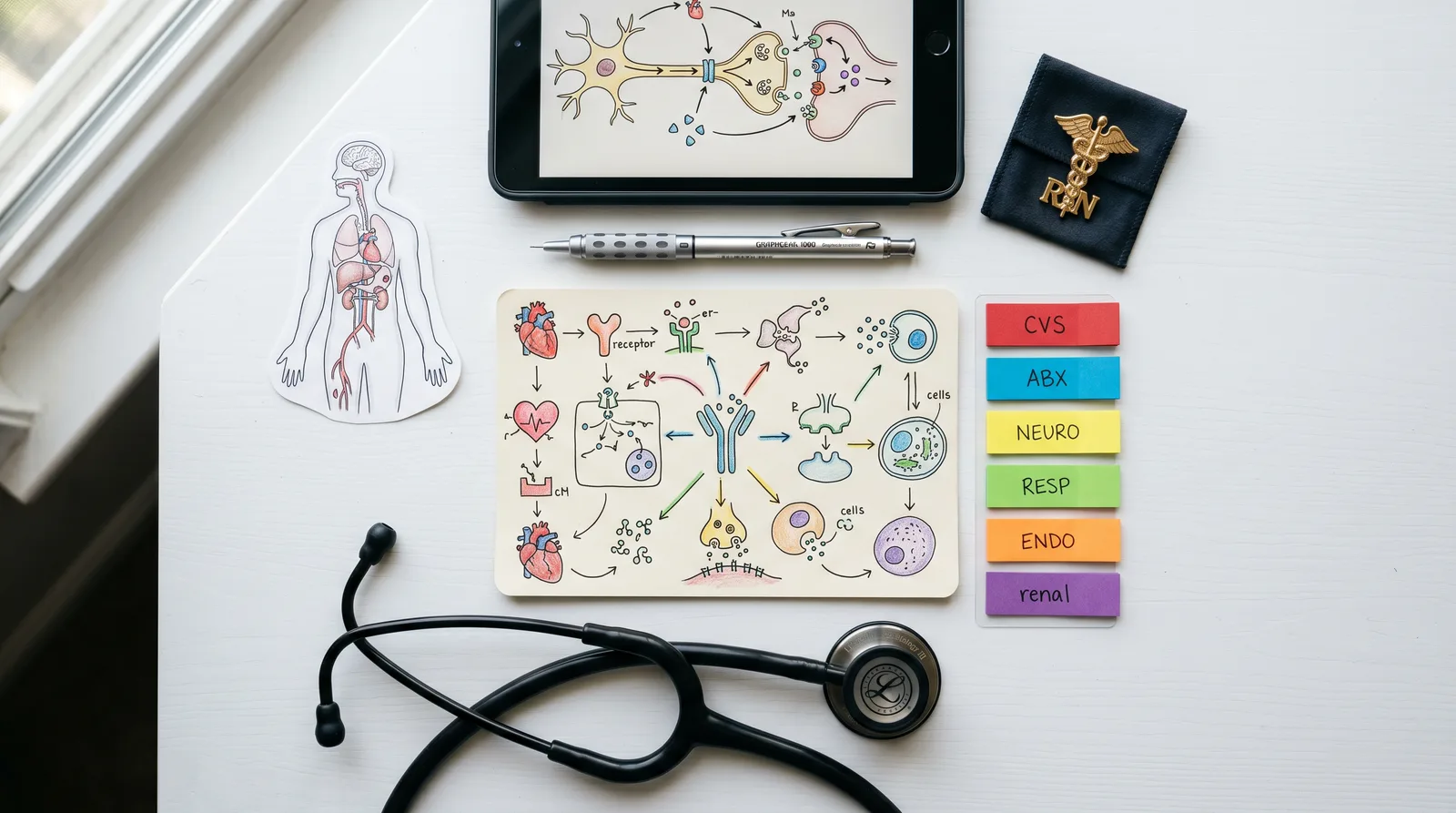
An AI-Adaptive Tutoring School built exclusively for nursing students who need to conquer pharmacology — the most failed subject on the path to your R.N. license. Master drug classes, mechanisms, nursing implications, and NCLEX-style pharmacology questions through personalized AI-driven lessons, avatar explainer videos, and visual infographics.

"Once you understand why a drug works, you'll never have to just memorize pharmacology again."— AIAdaptativeSchool
What you'll learn
What you'll be able to do
- Accurately identify the mechanism of action, therapeutic use, side effects, contraindications, and nursing implications for all major drug classifications tested on the NCLEX-RN.
- Apply pharmacokinetic and pharmacodynamic principles (absorption, distribution, metabolism, excretion) to predict how drugs behave in real patient scenarios.
- Safely calculate drug dosages — including IV drip rates, weight-based pediatric dosing, and high-alert medication math — with full dimensional analysis.
- Recognize and prioritize nursing interventions for high-risk drug categories including anticoagulants, insulin, opioids, antibiotics, and cardiac medications.
- Interpret medication orders, identify potential drug-drug and drug-food interactions, and apply the Six Rights of Medication Administration in clinical decision-making.
- Pass NCLEX-RN-style pharmacology questions with confidence by mastering test-taking strategies specific to pharmacology stems, priority questions, and select-all-that-apply (SATA) formats.
How it works
A school that adapts to you
This isn't a set of static videos. Every lesson is generated live and tuned to where you actually are.
We learn your level
A quick placement check tailors your starting point so you're never bored or lost.
Lessons adapt as you go
Each lesson is written for your pace and your goal, adjusting as your skills grow.
Your AI coach keeps you moving
Checkpoints, feedback, and gentle nudges turn progress into a real result.
The curriculum
What's inside your school
5 modules · 19 lessons

Pharmacology Foundations: How Drugs Work in the Body
This foundational module establishes the essential prerequisite knowledge every nursing student must master before approaching any drug classification or clinical scenario. Students learn how the body processes drugs (pharmacokinetics) and how drugs produce their effects (pharmacodynamics), then immediately connect this science to safe clinical practice through the Six Rights of Medication Administration and accurate interpretation of medication orders. AI Avatar explainer videos, animated infographics, and slide decks are used throughout to visualize abstract physiological concepts. Mastery of this module is required before advancing, as every subsequent module builds directly on these principles.
- 1.1Pharmacokinetics: Absorption, Distribution, Metabolism & Excretion (ADME)Included
- 1.2Pharmacodynamics: Mechanisms of Action, Receptors & Drug EffectsIncluded
- 1.3The Six Rights of Medication Administration & Interpreting Medication OrdersIncluded
Drug Dosage Calculations: From Basics to High-Alert Medication Math
Accurate drug dosage calculation is a non-negotiable nursing competency and a major source of NCLEX-RN questions. This module builds calculation confidence systematically — from the universal dimensional analysis method, through IV flow rate and infusion calculations, to complex weight-based pediatric dosing and high-alert medication math. A prerequisite math readiness check is embedded at the module entry point (fractions, ratios, unit conversions) so students with gaps can access a just-in-time remediation mini-lesson before proceeding. AI Avatar videos model every calculation type step-by-step, and all practice sets use clinically realistic values. Mastery checks gate each lesson before advancement.
- 2.1Math Readiness & Metric System ReviewIncluded
- 2.2Dimensional Analysis: The One Method That Works for Every CalculationIncluded
- 2.3IV Flow Rates, Infusion Times & Drip Rate CalculationsIncluded
- 2.4Weight-Based Dosing, Pediatric Calculations & High-Alert Medication MathIncluded
Major Drug Classifications: Mechanisms, Effects & Nursing Implications
This is the core clinical module of the curriculum and the most heavily tested area on the NCLEX-RN pharmacology exam. Students systematically work through every major drug classification, applying the pharmacokinetic and pharmacodynamic framework from Module 1 to understand — rather than memorize — each drug class. For every classification, students master: mechanism of action, therapeutic uses, major side effects and adverse effects, contraindications, key drug-drug interactions, and priority nursing implications. AI Avatar videos, classification explainer infographics, and slide decks are provided for each lesson. Lessons are sequenced from cardiovascular (highest NCLEX priority) through psychiatric medications.
- 3.1Cardiovascular Medications: Antihypertensives, Antiarrhythmics & Heart Failure DrugsIncluded
- 3.2Anticoagulants, Antiplatelets & ThrombolyticsIncluded
- 3.3Antibiotics, Antivirals & AntifungalsIncluded
- 3.4Opioid & Non-Opioid Analgesics, Anesthetics & CNS DrugsIncluded
- 3.5Endocrine Medications: Insulin, Oral Antidiabetics, Thyroid & CorticosteroidsIncluded
- 3.6Psychiatric Medications: Antidepressants, Antipsychotics, Mood Stabilizers & AnxiolyticsIncluded
Drug Interactions, Special Populations & Patient Safety
This module addresses the clinical reality that patients are never textbook cases — they take multiple medications, have comorbidities, and belong to populations with profoundly altered pharmacokinetics. The original draft correctly identified drug-drug and drug-food interactions and special populations as a standalone module, and this expanded version also incorporates patient education and medication reconciliation as essential safety-closing content. Students learn to integrate all prior pharmacology knowledge into complex, multi-variable clinical scenarios that mirror actual NCLEX-RN item formats. This module is intentionally positioned after all drug classifications have been taught so that interactions and population-specific modifications can be applied across a full drug knowledge base.
- 4.1Drug-Drug & Drug-Food Interactions: Recognizing & Preventing HarmIncluded
- 4.2Special Populations: Pediatric, Geriatric, Pregnant & Renally/Hepatically Impaired PatientsIncluded
- 4.3Patient Education, Medication Reconciliation & Discharge SafetyIncluded
NCLEX-RN Pharmacology Mastery: Test Strategy & Exam Simulation
This capstone module transforms comprehensive pharmacology knowledge into NCLEX-RN exam performance. Students master the cognitive strategies specific to pharmacology question stems, learn to efficiently eliminate wrong answers using mechanism-based reasoning, and practice under realistic exam conditions. The module opens with high-yield rapid review to consolidate must-know drugs, advances through targeted test strategy instruction, and culminates in a full-length NCLEX pharmacology simulation exam with AI-powered personalized performance debrief that maps results back to specific curriculum gaps. This module is positioned last to ensure the full drug knowledge base is in place before simulated exam practice begins.
- 5.1High-Yield Pharmacology Rapid Review: The Drugs You Must Know ColdIncluded
- 5.2Decoding NCLEX Pharmacology Questions: Stems, Traps & StrategyIncluded
- 5.3Full NCLEX Pharmacology Simulation Exam & Personalized Performance DebriefIncluded
Who it's for
Is this you?

The Struggling Pharm Student
You passed every other nursing course but pharmacology is the wall — this school breaks it down into frameworks that finally make the drugs click.

The NCLEX Retaker
Pharmacology questions hurt your score the first time around; the NCLEX simulation exam and targeted debrief help you close those specific gaps before you sit again.

The ADN Student in a Fast-Track Program
Your program moves at full speed with little time to catch up — the AI-adaptive lessons prioritize exactly what you need so no study minute is wasted.

The BSN Student Aiming for the A
You don't just want to pass pharmacology — you want to truly understand it, and the clinical-scenario approach here builds the deep knowledge your BSN program expects.

The Math-Anxious Calculator Doubter
Dosage calculations have always felt shaky; the dimensional analysis unit builds one method that works for every calculation type, from basics to high-alert IV math.

The Career-Changer in Nursing School
You came to nursing later and the science foundation feels thin — the Pharmacology Foundations unit builds ADME and drug mechanisms from the ground up, no assumptions made.
Questions
Frequently asked
Your teacher
A note from your teacher
AIAdaptativeSchool
If you're reading this, there's a good chance pharmacology is keeping you up at night — and not just because you're studying late. Maybe you've got an exam coming up and the drug tables feel endless. Maybe you passed anatomy and physiology with flying colors but pharm feels like a different language. Maybe you've already sat for the NCLEX once and pharmacology questions are the reason you're back here. I want you to know: that's not a reflection of how capable you are as a future nurse. It's a reflection of how pharmacology is usually taught.
Most pharmacology courses hand you a 600-page textbook, a list of drug classifications, and a deadline. What they rarely give you is a framework — a way to look at any drug you've never seen before and reason through what it does, what it risks, and what your nursing responsibility is. That's the shift this school is designed to make. Instead of memorizing isolated facts, you'll learn to think in drug mechanisms. Once you understand how a beta-blocker works at the receptor level, every beta-blocker on the market starts to make sense — the side effects, the contraindications, the patient teaching, the NCLEX question. The curriculum builds that kind of durable, transferable understanding from the ground up.
Here's what I want you to trust: every lesson in this school was built around the real sticking points nursing students face. Dimensional analysis is taught as one unified method — because switching between formulas for different calculation types is where the math errors happen. Drug interactions and special populations get their own dedicated unit — because those are exactly the kinds of nuanced clinical scenarios NCLEX loves to test. And the NCLEX Mastery module doesn't just review drugs; it teaches you how to read a pharmacology question stem, identify the trap the question writer set, and reason your way to the correct answer even when two choices look almost identical.
You don't need to love pharmacology to be a safe, excellent nurse. But you do need to understand it — and you absolutely can. The AI-adaptive format means this school adjusts to you: your pace, your gaps, your schedule. Whether you're squeezing in 20 minutes between clinical shifts or doing a dedicated weekend study session before boards, the curriculum meets you exactly where you are and moves you forward.
You chose nursing because you want to take care of people. Pharmacology is one of the most direct ways nurses protect their patients every single day — catching the interaction nobody else noticed, questioning the dose that doesn't look right, educating a patient so they actually take their medication correctly. That knowledge starts here. Let's build it together.
— AIAdaptativeSchool
Start your journey today
Join get instant access — learn at your own pace with an AI coach in your corner.
$1/wk
Recurring billing · cancel anytime
Secure checkout · Instant access
- 5 modules, 19 lessons
- AI-adaptive lessons tuned to your level
- Quizzes & checkpoints to lock in progress
- Your own AI learning coach
- Learn on any device, at your pace
- Full access for as long as you're subscribed