Master the Old Testament from Genesis to Malachi
A rigorous, Bible-college-level survey that takes you through all 39 books of the Hebrew canon — their history, literary genres, covenantal theology, and enduring message — with the depth and discipline of a seminary classroom, no prior academic training required.

"The Old Testament does not reward hurried reading — but for those willing to slow down and learn to see, it opens into something that will reshape how you read every page of Scripture for the rest of your life."— Arrandal Towe
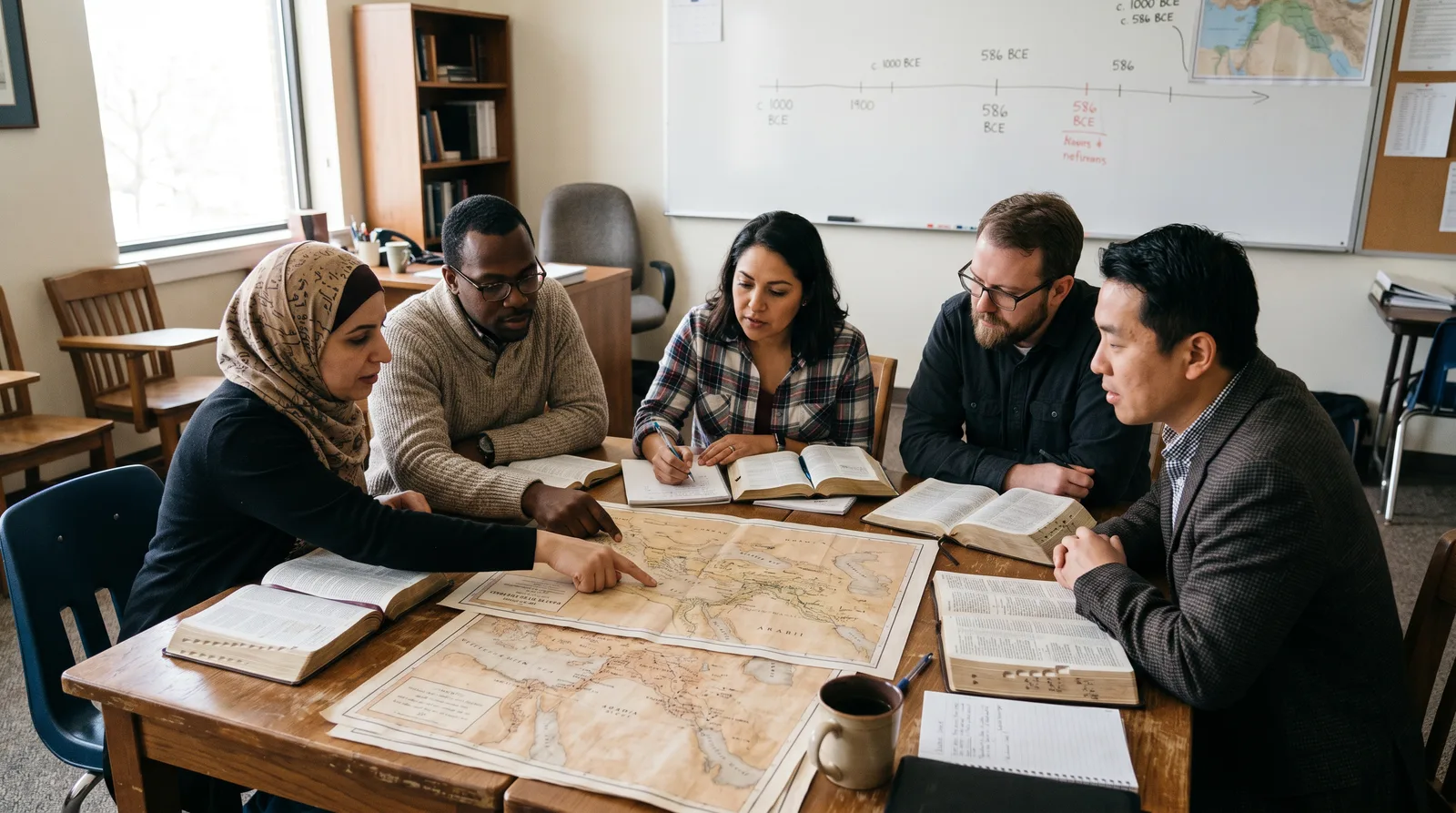
What you'll learn
What you'll be able to do
- Navigate the literary genres of the Old Testament — law, prophecy, poetry, wisdom, and narrative — and interpret each according to its own conventions.
- Trace the major covenants (Noahic, Abrahamic, Mosaic, Davidic) and articulate how each advances the Bible's unified theological storyline.
- Place every Old Testament book in its historical and cultural context using basic knowledge of the Ancient Near East.
- Identify the authorship, date, occasion, and key theological themes of each of the 39 canonical books.
- Apply sound hermeneutical principles to read Old Testament texts responsibly, avoiding common proof-texting and allegorical misreads.
- Engage critically with scholarly debates — documentary hypothesis, the exile, Deutero-Isaiah — and form and defend informed positions.
How it works
A school that adapts to you
This isn't a set of static videos. Every lesson is generated live and tuned to where you actually are.
We learn your level
A quick placement check tailors your starting point so you're never bored or lost.
Lessons adapt as you go
Each lesson is written for your pace and your goal, adjusting as your skills grow.
Your AI coach keeps you moving
Checkpoints, feedback, and gentle nudges turn progress into a real result.
The curriculum
What's inside your school
6 modules · 29 lessons

Foundations: How to Read the Old Testament
Equips students with the scholarly tools — hermeneutics, genre theory, ANE context, and canonical overview — needed for rigorous OT study.
- 1.1What Is the Old Testament? Canon, Text, and TranslationsIncluded
- 1.2The Ancient Near East and the World of the Old TestamentIncluded
- 1.3Hermeneutics 101: Principles for Responsible OT InterpretationIncluded
- 1.4Literary Genres of the Old TestamentIncluded
- 1.5The Covenantal Framework: The Bible's Theological SpineIncluded
The Torah: Law, Origins, and National Formation
Provides a book-by-book study of the Pentateuch, examining authorship debates, historical setting, legal genres, and foundational theology.
- 2.1Genesis: Creation, Fall, and the Patriarchal PromisesIncluded
- 2.2Exodus: Redemption, Revelation, and the Mosaic CovenantIncluded
- 2.3Leviticus and Numbers: Holiness, Priesthood, and Wilderness WanderingIncluded
- 2.4Deuteronomy: Covenant Renewed on the Plains of MoabIncluded
- 2.5The Documentary Hypothesis and Pentateuchal Authorship DebatesIncluded
The Former Prophets: History, Covenant, and Kingdom
Traces Israel's story from conquest to exile through the Deuteronomistic History, emphasizing theological interpretation of historical narrative.
- 3.1Joshua and Judges: Conquest, Settlement, and Covenant FailureIncluded
- 3.2Ruth and the Theology of HesedIncluded
- 3.3Samuel: The Rise of Prophecy and the MonarchyIncluded
- 3.4Kings: The Divided Kingdom, Prophetic Conflict, and ExileIncluded
- 3.5Chronicles, Ezra, and Nehemiah: Restoration and Renewed IdentityIncluded
The Latter Prophets: Prophecy, Judgment, and Hope
Surveys the major and minor prophets in their historical contexts, developing students' ability to interpret prophetic literature critically and theologically.
- 4.1Introduction to Hebrew Prophecy: Form, Function, and HistoryIncluded
- 4.2Isaiah: Unity, Authorship Debate, and the Servant of the LordIncluded
- 4.3Jeremiah and Ezekiel: Prophets of the ExileIncluded
- 4.4The Book of the Twelve: Surveying the Minor ProphetsIncluded
- 4.5Prophecy and Fulfillment: Hermeneutical Issues in Reading OT ProphecyIncluded
The Writings: Poetry, Wisdom, and Israel's Spiritual Life
Explores the Ketuvim's diverse literature — Psalms, wisdom books, and apocalyptic — as Israel's theological and devotional treasury.
- 5.1The Psalms: Israel's Hymnbook and Theology of PrayerIncluded
- 5.2Proverbs and the Wisdom TraditionIncluded
- 5.3Job and Ecclesiastes: Wisdom's Dark Night of the SoulIncluded
- 5.4Song of Songs, Ruth, and the Festal ScrollsIncluded
- 5.5Daniel and Apocalyptic LiteratureIncluded
Synthesis: The Old Testament as Unified Theological Witness
Pulls the entire course together by tracing the OT's grand narrative, its major theological themes, and its canonical relevance for faith and ministry.
- 6.1The Grand Narrative: From Creation to New CreationIncluded
- 6.2Major Theological Themes Across the CanonIncluded
- 6.3The Old Testament and the Church: Hermeneutical ResponsibilityIncluded
- 6.4Engaging Scholarship: Navigating Critical and Evangelical DebatesIncluded
Who it's for
Is this you?

Lay Ministers & Bible Teachers
You teach Scripture regularly and need a scholarly framework — not just devotional familiarity — to handle the Old Testament with accuracy and confidence.

Aspiring Seminary Students
You are heading toward formal theological education and want to arrive with the vocabulary, hermeneutical tools, and canonical fluency to hit the ground running.

Church & Ministry Leaders
You lead a congregation or ministry and feel the weight of handling the Hebrew scriptures responsibly — this course gives you the depth your role demands.

Homeschool Educators
You are building a rigorous, Bible-centered curriculum for your students and need an academically grounded Old Testament course you can teach from with conviction.

Serious Independent Learners
You have read the Old Testament for years but want the literary, historical, and theological framework that transforms familiarity into genuine understanding.

Critical Thinkers of Faith
You refuse to ignore hard scholarly questions — documentary hypothesis, exile, authorship debates — and want a course that meets you there with intellectual honesty.
Questions
Frequently asked
Your teacher
A note from your teacher

Arrandal Towe
If you have spent years in the Old Testament — reading it, teaching it, preaching from it — and still have the quiet sense that you are working with something you only partially understand, I want you to know: that feeling is not a failure of faith. It is an honest recognition of how deep this text actually goes.
The Old Testament was written across more than a thousand years, in a world with its own literary conventions, political structures, and theological vocabulary. It was shaped by covenants, crises, exiles, and restorations. Its poetry operates by rules most modern readers have never been taught. Its prophecy is almost always misread when we come to it without the right questions. And its grand theological story — the one that runs from the opening words of Genesis to the final line of Malachi — is breathtaking in its coherence, but only visible to those who have learned to look for it. My goal in this course is simple: to give you the eyes to see what has always been there.
I have organized this course the way I wish someone had taught it to me — beginning not with Genesis, but with the tools. Before we open a single text, we establish what the Old Testament is, how its canon was formed, what the Ancient Near Eastern world looked like, and what principles responsible interpretation actually demands of us. These are not academic formalities. They are the difference between reading the Old Testament on its own terms and unconsciously projecting our own categories onto it. Once those tools are in hand, we move through the entire Hebrew canon — Torah, Former Prophets, Latter Prophets, and Writings — with the attention each section deserves.
I also believe that intellectual honesty is itself an act of faithfulness. This course does not pretend that the hard questions do not exist. We will sit with the Documentary Hypothesis and evaluate the evidence. We will examine the authorship debates around Isaiah and Daniel. We will wrestle with what it means for ancient Israelite prophecy to be "fulfilled." My conviction is that faith is not threatened by rigorous inquiry — it is deepened by it. I have found, again and again, that the student who is willing to ask the hard questions comes out on the other side with a far more durable and mature trust in the text.
You do not need a seminary degree to take this course. You need curiosity, a willingness to read carefully, and the conviction that the Old Testament repays the effort you put into it. If that describes you, I believe this course will permanently change the way you read the Bible — and I would be honored to be your guide through it.
— Arrandal Towe
Start your journey today
Join get instant access — learn at your own pace with an AI coach in your corner.
$49/mo
Recurring billing · cancel anytime
Secure checkout · Instant access
- 6 modules, 29 lessons
- AI-adaptive lessons tuned to your level
- Quizzes & checkpoints to lock in progress
- Your own AI learning coach
- Learn on any device, at your pace
- Full access for as long as you're subscribed