See the whole planet clearly — and know what to do about it
A citizen-led school that cuts through the politics and economics of planetary survival — exploring rainforest protection, fossil fuel dependency, population dynamics, and alternative energy through the eyes of one honest, wide-awake human. This is the overview every person on Earth needs but rarely gets.

"I'm not here to tell you what to think — I'm here to make sure you have everything you need to think it yourself."— David Clilverd
What you'll learn
What you'll be able to do
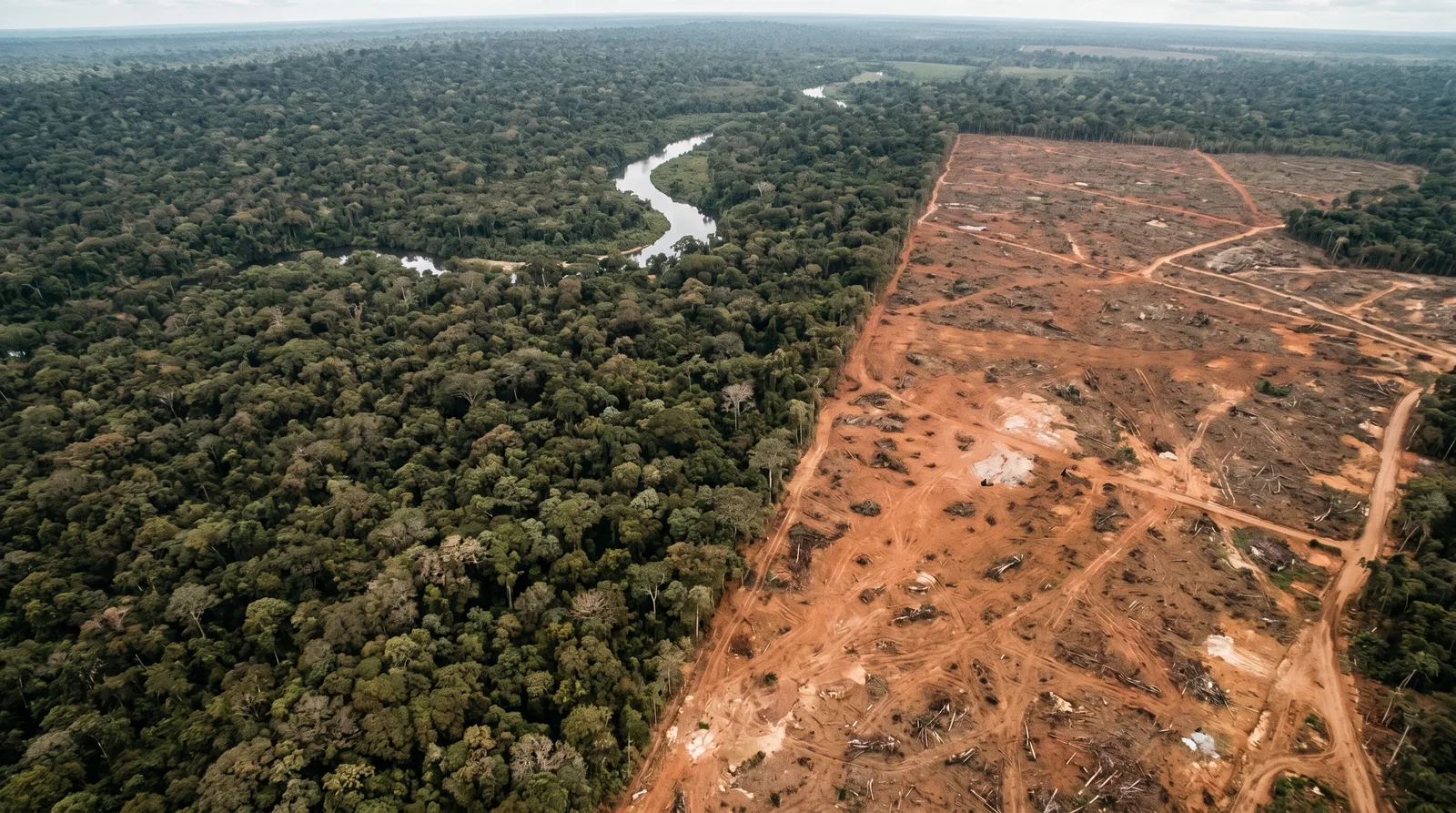
- Explain how tropical rainforest canopy functions as a carbon sink and articulate the scale of loss required to trigger irreversible tipping points
- Identify and critically evaluate the monetised political and corporate systems that block meaningful deforestation protection — and explore real mechanisms (public purchase, international treaty, carbon credit reform) that could overcome them
- Map the global fossil fuel dependency chain and confidently compare viable alternative energy sources by scalability, cost, and political resistance
- Analyse the relationship between human population growth and resource depletion, and discuss ethical, evidence-based approaches to voluntary population stabilisation through universal access to contraception and education
- Deconstruct the 'growth economy' model and explain why degrowth economics is a rational — not radical — response to a finite biosphere
- Use iconic imagery such as the Apollo Earthrise and Artemis photographs as a reflective tool to articulate a personal planetary worldview and communicate climate urgency to others in everyday life
How it works
A school that adapts to you
This isn't a set of static videos. Every lesson is generated live and tuned to where you actually are.
We learn your level
A quick placement check tailors your starting point so you're never bored or lost.
Lessons adapt as you go
Each lesson is written for your pace and your goal, adjusting as your skills grow.
Your AI coach keeps you moving
Checkpoints, feedback, and gentle nudges turn progress into a real result.
The curriculum
What's inside your school
6 modules · 17 lessons

One Small Planet — Seeing Earth Whole
This opening module uses the emotional and scientific power of iconic space photography to establish the foundational worldview underpinning the entire course. Students come to understand Earth as a single, finite, and fragile biosphere before any specific crisis is introduced — creating the perceptual 'home base' from which all later urgency becomes personal and visceral.
- 1.1Earthrise: What a Photograph ChangedIncluded
- 1.2The Biosphere as a System — How Earth Stays AliveIncluded
The Lungs of the Earth — Rainforests and the Carbon Crisis
This module delivers the first specific planetary crisis: deforestation and the destruction of the world's primary terrestrial carbon sinks. Students learn the precise science of how rainforest canopies function, who is responsible for their destruction and why, what tipping points are at stake, and — critically — what realistic protection mechanisms exist, including international purchase, treaty reform, and carbon credit systems. The module directly addresses the user's insight that 'buying the forests' may be a viable model, drawing on historical precedents such as the Louisiana Purchase and the Alaska Purchase.
- 2.1How the Canopy Works — Carbon, Cloud, and BiodiversityIncluded
- 2.2Who Is Cutting the Forest — and WhyIncluded
- 2.3Buying the Forest — Protection Mechanisms That Could Actually WorkIncluded
The Fossil Fuel Machine — Dependency, Resistance, and the Way Out
This module maps the full fossil fuel dependency chain — from extraction through to financial and political capture — and provides students with the analytical tools to compare all viable alternative energy sources honestly, by scalability, cost, intermittency, land use, and political resistance. It culminates in an honest, unromantic assessment of what a real energy transition requires and what is currently blocking it. The module addresses the user's emphasis on stopping oil extraction and the role of vested interests.
- 3.1How Fossil Fuels Captured the WorldIncluded
- 3.2Every Alternative on the Table — An Honest ComparisonIncluded
- 3.3Breaking the Lock — What an Honest Transition Looks LikeIncluded
Eight Billion and Counting — Population, Resources, and the Voluntary Path Forward
This module confronts one of the most politically sensitive topics in environmental education: human population growth. It grounds the discussion in factual data (3.5 billion in 1970 to 8.5 billion in 2026), examines the demographic drivers of growth, and critically evaluates the evidence on what actually reduces fertility rates — finding that universal education (especially of girls and women), universal access to contraception, economic security, and women's rights are both the most effective and the most ethical levers. Coercive approaches are examined historically and rejected on both ethical and practical grounds. A missing prerequisite lesson on resource depletion has been added to ensure students understand what population growth is actually pressing against before the demographic discussion begins.
- 4.1One Planet's Worth — Resources, Carrying Capacity, and the Overshoot ProblemIncluded
- 4.2From 3.5 Billion to 8.5 Billion — What Happened and Why It MattersIncluded
- 4.3The Ethical Path — Voluntary Stabilisation Through Rights, Education, and AccessIncluded
Beyond Growth — Degrowth Economics for a Finite Planet
This module challenges the foundational assumption of modern economics: that perpetual GDP growth is both possible and desirable on a finite planet. Students examine the origins and mechanics of growth-oriented economies, the role of debt, tax, and financialisation in locking societies into expansion, and the emerging degrowth literature that proposes reduction, redistribution, and sufficiency as rational alternatives. The module directly reflects the user's repeated emphasis on 'reduce, reduce, reduce' and the role of monetised systems and tax structures in blocking change. A lesson on the critical link between inequality and degrowth has been added as it was absent from the draft.
- 5.1Why Growth Economies Cannot Solve What They CausedIncluded
- 5.2Money, Tax, and the Systems That Lock Us InIncluded
- 5.3Inequality, Justice, and Why Degrowth Must Be FairIncluded
- 5.4Degrowth in Practice — Reduce, Redistribute, ReimagineIncluded
The Overview Effect — Becoming a Planetary Citizen
The closing module returns to where the course began — the Earthrise photographs — and asks students to integrate everything they have learned into a coherent personal planetary worldview. Students practise connecting the systems they have studied into a single analytical frame, and then develop the communication skills to articulate climate urgency to others in everyday life — not as activists performing a script, but as informed citizens expressing a genuine, evidence-grounded perspective. The module honours the user's own voice as 'a private person with an overview, as each of us can have.'
- 6.1Connecting the Dots — Everything Is One SystemIncluded
- 6.2Finding Your Voice — Communicating Planetary Urgency in Everyday LifeIncluded
Who it's for
Is this you?

The worried generalist
You follow the climate news closely but feel the pieces never quite add up into a coherent whole — this course finally connects them.

The burned-out activist
You've been at it for years and need a clear-eyed, non-partisan framework to re-anchor your energy and sharpen your arguments.

The conscientious retiree
You have the time, the worry, and the life experience — and you want a rigorous, adult conversation about what the world your grandchildren inherit actually faces.

The economics sceptic
You've always sensed that endless growth on a finite planet doesn't add up, and you want a serious course that treats degrowth as logic, not lunacy.
The mid-career professional
You work in business, policy, or education and want a grounded planetary overview that informs how you make decisions and talk about the future at work.

The quietly radicalised parent
Having children changed what the climate crisis means to you personally, and you want clear, honest knowledge — not panic, not spin — to guide what you say and do.
Questions
Frequently asked
Your teacher
A note from your teacher
David Clilverd
If you're reading this, I suspect you already know enough to be worried — and not quite enough to feel steady. You've read the headlines, watched the documentaries, perhaps argued at a dinner table or despaired quietly on a Sunday morning. You can feel that something is deeply wrong with the way the world is organised, but the full picture keeps slipping out of focus. The rainforest story is over here. The energy debate is over there. Population is a topic nobody wants to touch. Economics is apparently someone else's department. And through all of it runs a low hum of anxiety that nobody has quite given you the language to resolve.
I built One Small Planet because that disconnection is the problem. Not a lack of facts — there are facts everywhere. The problem is that no one is putting them together in a single, honest, human conversation. This course is my attempt to do that. I'm not a politician, not a corporate consultant, not a think-tank fellow with a funder to protect. I'm someone who has read widely, worried deeply, and spent a long time trying to understand this crisis as a whole system rather than a collection of separate emergencies.
What I've tried to create here is the overview every adult deserves but rarely gets. We start where I think all of this should start — with the photograph. The Earthrise image, taken from lunar orbit, changed something in the human imagination. The Artemis photographs are doing it again. There is something in seeing the whole planet at once — small, luminous, and utterly alone — that cuts through the noise and puts the stakes in your body rather than just your head. We begin there, and we build outward: into the biology of the rainforest canopy, the economics of who profits from cutting it down, the politics of fossil fuel dependency, the demographics of eight billion people on a planet built for far fewer, the structural logic of degrowth, and finally, back to you — to how you talk about all of this with the people in your life.
I won't pretend this material is comfortable. It isn't. But I also won't pretend it's hopeless, because it isn't that either. In every module, alongside the honest account of how we got here, there are real mechanisms — purchase schemes, treaty frameworks, energy transition models, rights-based population approaches, economic redesigns — that could work if enough people understood them well enough to demand them. That's the whole point. An informed, clear-eyed citizen is not a small thing. You are not a small thing.
Come and sit down. Let's talk about the planet — the whole of it, all at once, honestly. That's all this is. And I think it might be exactly what you've been looking for.
— David Clilverd
Start your journey today
Join get instant access — learn at your own pace with an AI coach in your corner.
$19/mo
Recurring billing · cancel anytime
Secure checkout · Instant access
- 6 modules, 17 lessons
- AI-adaptive lessons tuned to your level
- Quizzes & checkpoints to lock in progress
- Your own AI learning coach
- Learn on any device, at your pace
- Full access for as long as you're subscribed