Understand disease — don't just memorize it
Pathophysiology Mastery walks you through the exact cellular and molecular chain of events — from ion-channel dysfunction to systemic organ failure — so you can reason from mechanism to bedside, every time.

"I don't teach you what disease looks like — I teach you how it works, so you can figure out anything it throws at you."
— Tracy Burke
What you'll learn
What you'll be able to do
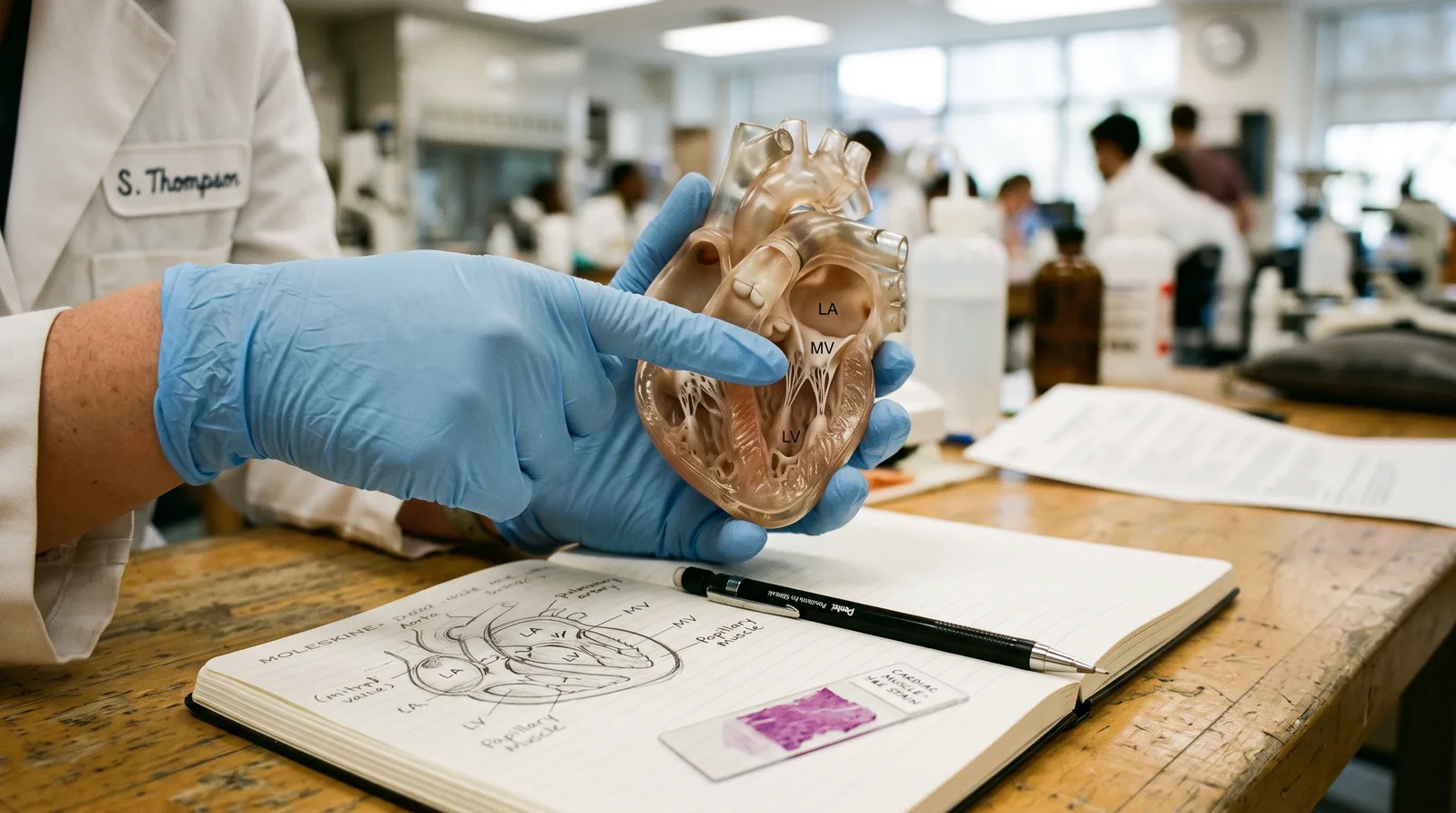
- Trace the step-by-step cellular and molecular mechanisms underlying any major disease process, from ion-channel dysfunction to systemic organ failure.
- Accurately predict the clinical signs and symptoms of a disorder by reasoning forward from its underlying pathophysiology.
- Distinguish adaptive from maladaptive physiological responses (e.g., compensatory hypertrophy vs. decompensated heart failure) and explain why the tipping point occurs.
- Interpret common diagnostic findings — lab values, imaging patterns, ECG changes — by linking them directly to the pathological mechanism causing them.
- Apply pathophysiological reasoning to understand the rationale behind first-line treatments and pharmacological interventions.
- Construct clear mechanistic explanations of complex multi-system disorders (sepsis, DKA, ARDS) that can be communicated confidently in clinical and academic settings.
How it works
A school that adapts to you
This isn't a set of static videos. Every lesson is generated live and tuned to where you actually are.
We learn your level
A quick placement check tailors your starting point so you're never bored or lost.
Lessons adapt as you go
Each lesson is written for your pace and your goal, adjusting as your skills grow.
Your AI coach keeps you moving
Checkpoints, feedback, and gentle nudges turn progress into a real result.
The curriculum
What's inside your school
6 modules · 30 lessons

Foundations of Pathophysiology
Establishes the cellular, molecular, and systemic language needed to reason mechanistically through any disease process.
- 1.1How to Think in PathophysiologyIncluded
- 1.2Cellular Injury, Adaptation, and DeathIncluded
- 1.3Ion Channels, Membrane Potentials, and DiseaseIncluded
- 1.4Genetics and Epigenetics in DiseaseIncluded
- 1.5From Cellular Chaos to Systemic FailureIncluded
Inflammation, Immunity, and Tissue Repair
Decodes the inflammatory and immune responses — the body's core defensive machinery — and shows when they become drivers of disease.
- 2.1Acute Inflammation: Mediators and Vascular EventsIncluded
- 2.2Chronic Inflammation and Granuloma FormationIncluded
- 2.3Innate vs. Adaptive Immunity in DiseaseIncluded
- 2.4Hypersensitivity Reactions: Types I–IVIncluded
- 2.5Autoimmunity and Tissue Repair Gone WrongIncluded
Cardiovascular and Pulmonary Pathophysiology
Builds mechanistic mastery of the most clinically high-stakes disorders of the heart, vasculature, and lungs.
- 3.1Atherosclerosis: From Endothelial Injury to Plaque RuptureIncluded
- 3.2Heart Failure: Compensation, Decompensation, and the Tipping PointIncluded
- 3.3Arrhythmias and ECG Interpretation Through a Mechanistic LensIncluded
- 3.4Hypertension: Pressure, Resistance, and End-Organ DamageIncluded
- 3.5Respiratory Failure, ARDS, and Pulmonary EdemaIncluded
Metabolic, Endocrine, and Renal Pathophysiology
Examines how disruptions in hormonal signaling, metabolic homeostasis, and renal regulation produce systemic disease.
- 4.1Diabetes Mellitus: Insulin Signaling Failure and Its ConsequencesIncluded
- 4.2Diabetic Ketoacidosis: A Multi-System Mechanistic Deep DiveIncluded
- 4.3Thyroid and Adrenal Axis DisordersIncluded
- 4.4Acute and Chronic Kidney DiseaseIncluded
- 4.5Acid-Base Disorders: Reading the Body's ChemistryIncluded
Neurological and Hematological Pathophysiology
Covers the mechanisms of nervous system dysfunction and blood disorders, linking cellular defects to neurological signs and hematologic lab findings.
- 5.1Ischemic and Hemorrhagic Stroke: Mechanism and ConsequenceIncluded
- 5.2Neurodegenerative Diseases: Protein Misfolding and Neuronal LossIncluded
- 5.3Anemias: Linking Lab Values to MechanismIncluded
- 5.4Coagulation Disorders: Clotting Too Much or Too LittleIncluded
- 5.5Oncological Pathophysiology: From Mutation to MalignancyIncluded
Sepsis, Multi-System Failure, and Clinical Reasoning Synthesis
Integrates all prior mechanisms into complex multi-system disorders and builds the confident clinical reasoning skills needed for practice.
- 6.1Sepsis and Septic Shock: When Inflammation Attacks the HostIncluded
- 6.2Gastrointestinal and Hepatic PathophysiologyIncluded
- 6.3Connecting Pathophysiology to PharmacologyIncluded
- 6.4Interpreting Diagnostics Through a Mechanistic LensIncluded
- 6.5Putting It All Together: Clinical Case ReasoningIncluded
Who it's for
Is this you?

Nursing students
Needs to go beyond NCLEX recall and build the mechanistic reasoning that makes clinical decisions feel grounded, not guessed.

Medical students
Preparing for Step 1 and Step 2 by developing the deep mechanistic framework that lets them derive answers rather than memorize them.

NP & PA candidates
Needs rigorous pathophysiological depth to practice at an advanced level and hold their own in complex clinical conversations.

Working clinicians
Experienced practitioners who want to finally own the science behind what they do every day, not just the protocols.

Pre-med students
Building a mechanistic foundation early so that medical school pathophysiology clicks into place rather than lands as a firehose.
Clinical educators
Instructors and preceptors who want a rigorous, case-anchored reference to sharpen the way they explain disease to learners.
Questions
Frequently asked
Your teacher
A note from your teacher

Tracy Burke
If you're in health science — whether you're a nursing student staring down NCLEX, a medical student approaching Step 1 and Step 2, a PA or NP candidate, or a clinician who's been practicing for years — there's a good chance you've felt a version of the same frustration. You can recall the fact. You can produce the answer. But when someone asks you why, or when the patient in front of you doesn't match the textbook description, the scaffolding quietly collapses.
That's not a failure of effort. That's what happens when you're taught what disease looks like instead of how disease works. And it's exactly what Pathophysiology Mastery is designed to fix.
I built this school around a single conviction: mechanistic understanding is the only kind that holds up under pressure. When you trace the exact sequence from endothelial injury to foam cell formation to plaque rupture — when you can explain why the anion gap widens in DKA, not just that it does — when you understand the precise reason a heart's compensatory hypertrophy becomes a liability rather than an asset, you stop retrieving answers and start generating them. That's a different cognitive mode. It's the one that functions at 3 AM on a difficult overnight, on a boards question you've never seen before, and in a conversation with an attending who wants to know if you actually understand what's happening to your patient.
Every unit in this school is built on the same architecture: we start at the site of injury — the cell, the ion channel, the molecular signal — and we follow the chain of consequence forward until it produces the clinical picture you'll recognize from practice. Nothing is asserted without explanation. Adaptive versus maladaptive responses are distinguished, not conflated. The tipping point in heart failure, the cascade of organ dysfunction in sepsis, the multi-system unraveling of DKA — these aren't described, they're dissected. And at every step, we connect mechanism to lab value, to imaging finding, to ECG morphology, to the drug that targets that precise point in the pathway.
I won't promise you that this is easy. Rigorous mechanistic thinking is a skill, and like any skill, it requires deliberate practice. What I will promise is that if you do the work — if you follow the reasoning, wrestle with the cases, and build this framework piece by piece — you will come out the other side with the kind of understanding that doesn't evaporate after the exam. You'll have a durable clinical reasoning engine, not a temporary cache of recalled facts.
If you're ready to stop memorizing disease and start understanding it, this is where we begin.
— Tracy Burke
Start your journey today
Get instant access — learn at your own pace with an AI coach in your corner.
$59/mo
Recurring billing · cancel anytime
Enrolling a child? Sign up as a parent — you'll add your student right here after.
Secure checkout · Instant access
- 6 modules, 30 lessons
- AI-adaptive lessons tuned to your level
- Quizzes & checkpoints to lock in progress
- Your own AI learning coach
- Learn on any device, at your pace
- Full access for as long as you're subscribed