Write poems worth keeping—one master's technique at a time
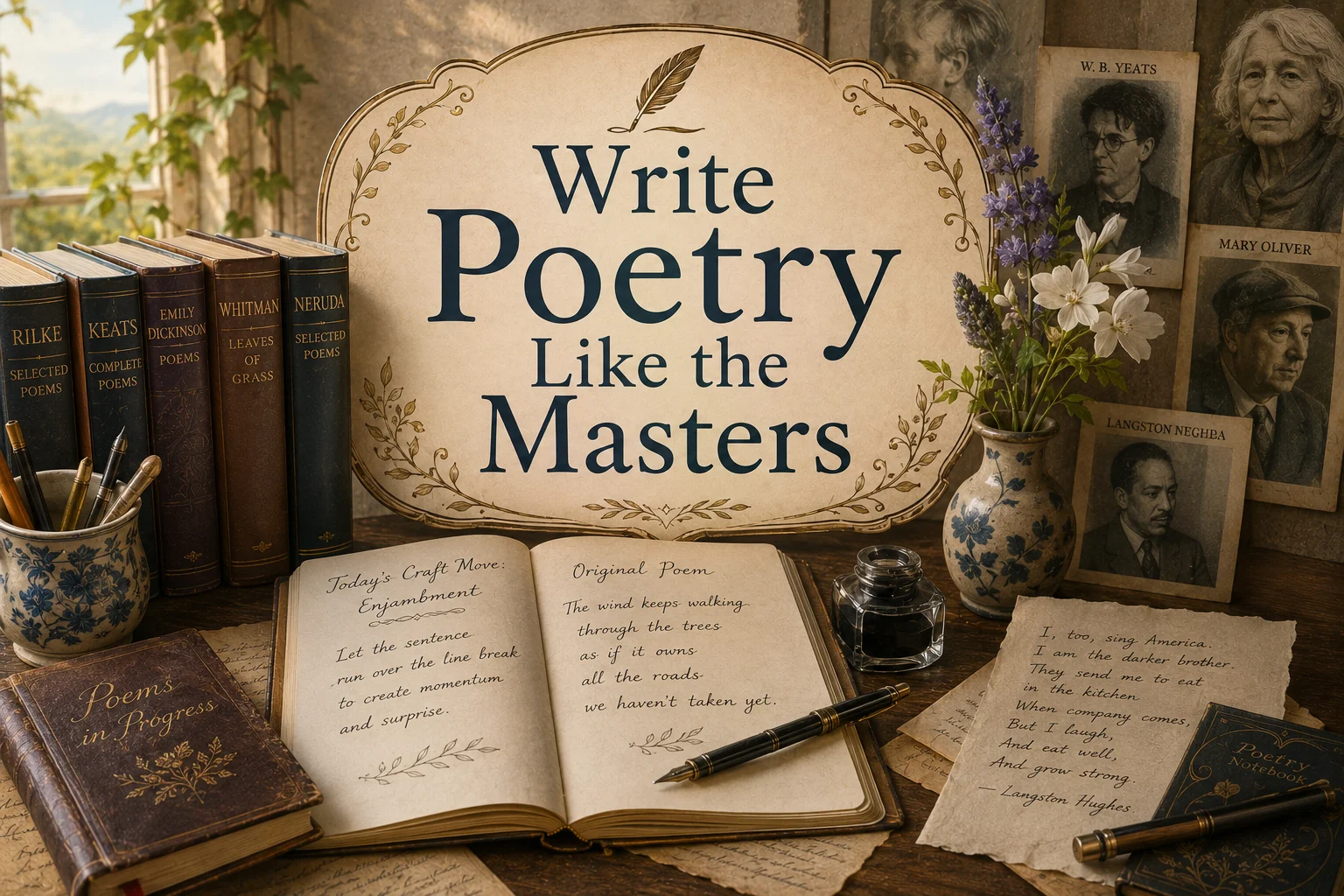
Learn one technique from a master poet, write an original poem, and build a personal portfolio—one craft move at a time. No literary analysis, just hands-on practice drawn from the greatest voices in poetry history.
"I'll never ask you to analyze a poem—only to let it show you something you can do."
— Carla Paton
What you'll learn
What you'll be able to do
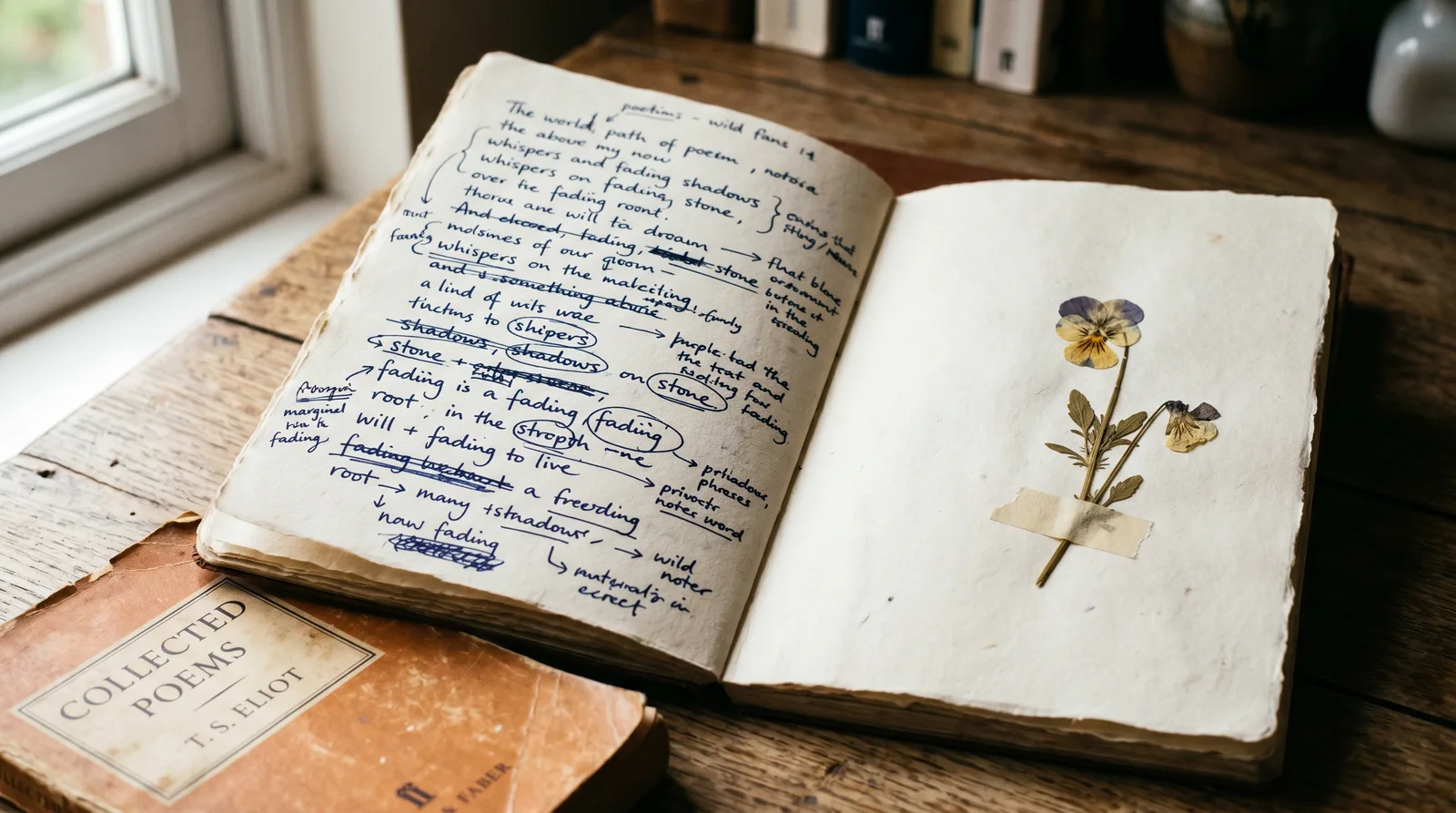
- Isolate and apply a single craft technique—compression, slant rhyme, imagism, and more—from ten master poets to your own original work.
- Write a finished, original poem in response to every lesson, building a personal portfolio of 10+ pieces by the end of the course.
- Use Dickinson's compression and slant rhyme to pack emotional weight into short, spare lines.
- Channel Whitman's expansive free verse and Hughes's rhythmic musicality to write poems with breath, momentum, and a distinct singing voice.
- Sharpen sensory observation through Bishop's close-looking and Williams's attention to everyday objects, transforming ordinary moments into vivid poems.
- Develop a recognizable personal style by consciously borrowing—and then making your own—the techniques that resonate most with you across the masters.
How it works
A school that adapts to you
This isn't a set of static videos. Every lesson is generated live and tuned to where you actually are.
We learn your level
A quick placement check tailors your starting point so you're never bored or lost.
Lessons adapt as you go
Each lesson is written for your pace and your goal, adjusting as your skills grow.
Your AI coach keeps you moving
Checkpoints, feedback, and gentle nudges turn progress into a real result.
The curriculum
What's inside your school
6 modules · 14 lessons

Compression and Sound
Students open the course by learning how to do more with less. Emily Dickinson's two signature techniques—compression and slant rhyme—are taught in sequence because slant rhyme is almost impossible to appreciate without first understanding how her radical compression creates the charged silences that make sound effects land. By the end of this module students have written their first two portfolio poems and understand that brevity is a craft choice, not a limitation.
- 1.1Emily Dickinson — CompressionIncluded
- 1.2Emily Dickinson — Slant RhymeIncluded
Voice and Breath
Students now move from tightly controlled compression to the full range of poetic voice—from Frost's intimate spoken cadence to Whitman's oceanic expansiveness to Hughes's jazz-and-blues-inflected music. The three poets are sequenced from smallest to largest scale: conversational speech → long-breathed free verse → rhythmic, song-like lines. Students write three portfolio poems and, for the first time, feel the difference between a poem that is heard and one that is sung.
- 2.1Robert Frost — Conversational VoiceIncluded
- 2.2Walt Whitman — Expansive Free VerseIncluded
- 2.3Langston Hughes — Rhythm and MusicalityIncluded
Observation and the Ordinary
After exploring voice and scale, students turn their attention outward to the visible world. This module pairs Bishop's disciplined, almost scientific close-looking with Williams's radical trust in everyday objects—the idea that a red wheelbarrow or a plum in the icebox is already a poem waiting to be noticed. Sequenced before the imagery and interiority module, it grounds students in the external, sensory world before asking them to move inward.
- 3.1Elizabeth Bishop — Close ObservationIncluded
- 3.2William Carlos Williams — Everyday ObjectsIncluded
Image and Interiority
Students now move inward, learning to use the external image as a vehicle for psychological and emotional states. Plath's imagery is volcanic and embodied; Rilke's interiority is quieter but equally intense. The module is placed here—after students have learned to observe accurately—so that when they make images they are grounded in real, physical detail rather than vague abstraction. By the end, students understand that an image is not decoration; it is thought.
- 4.1Sylvia Plath — Vivid ImageryIncluded
- 4.2Rainer Maria Rilke — Inner LifeIncluded
Memory, Place, and Simplicity
The penultimate module moves into two final, distinct territories: Heaney's deeply rooted sense that memory and landscape are inseparable, and Bashō's haiku-mind — the belief that a single, precisely chosen detail, held in silence, contains everything. Together these techniques ask students to trust both deep personal history and radical economy. This module prepares students for the final portfolio module by pushing them to their most personal and most distilled writing.
- 5.1Seamus Heaney — Memory and PlaceIncluded
- 5.2Matsuo Bashō — Precision and SimplicityIncluded
Portfolio, Voice, and What Comes Next
The final module is the course's synthesis and capstone. Students gather all nine (or more) portfolio poems, identify the techniques that have become most naturally their own, and write one final poem that consciously integrates at least two master techniques in the service of their own emerging voice. The module closes with a public or peer reading and a reflective artist's statement — the beginning of a writerly identity, not the end of one.
- 6.1Finding Your Signature TechniquesIncluded
- 6.2Integration Poem — Writing in Your Own VoiceIncluded
- 6.3Portfolio Reading and ReflectionIncluded
Who it's for
Is this you?

The longtime journaler
You've filled shelf after shelf with notebooks and are ready to shape that raw honesty into poems with real craft behind them.
The poetry lover who doesn't write
You've underlined other people's lines for years and finally want to find out if you have lines of your own worth keeping.

The returning creative
Life got busy and your creative writing fell away—this course is a structured, encouraging way to come back to it without pressure.

The English lit grad wary of academia
You analyzed poetry until you stopped enjoying it, and you want a practice that's about making things, not interpreting them.

The curious beginner
You've never thought of yourself as a 'writer' but something keeps pulling you toward poetry, and this is the low-stakes place to find out why.
The intermediate poet building a body of work
You've written poems here and there but want a deliberate method for expanding your technique and finishing a real, cohesive portfolio.
Questions
Frequently asked
Your teacher
A note from your teacher
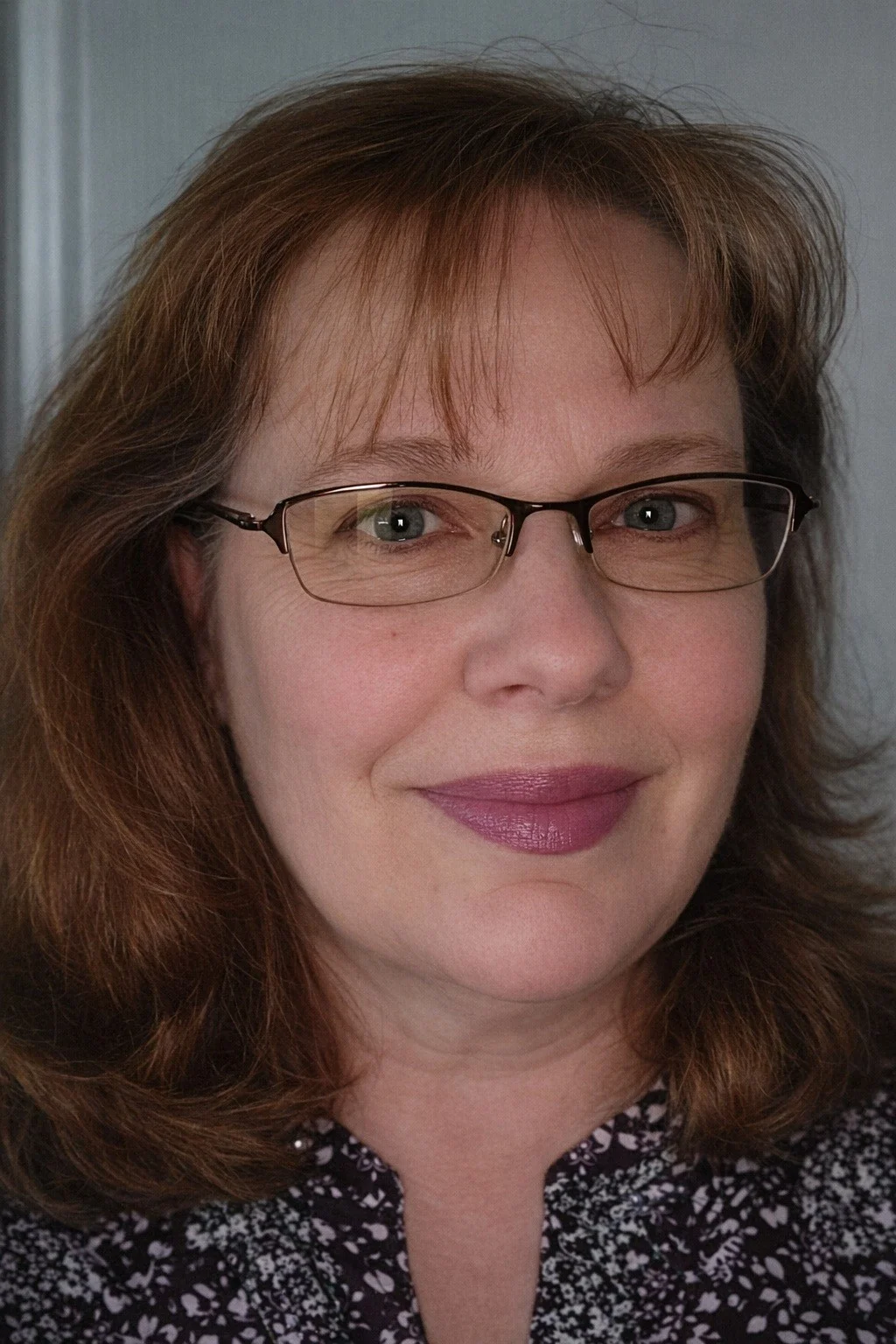
Carla Paton
Maybe you've been telling yourself you'll "get serious about writing" for a while now. You fill notebooks, you save poems to read again later, you feel things when you read a great line—but sitting down to write one yourself still feels presumptuous somehow. Like poetry is a club you haven't been invited into yet.
I understand that feeling deeply. And I want to tell you directly: it's a lie the literary world accidentally told you. Poetry isn't a credential. It's a craft. And like any craft, it can be learned move by move, attempt by attempt, poem by poem.
That's the entire premise of Craft & Verse. I built this course because I believe the fastest, most joyful way into poetry is to borrow a technique from someone who mastered it—really look at what Dickinson does with a compressed, slant-rhymed line, or what Bashō does with radical simplicity—and then immediately go make something of your own. Not imitate. Activate. Use that borrowed move as a key to unlock something only you could write.
So that's exactly how every lesson works. I explain one technique in plain language. I show you how a master poet uses it. And then I give you a prompt and send you to the page. No analysis papers, no quizzes, no right answers. Just you, a blank page, and a concrete move to try. Lesson by lesson, you'll move through compression and slant rhyme, conversational voice, expansive free verse, musicality, close observation, everyday objects, vivid imagery, inner life, memory, place, and precision—ten techniques from ten poets across six thematic units.
By the final unit, you won't just have studied these poets. You'll have a portfolio of finished poems, and you'll be able to see your own signature moves emerging in them. That's when it stops being borrowing and starts being yours. That's the moment I built this whole course to get you to—and I can't wait to see you reach it. Come write with me.
— Carla Paton
Start your journey today
Get instant access — learn at your own pace with an AI coach in your corner.
$19/mo
Recurring billing · cancel anytime
Secure checkout · Instant access
- 6 modules, 14 lessons
- AI-adaptive lessons tuned to your level
- Quizzes & checkpoints to lock in progress
- Your own AI learning coach
- Learn on any device, at your pace
- Full access for as long as you're subscribed