Read the grid. Write the hit.
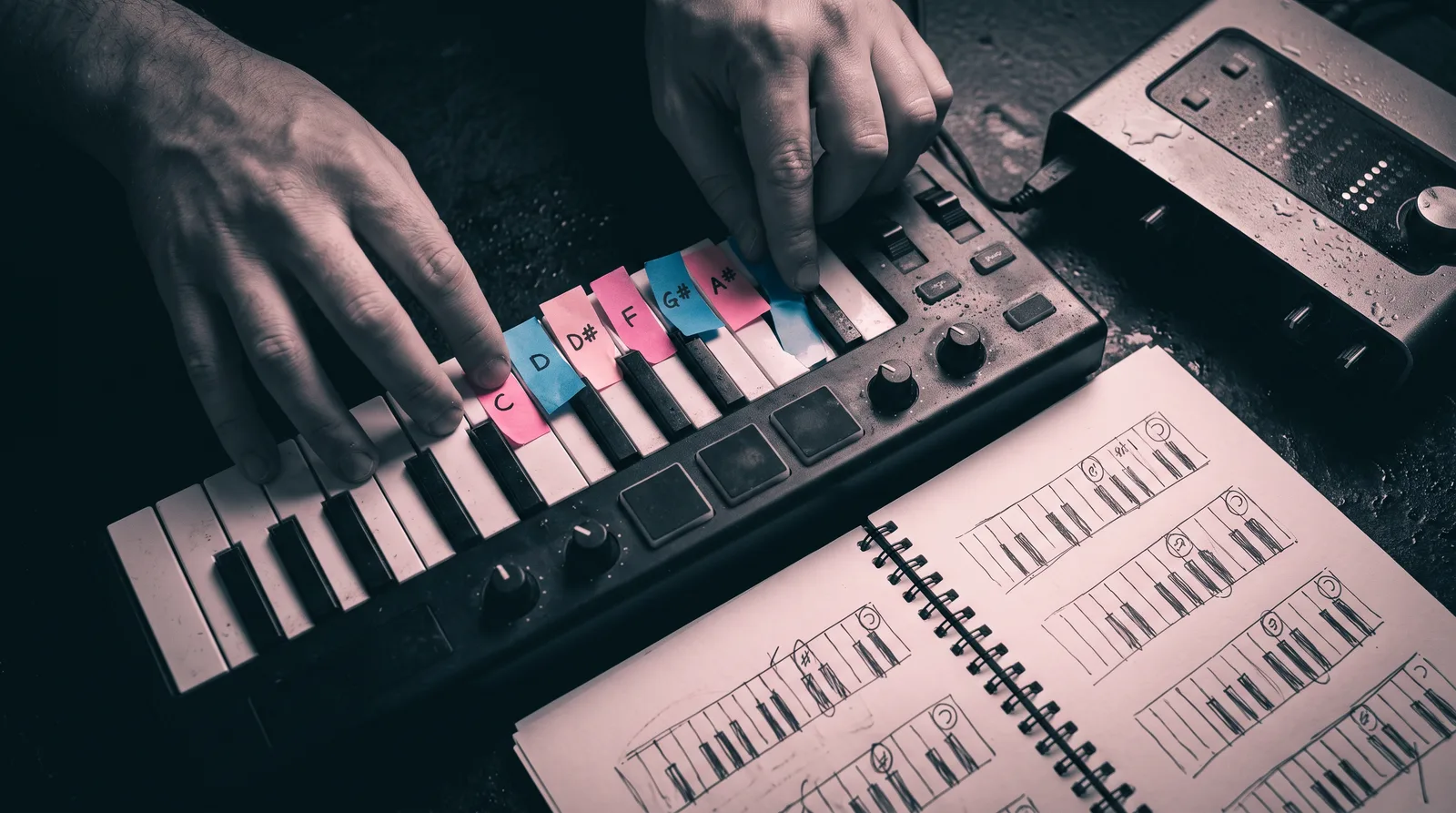
Real music theory for producers — taught entirely in your DAW's piano roll, so you can build scales, craft melodies, and transpose anything on the fly without ever reading a single note of sheet music.
"Theory isn't the opposite of feel — it's the tool that lets you get the exact feel you're chasing, every single time."
— Xavier Gonzalez
What you'll learn
What you'll be able to do
- Build and transpose major, minor, harmonic minor, and pentatonic scales in any DAW instantly using piano roll shapes — no sheet music required.
- Identify and use key intervals by ear and by eye on a grid so you can deliberately create tension, release, and emotional color in every beat.
- Map scale degrees to emotional moods (dark, triumphant, nostalgic, eerie) and choose the right scale for the vibe your track demands.
- Write catchy top-lines and hook patterns with strong rhythmic placement and passing tones that lock into hip-hop, R&B, and pop grooves.
- Find bass notes and root chords by ear in real time, and confidently transpose any loop or sample into a new key on the fly.
- Communicate and collaborate with other musicians and vocalists using the correct production-friendly music theory vocabulary.
How it works
A school that adapts to you
This isn't a set of static videos. Every lesson is generated live and tuned to where you actually are.
We learn your level
A quick placement check tailors your starting point so you're never bored or lost.
Lessons adapt as you go
Each lesson is written for your pace and your goal, adjusting as your skills grow.
Your AI coach keeps you moving
Checkpoints, feedback, and gentle nudges turn progress into a real result.
The curriculum
What's inside your school
4 modules · 19 lessons

The Producer's Coordinate System
Learn intervals and scale degrees as visual shapes on the piano roll so you can read, build, and feel music on a grid — no sheet music needed.
- 1.1The Grid Is Your StaffIncluded
- 1.2Intervals as Shapes, Not NamesIncluded
- 1.3Tension vs. Release: The Emotional Physics of IntervalsIncluded
- 1.4Scale Degrees as CoordinatesIncluded
- 1.5Transposing Shapes Anywhere on the GridIncluded
Decoding the Grid: Scales for Every Vibe
Build and manipulate the four essential scales inside your DAW, mapping each one to a specific emotional color for your productions.
- 2.1The Major Scale BlueprintIncluded
- 2.2Natural Minor: The Dark ModeIncluded
- 2.3Harmonic Minor: The Eerie UpgradeIncluded
- 2.4Pentatonic: The Producer's Safety NetIncluded
- 2.5Choosing the Right Scale for the VibeIncluded
The Anatomy of a Vibe: Building Better Melodies
Write hook-worthy top-lines and melodies by mastering rhythmic placement, passing tones, and groove-locked phrasing in hip-hop, R&B, and pop.
- 3.1What Makes a Melody StickIncluded
- 3.2Rhythmic Placement: Where the Note Lands Is EverythingIncluded
- 3.3Passing Tones and Color NotesIncluded
- 3.4Writing a Hook Pattern That Locks into the GrooveIncluded
- 3.5Melodic Variation Without Losing the VibeIncluded
Ear Training for the DAW Generation
Develop a producer's ear through DAW-native exercises that let you find root notes, identify chords, and transpose samples in real time by ear.
- 4.1Hearing the Root: Finding the Bass Note by EarIncluded
- 4.2Identifying Chords and Scales by Sound and FeelIncluded
- 4.3Transposing Loops and Samples on the FlyIncluded
- 4.4Producer Vocabulary: Talking Music with CollaboratorsIncluded
Who it's for
Is this you?

The self-taught beatmaker
He's been making beats for years by ear and wants the theory language to finally explain — and repeat — what he's already doing by instinct.

The rapper who produces
She writes her own tracks and loops but freezes when it's time to build a melodic hook that actually fits the vibe she's going for.

The bedroom pop producer
She's fluent in her DAW but wants to write more intentional melodies and understand why certain chord colors feel the way they do.

The sample-flip specialist
He chops and pitches samples constantly but wants to transpose them confidently and find the right key without trial-and-error every time.
The aspiring co-producer
She's starting to work with vocalists and other producers and needs the right vocabulary to collaborate without feeling out of her depth.

The R&B multi-instrumentalist
He can play by feel but wants to formalize his ear training and understand scales and intervals well enough to write parts with intention, not luck.
Questions
Frequently asked
Your teacher
A note from your teacher

Xavier Gonzalez
Hey — I see you.
You've got the plug-ins, the samples, the workflow. You can build a beat that knocks. But there's this gap — that moment when a track needs something and you don't know how to get there on purpose. So you loop through presets. You move notes around until something sounds right. And sometimes it works, but you couldn't tell someone why, and you couldn't do it again on command. That gap has a name: it's missing theory. And I know that word probably just made you tense up — because every time you've tried to learn theory, it's been some sheet-music-reading, classical-harmony, "what's a treble clef" situation that has absolutely nothing to do with what you're doing at 2am in your studio.
That's exactly why I built The Producer's Cheat Sheet.
I wanted to create the course I wish I'd had — one that speaks fluent DAW from the first minute. We're not touching staff paper. We're not talking about Mozart. We're talking about your piano roll, your grid, your workflow. When I teach you what an interval is, I'm showing you a shape on that grid that you can see, move, and use right now. When we get into scales, they're not abstract patterns you memorize — they're coordinates on your piano roll that you can transpose anywhere with two clicks. Every single concept in this course is handed to you in a form you can immediately drop into a real project.
Here's the thing I want you to understand: music theory isn't a gatekeeping system invented to make producers feel dumb. It's just a shared language for describing what sounds do to people — why a raised 7th feels eerie, why the root note feels like coming home, why that hook you love hits the way it does on beat 3 instead of beat 1. Once you know that language, you stop guessing and start deciding. You know what you want to make someone feel, and you know which notes get you there. That's real creative power.
By the end of this course, you'll be building and transposing scales in any key without thinking about it. You'll write melodies that actually lock into the groove because you understand rhythmic placement and passing tones. You'll hear a loop in a sample pack, know what key it's in, and pitch it into your track on the fly. And when you're in the studio with a vocalist or a co-producer and they say "can we try the IV chord in the minor?" — you'll know exactly what they mean and exactly what to play.
You don't need to become a music theory scholar. You just need enough to stop getting stuck. That's what I built this for. Let's get to work.
— Xavier Gonzalez
Start your journey today
Get instant access — learn at your own pace with an AI coach in your corner.
$39/mo
Recurring billing · cancel anytime
Secure checkout · Instant access
- 4 modules, 19 lessons
- AI-adaptive lessons tuned to your level
- Quizzes & checkpoints to lock in progress
- Your own AI learning coach
- Learn on any device, at your pace
- Full access for as long as you're subscribed