Write proposals that make decision-makers say yes
Master the art of writing proposals that win — from structuring a compelling narrative to closing with confidence. Whether you're chasing grants, contracts, or client projects, learn to make decision-makers say yes.

"The people who win consistently aren't necessarily better at what they do — they're better at making decision-makers feel certain about saying yes."— Dotimi
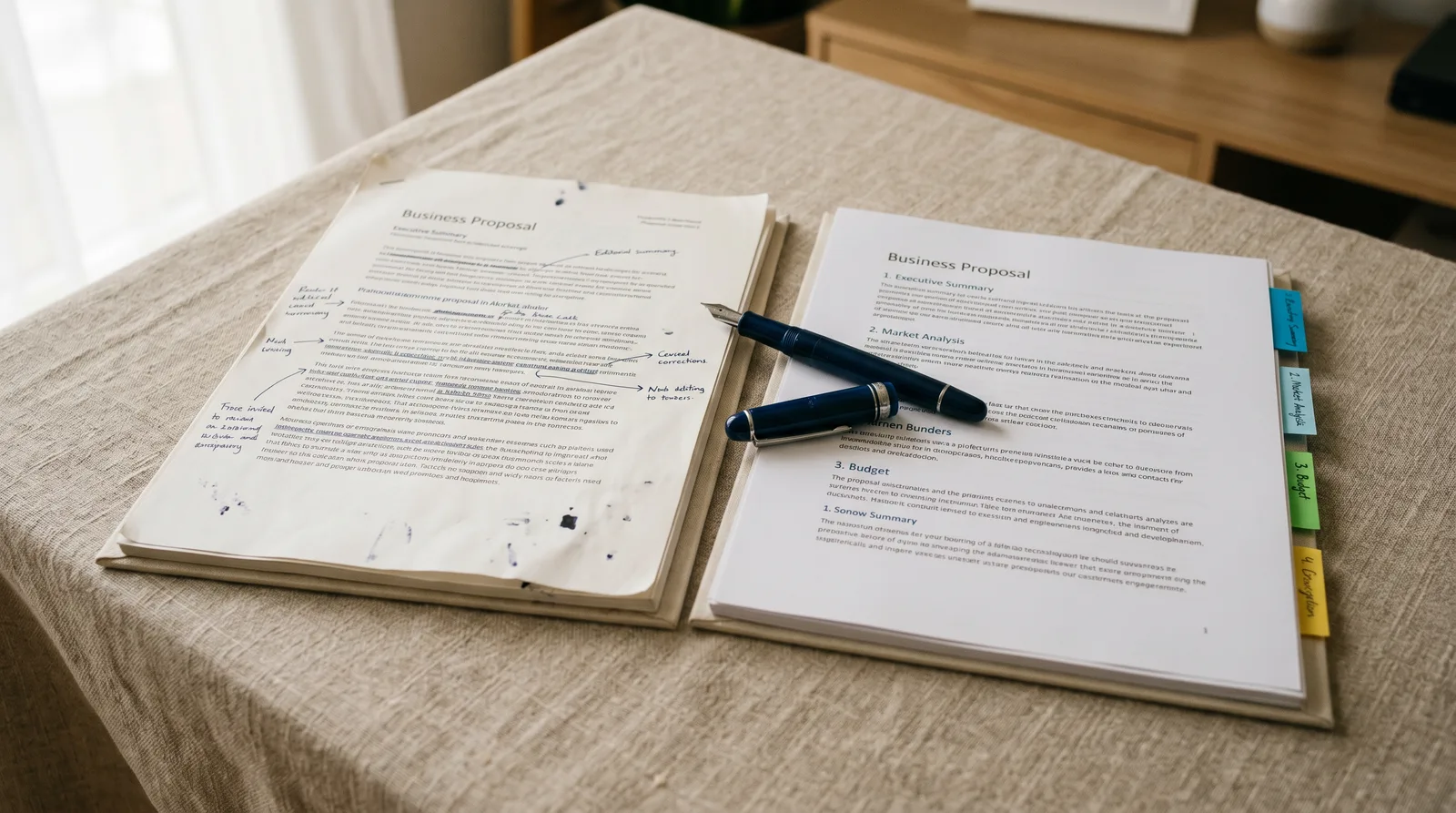
What you'll learn
What you'll be able to do
- Write a persuasive executive summary that hooks decision-makers in under 60 seconds
- Structure any proposal — grant, client, or contract — using a proven narrative framework
- Identify and articulate a client's core problem and position your solution compellingly
- Price and present your budget or fee section with confidence and transparency
- Tailor tone, language, and format to government, corporate, and nonprofit audiences
- Build a reusable proposal system with templates and a review checklist that cuts writing time in half
How it works
A school that adapts to you
This isn't a set of static videos. Every lesson is generated live and tuned to where you actually are.
We learn your level
A quick placement check tailors your starting point so you're never bored or lost.
Lessons adapt as you go
Each lesson is written for your pace and your goal, adjusting as your skills grow.
Your AI coach keeps you moving
Checkpoints, feedback, and gentle nudges turn progress into a real result.
The curriculum
What's inside your school
6 modules · 18 lessons

The Winning Proposal Mindset & Framework
Establishes the strategic foundation before any writing begins. Students learn how evaluators actually read and score proposals, internalize a narrative framework they will apply throughout the course, and diagnose past failures so they enter later modules with clear, personalized goals.
- 1.1How Decision-Makers Actually Read ProposalsIncluded
- 1.2The Narrative Arc: A Framework for Every ProposalIncluded
- 1.3Diagnosing What Went Wrong in Past ProposalsIncluded
Defining the Problem & Positioning Your Solution
Before a single persuasive sentence is written, students must deeply understand the client's or funder's real problem. This module covers discovery, problem articulation, and strategic solution positioning — the intellectual core of any winning proposal.
- 2.1The Discovery Process: Asking the Right QuestionsIncluded
- 2.2Writing the Problem Statement That Creates UrgencyIncluded
- 2.3Positioning Your Solution as the Inevitable ChoiceIncluded
Structuring & Writing Every Section
The practical writing module. Students draft and refine every major section of a proposal using the narrative arc as scaffolding. Each lesson isolates one high-stakes section, providing model language, structural patterns, and targeted practice.
- 3.1The Executive Summary: Hook in 60 SecondsIncluded
- 3.2Methodology & Deliverables: Making Your Approach BelievableIncluded
- 3.3Credentials & Team: Proof Without the BragIncluded
- 3.4Budgets & Fees: Pricing with Confidence and TransparencyIncluded
Tailoring Proposals for Different Audiences
Applies the universal framework to three distinct proposal ecosystems, each with different evaluators, conventions, compliance requirements, and persuasion cultures. Students practise audience analysis and targeted adaptation — not rewrites from scratch.
- 4.1Government & Contract Proposals: Compliance First, Persuasion SecondIncluded
- 4.2Corporate & Client Proposals: Selling Value, Not ServicesIncluded
- 4.3Grant & Nonprofit Proposals: Mission, Evidence, and StewardshipIncluded
Tone, Language & Persuasive Writing Craft
Elevates students from competent proposal writers to compelling ones. This module is intentionally placed after structural and audience skills are established — students now have something worth polishing. Covers voice, clarity, concision, and the persuasive micro-decisions that separate winning proposals from adequate ones.
- 5.1Writing with Authority: Voice, Clarity, and ConfidenceIncluded
- 5.2The Closing Section: Ending with a Confident Call to ActionIncluded
Building Your Reusable Proposal System
Converts everything learned into a durable, efficient production system. Students leave with a master template, a modular content library, and a pre-submission checklist — infrastructure that makes every future proposal faster, more consistent, and higher quality.
- 6.1Creating Your Master Proposal TemplateIncluded
- 6.2Building a Reusable Content LibraryIncluded
- 6.3The Pre-Submission Review Checklist & Quality SystemIncluded
Who it's for
Is this you?

Independent Consultants
You win work through relationships but struggle to translate your expertise into proposals that close with clients you haven't met yet.

Freelancers Scaling Up
You're moving from informal quotes to formal proposals and need a repeatable system that looks polished and wins higher-value projects.

Nonprofit Grant Writers
You know your mission inside out but want to write funding proposals that communicate evidence, stewardship, and urgency to reviewers.

Small Business Owners
You're bidding on contracts or pitching corporate clients and need proposals that sell your value — not just list your services.

Government Contract Bidders
You need to meet strict compliance requirements without losing the persuasive thread that separates your bid from every other compliant submission.

Agency & Studio Leads
You write proposals regularly across different clients and industries and want a shared framework and content library your whole team can use.
Questions
Frequently asked
Your teacher
A note from your teacher

Dotimi
If you've ever submitted a proposal you felt genuinely good about — and then heard nothing — you know how disorienting that silence is. You did the work. You know your field. You wrote something professional and thorough. And still, the contract went somewhere else, or the grant came back unfunded, and no one told you why.
That's the gap The Proposal Studio is built to close. Not by teaching you to write more — but to write with more strategic intention. Because the honest truth is that most proposals don't lose on qualifications. They lose because the decision-maker couldn't quickly understand the problem being solved, couldn't feel confident in the approach, or couldn't justify the investment to the people above them. Your proposal is doing work you may not even realize it needs to do — and once you see that, everything changes.
What I'll walk you through in this course is the full picture: how decision-makers actually read and evaluate proposals (it's not the way most people assume), how to build a narrative arc that carries a reader from problem to solution to confident yes, and how to write every section — the executive summary, the methodology, the credentials, the budget — so it earns trust instead of just filling space. We'll go deep on three distinct audiences — government bodies, corporate clients, and nonprofit funders — because each one has a different psychology, and your language needs to match it.
I also want to be honest about something: writing better proposals is a skill, not a talent. The people who win consistently aren't necessarily better at what they do. They're better at communicating what they do in the specific context of a proposal. That's entirely learnable. And once you've built your master template, your content library, and your review checklist, you'll find that proposals take less time and perform better — which is the combination that actually changes your business or your career.
You belong in rooms that are currently going to people with slicker proposals and no better ideas. Come build the system that gets you there.
— Dotimi
Start your journey today
Join get instant access — learn at your own pace with an AI coach in your corner.
$49/mo
Recurring billing · cancel anytime
Secure checkout · Instant access
- 6 modules, 18 lessons
- AI-adaptive lessons tuned to your level
- Quizzes & checkpoints to lock in progress
- Your own AI learning coach
- Learn on any device, at your pace
- Full access for as long as you're subscribed