Master quantum computing from first principles to working code
Go from qubits and Hilbert spaces to Grover's algorithm running on real quantum hardware — with the mathematical rigour and hands-on Qiskit practice to actually understand what you're building.
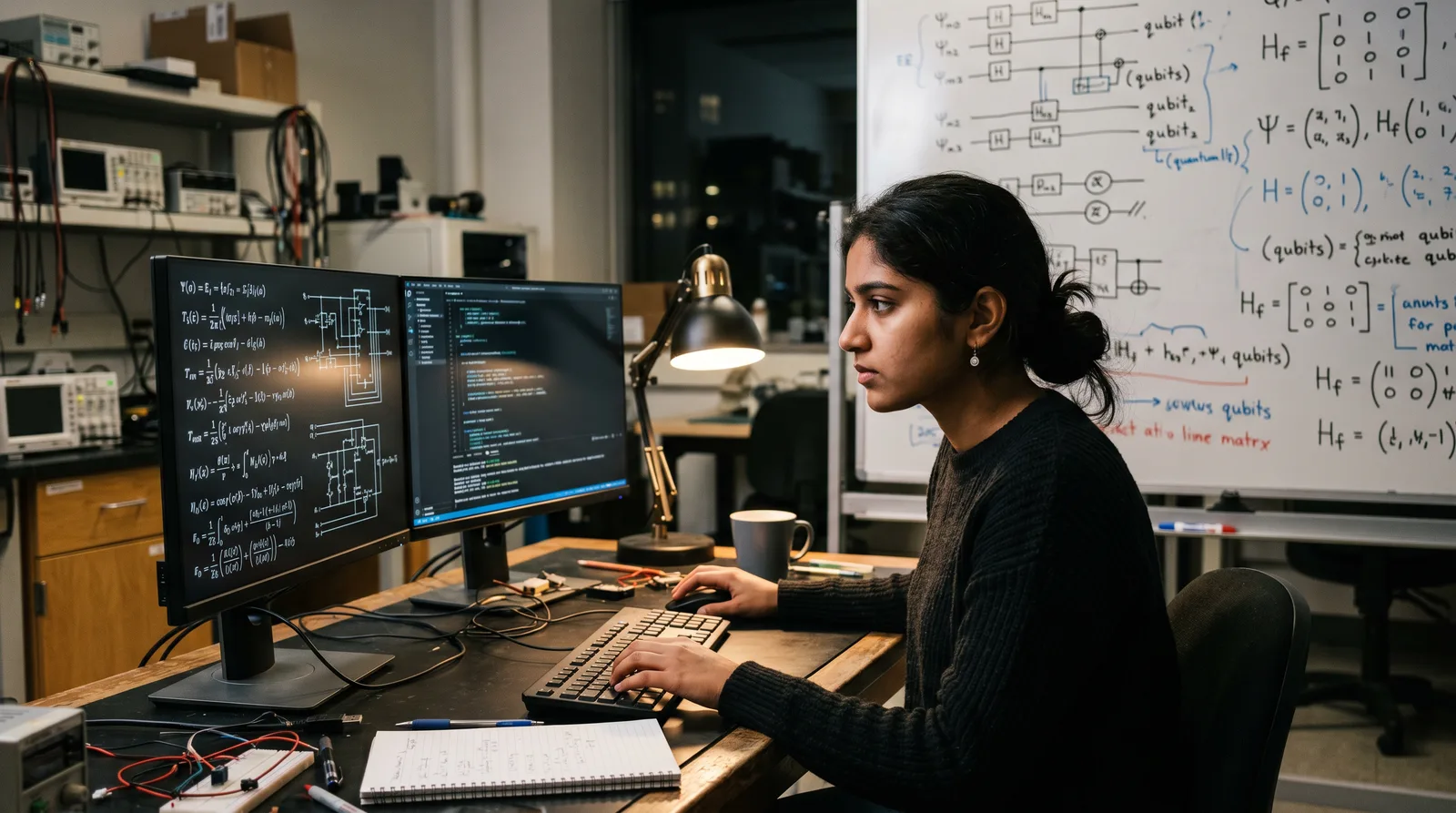
I'd rather give you one honest equation than ten flattering analogies — because the equation is what you'll actually use.— Freddy Foster
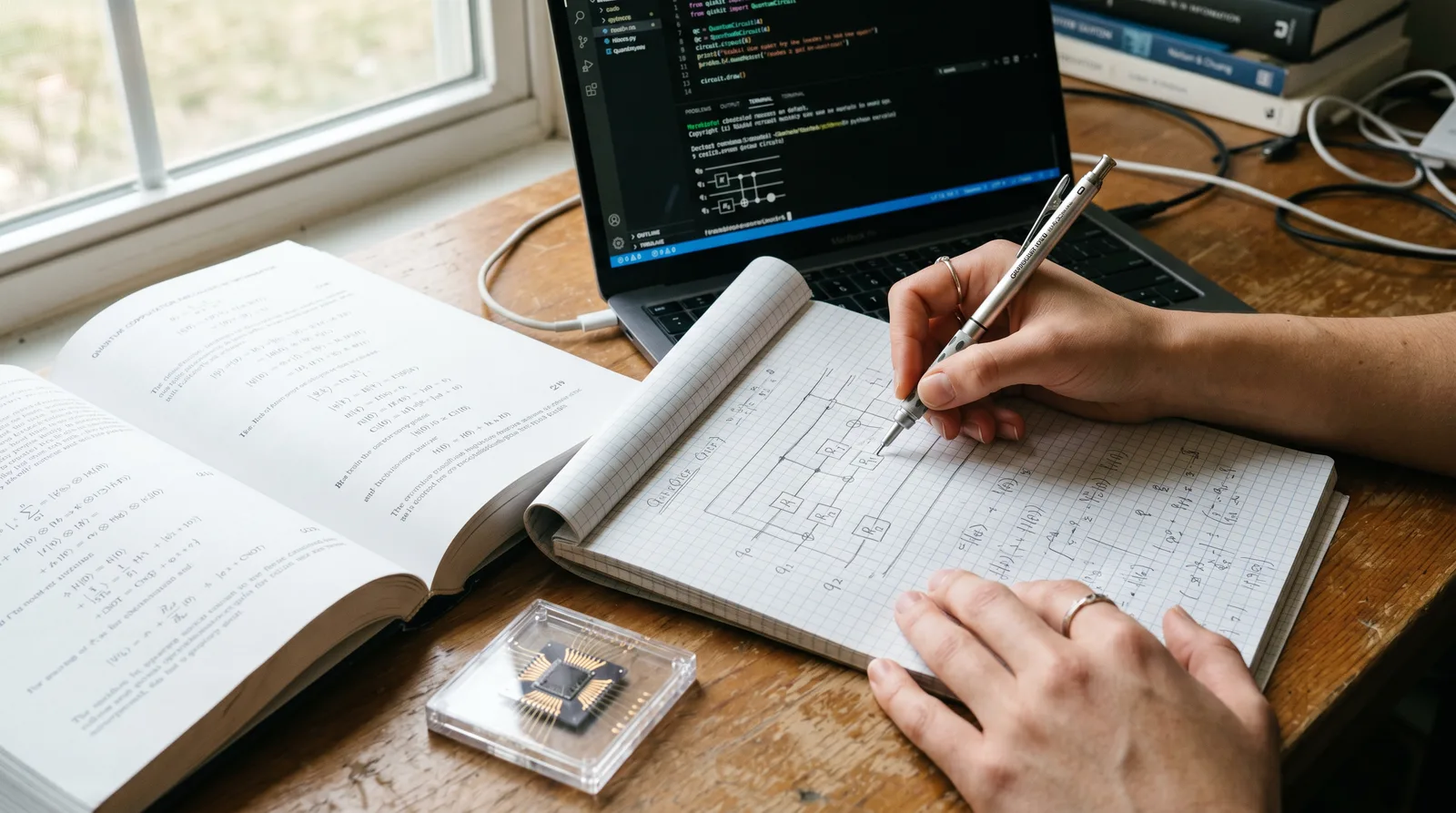
What you'll learn
What you'll be able to do
- Explain the core principles of quantum mechanics — superposition, entanglement, and interference — as they apply to computation
- Represent and manipulate qubits using Dirac (bra-ket) notation and quantum circuit diagrams
- Implement foundational quantum algorithms including Grover's search and the Quantum Fourier Transform
- Build and simulate quantum circuits using a real SDK such as Qiskit or Cirq on actual quantum hardware
- Analyze the computational advantage of quantum approaches over classical ones for specific problem classes
- Evaluate the current landscape of quantum hardware, error correction, and near-term (NISQ) applications to position yourself for industry opportunities
How it works
A school that adapts to you
This isn't a set of static videos. Every lesson is generated live and tuned to where you actually are.
We learn your level
A quick placement check tailors your starting point so you're never bored or lost.
Lessons adapt as you go
Each lesson is written for your pace and your goal, adjusting as your skills grow.
Your AI coach keeps you moving
Checkpoints, feedback, and gentle nudges turn progress into a real result.
The curriculum
What's inside your school
6 modules · 25 lessons

Foundations of Quantum Mechanics for Computing
Builds the essential physics and mathematical intuition needed to reason about quantum computation.
- 1.1Why Quantum Computing? Classical Limits and the Quantum PromiseIncluded
- 1.2Superposition, Entanglement, and InterferenceIncluded
- 1.3Probability Amplitudes and MeasurementIncluded
- 1.4The Mathematics of Quantum States: Vectors and Hilbert SpaceIncluded
Qubits, Notation, and Quantum Circuits
Teaches students to represent qubits precisely and to compose operations into readable quantum circuits.
- 2.1Dirac (Bra-Ket) NotationIncluded
- 2.2Single-Qubit Gates and the Bloch SphereIncluded
- 2.3Multi-Qubit Systems and Entangling GatesIncluded
- 2.4Reading and Writing Quantum Circuit DiagramsIncluded
Quantum Programming with Qiskit
Gets students writing, simulating, and running real quantum programs using the Qiskit SDK.
- 3.1Setting Up Your Quantum Development EnvironmentIncluded
- 3.2Building Circuits in Qiskit: Gates, Registers, and MeasurementIncluded
- 3.3Simulating Quantum Circuits LocallyIncluded
- 3.4Running Jobs on Real Quantum HardwareIncluded
Core Quantum Algorithms
Implements and analyzes the landmark algorithms that demonstrate provable quantum computational advantage.
- 4.1Quantum Parallelism and the Deutsch-Jozsa AlgorithmIncluded
- 4.2Grover's Search AlgorithmIncluded
- 4.3The Quantum Fourier Transform (QFT)Included
- 4.4Quantum Phase Estimation and Its ApplicationsIncluded
- 4.5Shor's Factoring Algorithm: Concepts and Circuit WalkthroughIncluded
Quantum Advantage: Complexity and Classical Comparisons
Equips students to rigorously evaluate when and why quantum approaches outperform classical ones.
- 5.1Quantum Complexity Classes: BQP, QMA, and Where They SitIncluded
- 5.2Oracles, Query Complexity, and Provable SpeedupsIncluded
- 5.3Problem Classes That Benefit Most from Quantum ComputingIncluded
Quantum Hardware, Error Correction, and the NISQ Era
Surveys the real-world hardware landscape, noise challenges, and near-term opportunities to position students for industry.
- 6.1Quantum Hardware Technologies: Superconducting, Trapped-Ion, and BeyondIncluded
- 6.2Noise, Decoherence, and Error Sources in Real DevicesIncluded
- 6.3Quantum Error Correction: Stabilizer Codes and the Surface CodeIncluded
- 6.4NISQ Algorithms: VQE and QAOAIncluded
- 6.5The Quantum Industry Landscape and Career PathwaysIncluded
Who it's for
Is this you?

Backend software engineers
You write production code daily and want rigorous, grounded training that connects quantum computing to the programming mental models you already rely on.

CS graduate students
You're comfortable with algorithms and complexity theory and want a precise, mathematically honest treatment of quantum computation to complement your research.

Quantum-curious physicists
You have the mechanics background but want to bridge into the computational and programming side — circuits, Qiskit, and algorithm design — with equal rigour.

Data scientists and ML engineers
You're watching quantum machine learning emerge and want the foundational depth — QFT, VQE, QAOA — to evaluate it critically rather than take it on faith.

Tech leads and engineering managers
You need to make informed decisions about quantum investments and roadmaps, and superficial overviews no longer cut it — you want the real picture of what NISQ hardware can and cannot do.

Career-changers targeting quantum industry
You have a strong technical background and are positioning yourself for roles in quantum software or hardware, and need a curriculum that produces genuine, demonstrable depth.
Questions
Frequently asked
Your teacher
A note from your teacher
Freddy Foster
If you've tried to learn quantum computing before and walked away feeling like you sort of understand it — but couldn't quite explain why a quantum algorithm is faster, or derive what a gate actually does to a state — then you know exactly the problem this school is designed to solve.
Most quantum computing content exists at one of two altitudes: pop-science analogies that feel satisfying until you try to use them, or graduate-level textbooks that assume you already live in a physics department. Neither serves the software engineer or computer scientist who wants to work at this level. You have the mathematical preparation. You have the programming skills. What has been missing is a curriculum that meets you there and takes you somewhere real.
This school starts with quantum mechanics stated the way it actually is — in the language of Hilbert spaces, probability amplitudes, and linear operators — and builds the full computational framework on top: Dirac notation, the circuit model, multi-qubit entanglement, the works. Then we move to Qiskit and get your hands on real hardware, because understanding a Hadamard gate in the abstract and watching it create superposition in a simulation are two different kinds of knowing, and you need both. The algorithms — Grover, QFT, Phase Estimation, Shor — are each walked through at the circuit level, with explicit analysis of where the quantum advantage comes from and what problem classes it applies to.
By the time we reach quantum complexity, hardware platforms, error correction, and the NISQ landscape, you will have the grounding to engage with those topics critically — not as a spectator reading headlines, but as someone who can evaluate claims, read a paper, and contribute to the work.
I want to be direct about what this school is and is not. It will challenge you. The mathematics is real and the depth is intentional. But if you are the kind of person who finds precision satisfying rather than daunting, who wants to know why and not just how, and who is serious about positioning yourself at the frontier of the next era of computing — this is exactly where to start. I am glad you found it.
— Freddy Foster
Start your journey today
Join get instant access — learn at your own pace with an AI coach in your corner.
$79/mo
Recurring billing · cancel anytime
Secure checkout · Instant access
- 6 modules, 25 lessons
- AI-adaptive lessons tuned to your level
- Quizzes & checkpoints to lock in progress
- Your own AI learning coach
- Learn on any device, at your pace
- Full access for as long as you're subscribed