Understand the Christians the Reformation Left Behind
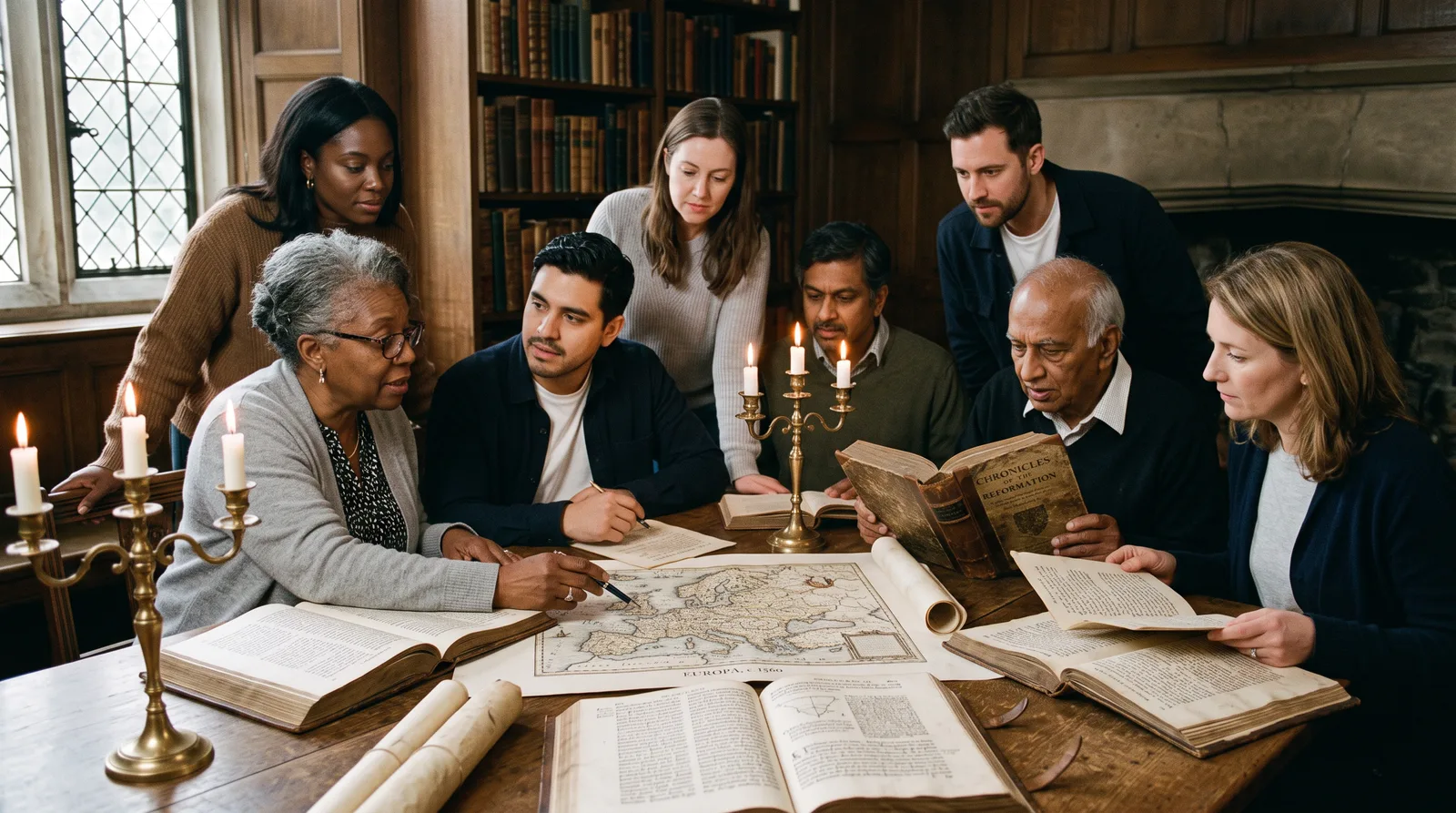
A rigorous, source-grounded journey through the Radical Reformation — from the Zurich circle's first rebaptisms to the Martyrs' Mirror to the global free church movements that still carry this tradition's DNA. For learners who want scholarly depth, not easy answers.
"The people we are studying paid a very high price for their convictions — the least we can do is understand them carefully."
— Theoria

What you'll learn
What you'll be able to do
- Explain the historical, political, and ecclesiastical conditions in sixteenth-century Europe that gave rise to the Radical Reformation
- Distinguish the major branches of the Radical Reformation — Swiss Brethren, Anabaptists, Hutterites, Mennonites, and Spiritualists — and articulate the theological convictions that set them apart from one another
- Analyze the lives and writings of key figures such as Conrad Grebel, Balthasar Hubmaier, Menno Simons, and Caspar Schwenckfeld using both primary sources and modern scholarship
- Evaluate core Radical Reformation themes — believer's baptism, nonviolence, separation of church and state, discipleship, and community of goods — within their precise historical and scriptural contexts
- Assess the role of persecution by Catholic and Protestant authorities in shaping Radical Reformers' theology of the church, religious liberty, and Christian suffering
- Trace the lasting influence of Radical Reformation traditions on Baptist, Mennonite, Amish, Brethren, and global free church movements while recognizing meaningful distinctions among them
How it works
A school that adapts to you
This isn't a set of static videos. Every lesson is generated live and tuned to where you actually are.
We learn your level
A quick placement check tailors your starting point so you're never bored or lost.
Lessons adapt as you go
Each lesson is written for your pace and your goal, adjusting as your skills grow.
Your AI coach keeps you moving
Checkpoints, feedback, and gentle nudges turn progress into a real result.
The curriculum
What's inside your school
6 modules · 26 lessons

The World That Made the Radical Reformation
Surveys sixteenth-century Europe's religious, political, and social landscape to explain why many reformers felt the Protestant Reformation had not gone far enough.
- 1.1Christendom on the Eve of ReformIncluded
- 1.2Luther, Zwingli, and the Limits of Magisterial ReformIncluded
- 1.3Social Unrest, the Peasants' War, and Competing Visions of ReformIncluded
- 1.4The Authority of Scripture and the Role of TraditionIncluded
The Birth of the Swiss Brethren and Early Anabaptism
Reconstructs the origins of the Anabaptist movement in Zurich, tracing the key figures, founding events, and foundational convictions of the Swiss Brethren.
- 2.1Conrad Grebel, Felix Manz, and the Zurich CircleIncluded
- 2.2Believer's Baptism and the Rejection of Infant BaptismIncluded
- 2.3The Schleitheim Confession of 1527Included
- 2.4Balthasar Hubmaier: Theologian of the AnabaptistsIncluded
Diversity Within the Radical Reformation
Introduces the full range of communities and convictions that made the Radical Reformation a theologically diverse and internally contested movement.
- 3.1The Hutterites and Community of GoodsIncluded
- 3.2Menno Simons and the Consolidation of Dutch AnabaptismIncluded
- 3.3Pilgram Marpeck and the Middle WayIncluded
- 3.4Spiritualists: Caspar Schwenckfeld and the Inner WordIncluded
- 3.5Other Voices: Revolutionary, Prophetic, and Mystical StreamsIncluded
The Münster Rebellion and Its Aftermath
Examines the Münster crisis of 1534–1535 as the movement's most dramatic episode and analyzes why mainstream Anabaptism decisively rejected its violent trajectory.
- 4.1The Road to Münster: Apocalypticism and Political AnabaptismIncluded
- 4.2The Kingdom of Münster: Events, Leaders, and CollapseIncluded
- 4.3Mainstream Anabaptist Responses to MünsterIncluded
Core Themes: Theology, Ethics, and Church Life
Provides a thematic study of the theological convictions and communal practices that defined Radical Reformation identity across its diverse branches.
- 5.1The Church as Voluntary Community: Ecclesiology and DisciplineIncluded
- 5.2Nonviolence, the Sword, and the Two KingdomsIncluded
- 5.3Separation of Church and State as Theological ConvictionIncluded
- 5.4Discipleship, the Sermon on the Mount, and the Suffering ChurchIncluded
- 5.5Reading the Bible in Community: Scripture, Tradition, and InterpretationIncluded
Persecution, Legacy, and the Living Tradition
Traces the severe persecution Radical Reformers endured, their theology of martyrdom, and their enduring influence on global free church Christianity.
- 6.1Suffering as Discipleship: Martyrdom and the Martyrs' MirrorIncluded
- 6.2Catholic and Protestant Persecution of Radical ReformersIncluded
- 6.3From Anabaptists to Mennonites, Amish, and BrethrenIncluded
- 6.4Baptist and Free Church Traditions: Connections and DistinctionsIncluded
- 6.5The Radical Reformation's Global Legacy and Contemporary RelevanceIncluded
Who it's for
Is this you?

Seminary students
Engaging the Radical Reformation with the primary sources and scholarly framework that formal theological education demands but doesn't always provide in depth.

Free church pastors
Tracing the historical and theological roots of believer's baptism, voluntary church membership, and the separation of church and state that define the tradition they serve.

Mennonite & Anabaptist laypeople
Moving beyond inherited stories to engage the founding figures, confessions, and controversies of their own tradition with honest scholarly rigor.

Reformation history enthusiasts
Filling the conspicuous gap in standard Reformation narratives by studying the movements that Luther, Zwingli, and Calvin actively opposed and persecuted.

Christian educators & curriculum writers
Building source-grounded, intellectually honest teaching material on a tradition that standard church history curricula routinely underserve.
Theologians & independent scholars
Examining Radical Reformation ecclesiology, hermeneutics, and ethics as live theological questions with direct bearing on contemporary church life and political theology.
Questions
Frequently asked
Your teacher
A note from your teacher

Theoria
If you have spent any time studying the Protestant Reformation, you have probably encountered a familiar cast of characters: Luther at Worms, Zwingli in Zurich, Calvin in Geneva. These are important figures, and their work genuinely reshaped Western Christianity. But if you have ever read far enough into the sources to notice the people being drowned in the rivers of Zurich, burned in the squares of the Netherlands, or expelled from city after city across the Holy Roman Empire — and found yourself asking who were they, and what exactly did they believe? — then you are asking exactly the right question. That question is what this course is built to answer.
I came to the Radical Reformation the way many serious students do: through a footnote, a passing reference, a name in a margin. Conrad Grebel. Felix Manz. Menno Simons. Figures who appeared briefly in standard Reformation narratives and then vanished, usually around the moment they became inconvenient to the story being told. The deeper I went into the primary sources — the confessions, the letters, the trial records, the martyr accounts — the clearer it became that these were not fringe curiosities. They were people working out a coherent, demanding, and often brilliant theology under conditions of extreme pressure, and the questions they raised about the church, the state, scripture, and the cost of discipleship have never stopped being relevant.
What I want to offer you in this course is not a hagiography of the Radical Reformers, and not a prosecution of their opponents. Both would be intellectually dishonest. The Catholic and Protestant authorities who persecuted these communities had arguments, some of which were serious. The Radical Reformers themselves were not a unified movement — they disagreed sharply with one another on baptism, on the nature of Christ, on violence, on how to read scripture — and those disagreements matter for understanding them accurately. The Münster episode is not swept under the rug; it is examined carefully, in context, so you can understand both what actually happened and why it has been used, often unfairly, to discredit movements that had nothing to do with it.
What you will find here is a course that trusts you. It trusts you to read primary sources and form judgments. It trusts you to hold competing arguments in tension without needing one of them declared the winner before you have thought it through. It trusts you to care about the difference between Balthasar Hubmaier's theology and Caspar Schwenckfeld's — because that difference is real, and it matters.
Whether you are a seminary student encountering this material in a formal program, a pastor trying to understand the roots of the free church tradition you serve, or a historically serious independent learner who simply will not accept a shallow account of things that deserve better — I am glad you are here. The people we are studying paid a very high price for their convictions. The least we can do is understand them carefully.
— Theoria
Start your journey today
Get instant access — learn at your own pace with an AI coach in your corner.
$39/mo
Recurring billing · cancel anytime
Secure checkout · Instant access
- 6 modules, 26 lessons
- AI-adaptive lessons tuned to your level
- Quizzes & checkpoints to lock in progress
- Your own AI learning coach
- Learn on any device, at your pace
- Full access for as long as you're subscribed