Learn to read the language of Beowulf
Learn to read the language of Beowulf from the ground up — no prior experience required. Build real translation skills through guided readings of authentic Anglo-Saxon texts.
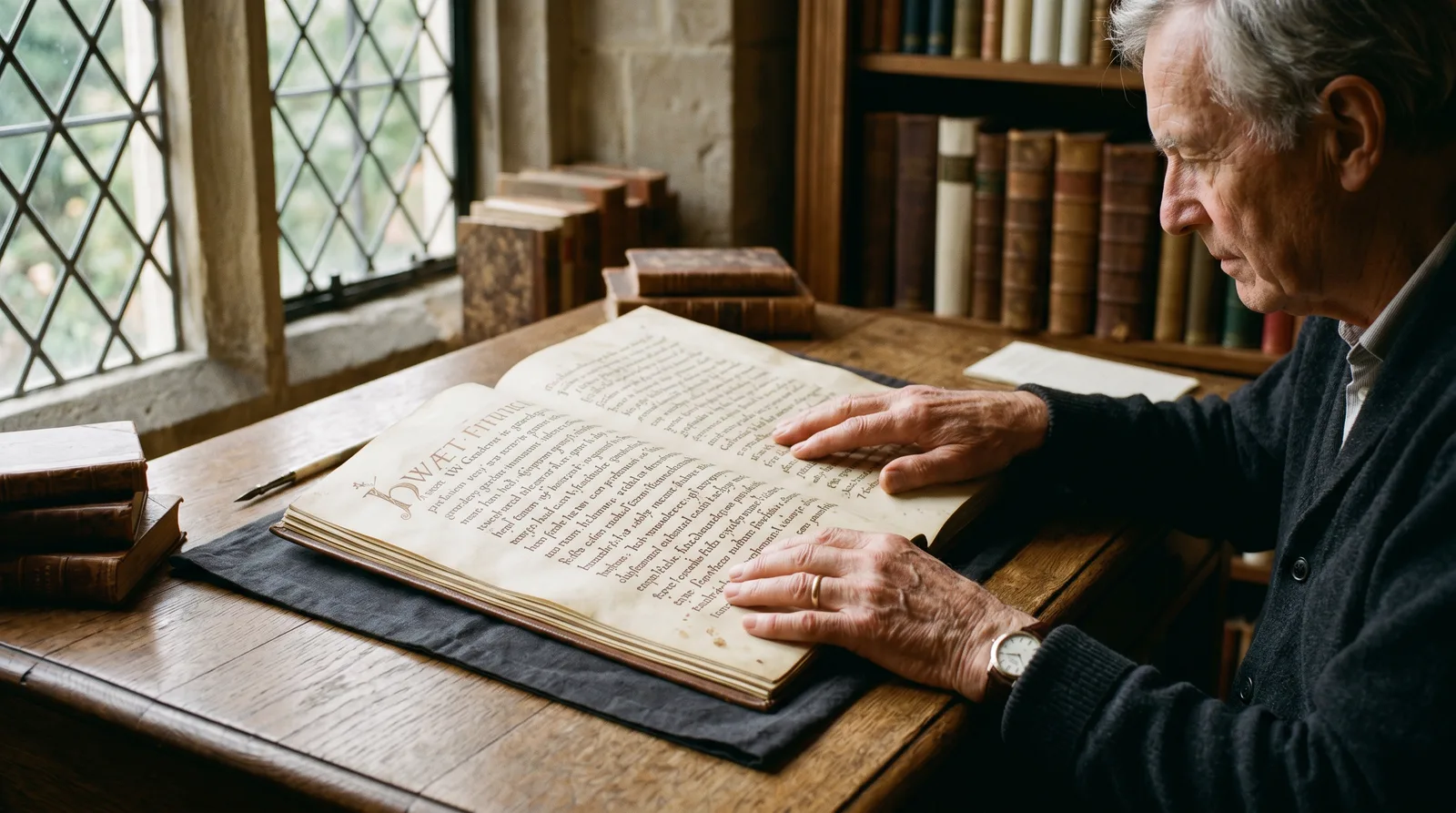
"Old English isn't a dead language — it's your language, and I'll prove it to you line by line."
— Carla Paton
What you'll learn
What you'll be able to do
- Read and pronounce Old English aloud using the runic and Roman alphabet conventions of Anglo-Saxon manuscripts
- Recognize the most common grammatical patterns in Old English — including noun cases, strong and weak verbs, and sentence structure — without rote memorization
- Navigate a standard Old English dictionary (such as Bosworth-Toller) to look up unfamiliar words independently
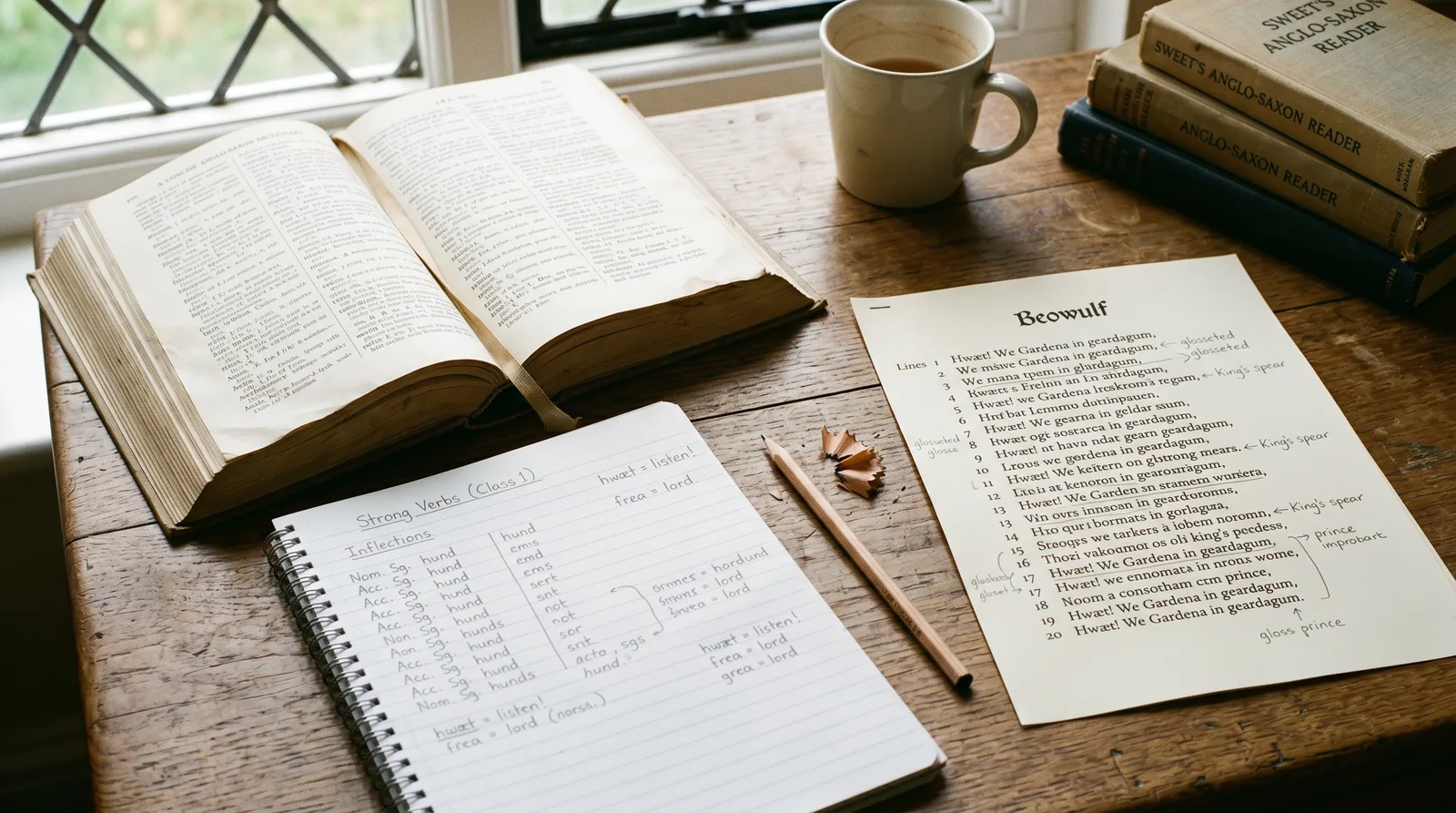
- Work through line-by-line passages from Beowulf, The Wanderer, The Seafarer, and the Old English Rune Poem with guided support
- Produce accurate prose translations of short Old English passages, explaining your grammatical reasoning
- Describe how Old English evolved into Middle and Modern English, placing texts in their historical and literary context
How it works
A school that adapts to you
This isn't a set of static videos. Every lesson is generated live and tuned to where you actually are.
We learn your level
A quick placement check tailors your starting point so you're never bored or lost.
Lessons adapt as you go
Each lesson is written for your pace and your goal, adjusting as your skills grow.
Your AI coach keeps you moving
Checkpoints, feedback, and gentle nudges turn progress into a real result.
The curriculum
What's inside your school
6 modules · 19 lessons

Sound, Script, and First Words
This foundational module orients learners to the look and sound of Old English before any grammar is introduced. Students learn to recognize and produce the letters and symbols of Anglo-Saxon manuscripts — including runic characters, thorn (þ), eth (ð), wynn (ƿ), and yogh (ȝ) — and develop confident pronunciation through guided listening and speaking practice. The module closes by building a working vocabulary of the 100 most frequent Old English words, giving students immediate leverage when they encounter real texts.
- 1.1The Old English Alphabet and Manuscript ConventionsIncluded
- 1.2Pronouncing Old English — Vowels, Consonants, and StressIncluded
- 1.3Core Vocabulary — The 100 Words That Unlock Old EnglishIncluded
Grammar Without the Tables — Nouns, Cases, and the Sentence
This module introduces Old English grammar inductively, starting from meaning and function rather than from paradigm tables. Students learn what grammatical cases actually do in a sentence — how they signal who acts, who is acted upon, and the relationships between words — before looking at how nouns change their endings to signal those roles. The module builds toward reading full nominal phrases in context, covering strong and weak declensions and the determiner and pronoun system that students will encounter on nearly every page of a text.
- 2.1What Cases Do — Subject, Object, and BeyondIncluded
- 2.2Nouns in Action — Strong and Weak DeclensionsIncluded
- 2.3Pronouns and the Determiner SystemIncluded
Verbs — The Engine of the Sentence
This module covers the Old English verb system comprehensively enough for reading purposes, distinguishing the regular (weak) verbs from the ablaut-based (strong) verbs that dominate the poetic vocabulary. Students also learn the high-frequency irregular verbs — bēon/wesan ('to be'), the preterite-present verbs that function as modals, and negation — that appear in virtually every passage they will encounter. The goal is pattern recognition under reading conditions, not production of every form from memory.
- 3.1Weak Verbs — Regular Patterns in Old EnglishIncluded
- 3.2Strong Verbs — Ablaut and the Seven ClassesIncluded
- 3.3The Verb 'To Be', Modals, and NegationIncluded
Reading Old English Poetry — Meter, Form, and the Poetic Lexicon
Before encountering the extended poetic texts in Module 5, students need two competencies beyond grammar: an understanding of the alliterative metrical system that governs how Old English poetry is organized and performed, and familiarity with the special vocabulary of the poetic register — particularly kennings and the technique of variation. This module builds both competencies through short, well-chosen examples, preparing students to read whole poems with attention to both meaning and art. A new lesson on elegiac and heroic themes is added here to provide the literary-historical context that makes the Module 5 texts fully legible.
- 4.1The Alliterative Line — Stress, Caesura, and the Four TypesIncluded
- 4.2Kennings, Variation, and the Poetic VocabularyIncluded
- 4.3Heroic and Elegiac Themes — Literary and Historical ContextIncluded
Guided Readings — Four Texts, Line by Line
This is the heart of the course. Having built pronunciation, vocabulary, grammar, poetic form, and cultural context, students now work through substantial passages from the four target texts with full guided support: interlinear vocabulary, grammatical notes keyed to earlier lessons, and translation exercises that require students to explain their reasoning rather than just produce an output. Lessons are sequenced from most accessible (the Rune Poem's short individual stanzas) through the sustained syntactic complexity of Beowulf, and each lesson ends with a semi-independent translation task that reduces scaffolding slightly compared to the guided portion.
- 5.1The Old English Rune Poem — Language, Culture, and the Runic TraditionIncluded
- 5.2The Wanderer — Exile, Memory, and the Elegiac VoiceIncluded
- 5.3The Seafarer — Journey, Longing, and the Natural WorldIncluded
- 5.4Beowulf — The Opening and the Arrival of the HeroIncluded
From Old English to Now — History, Evolution, and Independent Reading
The final module serves two purposes: it fulfils the outcome of understanding how Old English evolved into later forms of English, and it builds the independent reading skills — dictionary navigation, use of scholarly grammars, and translation methodology — that allow students to go beyond the course and continue reading on their own. The module closes with a capstone translation task that synthesizes every skill acquired, requires students to work with an entirely unseen passage, and asks them to articulate their grammatical and interpretive reasoning in writing.
- 6.1How Old English Became Modern EnglishIncluded
- 6.2Using Dictionaries, Grammars, and Scholarly Resources IndependentlyIncluded
- 6.3Capstone — Translating Unseen Passages and Presenting Your ReasoningIncluded
Who it's for
Is this you?

Beowulf devotees
You've read every translation on the shelf and finally want to meet the original poem in its own language, unmediated.

Prospective medievalists
You're heading into graduate study in medieval literature or history and need a rigorous, practical foundation in Old English before seminars begin.

History buffs
Anglo-Saxon England fascinates you, and you want to read primary sources — charters, poems, chronicles — on your own terms, not through a translator's filter.

Language enthusiasts
You love tracing where words come from, and Old English is the missing chapter in the story of every English word you've ever used.

Literature teachers
You teach English or classics and want the linguistic depth to discuss Old English texts — their form, meter, and vocabulary — with real authority.

Lifelong learners
You've always been curious about the medieval world and want a structured, expert-guided course that respects your intelligence and your time.
Questions
Frequently asked
Your teacher
A note from your teacher

Carla Paton
If you've ever picked up a facing-page translation of Beowulf and found yourself more drawn to the strange, knotted lines on the left than the smooth English on the right — this course was made for you.
I know what it feels like to want to cross that barrier. Old English sits there, tantalizingly close, full of words you almost recognize — mann, land, cyning — and yet just opaque enough to feel like a locked door. Most people assume you need a linguistics degree to pick up that key. You don't. What you need is a patient guide who will explain the grammar as a system that makes sense, introduce vocabulary in a way that sticks, and put real texts in your hands as quickly as possible. That's exactly what this course does.
We start with sound and script — not because it's obligatory, but because hearing Old English changes everything. Once you know how to pronounce the words, the poetry opens up. Alliteration isn't a decoration in these texts; it's the structural skeleton of every line. From there, we work through the grammar — cases, declensions, strong and weak verbs — but always through the logic of why, not the drudgery of memorize this table. Modern English hasn't drifted as far from its ancestor as you might think, and I'll show you the threads of continuity at every turn.
By the time we reach the guided readings, you'll be doing real translation work — not just reading someone else's version, but wrestling with the Old English yourself, reaching for Bosworth-Toller, forming an argument for why that word means that thing in that context. We read the Rune Poem, The Wanderer, The Seafarer, and the opening of Beowulf — four very different windows into Anglo-Saxon life, all of them stunning in the original.
This isn't a history lecture about the Anglo-Saxons. It's an invitation to read what they actually wrote, in the language they wrote it. That's a different thing entirely — and it's available to anyone willing to take it seriously. I'd love to help you get there.
Come read with me. Hwæt!
— Carla Paton
Start your journey today
Get instant access — learn at your own pace with an AI coach in your corner.
$19/mo
Recurring billing · cancel anytime
Secure checkout · Instant access
- 6 modules, 19 lessons
- AI-adaptive lessons tuned to your level
- Quizzes & checkpoints to lock in progress
- Your own AI learning coach
- Learn on any device, at your pace
- Full access for as long as you're subscribed