Learn to redesign democracy from the ground up
No law degree required — just the curiosity to ask hard questions about power, representation, and who really governs. From the House of Lords to the US presidency to authoritarian drift in Russia and China, this school gives you the intellectual tools to understand broken democratic structures and imagine better ones.
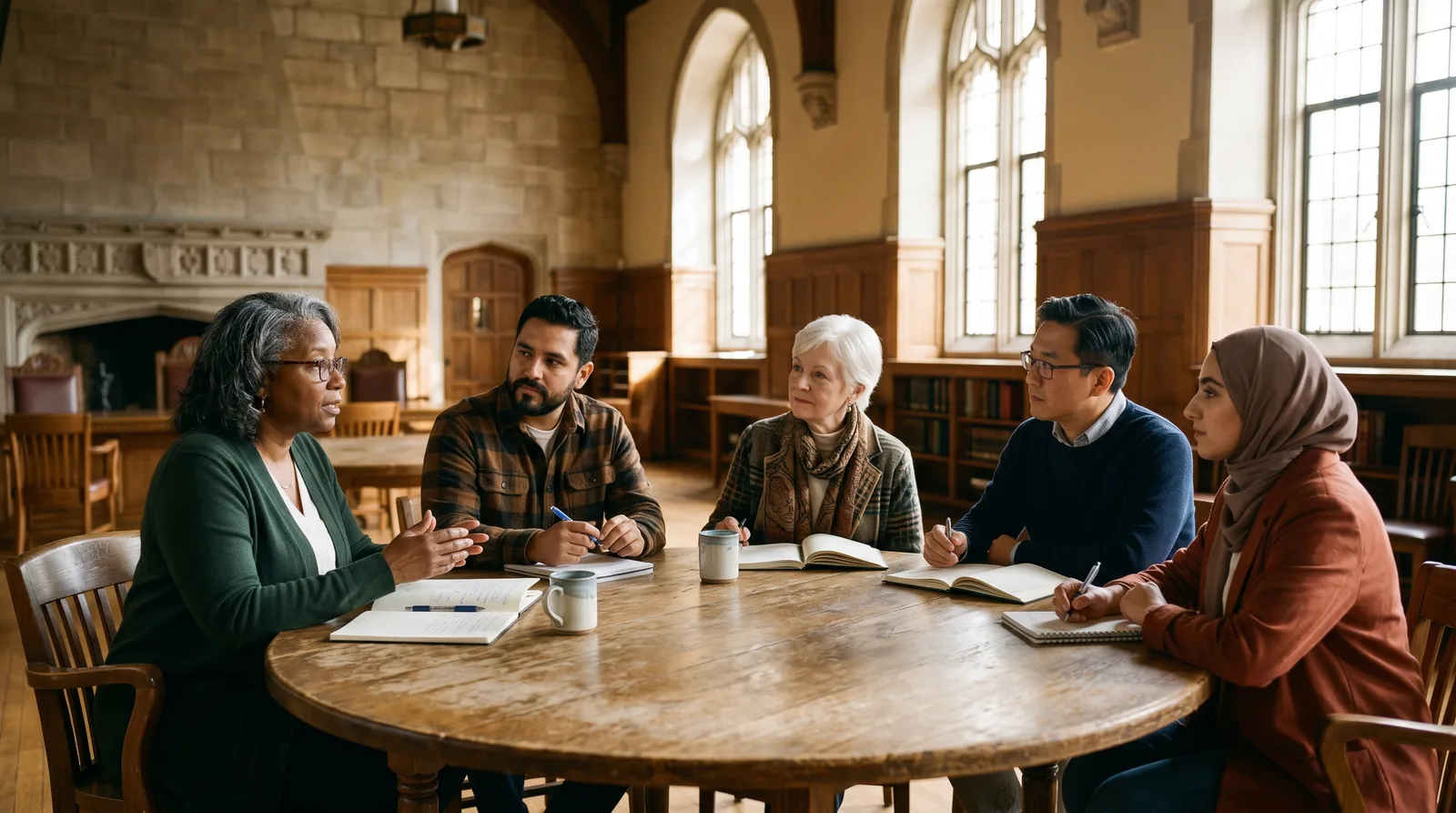
"I believe that anyone who pays attention to the world deserves the tools to imagine it differently — and that's exactly what we build here, together."— David Clilverd

What you'll learn
What you'll be able to do
- Critically analyse the structure and legitimacy of the UK House of Lords and articulate evidence-based arguments for mayoral or elected-peer reform
- Compare multi-party democratic systems internationally and explain why two-party polarisation weakens representative government
- Evaluate models of decentralised presidential leadership — including state-level executive federalism — and assess their feasibility in the USA, China, and Russia
- Identify key constitutional anomalies (gun access, judicial appointment, reproductive rights) and construct reasoned, balanced reform proposals
- Apply historical lessons — from Prohibition to authoritarian drift — to current policy debates, demonstrating how past governance failures inform wiser future choices
- Design a coherent civic reform proposal for a real institution, presenting a structured argument for more humane, locally accountable, and inclusive democratic governance
How it works
A school that adapts to you
This isn't a set of static videos. Every lesson is generated live and tuned to where you actually are.
We learn your level
A quick placement check tailors your starting point so you're never bored or lost.
Lessons adapt as you go
Each lesson is written for your pace and your goal, adjusting as your skills grow.
Your AI coach keeps you moving
Checkpoints, feedback, and gentle nudges turn progress into a real result.
The curriculum
What's inside your school
6 modules · 18 lessons

The House of Lords: Legitimacy, History, and the Case for Reform
Students explore the origins, current structure, and democratic legitimacy of the UK House of Lords. They examine the patronage system that underlies peer appointments and evaluate the compelling proposal to integrate retired elected Mayors as citizen-representative peers — either within the existing chamber or as its replacement. This module establishes the foundational UK case study before the curriculum broadens internationally.
- 1.1How the House of Lords Actually WorksIncluded
- 1.2The Patronage Problem: Appointments, Favours, and the Erosion of TrustIncluded
- 1.3The Mayoral Reform Model: Retired Mayors as Citizens' PeersIncluded
- 1.4Reform, Replace, or Abolish? Designing the Future Second ChamberIncluded
The Two-Party Trap: Polarisation, Multi-Party Democracy, and the American Divide
Students move from the UK to the USA, examining how a two-party system generates ideological polarisation in a multi-cultural, multi-regional society. They explore international multi-party models as working alternatives and then — critically for sequencing — encounter the USA's specific constitutional anomalies (gun rights, judicial appointments, reproductive rights) in their proper political context, having already understood why the system itself produces gridlock before examining specific policy failures.
- 2.1Why Two Parties Divide: The Mechanics of PolarisationIncluded
- 2.2Multi-Party Models That Work: Global Lessons for AmericaIncluded
- 2.3Constitutional Anomalies: Guns, the Supreme Court, and Reproductive RightsIncluded
Decentralising Power: Federal Models, State Presidencies, and the Limits of Single Leadership
Students examine the structural argument that a single executive cannot legitimately or practically govern vast, diverse nations of hundreds of millions. They explore the 'collective presidency' model — where each US state elects its own president with full executive powers, and these state presidents collectively govern nationally — and then extend this analysis to China and Russia, where decentralisation is evaluated as a democratic check on authoritarian drift.
- 3.1Can One Person Lead 330 Million? The Scale Problem of the Modern PresidencyIncluded
- 3.2State-Level Executive Federalism: The Collective Presidency ModelIncluded
- 3.3Russia and China: Decentralisation as a Check on Authoritarian DriftIncluded
Historical Lessons for Modern Governance: When States Get It Wrong
Students step back from contemporary proposals to ground their thinking in historical governance failures. By examining Prohibition, the mechanics of authoritarian drift in democracies, and the critical role of civic education, students develop the analytical tools to recognise warning signs and apply past failures — rather than repeat them — in their own reform proposals. This module is sequenced after the structural critiques of Modules 1–3 so students can immediately apply historical lessons to the systems they have already critiqued.
- 4.1Prohibition and the Law of Unintended ConsequencesIncluded
- 4.2Authoritarian Drift: How Democracies Slide and How They Can RecoverIncluded
- 4.3Education, Wisdom, and the Citizen's Role in Democratic HealthIncluded
Rights, Bodies, and the Limits of the State: Reproductive Rights and Personal Sovereignty
Students focus on reproductive rights as a case study in the limits of state authority over personal life, examining the legal architecture of Roe v. Wade, its reversal in Dobbs v. Jackson, and the real-world consequences for women's lives and public health. The module addresses the user's specific arguments — that abortion is a personal private right, that criminalisation creates danger analogous to Prohibition, and that legislative interference in deeply personal decisions is a sovereignty violation — while maintaining the balanced, evidence-based tone appropriate to a civic curriculum. Sensitive content is handled with care and appropriate framing throughout.
- 5.1Roe, Dobbs, and the Architecture of Reproductive RightsIncluded
- 5.2Personal Sovereignty, Public Health, and the Role of the StateIncluded
Designing the Future: Civic Reform Proposals for a Kinder, Safer Democracy
The culminating module brings together all prior learning. Students develop, refine, and publicly defend an original civic reform proposal for a real institution — building directly on the UK Lords reform, US multi-party system, collective presidency, constitutional anomaly, and historical lessons content. New prerequisite lessons on what makes reform credible and how to structure a persuasive argument are fully developed here, ensuring students have the scaffolding to produce genuinely coherent reform proposals rather than unsupported opinions.
- 6.1What Makes a Reform Proposal Credible and Feasible?Included
- 6.2Voices of Reform: Humane Leadership, Local Accountability, and Kindness as a Political ValueIncluded
- 6.3Your Civic Reform Proposal: Design, Present, and DefendIncluded
Who it's for
Is this you?

Civically curious adults
You follow the news closely and want to move beyond outrage into genuine understanding of why democratic structures work — or don't.

Local councillors
You work inside democratic institutions and want a sharper analytical framework for understanding reform, accountability, and the limits of local power.

Educators & teachers
You want richer, more globally grounded material to bring political literacy alive in the classroom or community education setting.

Community activists
You're already campaigning for change and want the intellectual scaffolding to make your reform arguments more credible, structured, and persuasive.

Independent thinkers
You distrust political tribalism and want a space to examine big governance questions from first principles, without being handed a party line.

Political enthusiasts
You love comparative politics and want to go deeper — from multi-party democracies worldwide to decentralisation models in the USA, Russia, and China.
Questions
Frequently asked
Your teacher
A note from your teacher

David Clilverd
If you've ever found yourself reading about the House of Lords or the latest US Supreme Court ruling and thinking, this can't be the best we can do — I want you to know that feeling is worth taking seriously. Not as frustration, not as cynicism, but as the beginning of something more useful: genuine inquiry.
That's why this school exists.
I didn't build Reimagining Democracy to give you a set of approved opinions about what's wrong with the world. I built it because I believe most of us — teachers, activists, councillors, concerned citizens, people who simply pay attention — are far more capable of serious political thinking than public discourse usually allows for. We're given talking points when we deserve arguments. We're given outrage when we need history. We're given slogans when what would actually help is a clearer understanding of how institutions work, why they calcify, and what has ever actually changed them.
So we start close to home, with the House of Lords — an institution most people in Britain have a vague sense of unease about without quite knowing how its appointment system works, or why that matters. We look at the patronage problem honestly. We examine a concrete alternative — the mayoral reform model — and we ask hard questions about what a legitimate, representative second chamber might actually look like. From there, we move outward: to the United States, where two parties have sorted themselves into something closer to permanent warfare; to federal systems that distribute presidential power rather than concentrating it; to Russia and China, where the consequences of unchecked centralised authority are most visible; and finally, to the constitutional questions that touch the most intimate corners of human life — reproductive rights, judicial legitimacy, personal sovereignty.
Throughout, I've tried to hold one thing steady: the belief that complexity deserves patience, not shortcuts. We look at Prohibition not to make a clever point, but because it is one of history's clearest demonstrations of what happens when the law races ahead of wisdom. We look at authoritarian drift not to alarm, but to understand the gradual mechanisms by which even functioning democracies can hollow out — and what citizens have done, historically, to pull them back. History, treated honestly, is among the most practical tools we have.
The final module asks you to do something I think is genuinely rare in political education: to build something. A coherent, credible reform proposal for a real institution, grounded in evidence, structured for scrutiny, and presented with the kind of care you'd want someone to bring to your rights and your community. It's where everything else lands.
If you come to this school with an open mind, a willingness to sit with hard questions, and a genuine care for how human beings are governed — you're home. Whatever your politics, whatever your background, you belong in this conversation.
— David Clilverd
Start your journey today
Join get instant access — learn at your own pace with an AI coach in your corner.
$29/mo
Recurring billing · cancel anytime
Secure checkout · Instant access
- 6 modules, 18 lessons
- AI-adaptive lessons tuned to your level
- Quizzes & checkpoints to lock in progress
- Your own AI learning coach
- Learn on any device, at your pace
- Full access for as long as you're subscribed