Turn emerging readers into confident, evidence-based thinkers
Right Track Explorers takes 3rd–5th graders on a personalized literacy expedition — through real texts, academic vocabulary, and scholar-level analysis — so they don't just read better, they think sharper. OPTIONAL: Live 1-1 Virtual Coaching Sessions Available Upon Request.

Every child who walks through this door gets treated as a capable scholar — because that's exactly what they are.— Right Track Learning Academy
What you'll learn
What you'll be able to do
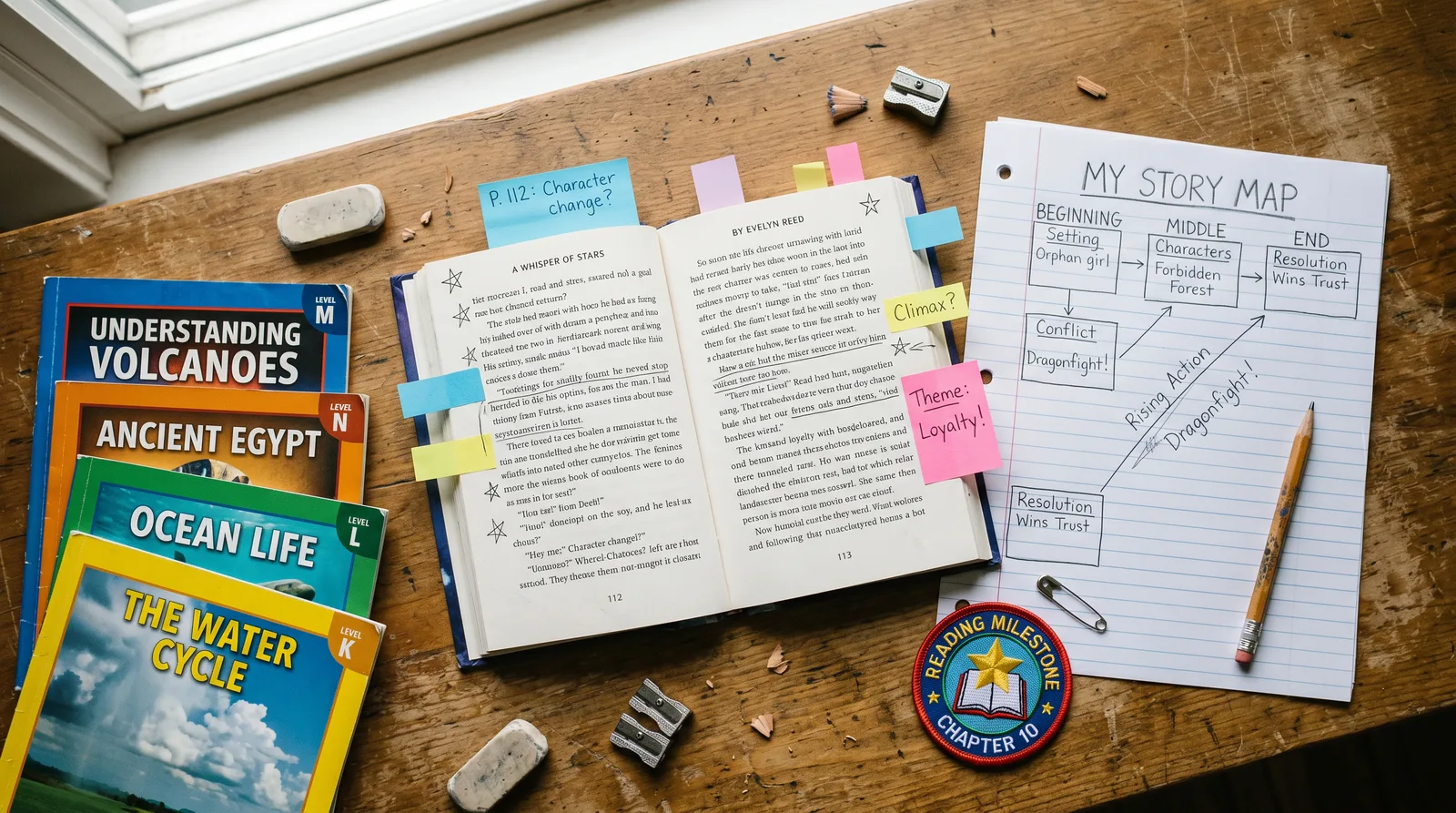
- Accurately assess your own reading level through the Explorer Assessment and follow a personalized literacy path that grows with you
- Master Tier 2 and Tier 3 academic vocabulary by unlocking word origins and context clues across every genre you encounter
- Read fiction and nonfiction with fluency, expression, and confident pacing — moving well beyond word-by-word accuracy into real prosody
- Analyze literary texts for theme, character motivation, point of view, and figurative language with the tools of a genuine literary scholar
- Construct written responses that cite textual evidence clearly and build a cohesive argument, meeting Common Core and Florida B.E.S.T. writing standards
- Earn Mastery Milestone badges across all five literacy pillars and take on Explorer Challenges that apply your skills to the real world beyond the screen
How it works
A school that adapts to you
This isn't a set of static videos. Every lesson is generated live and tuned to where you actually are.
We learn your level
A quick placement check tailors your starting point so you're never bored or lost.
Lessons adapt as you go
Each lesson is written for your pace and your goal, adjusting as your skills grow.
Your AI coach keeps you moving
Checkpoints, feedback, and gentle nudges turn progress into a real result.
The curriculum
What's inside your school
6 modules · 28 lessons

Launch Your Expedition: The Explorer Assessment & Personalized Path
Students complete the baseline Explorer Assessment to map their current literacy strengths, receive a personalized learning path, and get oriented to the five pillars and the Right Track Explorers platform.
- 1.1The Explorer Assessment: Know Your Starting PointIncluded
- 1.2Reading Your Results: Understanding Your Literacy MapIncluded
- 1.3The Five Pillars: Your Tools for Every ExpeditionIncluded
- 1.4Setting Up Base Camp: Goals, Badges, and Explorer ChallengesIncluded
Word Expedition: Academic Vocabulary and Word Origins
Students build powerful Tier 2 and Tier 3 academic vocabulary by investigating word roots, prefixes, suffixes, and context clues across fiction and nonfiction texts.
- 2.1Context Clues: Let the Text Be Your GuideIncluded
- 2.2Cracking the Code: Roots, Prefixes, and SuffixesIncluded
- 2.3Tier 2 Words: The Language of LearningIncluded
- 2.4Tier 3 Words: Vocabulary of the ExpertsIncluded
- 2.5Word Explorer Challenge: Vocabulary in the WildIncluded
Fluency Base Camp: Reading with Expression, Pacing, and Prosody
Students move beyond word-by-word accuracy to develop confident, expressive oral and silent reading through modeled fluency, repeated reading, and performance practice.
- 3.1From Accurate to Expressive: What Fluency Really MeansIncluded
- 3.2Prosody in Action: Punctuation as Your Performance ScriptIncluded
- 3.3Echo and Partner Reading: Building Fluency TogetherIncluded
- 3.4Reading Aloud with Purpose: Performing Real TextsIncluded
Literary Scholars: Analyzing Fiction Like an Expert
Students dig deeply into literary texts to analyze theme, character motivation, point of view, and figurative language using the strategies of genuine literary scholars.
- 4.1Character Detectives: Unpacking Motivation and ChangeIncluded
- 4.2Point of View: Who Is Telling This Story and Why Does It Matter?Included
- 4.3Theme Hunters: Finding the Central MessageIncluded
- 4.4Figurative Language Field Notes: Metaphor, Simile, and BeyondIncluded
- 4.5Comparative Literary Expedition: Two Texts, One Big IdeaIncluded
Informational Explorers: Reading Nonfiction with a Scholar's Eye
Students navigate nonfiction and informational texts by examining text structure, central idea, supporting evidence, and cross-curricular content from science and social studies.
- 5.1Mapping the Text: Chronology, Cause-Effect, and Compare-ContrastIncluded
- 5.2Central Idea Detectives: Main Idea vs. Key DetailsIncluded
- 5.3Reading Like a Scientist: Cross-Curricular NonfictionIncluded
- 5.4Author's Purpose and Perspective in NonfictionIncluded
- 5.5Synthesizing Multiple Sources: One Topic, Many LensesIncluded
Evidence-Based Writing: Building Arguments That Hold Up
Students construct written responses — from short answers to structured arguments — that cite textual evidence clearly and meet Common Core and Florida B.E.S.T. writing standards.
- 6.1What Is Evidence-Based Writing? From Opinion to ArgumentIncluded
- 6.2Claim, Evidence, Reasoning: The Scholar's Writing FormulaIncluded
- 6.3Quoting and Paraphrasing: Using the Text's Own Words WiselyIncluded
- 6.4Writing About Literature: Responding to Fiction with EvidenceIncluded
- 6.5The Capstone Explorer Challenge: Research, Write, and PublishIncluded
Who it's for
Is this you?

The Homeschool Parent
Needs a rigorous, standards-aligned literacy curriculum that does the scaffolding for them — with real progress data to know it's actually working.

The Capable-but-Coasting Reader
Reads independently but hasn't been given scholarly tools to analyze, argue, or go deeper — this expedition is built to push them further.

The Struggling Middle-Grader
Decodes well but hits a wall with comprehension, vocabulary, and writing — the personalized path and five-pillar structure meet them exactly where they are.

The School Supplement Seeker
A parent whose child is doing okay in class but wants targeted, at-home practice that strengthens skills without duplicating homework.

The Reluctant Reader
A student who finds reading frustrating or dull — the adventure-framed lessons, real texts, and badge system reframe literacy as something worth exploring.

The Writing-Phobic Student
Knows things but freezes when asked to write about them — the Evidence-Based Writing pillar gives them a clear, step-by-step formula that builds real confidence.
Questions
Frequently asked
Your teacher
A note from your teacher
Right Track Learning Academy
If your child is somewhere in that wide, frustrating middle — reading the words on the page just fine, but not really getting the text the way their teacher is asking them to — you're in exactly the right place. And if they're the opposite: a curious, capable reader who blazes through books but hasn't yet been handed the scholarly tools to go deeper — you're in the right place too.
I built Right Track Explorers because I kept seeing the same thing: students in grades 3–5 who were smart, curious, and capable, but hadn't yet been given a map. They didn't know how to use context clues to crack an unfamiliar word. They could summarize a story but couldn't quite name its theme. They'd been told to "use evidence in your writing" without ever being shown exactly how evidence, reasoning, and a clear claim work together. The tools were missing — not the intelligence.
This school is built on one foundational belief: young readers deserve to be treated as scholars. That means using precise academic language with them — words like perspective, analyze, synthesize, prosody — not as intimidating vocabulary tests, but as real tools that unlock real understanding. Every lesson in Right Track Explorers is framed as an expedition with a genuine payoff: you go in, you discover something, you come out knowing more than when you started and able to do something you couldn't before.
The five pillars — vocabulary, fluency, literary analysis, informational reading, and evidence-based writing — aren't separate subjects bolted together. They're interconnected skills that reinforce each other every step of the way. When your child learns to read like a scientist in the informational pillar, those same analytical habits sharpen their literary analysis. When they master quoting and paraphrasing, their vocabulary deepens. The whole expedition is designed to build thinkers, not just test-takers.
Here's what I want you to know about the journey ahead: every student starts with the Explorer Assessment — a real diagnostic, not a placement guess — so we meet your child exactly where they are. From there, the path is theirs. Badges, challenges, and real-world applications keep motivation alive. And you, as a parent, stay fully in the picture with progress data and tools to extend learning at home.
Your young scholar is ready for this expedition. Come find out how far they can go.
— Right Track Learning Academy
Start your journey today
Join get instant access — learn at your own pace with an AI coach in your corner.
$250/mo
Recurring billing · cancel anytime
Enrolling a child? Sign up as a parent — you'll add your student right here after.
Secure checkout · Instant access
- 6 modules, 28 lessons
- AI-adaptive lessons tuned to your level
- Quizzes & checkpoints to lock in progress
- Your own AI learning coach
- Learn on any device, at your pace
- Full access for as long as you're subscribed