AI Tutor: Easily Learn Anatomy & Physiology
A college-level anatomy & physiology deep-dive built exclusively for pre-licensure nursing students — every body system explained with clinical clarity so you pass your courses, crush the NCLEX, and walk into your first shift confident.

"I teach A&P the way nurses need to learn it — every structure, every mechanism, every feedback loop connected to a real patient, because that's the only version of this science that actually sticks."— AIAdaptativeSchool
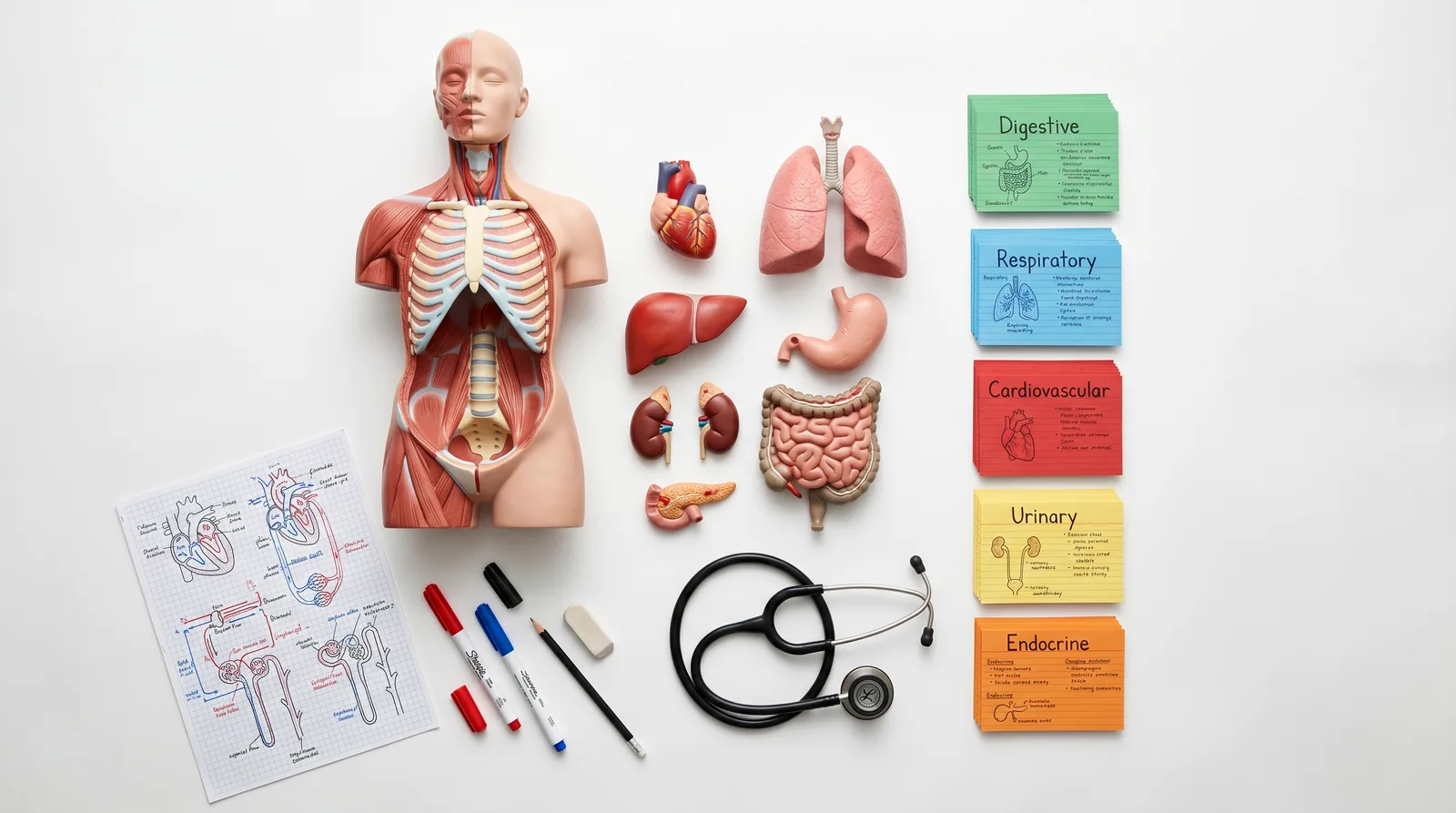
What you'll learn
What you'll be able to do
- Accurately identify and describe the structures and functions of all 11 major body systems, from integumentary to reproductive, at the level required for RN licensure exams.
- Explain the homeostatic mechanisms that maintain physiological balance and predict how disruptions lead to the clinical signs and symptoms nurses assess daily.
- Interpret anatomical diagrams, histology slides, and physiology flow-charts well enough to teach the concepts back — a proven retention strategy for high-stakes exams.
- Connect core A&P principles directly to nursing pharmacology and pathophysiology, so drug mechanisms and disease processes make intuitive sense from day one of clinical rotations.
- Apply accurate anatomical and physiological reasoning to NCLEX-style questions, reducing test anxiety and increasing correct responses on systems-based item sets.
- Build a personal digital reference library of body-system summaries, landmark structures, and physiological pathways that supports ongoing study throughout the entire nursing program.
How it works
A school that adapts to you
This isn't a set of static videos. Every lesson is generated live and tuned to where you actually are.
We learn your level
A quick placement check tailors your starting point so you're never bored or lost.
Lessons adapt as you go
Each lesson is written for your pace and your goal, adjusting as your skills grow.
Your AI coach keeps you moving
Checkpoints, feedback, and gentle nudges turn progress into a real result.
The curriculum
What's inside your school
6 modules · 22 lessons

Foundations of Anatomy & Physiology for Nursing
Establishes the essential prerequisite vocabulary, cellular biology, tissue science, and homeostatic theory that every subsequent body-system module depends on. Without this foundation, students cannot accurately interpret anatomical diagrams, understand drug mechanisms, or reason through NCLEX-style clinical scenarios. All four lessons are deliberately sequenced from macro language → micro structure → tissue organization → regulatory control so that each lesson builds on the last.
- 1.1Anatomical Language, Body Planes & Directional TermsIncluded
- 1.2Cell Structure, Function & the Nursing ConnectionIncluded
- 1.3The Four Tissue Types & Histology InterpretationIncluded
- 1.4Homeostasis, Feedback Loops & Clinical DisruptionIncluded
Protection, Support & Movement — Integumentary, Skeletal & Muscular Systems
Covers the three systems that form the body's outer protection, structural scaffold, and movement apparatus. Sequenced integumentary → skeletal → muscular because each system anatomically wraps or attaches to the next. Clinical nursing applications (wound staging, fracture assessment, mobility evaluation) are woven into every lesson. A prerequisite-gap lesson on bone and muscle tissue microstructure bridges directly from the tissue-types lesson in Module 1.
- 2.1Integumentary System — Skin Layers, Accessory Structures & Wound AssessmentIncluded
- 2.2Skeletal System — Bone Anatomy, Joints & Clinical LandmarksIncluded
- 2.3Muscular System — Fiber Types, Contraction Mechanics & Mobility AssessmentIncluded
Communication & Control — Nervous & Endocrine Systems
Covers the two master regulatory systems of the body. Sequenced nervous → sensory → endocrine → pharmacology bridge because electrical signaling must be understood before chemical signaling, and both must be understood before pharmacological manipulation of neurotransmitters and hormones makes sense. The pharmacology bridge lesson fulfills the target outcome of connecting A&P to nursing pharmacology from day one of clinical rotations and is a deliberate prerequisite for cardiovascular drug discussions in Module 4.
- 3.1Nervous System Organization — CNS, PNS & the NeuronIncluded
- 3.2Sensory Systems — Vision, Hearing, Equilibrium & PainIncluded
- 3.3Endocrine System — Glands, Hormones & Feedback AxesIncluded
- 3.4Pharmacology Bridge — Neurotransmitters, Receptors & Hormone MimicsIncluded
Circulation & Respiration — Cardiovascular, Lymphatic & Respiratory Systems
Covers the body's transport and gas-exchange infrastructure. Sequenced heart anatomy and electrical function → vascular anatomy and hemodynamics → blood and lymph → respiratory anatomy and gas exchange because students must understand the pump before the pipes, the pipes before the fluid within them, and the cardiovascular circuit before the pulmonary circuit that oxygenates it. This module has the highest NCLEX item density of any system cluster and is therefore the most extensively scaffolded, with explicit pharmacology bridges in each lesson.
- 4.1Heart Anatomy, Cardiac Cycle & Electrical ConductionIncluded
- 4.2Vascular Anatomy, Blood Pressure Regulation & HemodynamicsIncluded
- 4.3Blood Composition, Coagulation & the Lymphatic SystemIncluded
- 4.4Respiratory System — Anatomy, Mechanics & Gas ExchangeIncluded
Digestion, Filtration & Fluid Balance — Digestive, Urinary & Fluid-Electrolyte Systems
Covers the body's nutrient processing, waste filtration, and internal fluid regulation systems. Sequenced digestive → urinary → fluid-electrolyte-acid-base because nutrients must be absorbed before wastes are produced, and the kidney's role in fluid and acid-base regulation is best understood after its filtration anatomy is established. The acid-base lesson in this module completes the ABG preview introduced in Module 4 and is a high-yield NCLEX topic requiring its own dedicated lesson.
- 5.1Digestive System — Organs, Enzymes & Nutrient AbsorptionIncluded
- 5.2Urinary System — Kidney Anatomy, Nephron Function & Urine FormationIncluded
- 5.3Fluid, Electrolyte & Acid-Base Balance — The Nurse's Daily ScienceIncluded
Immunity, Reproduction & Integration — Immune, Reproductive & Comprehensive NCLEX Mastery
Covers the body's defense and reproductive systems, then synthesizes the entire course into multi-system clinical reasoning and NCLEX exam mastery. The immune system lesson builds on lymphatic anatomy from Module 4 and cellular biology from Module 1. The reproductive lesson is sequenced after all other systems because it integrates endocrine, circulatory, and renal changes. The systems integration lesson and capstone are positioned last because they require all prior knowledge to be meaningful. Two gap-filling lessons are added: a dedicated musculoskeletal-neurological integration lesson addressing multi-system trauma patients (a high-frequency NCLEX topic missing from the draft) and an explicit teach-back and digital library review session.
- 6.1Immune System — Innate Defenses, Adaptive Immunity & InflammationIncluded
- 6.2Reproductive System — Anatomy, Hormonal Cycles & Perinatal PhysiologyIncluded
- 6.3Systems Integration — Pathophysiology Crossover & Multi-System PatientsIncluded
- 6.4NCLEX-Style Mastery Assessment & Teach-Back CapstoneIncluded
Who it's for
Is this you?

The Struggling ADN Student
You're in a two-year program and A&P is the wall between you and nursing courses — this course breaks it down at exactly the depth and pace your licensure track demands.

The BSN Pre-Clinicals Overachiever
You want to walk into your first clinical rotation already knowing why the cardiovascular and renal systems talk to each other — this course gives you that integrated mental model early.

The Repeat Test-Taker
You've been through A&P once and the grade didn't stick — this course replaces surface-level memorization with the physiological reasoning that actually holds up on exams.

The NCLEX Studier
You've finished your nursing program but systems-based NCLEX questions expose gaps in your A&P foundation — the mastery assessment and teach-back capstone are built precisely for you.

The Career-Changer
You're coming from a non-science background and need to build a rigorous, clinical-grade understanding of the human body from the ground up before nursing school accelerates.
The Pharmacology Connector
Drug mechanisms feel abstract until you own the receptor and hormone science behind them — the Pharmacology Bridge lessons make your pharm coursework click into place.
Questions
Frequently asked
Your teacher
A note from your teacher
AIAdaptativeSchool
If you're reading this, there's a good chance A&P is either looming over you like a storm cloud or already raining on your semester. You picked nursing because you want to care for people — and now you're buried in directional terms, sarcomere diagrams, and feedback loop charts that don't obviously connect to anything you'll do at a bedside. I see this every semester. You're not struggling because you're not smart enough. You're struggling because most A&P instruction was never designed with a nursing student's actual destination in mind.
That's exactly why I built this course. Every unit — from the integumentary system to reproductive physiology — is taught with a single north star: what does a nurse need to understand about this, and why? I don't spend your study time on trivia. I spend it on the structures, mechanisms, and homeostatic logic that your nursing instructors will assume you know, that pathophysiology and pharmacology will build on, and that the NCLEX will test in ways that reward genuine understanding over memorized flashcards.
Here's what I know about how nurses actually learn science: you need the precise terminology (there's no shortcut there — I use it from day one), you need the concept anchored to a real clinical picture, and then you need to retrieve it under pressure. So throughout this course, we interpret diagrams together, we draw out physiological pathways, and we use teach-back — you explaining the concept as if you're the teacher — because that's the moment you find out whether you actually own the knowledge or just recognize it on a page. Those are two very different things going into a high-stakes exam.
The Pharmacology Bridge lessons are some of my favorites to teach, because the moment a student sees how a beta-blocker works because they understand adrenergic receptors, or how insulin mimics a natural feedback axis, something clicks that carries them through the rest of the program. That's the kind of understanding I'm after — not "I can pass this test" but "I understand what's happening inside this patient."
I also know you are busy. You may be working, parenting, managing a life alongside a demanding program. This course is built to respect your time: every lesson is purposeful, every clinical connection is explicit, and the digital reference library you build as you go is yours to keep and use every semester from here on out.
You chose nursing. That means you're already someone who shows up. Let me give you the science foundation that lets you show up prepared — in your courses, on your NCLEX, and on that first clinical shift when it actually counts. I'll see you in the first lesson.
— AIAdaptativeSchool
Start your journey today
Join get instant access — learn at your own pace with an AI coach in your corner.
$5/mo
Recurring billing · cancel anytime
Secure checkout · Instant access
- 6 modules, 22 lessons
- AI-adaptive lessons tuned to your level
- Quizzes & checkpoints to lock in progress
- Your own AI learning coach
- Learn on any device, at your pace
- Full access for as long as you're subscribed