Read Romans the way Paul wrote it
A rigorous verse-by-verse journey through Paul's greatest letter — tracing its unified theological argument from humanity's universal problem to the hope of new creation, and placing every passage inside its first-century historical and rhetorical world.
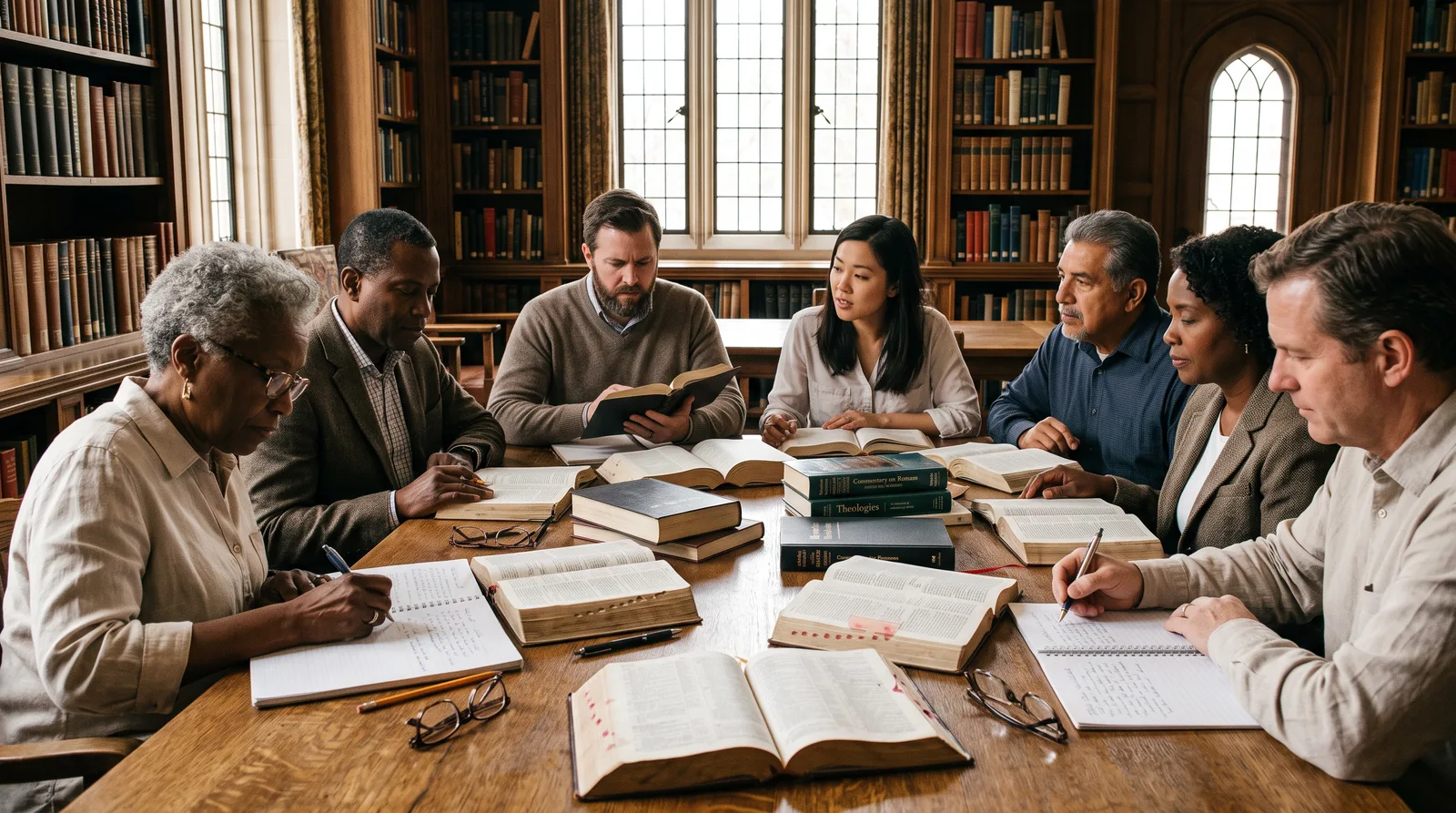
"My goal isn't to tell you what Romans means — it's to give you the tools, the context, and the guided practice to read it carefully enough to find out for yourself."
— Theoria

What you'll learn
What you'll be able to do
- Follow Paul's argument in Romans as a unified theological letter from opening to closing doxology, rather than a collection of isolated proof texts.
- Explain the historical and pastoral context of the Roman church, including the tensions between Jewish and Gentile believers that shaped Paul's writing.
- Interpret major theological themes — justification by faith, grace and law, adoption, sanctification, and the hope of new creation — within their first-century literary setting.
- Navigate the difficult questions of Romans 9–11 concerning Israel, election, and God's covenant faithfulness with greater exegetical confidence.
- Evaluate key interpretive debates and trace the reception of Romans through Augustine, Luther, Wesley, Barth, and other major theological voices.
- Apply responsible methods for reading New Testament letters — attending to rhetoric, Old Testament allusion, and canonical context — to other books of the Bible.
How it works
A school that adapts to you
This isn't a set of static videos. Every lesson is generated live and tuned to where you actually are.
We learn your level
A quick placement check tailors your starting point so you're never bored or lost.
Lessons adapt as you go
Each lesson is written for your pace and your goal, adjusting as your skills grow.
Your AI coach keeps you moving
Checkpoints, feedback, and gentle nudges turn progress into a real result.
The curriculum
What's inside your school
7 modules · 30 lessons

Reading Romans Well: Context, Method, and Structure
Equips learners with the historical background, interpretive tools, and structural map needed to read Romans as a unified theological letter.
- 1.1The World Paul Wrote Into: Rome, Empire, and the Early ChurchIncluded
- 1.2Jewish and Gentile Believers in Rome: The Community Behind the LetterIncluded
- 1.3Paul the Letter-Writer: Rhetoric, Genre, and Interpretive MethodIncluded
- 1.4Mapping the Argument: Structure and Flow of RomansIncluded
- 1.5Paul and the Old Testament: Scripture as ArgumentIncluded
The Universal Problem: Sin, Wrath, and the Need for Salvation (Romans 1–3)
Traces Paul's case that all humanity — Gentile and Jew alike — stands under God's judgment and in need of his righteousness.
- 2.1Gospel and Righteousness: The Thesis of Romans (1:1–17)Included
- 2.2The Gentile World Under Judgment (1:18–32)Included
- 2.3The Jewish World Under Judgment (2:1–3:8)Included
- 2.4All Under Sin: The Universal Verdict (3:9–20)Included
- 2.5The Righteousness of God Revealed: Justification Introduced (3:21–31)Included
Justification by Faith: Abraham, Adam, and the Reign of Grace (Romans 4–5)
Deepens Paul's case for justification through the paradigm of Abraham and the sweeping contrast between Adam and Christ.
- 3.1Abraham: The Model of Justifying Faith (Romans 4)Included
- 3.2Peace, Hope, and Reconciliation: The Fruits of Justification (5:1–11)Included
- 3.3Adam and Christ: Two Humanities, Two Destinies (5:12–21)Included
Freedom, the Spirit, and the New Life (Romans 6–8)
Explores Paul's account of how the gospel delivers believers from sin's dominion, transforms them through the Spirit, and grounds their hope in the new creation.
- 4.1Dead to Sin, Alive to God: Baptism and the New Identity (Romans 6)Included
- 4.2Law, Sin, and the Divided Self (Romans 7)Included
- 4.3Life in the Spirit: Adoption, Assurance, and Intercession (8:1–27)Included
- 4.4The Hope of New Creation: Romans 8:28–39Included
Israel, Election, and the Faithfulness of God (Romans 9–11)
Guides learners through Paul's most theologically dense section, addressing God's covenant faithfulness, Israel's stumbling, and the hope of final restoration.
- 5.1Has God's Word Failed? Election and God's Sovereign Choice (Romans 9)Included
- 5.2Israel's Stumbling and the Righteousness of Faith (Romans 10)Included
- 5.3A Mystery Revealed: The Future of Israel and the Fullness of the Nations (Romans 11)Included
- 5.4Navigating Romans 9–11: Major Interpretive DebatesIncluded
The Gospel and the Christian Community (Romans 12–16)
Shows how Paul grounds the practical, relational, and civic demands of Christian life in the theological argument of the preceding chapters.
- 6.1Living Sacrifices: Worship, Transformation, and Community (12:1–21)Included
- 6.2Governing Authorities, Debt, and the Law of Love (13:1–14)Included
- 6.3The Strong and the Weak: Unity Across Difference (14:1–15:13)Included
- 6.4Letter Closing, Doxology, and Paul's Mission Vision (15:14–16:27)Included
Romans Through the Ages: Reception, Influence, and Ongoing Conversation
Traces how Romans has been read and debated across Christian history and equips learners to engage contemporary interpretive conversations responsibly.
- 7.1Augustine and the Doctrine of GraceIncluded
- 7.2Luther, the Reformation, and Justification by Faith AloneIncluded
- 7.3Wesley, Barth, and Twentieth-Century ReadingsIncluded
- 7.4The New Perspective on Paul and Contemporary DebatesIncluded
- 7.5Romans, Biblical Theology, and the Life of the Church TodayIncluded
Who it's for
Is this you?

Lay theologian
He reads widely and thinks rigorously, and is ready for a course that matches his seriousness without requiring a seminary ID.

Small-group leader
She leads a church Bible study and wants the historical depth and exegetical confidence to guide honest discussions of even Romans' hardest passages.

Seminary student
He's entering formal theological education and wants a rigorous grounding in Romans — its argument, its debates, and its reception history — before stepping into the classroom.

Lifelong learner of faith
She has worshipped for decades but senses she has only ever touched the surface of Paul's letter, and is ready to finally read it whole.

Curious independent scholar
He approaches the Bible as an intellectual challenge and wants a course that takes interpretive debates, historical context, and theological complexity seriously.

Pastor in formation
She is preparing to preach and teach Romans and needs the kind of sustained, structured engagement with the text that sermon prep alone can't provide.
Questions
Frequently asked
Your teacher
A note from your teacher

Theoria
If you've spent time in Christian communities, you've almost certainly heard Romans — quoted from the pulpit, deployed in evangelism, cited in theological debates. And if you're honest, you may have noticed that the same dozen verses tend to do all the work, while the rest of the letter waits in silence. That's not a criticism. Romans is genuinely hard. It is dense, allusive, rhetorically sophisticated, and written into a first-century world that requires real historical imagination to enter. The difficulty is not a failure of your attention. It is an invitation to go deeper.
That's what this school is for. I've spent years teaching Paul's letters to students who came in thinking they already knew Romans — and watching them discover, often with something like shock, that the letter is far more coherent, far more ambitious, and far more demanding than they had realized. Paul is not stringing together theological propositions. He is making a sustained, carefully constructed argument to a specific community with specific tensions, using rhetorical strategies drawn from both Jewish and Greco-Roman traditions, saturating every paragraph with Old Testament scripture. When you begin to read Romans the way Paul wrote it, the whole thing lights up.
What I want for you in this school is not just more information about Romans. I want you to develop a feel for the argument — to be able to sit with chapter 7 and not panic, to move through Romans 9–11 with exegetical patience rather than anxious avoidance, to arrive at the doxology of chapter 16 and understand why Paul ends there. I want you to encounter the great interpreters — Augustine, Luther, Wesley, Barth — not as authorities to defer to, but as serious readers you can now engage, agree with, and push back against, because you've done your own careful work in the text.
This school will ask something of you. The material is presented accessibly, but it is not watered down. You will meet technical vocabulary, and you will be expected to sit with interpretive complexity without rushing to easy resolution. What you will not find here is condescension. You are an intelligent adult who takes the Bible seriously. My job is to give you the tools, the context, and the guided practice to read it well. The transformation I'm promising is not a feeling — it is a set of skills and a depth of understanding that will change how you read not just Romans, but every New Testament letter you open for the rest of your life.
Come ready to read slowly. Bring your Bible, your questions, and your honest doubts. Everything else, we'll work through together.
— Theoria
Start your journey today
Get instant access — learn at your own pace with an AI coach in your corner.
$39/mo
Recurring billing · cancel anytime
Secure checkout · Instant access
- 7 modules, 30 lessons
- AI-adaptive lessons tuned to your level
- Quizzes & checkpoints to lock in progress
- Your own AI learning coach
- Learn on any device, at your pace
- Full access for as long as you're subscribed