Learn to read the geometry hidden in everything
From the Flower of Life to the Golden Ratio, this school teaches you to see, understand, and draw the timeless mathematical patterns woven into nature, art, architecture, and spiritual tradition — with compass, straightedge, and genuine wonder.
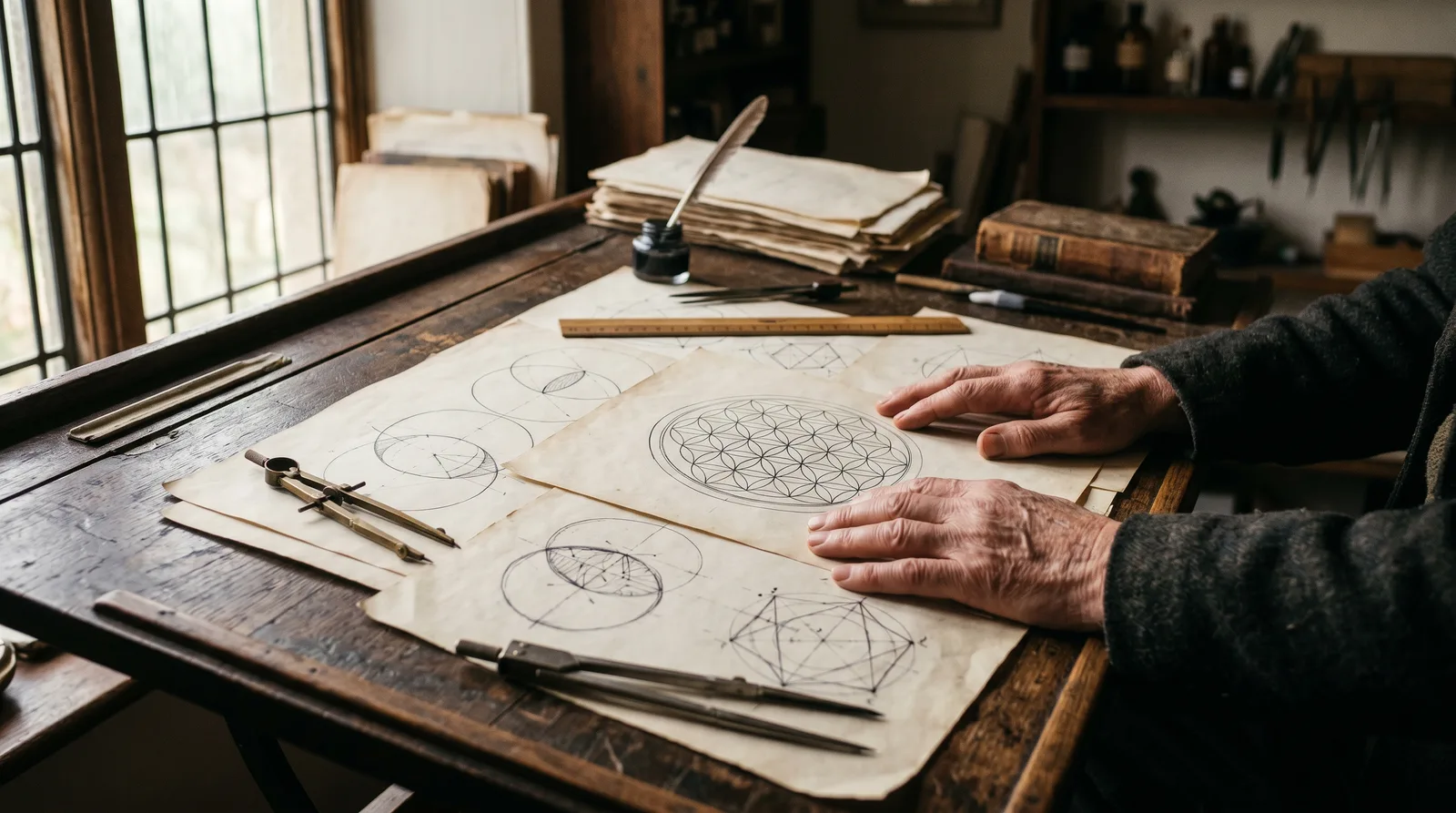
Sacred geometry has been waiting in plain sight for millennia — my job is simply to teach you how to look.— Carla Paton
What you'll learn
What you'll be able to do
- Identify and accurately draw the core sacred geometry forms — Seed of Life, Flower of Life, Metatron's Cube, and the Vesica Piscis — using compass and straightedge
- Explain the mathematical properties of the Golden Ratio and Fibonacci sequence and trace their appearance in nature, classical art, and iconic architecture
- Describe the five Platonic solids, their symbolic roles across philosophical and spiritual traditions, and construct each one from first principles
- Analyze how sacred geometry has been encoded in historical sacred sites and temples — from the Pyramids of Giza and the Parthenon to Gothic cathedrals and Hindu mandalas
- Apply geometric principles such as the Golden Rectangle and dynamic symmetry to your own creative or design work
- Articulate the philosophical and cross-cultural significance of sacred geometry as a bridge between mathematics, beauty, and the human search for meaning
How it works
A school that adapts to you
This isn't a set of static videos. Every lesson is generated live and tuned to where you actually are.
We learn your level
A quick placement check tailors your starting point so you're never bored or lost.
Lessons adapt as you go
Each lesson is written for your pace and your goal, adjusting as your skills grow.
Your AI coach keeps you moving
Checkpoints, feedback, and gentle nudges turn progress into a real result.
The curriculum
What's inside your school
6 modules · 18 lessons

The Language of Sacred Geometry
Establishes the conceptual and practical foundation for the entire course. Students are introduced to what sacred geometry is, why it matters across cultures and disciplines, and how to use the physical tools of compass and straightedge. By the end of this module, students can execute basic constructions with precision and understand the primordial significance of the circle, the point, and the Vesica Piscis — the building block from which all subsequent forms in the course are derived.
- 1.1What Is Sacred Geometry?Included
- 1.2Tools, Terms, and First ConstructionsIncluded
- 1.3The Circle, the Point, and the Vesica PiscisIncluded
The Flower of Life and Its Family
Builds directly on the Vesica Piscis to guide students through the full generative sequence: from a single circle, to the Seed of Life, to the Flower of Life, and finally to Metatron's Cube — the form from which all five Platonic solids can be extracted. Each lesson is both a drawing lesson and a symbolic investigation, ensuring students can accurately construct each form and articulate its cultural and philosophical significance. This module delivers two core target outcomes: accurate construction of the primary sacred geometry forms and understanding of their interconnection.
- 2.1The Seed of LifeIncluded
- 2.2The Flower of LifeIncluded
- 2.3Metatron's CubeIncluded
The Platonic Solids
Provides rigorous treatment of the five Platonic solids — tetrahedron, cube (hexahedron), octahedron, dodecahedron, and icosahedron — from the mathematical proof that only five can exist, through hands-on net construction of each solid, to their roles in Platonic philosophy, Kepler's cosmology, and elemental and alchemical traditions. Arriving after Metatron's Cube, students already have an intuitive sense of the solids from their embedded forms; this module formalises that knowledge and adds the philosophical and historical context required by the target outcomes.
- 3.1Why Only Five? The Mathematics of PerfectionIncluded
- 3.2Constructing the Solids — Nets, Folds, and FormsIncluded
- 3.3The Solids in Philosophy, Alchemy, and Sacred TraditionIncluded
The Golden Ratio and the Fibonacci Sequence
Delivers a mathematically rigorous yet visually rich exploration of Phi (φ ≈ 1.618) and the Fibonacci sequence, covering their algebraic definitions, their remarkable convergence, and their verified and alleged appearances in nature, classical art, and iconic architecture. Students learn to construct the Golden Rectangle, the golden spiral, and the golden section of a line using compass and straightedge, and develop the critical literacy to distinguish documented proportional use from retrospective over-attribution. This module is sequenced after the Platonic solids because Phi appears in the dodecahedron and icosahedron, allowing direct cross-reference.
- 4.1Phi — The Mathematics of the Golden RatioIncluded
- 4.2The Fibonacci Sequence — Nature's Counting SystemIncluded
- 4.3Phi in Art and ArchitectureIncluded
Sacred Geometry in Sacred Sites and Traditions
Applies the geometric vocabulary built across Modules 1–4 to the analysis of real historical sacred sites and living spiritual traditions. Students learn to 'read' buildings and ritual objects geometrically, examining documented evidence of intentional geometric encoding at the Pyramids of Giza, the Parthenon, Gothic cathedrals, Islamic geometric art, and South and East Asian contemplative diagrams. The module develops both analytical rigour (distinguishing evidence from projection) and cultural sensitivity (approaching each tradition on its own terms).
- 5.1The Ancient World — Pyramids, Temples, and Megalithic GeometryIncluded
- 5.2Gothic Cathedrals and Islamic Geometric ArtIncluded
- 5.3Hindu Yantras, Buddhist Mandalas, and the Sri YantraIncluded
Living Geometry — Creative Application and Personal Practice
Synthesises everything learned across the course by moving from analysis to creation and from knowledge to personal integration. Students apply the Golden Rectangle, dynamic symmetry, and sacred geometry compositional principles to their own design work; explore sacred geometry as a contemplative and meditative practice with roots in multiple traditions; and complete a substantial capstone project that demonstrates mastery of both construction skills and reflective understanding. This module ensures the course delivers its applied and philosophical target outcomes.
- 6.1Dynamic Symmetry and Compositional DesignIncluded
- 6.2Sacred Geometry as Contemplative PracticeIncluded
- 6.3Capstone — Your Sacred Geometry ProjectIncluded
Who it's for
Is this you?

Visual artists
You want to move beyond intuition and ground your compositional instincts in the same proportional principles that guided the great painters and illuminators.

Architects & designers
You are drawn to the deep logic of proportion and want a rigorous, historically informed understanding of how geometry has shaped the built environment from the Parthenon to Gothic cathedrals.

Yoga & meditation practitioners
Mandalas, yantras, and the Sri Yantra are already part of your practice — now you want to understand the precise geometry and philosophical lineage behind them.

Lifelong learners
You have always sensed a deeper order in nature and beauty, and you are finally ready to explore it with the intellectual seriousness it deserves.

Philosophy & history enthusiasts
From Plato's Timaeus to Islamic geometric art to Renaissance cosmology, you want to trace how sacred geometry has shaped human thought across cultures and centuries.

Mathematics explorers
The Golden Ratio and Fibonacci sequence have always intrigued you, and you want a course that respects the mathematics while also tracing its astonishing reach into art and nature.
Questions
Frequently asked
Your teacher
A note from your teacher

Carla Paton
If you have found your way here, I suspect you already sense what drew me to this subject: that the world has a hidden structure, and that structure is beautiful. Maybe you noticed it in the spiral of a nautilus shell, in the proportions of a building that moved you without your knowing why, in a mandala or a rose window that felt less like decoration and more like a diagram of something real. That feeling is not imagination. It is recognition.
I came to sacred geometry from two directions at once — from mathematics, where I learned to demand precision and proof, and from art and contemplative practice, where I learned that not everything true can be reduced to a formula. What I found, and what I want to share with you, is that sacred geometry lives exactly at the meeting point of those two ways of knowing. It is rigorous and it is numinous. The Golden Ratio is a precise, provable mathematical relationship — and it is also present in the growth of living organisms, in centuries of great painting, in the architecture of temples built before our written records begin. Both things are true. Both things matter.
This school is structured the way I believe the subject deserves to be taught: from the ground up, by hand, with understanding. We begin with a compass and a blank page — the same starting point used by every geometer from Euclid to the medieval cathedral builders — and we build outward, form by form, idea by idea. You will not just see the Flower of Life; you will draw it yourself, and you will understand why it emerges from the most elementary circular construction possible. You will not just hear that the Platonic solids are philosophically significant; you will construct them, hold their geometry in your hands, and read the traditions that found in them a map of the cosmos. That kind of knowledge stays with you.
I also want to be honest about what this school is not. It is not a course in mysticism that uses geometric imagery as mood. And it is not a mathematics course that treats the spiritual dimensions of this subject as embarrassing folklore. I have tried, throughout every module, to hold the scholarly and the contemplative with equal respect — because that is what the subject demands, and because I believe that is what you deserve.
Whether you are an artist looking for principled tools, a designer who wants to understand proportion at a deeper level, a yoga or meditation practitioner drawn to the geometry of mandalas and yantras, an architect, a philosopher, or simply someone who has always sensed that pattern and meaning are connected — there is a place for you here. The geometry has been waiting. Come and learn to see it.
— Carla Paton
Start your journey today
Join get instant access — learn at your own pace with an AI coach in your corner.
$17.99/mo
Recurring billing · cancel anytime
Secure checkout · Instant access
- 6 modules, 18 lessons
- AI-adaptive lessons tuned to your level
- Quizzes & checkpoints to lock in progress
- Your own AI learning coach
- Learn on any device, at your pace
- Full access for as long as you're subscribed