See what the system keeps missing
A professional training school that gives front-line public servants the clinical literacy to identify narcissistic abuse, parental alienation, and the cognitive errors that turn well-meaning institutions into instruments of re-victimization — before another case goes wrong.

The professionals in these cases don't need more empathy training — they need the precise clinical vocabulary that lets them name what they're already sensing.
— HN Publishing
What you'll learn
What you'll be able to do
- Recognize the behavioral hallmarks of Narcissistic Personality Disorder in high-conflict custody, domestic violence, and child welfare cases — and distinguish them from mutual-conflict narratives
- Explain Attachment-Based Parental Alienation (ABPA) using current research, and identify its presentation in children, targeted parents, and alienating parent behavior patterns
- Detect the Fundamental Attribution Error in your own and your agency's case assessments, and apply structured protocols to correct for it before making consequential decisions
- Identify how confirmation bias and cognitive dissonance operate inside institutional systems — courts, CPS, law enforcement — to perpetuate rather than interrupt coercive abuse cycles
- Apply trauma-informed, NPD-aware interviewing techniques when working with children and adult victims who present as 'non-credible,' hostile, or contradictory
- Build and advocate for updated agency frameworks, referral pathways, and documentation practices that close the systemic gaps exploited by narcissistic abusers
How it works
A school that adapts to you
This isn't a set of static videos. Every lesson is generated live and tuned to where you actually are.
We learn your level
A quick placement check tailors your starting point so you're never bored or lost.
Lessons adapt as you go
Each lesson is written for your pace and your goal, adjusting as your skills grow.
Your AI coach keeps you moving
Checkpoints, feedback, and gentle nudges turn progress into a real result.
The curriculum
What's inside your school
6 modules · 30 lessons

The Narcissistic Abuser in the System
Builds foundational clinical literacy on NPD, coercive control, and how high-conflict abusers deliberately weaponize institutions.
- 1.1NPD 101: Beyond the BuzzwordIncluded
- 1.2Coercive Control vs. Mutual ConflictIncluded
- 1.3How Narcissistic Abusers Navigate SystemsIncluded
- 1.4The DARVO Playbook: Deny, Attack, Reverse Victim and OffenderIncluded
- 1.5What Victims Look Like — and Why It Confuses UsIncluded
Attachment-Based Parental Alienation (ABPA): Science, Signs, and Stakes
Delivers a research-grounded understanding of ABPA — its mechanisms, its presentation across family members, and why it is chronically missed.
- 2.1The Science of Attachment and Why It Matters HereIncluded
- 2.2Defining ABPA: What the Research Actually SaysIncluded
- 2.3Reading the Child: Behavioral Indicators of AlienationIncluded
- 2.4The Targeted Parent: Misread, Dismissed, and Re-VictimizedIncluded
- 2.5The Alienating Parent: Recognizing the Pattern Beneath the PerformanceIncluded
Your Brain on the Case: Cognitive Errors That Perpetuate Abuse
Exposes the three core cognitive distortions — Fundamental Attribution Error, confirmation bias, and cognitive dissonance — that cause well-meaning professionals to become instruments of continued harm.
- 3.1The Fundamental Attribution Error: When We Blame the Person, Not the PressureIncluded
- 3.2Confirmation Bias in Case AssessmentIncluded
- 3.3Cognitive Dissonance and the Institutional Comfort of DenialIncluded
- 3.4How Abusers Exploit These Errors — DeliberatelyIncluded
- 3.5Structured Protocols for Bias InterruptionIncluded
Systems as Accomplices: Institutional Failure in High-Conflict Cases
Examines how courts, CPS, law enforcement, and schools are structurally designed in ways that narcissistic abusers exploit — and how those structures perpetuate abuse cycles.
- 4.1How the Family Court System Is ExploitedIncluded
- 4.2CPS and DCFS: When Investigations Become WeaponsIncluded
- 4.3Law Enforcement at the Door: First-Contact FailuresIncluded
- 4.4Schools and Counselors as Unwitting ParticipantsIncluded
- 4.5The Re-Victimization Loop: How Systems Teach Survivors to Go SilentIncluded
Trauma-Informed, NPD-Aware Field Practice
Translates clinical knowledge into concrete interviewing techniques, assessment approaches, and documentation practices for each professional role.
- 5.1Trauma-Informed Interviewing: Principles Every Role Must KnowIncluded
- 5.2Interviewing Children in Suspected Alienation CasesIncluded
- 5.3Working with 'Non-Credible' Adult VictimsIncluded
- 5.4Documentation That Tells the Real StoryIncluded
- 5.5Red Flag Protocols: When to Pause and EscalateIncluded
Building Systems That See Clearly: Advocacy, Reform, and Referral
Empowers professionals to move beyond individual case competence and drive structural change in their agencies, courts, and communities.
- 6.1Auditing Your Agency: Identifying the Gaps Abusers Walk ThroughIncluded
- 6.2Building Referral Pathways That Actually WorkIncluded
- 6.3Updating Policies and Training From the InsideIncluded
- 6.4Vicarious Trauma and Sustainable PracticeIncluded
- 6.5Becoming a Systems-Change AdvocateIncluded
Who it's for
Is this you?

Law Enforcement Officers
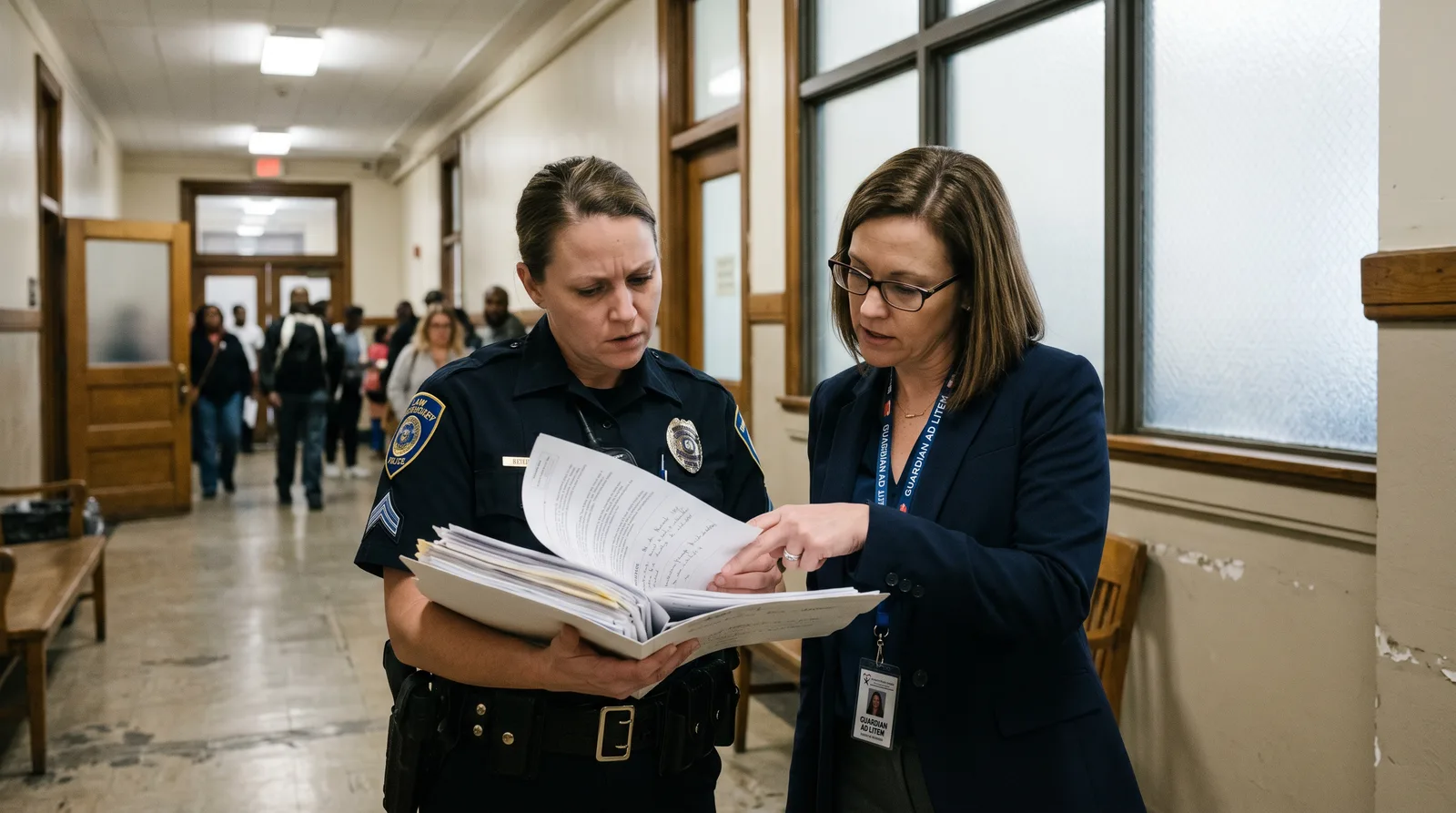
First-contact responders who need NPD-aware tools to read high-conflict domestic calls accurately — before DARVO tactics redirect the narrative at the door.

CPS & DCFS Caseworkers
Child welfare investigators who must distinguish genuine child safety concerns from weaponized allegations — and document the difference in ways that hold up.

Guardians ad Litem
Court-appointed advocates whose recommendations shape children's lives and who need the science of attachment disruption to represent children's actual best interests.

Family Court Attorneys
Legal professionals navigating cases where coercive control is invisible to the bench and where understanding the abuser's system-exploitation tactics is a litigation essential.

School Counselors & Educators
School-based professionals who are often the first to hear a child's disclosure — and who are routinely recruited into alienation dynamics without recognizing the pattern.

Social Workers & Advocates
Community-based practitioners who work with survivors long-term and need institutional reform frameworks to stop the re-victimization loop from closing around their clients.
Questions
Frequently asked
Your teacher
A note from your teacher

HN Publishing
If you've been doing this work for any length of time, you already know the feeling I'm describing. You're looking at a case, and something is wrong — but you can't get traction on it. The paperwork doesn't support it. The victim isn't presenting the way victims are supposed to present. The other party is articulate, cooperative, and has already framed themselves as the one being harmed. Your supervisor is ready to close it out. And somewhere, a child is caught in the middle of something that no one around them has the language to name.
I built this training because that gap — between what professionals sense and what they can document, articulate, and act on — is not a failure of instinct. It's a failure of the frameworks we were handed. Standard agency training was not designed for the specific dynamics of narcissistic coercive control. It was not designed for Attachment-Based Parental Alienation. It was not designed for the sophisticated, system-literate abuser who walks into a courthouse or CPS intake knowing exactly which levers to pull. And because our frameworks weren't built for these cases, our institutions keep getting them wrong — not out of malice, but out of an honest mismatch between the tool and the job.
What I want to give you in this school is precision. Not ideology. Not a predetermined conclusion about who is always right or always wrong. Precision — the kind that comes from understanding NPD and coercive control as operationally defined clinical phenomena, not buzzwords. The kind that comes from understanding what your own brain is doing when it makes a Fundamental Attribution Error, and having a structured protocol to catch it before it shapes a decision that will affect a family for years. The kind that comes from knowing what a traumatized adult looks like when they've been coached by their abuser to seem unstable, and what a child looks like when their attachment has been systematically disrupted — and being able to tell the difference between that and the hundred other things it could be.
I want to be direct with you about something: this training will ask you to look at institutional failure squarely. Not to shame you or your colleagues, but because the systems we work inside — courts, law enforcement, child welfare, schools — have real, documented patterns of getting these cases wrong in predictable ways. Those patterns have names. They have mechanisms. And once you can see the mechanism, you can interrupt it. You can build referral pathways that function. You can update documentation practices. You can be the person in the room who knows what they're looking at.
That's the professional I'm trying to help you become. Not more cynical — clearer. Not more burdened — better equipped. The cases aren't going to get simpler. But your capacity to see through them can. I'm glad you're here.
— HN Publishing
Start your journey today
Get instant access — learn at your own pace with an AI coach in your corner.
$79/mo
Recurring billing · cancel anytime
Secure checkout · Instant access
- 6 modules, 30 lessons
- AI-adaptive lessons tuned to your level
- Quizzes & checkpoints to lock in progress
- Your own AI learning coach
- Learn on any device, at your pace
- Full access for as long as you're subscribed