
Learn to edit your own fiction like a pro
Stop relying on luck and learn to read your own fiction the way a professional editor does. This school gives novelists and short-story writers the exact techniques to elevate their prose from competent to compelling — before anyone else sees it.
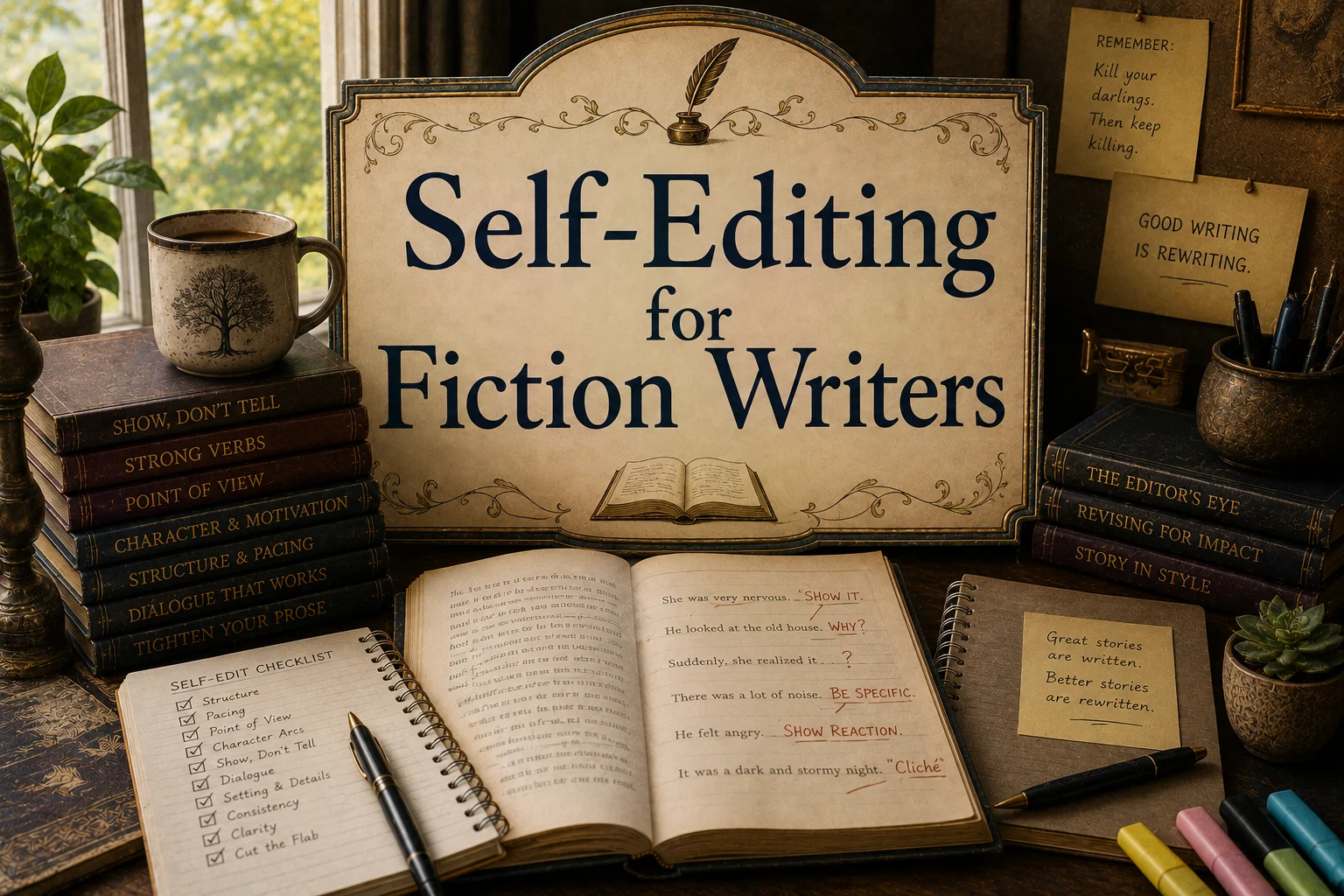
"I'll praise your real progress and name your real problems — because that's the only way your manuscript gets better."
— Carla Paton
What you'll learn
What you'll be able to do
- Diagnose and fix the most common grammatical mistakes fiction writers make — without memorising textbook rules
- Rewrite tangled sentences for clarity and rhythm so readers never stumble or re-read a line
- Craft dialogue tags and beats that disappear into the story and make every conversation crackle
- Identify and convert flat 'telling' passages into vivid, emotionally resonant scenes
- Trim bloated description and filler words so every sentence earns its place on the page
- Produce a clean, industry-standard manuscript ready to query agents or self-publish with confidence
How it works
A school that adapts to you
This isn't a set of static videos. Every lesson is generated live and tuned to where you actually are.
We learn your level
A quick placement check tailors your starting point so you're never bored or lost.
Lessons adapt as you go
Each lesson is written for your pace and your goal, adjusting as your skills grow.
Your AI coach keeps you moving
Checkpoints, feedback, and gentle nudges turn progress into a real result.
The curriculum
What's inside your school
6 modules · 17 lessons

Grammar Without Overwhelm
Writers learn to diagnose and fix the grammatical mistakes most likely to flag a manuscript as amateur — not by memorising rules, but by training their eye to spot patterns that break a reader's immersion. This module is placed first because clean grammar provides the foundation every later editing skill builds on.
- 1.1The Fiction Writer's Grammar Hit ListIncluded
- 1.2Punctuation That Serves the StoryIncluded
- 1.3Tense and POV ConsistencyIncluded
Clearer Sentences
Tangled sentences are the single biggest reason readers re-read a line or put a book down. This module trains writers to diagnose exactly what makes a sentence stumble — then rewrite it so the meaning lands immediately and the rhythm keeps the reader moving. Placed after grammar so writers are already reading at the sentence level.
- 2.1Diagnosing Sentence ProblemsIncluded
- 2.2Rewriting for Clarity and RhythmIncluded
Better Dialogue Tags and Beats
Dialogue is where amateur and professional manuscripts diverge most visibly. This module covers the full toolkit: invisible tags, action beats, white space, and the internal beat — so every conversation feels propulsive and every character sounds distinct. Placed after sentence-level work so writers can apply clarity skills directly to dialogue lines.
- 3.1Tags: Invisible or Intrusive?Included
- 3.2Beats, White Space, and the Untagged LineIncluded
- 3.3Making Every Conversation CrackleIncluded
Show Versus Tell
The most misunderstood instruction in all of writing advice. This module gives writers a precise, usable definition of the difference, teaches them when telling is actually the right choice, and provides a systematic method for converting flat telling into visceral, emotionally resonant scenes — without over-writing. Placed after sentence and dialogue work so writers have the technical tools to execute the rewrites.
- 4.1When Telling Is a Problem (and When It Isn't)Included
- 4.2Converting Tell to ShowIncluded
- 4.3Interiority: Thought and Feeling Done RightIncluded
Description and Word Economy
The user's 'Description' and 'Word Economy' modules are combined here as they were in the draft — they are most effective together because the cure for over-description and the cure for filler words are the same: make every word earn its place. Pacing through prose density is added as a capstone because it synthesises both skills at the scene level.
- 5.1Description That Does Double DutyIncluded
- 5.2Filler Words, Redundancy, and the Flabby DraftIncluded
- 5.3Pacing Through Prose DensityIncluded
Proofreading and Professional Formatting
The final module shifts from craft to craft-in-the-world: producing a manuscript that signals professionalism the moment an agent or publisher opens it. Placed last deliberately — proofreading a structurally unrevised draft wastes effort; formatting a poorly proofread manuscript is putting a frame on an unfinished painting. This is the module that gets a manuscript query-ready.
- 6.1Proofreading Like a ProfessionalIncluded
- 6.2Consistency: Names, Terms, and the Style SheetIncluded
- 6.3Industry-Standard Manuscript FormattingIncluded
Who it's for
Is this you?

NaNoWriMo survivors
You crossed the 50k finish line and now face a messy first draft you're not sure how to untangle — this school gives you the systematic process to turn that raw output into something you're proud of.

Querying novelists
You're preparing to send your manuscript to agents and want it to look and read as professionally as possible before it lands in anyone's inbox.

Short story writers
Every sentence in a short story carries weight, and you want the craft to make sure none of yours are wasted — from dialogue beats to word economy.

Self-publishing authors
You're releasing your work directly to readers and need your manuscript to meet the same standard of clarity, consistency, and formatting as anything on a bookstore shelf.

Writing-group regulars
You give and receive feedback every month, but want a sharper editorial eye so you can diagnose problems in your own work before you bring it to the group.

Returning writers
You've come back to fiction after a long break and want to build the self-editing skills you never formally learned, so this draft goes further than the last one did.
Questions
Frequently asked
Your teacher
A note from your teacher

Carla Paton
You've finished a draft. Or you're deep enough into one that you can see the finish line. Either way, you've done something most people who say "I want to write a novel" never actually do — you've put words on the page.
And now you're staring at those words, and something feels off. Maybe the dialogue reads stiff. Maybe there are sentences you've rewritten four times and they're still not right. Maybe you know, somewhere in your gut, that a stretch of your manuscript is telling the reader what to feel instead of making them feel it — but you're not sure how to fix it, or even precisely where the problem is. That gap between "I know something isn't working" and "I know exactly how to make it work" is the most frustrating place in a writer's life. I built this school to get you across it.
What you'll find here isn't a set of abstract rules handed down from on high. Every module works directly with the kind of problems that appear in real fiction manuscripts — the tense slip that crept in around chapter seven, the dialogue tag that stomps on a perfect line, the paragraph of description that's doing nothing but filling space. I'll show you how to see these things on your own page, name them precisely, and fix them with techniques that actually hold up across a whole manuscript. We'll cover grammar — not the full textbook, but the specific handful of issues that flag a manuscript as unpolished. We'll work through sentence clarity and rhythm, dialogue mechanics, show versus tell (including the honest conversation about when telling is fine), word economy, pacing, proofreading, and professional formatting.
I want to be direct with you about one thing: this school is not going to tell you that everything you've written is wonderful and just needs a light polish. Real editing means being honest about what isn't working — and it means having the vocabulary and technique to fix it yourself, without waiting for permission or a professional's red pen. That's the skill I'm here to give you.
By the time you've worked through these modules, you'll read your own manuscript differently. You'll catch the things you used to skip over. You'll know why a sentence isn't landing and what to do about it. You'll send your work out — to agents, to publishers, to readers — with the confidence that you've genuinely done the work, not just hoped for the best. That's the transformation this studio is built for. Come and do the work.
— Carla Paton
Start your journey today
Get instant access — learn at your own pace with an AI coach in your corner.
$19/mo
Recurring billing · cancel anytime
Secure checkout · Instant access
- 6 modules, 17 lessons
- AI-adaptive lessons tuned to your level
- Quizzes & checkpoints to lock in progress
- Your own AI learning coach
- Learn on any device, at your pace
- Full access for as long as you're subscribed