Read Siddhartha. Know yourself.
A close, structured reading of Hesse's masterpiece that turns its spiritual insights into honest, practical tools for self-awareness — no prior meditation, no retreat required.
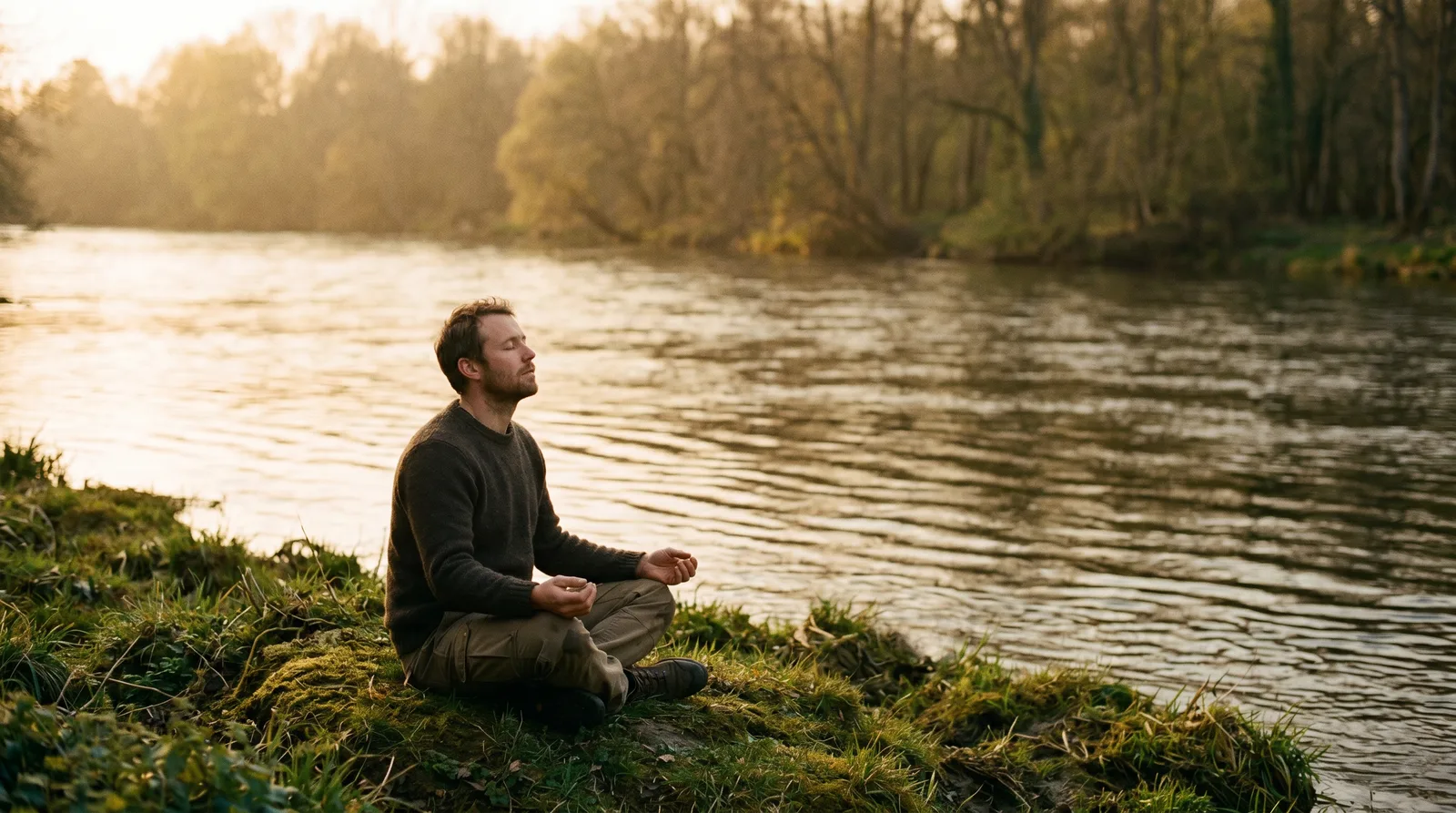
"I don't teach Siddhartha — I use it as a precise instrument, and we turn it toward your life together."— Joseph Riggio

What you'll learn
What you'll be able to do
- Identify the three archetypal distractions Hesse dramatizes — sensory craving, social approval, and material accumulation — and recognize them in your own daily patterns.
- Apply Siddhartha's practice of deep listening (to the river, to silence, to the self) as a structured self-inquiry technique you can use without any prior meditation experience.
- Distinguish between inherited beliefs and self-discovered truth by working through the novel's 'leaving the Brahmin house' arc as a personal audit of your own assumptions.
- Map your own life chapters onto Hesse's three-stage arc (seeking → losing → returning) to locate where you are and what the next honest step looks like.
- Recognize the 'Kamala and Kamaswami trap' — the seduction of pleasure and status — and name the specific trade-offs you are currently making against your own self-knowledge.
- Develop a personal self-awareness practice — drawn from the novel's core disciplines of observing, waiting, and fasting — that you can sustain in ordinary, non-retreat life.
How it works
A school that adapts to you
This isn't a set of static videos. Every lesson is generated live and tuned to where you actually are.
We learn your level
A quick placement check tailors your starting point so you're never bored or lost.
Lessons adapt as you go
Each lesson is written for your pace and your goal, adjusting as your skills grow.
Your AI coach keeps you moving
Checkpoints, feedback, and gentle nudges turn progress into a real result.
The curriculum
What's inside your school
6 modules · 23 lessons

The Examined Self — Why Siddhartha Still Speaks
Establishes the novel's central premise and prepares students to read Hesse as a mirror for their own self-awareness journey.
- 1.1Hesse's Question and YoursIncluded
- 1.2Reading Fiction as Self-InquiryIncluded
- 1.3Mapping Your Life Chapters Before We BeginIncluded
Leaving the Brahmin House — Auditing Inherited Beliefs
Uses Siddhartha's departure from his father's world to help you distinguish between beliefs you chose and beliefs that were handed to you.
- 2.1The Comfort of Borrowed TruthIncluded
- 2.2The Personal Belief AuditIncluded
- 2.3The Cost of Staying and the Fear of LeavingIncluded
- 2.4What You Are Seeking vs. What You Were Told to SeekIncluded
The Three Archetypal Distractions — Desire, Approval, and Accumulation
Identifies the three seductive forces Hesse dramatizes and trains you to spot each one operating in your own daily patterns.
- 3.1Sensory Craving — The Pleasure That Drowns the SignalIncluded
- 3.2Social Approval — The Mirror We Mistake for a WindowIncluded
- 3.3Material Accumulation — How Comfort Becomes a CageIncluded
- 3.4Your Distraction ProfileIncluded
The Kamala and Kamaswami Trap — Pleasure, Status, and the Trade-Off You're Making
Deep-dives into Hesse's most psychologically rich arc to help you name the specific bargains you are currently striking against your own self-knowledge.
- 4.1Kamala — When Desire Teaches and Then ImprisonsIncluded
- 4.2Kamaswami — Ambition as an Identity SubstituteIncluded
- 4.3Naming Your Current Trade-OffIncluded
- 4.4The Moment Siddhartha Almost Doesn't LeaveIncluded
The River — Deep Listening as a Self-Awareness Practice
Extracts Hesse's most concrete spiritual discipline — listening without agenda — and translates it into a structured, repeatable self-inquiry technique.
- 5.1What the River Does That We Don'tIncluded
- 5.2The Practice of Observing, Waiting, and FastingIncluded
- 5.3Structured Self-Inquiry — The Listening SessionIncluded
- 5.4Listening to What You Keep AvoidingIncluded
Seeking → Losing → Returning — Mapping Your Arc and Your Next Step
Synthesizes the entire novel's three-stage arc into a personal life-map and helps you locate yourself honestly within it.
- 6.1The Three Stages as a Universal PatternIncluded
- 6.2Where Are You Right Now?Included
- 6.3What Returning Actually Looks Like in Ordinary LifeIncluded
- 6.4Designing Your Ongoing Self-Awareness PracticeIncluded
Who it's for
Is this you?

The Restless Professional
You have built a successful life by most measures, but Kamaswami's trap — ambition as identity — is starting to feel uncomfortably familiar.

The Literary Self-Explorer
You have always learned more about yourself through great fiction than through self-help, and you want a framework that honours that instinct.

The Lapsed Seeker
You explored spiritual traditions in your twenties and have since lost the thread — this is a way back in that doesn't require you to adopt anyone else's vocabulary.

The Inherited-Life Auditor
You are quietly questioning whether your beliefs, your career path, or your definition of success were ever truly yours to begin with.

The Reflective Mid-Lifer
You are somewhere in the 'losing' stage of Hesse's arc and want language, structure, and honesty — not cheerful reassurance — to help you find your footing.

The Philosophy-Minded Reader
You take ideas seriously and want a school that treats Eastern philosophy with intellectual precision rather than softening it into wellness platitudes.
Questions
Frequently asked
Your teacher
A note from your teacher
Joseph Riggio
There is a particular kind of restlessness that brings a person to a book like Siddhartha. It is not quite dissatisfaction, though it can feel like that. It is more like a suspicion — quiet but persistent — that you have been living more from the outside in than the inside out. That something important is being drowned out, and you are not entirely sure what it is or what has been drowning it.
If that is where you are, I want you to know: Hesse wrote this novel for exactly that feeling. And I built this school because I believe the novel, read carefully and honestly, does something that most self-awareness frameworks cannot. It does not hand you a system. It hands you a mirror — one precise enough that you can actually see yourself in it.
What we do here is close reading in service of self-knowledge. We move through the novel deliberately, passage by passage, arc by arc, and at every stage we ask the same essential question: where is this in my own life? The Brahmin house is not just Siddhartha's childhood home. It is every belief you hold that you did not choose. Kamala is not just a courtesan in ancient India. She is every beautiful distraction that has ever taught you something and then slowly cost you more than you intended to pay. The river is not metaphor. It is a practice — one you can learn.
I want to be honest with you about what this school will ask of you. It will ask you to read slowly. It will ask you to sit with questions longer than is comfortable. It will ask you to name things — specific trade-offs, specific inherited assumptions, specific distractions — that are easier to leave unnamed. That is the work. Hesse called it listening to the self. I think it is the most important work there is.
What you will leave with is not a philosophy. It is a practice: a personal, sustainable way of observing your own inner life that does not require a retreat, a guru, or a dramatic rupture. Just attention. And the willingness to look honestly at what the attention finds.
I am glad you are here. Let's read carefully.
— Joseph Riggio
Start your journey today
Join get instant access — learn at your own pace with an AI coach in your corner.
$39/mo
Recurring billing · cancel anytime
Secure checkout · Instant access
- 6 modules, 23 lessons
- AI-adaptive lessons tuned to your level
- Quizzes & checkpoints to lock in progress
- Your own AI learning coach
- Learn on any device, at your pace
- Full access for as long as you're subscribed