
Train for the post. Be ready for the call.
Professional training for security officers anywhere in the world — from your first post to armed, supervisor, executive protection, and special response roles. Built on U.S. and international best practice by a security company owner with 30+ years in the field.
"I don't train officers to look the part — I train them to handle what actually happens when the radio goes quiet and it's just them and the situation."
— Robert Long
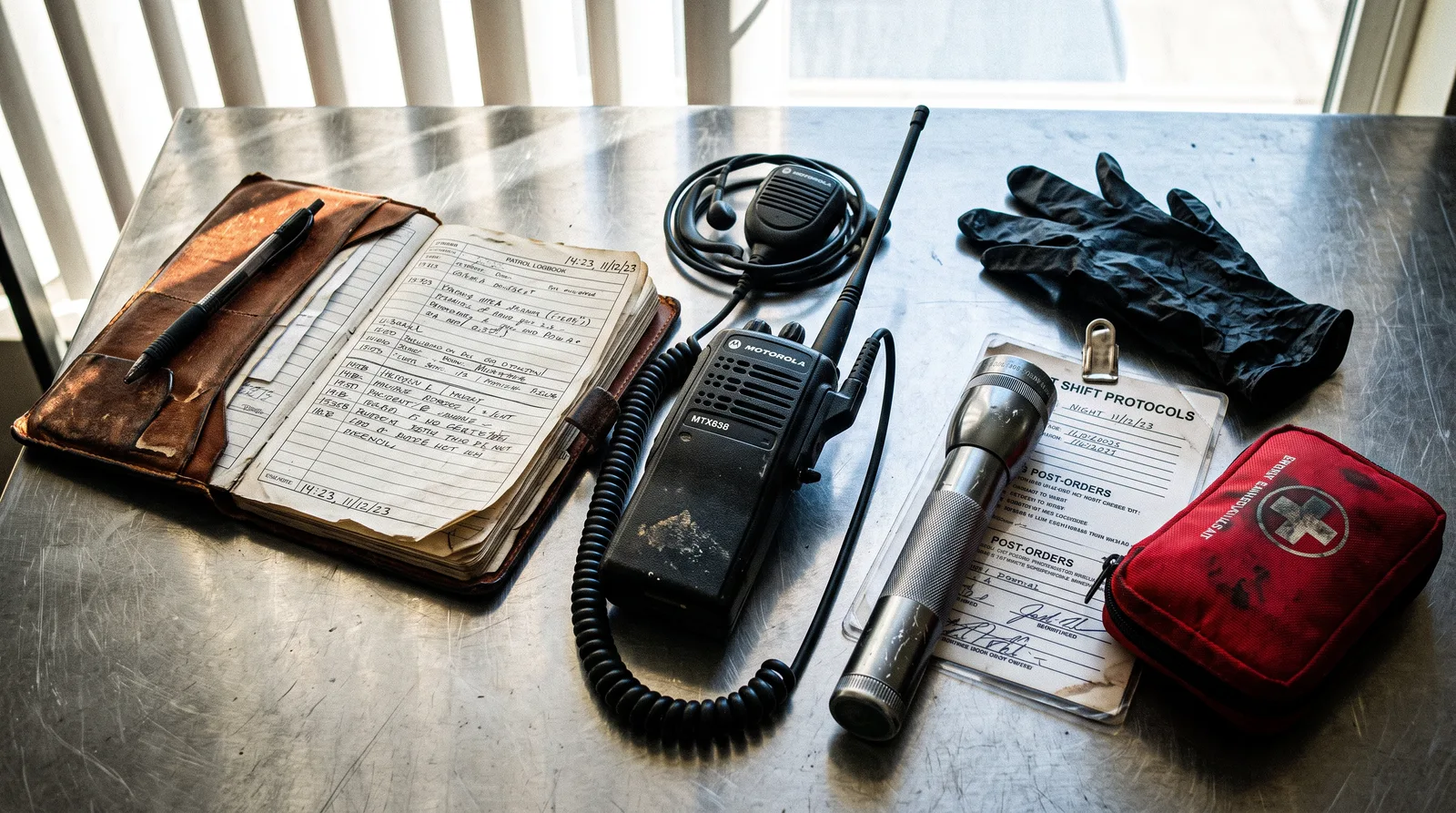
What you'll learn
What you'll be able to do
- Understand and apply applicable use-of-force laws and security officer legal authorities in your jurisdiction
- Conduct professional post-orders compliance, access control, and patrol procedures with confidence
- De-escalate verbal confrontations and manage crowd situations using proven communication tactics
- Write clear, defensible incident reports that meet industry and legal documentation standards
- Recognize and respond to emergency scenarios — medical, fire, active threat — using established protocols
- Project a command presence and professional bearing that earns credibility with clients, coworkers, and the public
How it works
A school that adapts to you
This isn't a set of static videos. Every lesson is generated live and tuned to where you actually are.
We learn your level
A quick placement check tailors your starting point so you're never bored or lost.
Lessons adapt as you go
Each lesson is written for your pace and your goal, adjusting as your skills grow.
Your AI coach keeps you moving
Checkpoints, feedback, and gentle nudges turn progress into a real result.
The curriculum
What's inside your school
49 modules · 300 lessons

Montana Licensing Track — 16-Hour Guard Training (ARM 24.182.807)
Working in Montana? Start here. This track covers every topic in Montana's mandatory 16-hour private security guard training under ARM 24.182.807 — legal authority, use of force, emergency procedures, and documentation — before you step onto any post. Outside Montana? Skip ahead to Module 2.
- 1.1Role and Responsibilities of a Private Security Guard in MontanaIncluded
- 1.2Federal, Montana, and Local Laws Governing Security OfficersIncluded
- 1.3Working with Law Enforcement and Handing Off IncidentsIncluded
- 1.4Limits on Use of Force and Self-Defense: The Force ContinuumIncluded
- 1.5Emergency Procedures and Hazardous Materials PreparednessIncluded
- 1.6Communication, Radio Use, Report Writing, DARs, and IRsIncluded
- 1.7Crisis Intervention, De-escalation, and Crowd ControlIncluded
- 1.8Patrol Techniques and ObservationIncluded
- 1.9Ethics, Privacy, Confidentiality, Searches, and Limits on Arrest and DetentionIncluded
- 1.10Working with Juveniles, People with Disabilities, and Diverse PopulationsIncluded
- 1.11Crime Scene Preservation and Evidence HandlingIncluded
The Professional Security Officer
Start here if you work outside Montana. Establishes the mindset, ethics, and professional standards that define a credible, high-performing security officer — anywhere in the world.
- 2.1Role, Responsibilities, and Industry OverviewIncluded
- 2.2Ethics, Conduct, and Professional StandardsIncluded
- 2.3Command Presence and Professional BearingIncluded
- 2.4Licensing, Certifications, and Career PathwaysIncluded
- 2.5Building Your Security Career: Resumes and InterviewsIncluded
- 2.6Professional Certifications and Career Paths: IFPO, ASIS, Law Enforcement, and ManagementIncluded
- 2.7Client Confidentiality, NDAs, and Off-Duty ConductIncluded
- 2.8Annual Refresher: Use of Force, Harassment, Emergency Response, and Reporting ReviewIncluded
- 2.9Certification Prep: IFPO Certified Protection Officer (CPO)Included
Legal Authority and Use of Force
Builds a clear understanding of the legal powers, limitations, and use-of-force continuum that govern every officer's actions.
- 3.1Legal Authority of a Security OfficerIncluded
- 3.2Use-of-Force Laws and the Force ContinuumIncluded
- 3.3Liability, Negligence, and Personal ExposureIncluded
- 3.4Armed Security: Additional Legal ConsiderationsIncluded
- 3.5Jurisdiction-Specific Regulations and ComplianceIncluded
- 3.6Montana's Tribal Nations and Tribal SovereigntyIncluded
- 3.7Criminal Jurisdiction on Reservations: Tribal, Federal, and StateIncluded
- 3.8Working Respectfully with Tribal Police and CommunitiesIncluded
Post Operations and Patrol Procedures
Develops the core daily skills of access control, post-orders execution, and systematic patrol techniques.
- 4.1Reading and Following Post OrdersIncluded
- 4.2Access Control FundamentalsIncluded
- 4.3Patrol Techniques and Observation SkillsIncluded
- 4.4Security Technology on the JobIncluded
- 4.5Shift Briefing, Handover, and Post AccountabilityIncluded
- 4.6Building Systems: Fire Alarm Panels, Sprinklers, and ElevatorsIncluded
- 4.7Utility Failures: Power Outages, Water Leaks, and Gas LeaksIncluded
- 4.8Bike and Foot Patrol OperationsIncluded
- 4.9Wildlife Encounters and Bear Spray on Remote PatrolsIncluded
- 4.10Guard Tour Systems and Checkpoint PatrolsIncluded
- 4.11Your First Week at a New Post: Site Orientation ChecklistIncluded
Communication, De-escalation, and Crowd Management
Equips officers with the verbal tactics and interpersonal skills to defuse tension, manage crowds, and communicate with authority.
- 5.1Professional Communication on PostIncluded
- 5.2De-escalation Principles and TacticsIncluded
- 5.3Active Listening and Emotional IntelligenceIncluded
- 5.4Crowd Management and Crowd Control BasicsIncluded
- 5.5Dealing with Difficult, Impaired, or Mentally Distressed IndividualsIncluded
- 5.6Using Distance and Personal Zones to De-escalateIncluded
- 5.7Being Filmed on Duty: First Amendment Auditors and Recording LawsIncluded
- 5.8Talking to the Media and Social Media RisksIncluded
- 5.9Mental Health First Aid for Security OfficersIncluded
Incident Reporting and Documentation
Teaches officers to produce clear, accurate, and legally defensible written documentation for every incident and routine event.
- 6.1Why Documentation Matters: Legal and Operational StakesIncluded
- 6.2Elements of a Strong Incident ReportIncluded
- 6.3Writing Clearly and ObjectivelyIncluded
- 6.4Daily Activity Logs and Routine DocumentationIncluded
- 6.5Common Reporting Errors and How to Avoid ThemIncluded
- 6.6Report Writing Practice: Sample Incident Reports, DARs, and TemplatesIncluded
- 6.7Specialized Reports: Use of Force, Injury, Property Damage, Vehicle Accidents, and Trespass NoticesIncluded
- 6.8Electronic Reporting Apps, Photos, Video Evidence, and Field NotesIncluded
- 6.9Report Writing for Court: Preparing Your Report for the CourtroomIncluded
- 6.10Giving Courtroom Testimony as a Security OfficerIncluded
Emergency Response Preparedness
Prepares officers to recognize and respond decisively to medical emergencies, fire, and active-threat scenarios using established protocols.
- 7.1Emergency Response Roles and the Notification ChainIncluded
- 7.2Medical Emergency Response: CPR, AED, and First Aid BasicsIncluded
- 7.3Fire Prevention, Evacuation, and Fire Safety ProtocolsIncluded
- 7.4Active Threat and Violent Incident ResponseIncluded
- 7.5Post-Incident Procedures and Psychological ReadinessIncluded
- 7.6Fire Watch Requirements: Fire Codes, NFPA 241, and NFPA 51BIncluded
- 7.7Fire Watch Patrols, Logs, and System Impairment ProceduresIncluded
- 7.8Hot Work Fire Watch DutiesIncluded
Supplemental Officer Training
Supplemental officer courses covering access control, life safety, legal responsibilities, defensive tactics, use of force, de-escalation, and officer safety.
- 8.1Access Control and Physical FundamentalsIncluded
- 8.2Assets Protection and Life SafetyIncluded
- 8.3Customer Service Excellence for Security OfficersIncluded
- 8.4Emergency SituationsIncluded
- 8.5Ethics, Deportment, and Professional ConductIncluded
- 8.6Fire Protection and Life SafetyIncluded
- 8.7Legal Responsibilities and Courtroom PreparednessIncluded
- 8.8Report Writing Best Practices for Security ProfessionalsIncluded
- 8.9Security Officer Patrols and Fixed PostsIncluded
- 8.10Traffic Control and Parking Lot Safety for Security OfficersIncluded
- 8.11Edged Weapon DefensesIncluded
- 8.12Evaluate and Use Non-Verbal Messages, Part IIncluded
- 8.13Evaluate and Use Non-Verbal Messages, Part IIIncluded
- 8.14General HIPAA AwarenessIncluded
- 8.15Handcuffing TechniquesIncluded
- 8.16Identifying and Understanding a Mental Health CrisisIncluded
- 8.17Legally Defensible Training Tactics, Part IIncluded
- 8.18Legally Defensible Training Tactics, Part IIIncluded
- 8.19Fire Extinguisher FundamentalsIncluded
- 8.20Non-Aggressive DefenseIncluded
- 8.21OC SpraysIncluded
- 8.22Principles for the Use of ForceIncluded
- 8.23Security Officer SafetyIncluded
- 8.24Sexual HarassmentIncluded
- 8.25Verbal Judo: Tactical Communication and Voluntary ComplianceIncluded
The First 15: Simulated Shift
A realistic, scenario-based 15-hour shift that puts everything you've learned to work, decision by decision.
- 9.1Pre-Shift Briefing and Post HandoverIncluded
- 9.2Hours 1–5: Patrol and Access Control ScenariosIncluded
- 9.3Hours 6–10: Incident Response and Report WritingIncluded
- 9.4Hours 11–15: Emergency Escalation and End-of-Shift DebriefIncluded
Practical Skills and Qualification Records
Track your hands-on skills, instructor sign-offs, and training records so you are ready for licensing and client audits.
- 10.1Hands-On Skills Sign-Off, Training Records, and Your Montana License ApplicationIncluded
Investigations, Interviewing, and Compliance
Develops the investigative and compliance skills every advanced officer needs — from structured interviewing techniques and cognitive methods to scene hazard recognition, bias awareness, and regulatory frameworks like PREA and the Clery Act.
- 11.1Conducting Effective Use of Force InvestigationsIncluded
- 11.2Cognitive InterviewingIncluded
- 11.3Recognizing and Responding to Scene HazardsIncluded
- 11.4Implicit Bias and Professional Decision-MakingIncluded
- 11.5Identity Fraud Response and Victim AssistanceIncluded
- 11.6PREA Compliance and Staff ResponsibilitiesIncluded
- 11.7Understanding the Clery ActIncluded
- 11.8The Reid Technique: Behavioral Analysis and Structured InterrogationIncluded
Officer Safety and Medical Response
Equips officers to respond safely and effectively to the medical and safety emergencies most likely to arise on post, including bloodborne pathogen exposure, hemorrhage control, overdose recognition, and fentanyl safety.
- 12.1Bloodborne Pathogens Safety for First RespondersIncluded
- 12.2Hemorrhage Control and TECC PrinciplesIncluded
- 12.3Recognizing and Managing Overdose CallsIncluded
- 12.4Recognizing Common Drugs and ParaphernaliaIncluded
- 12.5Fentanyl Exposure Safety: Myths and FactsIncluded
Victim and Public Interaction
Builds the communication skills and legal awareness needed when officers interact with victims, vulnerable populations, and the public — from domestic violence response and human trafficking indicators to ADA compliance and suicide intervention.
- 13.1Supporting Victims of Domestic Violence and Sexual AssaultIncluded
- 13.2Professional and Ethical Standards in Victim InteractionsIncluded
- 13.3Responding to Individuals with Alzheimer's Disease and DementiaIncluded
- 13.4Serving Callers with Access and Functional NeedsIncluded
- 13.5Customer Service on Municipal and Government PostsIncluded
- 13.6Human Trafficking Indicators and ReportingIncluded
- 13.7Unhoused Individuals and Trespass LawIncluded
- 13.8Missing Child (Code Adam) and Missing Vulnerable AdultsIncluded
- 13.9Suicide Intervention on Post and the 988 LifelineIncluded
- 13.10ADA, Service Animals, and Serving People with DisabilitiesIncluded
- 13.11Autism, Intellectual Disabilities, and Non-Speaking Communication on PostIncluded
- 13.12Sensory Overload Environments and De-escalation for Neurodivergent IndividualsIncluded
Driving (Mobile Patrol)
Covers the safety principles, defensive strategies, and emergency procedures that govern vehicle operations during mobile patrol assignments.
- 14.1Safe Driving StrategiesIncluded
- 14.2Defensive Driving StrategiesIncluded
- 14.3Distracted DrivingIncluded
- 14.4Driver Safety OrientationIncluded
- 14.5Accidents and EmergenciesIncluded
- 14.6Adjusting to Changing Driving ConditionsIncluded
Defensive Weapons Training
Trains officers in the legal deployment, liability framework, and proper technique for each authorized intermediate weapon, from baton and OC spray to conducted energy weapons and retention under threat.
- 15.1Baton: Legal Use, Techniques, and LiabilityIncluded
- 15.2OC Spray: Deployment, Decontamination, and DocumentationIncluded
- 15.3Taser / CEW: Operation, Legal Standards, and Officer SafetyIncluded
- 15.4Weapon Retention for Duty Gear: Baton, OC Spray, and Taser/CEWIncluded
Terrorism Awareness and Suspicious Activity
Develops the awareness, reporting skills, and protective mindset officers need to identify pre-attack indicators, report suspicious activity through proper channels, and harden soft targets against terrorist threats.
- 16.1Terrorism Awareness and Pre-Attack IndicatorsIncluded
- 16.2Suspicious Activity Reporting (SAR) and Fusion Center ProtocolsIncluded
- 16.3Soft Target Awareness and Protection PrinciplesIncluded
Bomb Threat and Suspicious Package Response
Prepares officers to handle bomb threats and suspicious packages with sound procedure — covering evacuation decision-making, recognition criteria, and foundational IED awareness.
- 17.1Bomb Threat Procedures and Evacuation DecisionsIncluded
- 17.2Suspicious Package Recognition and ResponseIncluded
- 17.3IED Awareness Basics for Security OfficersIncluded
Security Investigations and Evidence Handling
Builds the full investigative workflow from initial scene response through evidence handling, witness interviews, CCTV review, and professional handoff to law enforcement.
- 18.1Initial Incident InvestigationIncluded
- 18.2Witness and Victim InterviewsIncluded
- 18.3Scene Preservation and Evidence HandlingIncluded
- 18.4CCTV and Access Log ReviewIncluded
- 18.5Report Writing for InvestigationsIncluded
- 18.6Coordinating with Law Enforcement and Handing Off an InvestigationIncluded
- 18.7AI Tools, Open-Source Research, and Skip Tracing: What Security Officers Can and Cannot DoIncluded
- 18.8The Wicklander-Zulawski (WZ) Method: Non-Confrontational Interview TechniqueIncluded
Radio Communication and Dispatch Procedures
Develops clear, professional radio communication — from phonetic alphabet and 10-codes to dispatch calls and high-pressure multi-incident management.
- 19.1Radio Communication Fundamentals, 10-Codes, and Phonetic AlphabetIncluded
- 19.2Dispatch Communication and Emergency Radio CallsIncluded
- 19.3SOC Multi-Site Dispatch Practicum: Managing Multiple Posts Under PressureIncluded
Workplace Violence Prevention
Trains officers and supervisors to recognize early threat indicators, assess risk, and coordinate the reporting and interdepartmental response needed to prevent workplace violence before it escalates.
- 20.1Recognizing Warning Signs and Threat Indicators Before EscalationIncluded
- 20.2Threat Assessment, Reporting Procedures, and Coordinating with HR and ManagementIncluded
Uniform, Grooming, and Duty Readiness
Sets the standard for professional appearance and duty readiness, covering uniform requirements, grooming standards, PPE selection, and Montana-specific identification and vehicle marking rules.
- 21.1Uniform Standards, Identification, and Assignment-Appropriate DressIncluded
- 21.2Grooming Standards and Personal PresentationIncluded
- 21.3Weather Gear, PPE, and Equipment ServiceabilityIncluded
- 21.4Pre-Shift Appearance and Readiness CheckIncluded
- 21.5Montana Uniform Standards, Photo ID Requirements, and Vehicle MarkingsIncluded
Attendance, Clocking In, and Payroll Records
Covers the professional obligations around time and attendance: reporting ready for duty, timekeeping systems, missed punches, call-off procedures, and maintaining your own payroll records.
- 22.1Reporting On Time and Ready for DutyIncluded
- 22.2Timekeeping Systems, Missed Punches, and App OutagesIncluded
- 22.3Call-Off Procedures, Lateness Reporting, and Chain of Command NotificationIncluded
- 22.4Documenting Exceptions and Maintaining Your Own RecordsIncluded
Equipment Checks and Duty Gear
Establishes the standards for duty gear accountability: standard inventory and inspection, key and badge control, maintenance and replacement procedures, and correct duty belt setup for every tool.
- 23.1Standard Duty Gear Inventory and InspectionIncluded
- 23.2Key and Badge AccountabilityIncluded
- 23.3Duty Gear Maintenance and Replacement ProceduresIncluded
- 23.4Duty Belt Setup: Where to Place Each Tool and WhyIncluded
Fire Extinguishers, First Aid, and CPR
Covers the life-safety equipment every officer should know: fire extinguisher classes and PASS technique, first aid fundamentals, adult and pediatric CPR and AED use, choking response, bleeding control, and EMS handoff.
- 24.1Fire Classes (A, B, C, D, K) and Choosing the Right ExtinguisherIncluded
- 24.2Using a Fire Extinguisher: PASS Technique and When to EvacuateIncluded
- 24.3First Aid Fundamentals for Security OfficersIncluded
- 24.4Adult CPR and AED Use (Current Guidelines)Included
- 24.5Child and Infant CPR and Choking ResponseIncluded
- 24.6Bleeding Control, Shock, and Handing Off to EMSIncluded
Defensive Tactics for Security Officers
Introduces the physical concepts and legal framework underpinning security defensive tactics: situational awareness, distance and reactionary gap, defensive posture, escaping grabs and holds, legal justification for self-defense, and the distinction between military combatives and security use of force.
- 25.1Situational Awareness and Pre-Attack IndicatorsIncluded
- 25.2Personal Space Zones and the Reactionary GapIncluded
- 25.3Defensive Stance, Balance, and Creating DistanceIncluded
- 25.4Escaping Grabs and Holds: Concepts and SafetyIncluded
- 25.5Legal Justification for Self-Defense and Documenting the IncidentIncluded
- 25.6Military Combatives vs. Security Use of Force: What Transfers and What Doesn'tIncluded
Event and Venue Security
Prepares officers for the unique demands of event and venue security: pre-event planning, post assignments, entry screening, bag checks, crowd dynamics and crush prevention, evacuation procedures, and managing ejections and intoxicated patrons.
- 26.1Event Security Planning and Post AssignmentsIncluded
- 26.2Entry Screening, Bag Checks, and Prohibited ItemsIncluded
- 26.3Crowd Dynamics, Crowd Crush Prevention, and EvacuationIncluded
- 26.4Ejections, Intoxicated Patrons, and Working with Event StaffIncluded
Executive Protection Fundamentals
Introduces the specialized discipline of executive protection: the structure and duties of a protective detail, advance work, threat assessment, protective formations, attack recognition, travel security, motorcade operations, and the intelligence-led Secret Service model.
- 27.1Role of the Protection Specialist and the Protective DetailIncluded
- 27.2Advance Work and Threat AssessmentIncluded
- 27.3Protective Formations, Walking Routes, and Vehicle MovementsIncluded
- 27.4Attack Recognition, Cover, and Evacuation of the PrincipalIncluded
- 27.5Travel Security for Staff and ExecutivesIncluded
- 27.6Protective Intelligence and Threat Assessment: The Secret Service ModelIncluded
- 27.7Military Protective Services Standards (Army ATP 3-39.35)Included
- 27.8Motorcade Operations, Secure Sites, and Emergency Medical Planning for the PrincipalIncluded
- 27.9Final Protective Detail Scenario ExamIncluded
Retail Loss Prevention
Covers the core skills of a loss prevention professional: understanding shrink, shoplifting law and the merchant's privilege to detain, safe apprehension policies, organized retail crime, and applying WZ non-confrontational interviewing to shoplifter and employee investigations.
- 28.1Loss Prevention Basics: Shrink, Theft, and FraudIncluded
- 28.2Shoplifting Law and the Merchant's Privilege to DetainIncluded
- 28.3Safe Apprehension Policies and When Not to EngageIncluded
- 28.4Organized Retail Crime and Evidence for ProsecutionIncluded
- 28.5WZ Method in Loss Prevention: Interviewing Shoplifters and EmployeesIncluded
Healthcare and Hospital Security
Addresses the specific security challenges of healthcare environments: hospital emergency codes, managing behavioral health patients and workplace violence, supporting clinical staff during restraint and seclusion, and protecting against infant abduction and patient elopement.
- 29.1Hospital Security Roles and Emergency CodesIncluded
- 29.2Workplace Violence in Healthcare and Behavioral Health PatientsIncluded
- 29.3Supporting Clinical Staff During Restraint and SeclusionIncluded
- 29.4Infant Abduction Prevention, Patient Elopement, and HIPAA on PostIncluded
School and Campus Security
Covers the distinctive role of security on K-12 and college campuses: working alongside school resource officers and administrators, managing visitors, executing lockdown and reunification procedures, and understanding Title IX, Clery Act reporting, and student privacy.
- 30.1Role of Security Officers in K-12 Schools and on College CampusesIncluded
- 30.2Working Alongside School Resource Officers and AdministratorsIncluded
- 30.3Visitor Management, Lockdown, and Reunification ProceduresIncluded
- 30.4Title IX, Clery Reporting, and Student Privacy BasicsIncluded
Armed Security Officer: Firearms Law and Safety
Establishes the law, safety standards, and qualification requirements specific to armed security officers: safe firearms handling, deadly force law, weapon retention and holster security, range qualification standards, and post-shooting procedures and documentation.
- 31.1Firearms Safety Rules and Safe HandlingIncluded
- 31.2Deadly Force Law for Armed Security OfficersIncluded
- 31.3Weapon Retention, Holster Security, and Carry RequirementsIncluded
- 31.4Range Qualification Standards and Hands-On Training RequirementsIncluded
- 31.5Post-Shooting Procedures and DocumentationIncluded
Alarm Response and Remote Video Monitoring
Covers alarm response and remote monitoring operations: responding to intrusion, panic, and fire alarms; alarm verification and false alarm reduction; virtual guarding; and dispatching police and keyholders from a monitoring center.
- 32.1Responding to Intrusion, Panic, and Fire AlarmsIncluded
- 32.2Alarm Verification and False Alarm ReductionIncluded
- 32.3Remote Video Monitoring and Virtual Guarding OperationsIncluded
- 32.4Dispatching Police and Keyholders from a Monitoring CenterIncluded
Specialized Sites: Cannabis, Banking, and Cash-in-Transit
Addresses the security requirements of high-risk specialized environments: cannabis facility compliance, bank robbery response, cash-in-transit and ATM servicing, casino gaming security, armored car operations, and the firearms safety and documentation standards that govern armed transport.
- 33.1Cannabis Facility Security and State ComplianceIncluded
- 33.2Bank and Financial Institution Security: Robbery ResponseIncluded
- 33.3Cash-in-Transit and ATM Servicing SecurityIncluded
- 33.4Casino and Gaming SecurityIncluded
- 33.5Armored Car Operations: Roles, Protocols, and Chain of CustodyIncluded
- 33.6Armed Transport: Threat Recognition and Robbery ResponseIncluded
- 33.7Weapon Retention and Firearms Safety During Cash-in-Transit RunsIncluded
- 33.8Post-Incident Reporting for Armored Car OfficersIncluded
Cybersecurity and Social Engineering Awareness
Raises officers' awareness of cyber-physical threats: social engineering tactics including tailgating, pretexting, and impersonation; phishing and device security; badge cloning and access control hacking; and how to report incidents that bridge the physical and digital worlds.
- 34.1Social Engineering: Tailgating, Pretexting, and ImpersonationIncluded
- 34.2Phishing, Device Security, and Protecting Client InformationIncluded
- 34.3Badge Cloning, Access Control Hacking, and Reporting Cyber-Physical IncidentsIncluded
Hazmat Awareness and Natural Disaster Response
Covers hazardous materials awareness using the recognize-isolate-notify framework, ERG and SDS interpretation, and emergency response protocols for severe weather, earthquakes, floods, wildfires, shelter-in-place situations, and business continuity.
- 35.1Hazmat Awareness: Recognize, Isolate, NotifyIncluded
- 35.2Using the ERG and Safety Data SheetsIncluded
- 35.3Severe Weather, Earthquake, Flood, and Wildfire ResponseIncluded
- 35.4Shelter-in-Place and Business ContinuityIncluded
Special Response Team (SRT) Operations
Covers the structure, tactics, and standards of a private security special response team: team roles and selection, ICS-100/200 fundamentals, building search and room clearing concepts, law enforcement coordination during active threats, and after-action review processes.
- 36.1SRT Roles, Selection, and Team StructureIncluded
- 36.2Incident Command System (ICS-100/200) for Security TeamsIncluded
- 36.3Team Movement, Building Search, and Room Clearing ConceptsIncluded
- 36.4Coordinating with Police During Active Threats and Critical IncidentsIncluded
- 36.5After-Action Reviews and Team Training StandardsIncluded
- 36.6Tactical Team Scenario Training: SWAT-Style Drills, Stress Inoculation, and Decision-MakingIncluded
- 36.7SRT Final Scenario Exam: Critical Incident at a Large SiteIncluded
Supervisor and Field Training Officer Track
Develops the skills required to lead officers effectively: transitioning from officer to supervisor, managing conduct and progressive discipline, scheduling, post inspections, field training officer responsibilities, critical incident leadership, training records, and certification preparation for IFPO CSS and ASIS APP.
- 37.1Transitioning from Officer to SupervisorIncluded
- 37.2Workplace Conduct Standards and the Supervisor's RoleIncluded
- 37.3Progressive Discipline Documentation for SupervisorsIncluded
- 37.4Scheduling, Post Inspections, and Client RelationsIncluded
- 37.5Field Training: Coaching and Evaluating New OfficersIncluded
- 37.6Leading Through Critical Incidents and Supporting Your TeamIncluded
- 37.7Running Site-Specific Orientation, Shadow Shifts, and Sign-OffIncluded
- 37.8Training Records, Compliance Tracking, and Client AuditsIncluded
- 37.9Certification Prep: IFPO Certified Security Supervisor (CSS)Included
- 37.10Certification Prep: ASIS Associate Protection Professional (APP)Included
- 37.11FTO Final Scenario Exam: Evaluate, Coach, and Sign OffIncluded
- 37.12Shift Supervisor Final Scenario Exam: Triple Crisis ManagementIncluded
- 37.13Site and Account Manager Final Scenario Exam: Hospital Launch PlanIncluded
Global Standards and Human Rights in Private Security
Examines international frameworks governing private security: ISO 18788, ANSI/ASIS PSC.1, ICoCA, UN Voluntary Principles on human rights and dignity, comparative licensing standards across the US, UK, Canada, and Australia, and CPP certification preparation.
- 38.1International Standards: ISO 18788, ANSI/ASIS PSC.1, and the ICoCAIncluded
- 38.2Human Rights, Dignity, and the UN Voluntary PrinciplesIncluded
- 38.3How Security Is Licensed Around the World: US, UK SIA, Canada, AustraliaIncluded
- 38.4Certification Prep: ASIS Certified Protection Professional (CPP)Included
Hostile Reconnaissance and Counter-Terrorism (International Best Practice)
Applies international counter-terrorism best practices to the security officer's role: hostile reconnaissance detection, UK ACT and SCaN principles, comparison of Run-Hide-Tell and Run-Hide-Fight protocols, and the public venue protective security requirements of Martyn's Law.
- 39.1Spotting Hostile Reconnaissance and Surveillance DetectionIncluded
- 39.2UK ACT and SCaN Principles: See, Check and NotifyIncluded
- 39.3Run Hide Tell vs. Run Hide Fight: Lessons from Global AttacksIncluded
- 39.4Martyn's Law and Protective Security at Public VenuesIncluded
Door Supervision and Licensed Venues
Covers the specific duties and legal requirements of door supervisors at licensed venues: licensing law, ID verification and fake-ID detection, managing vulnerability and drink spiking, and the principles of searching for drugs and weapons.
- 40.1Door Supervisor Duties and Licensing Law for Bars and ClubsIncluded
- 40.2ID Checks, Fake IDs, and Refusing EntryIncluded
- 40.3Vulnerability, Drink Spiking, and Ask for AngelaIncluded
- 40.4Drugs, Weapons Searches, and Physical Intervention PrinciplesIncluded
Critical Infrastructure, Port, and Aviation Security
Addresses security at the most sensitive infrastructure categories: utility, energy, and data center protection; port and maritime security under the ISPS Code and TWIC; aviation and airport security basics; and insider threat and perimeter intrusion detection.
- 41.1Protecting Critical Infrastructure: Utilities, Energy, and Data CentersIncluded
- 41.2Port and Maritime Security: ISPS Code and TWICIncluded
- 41.3Aviation and Airport Security BasicsIncluded
- 41.4Insider Threats and Perimeter Intrusion DetectionIncluded
Officer Wellness, Fatigue, and Critical Incident Stress
Keeping officers alert, safe, and healthy: night shift fatigue, lone worker safety, critical incident stress and peer support, and physical fitness for duty.
- 42.1Night Shift Fatigue, Sleep, and Alertness on PostIncluded
- 42.2Lone Worker Safety and Check-In ProceduresIncluded
- 42.3Critical Incident Stress, PTSD, and Peer SupportIncluded
- 42.4Physical Fitness and Injury Prevention for OfficersIncluded
- 42.5Workplace Safety on Patrol: Slips, Falls, Heat and Cold Stress, and Safe LiftingIncluded
- 42.6Elite Mindset: Stress Control and Mental Toughness Lessons from SEAL and Special Forces TrainingIncluded
Emerging Threats and Technology: Drones, K9, and AI Surveillance
Introduces the emerging technologies and specialized assets — drones, K9 teams, AI video analytics, and body-worn cameras — that officers and supervisors increasingly encounter on modern posts.
- 43.1Drone Threat Awareness and ResponseIncluded
- 43.2Working Alongside K9 Detection TeamsIncluded
- 43.3AI Video Analytics, Body-Worn Cameras, and Privacy LawIncluded
Industrial and Energy Sites: Mines, Oil and Gas, and Utilities
Prepares officers for the unique hazards, regulatory frameworks, and security demands of mines, oil and gas sites, refineries, and energy infrastructure.
- 44.1Mine Site Security and MSHA Safety RulesIncluded
- 44.2Oil and Gas Well Sites, H2S Awareness, and Remote PatrolsIncluded
- 44.3Refineries, Pipelines, and Chemical Plants (CFATS and Process Safety)Included
- 44.4Wind, Solar, and Power Generation Site SecurityIncluded
- 44.5Protests, Trespass, and Lockouts at Industrial SitesIncluded
- 44.6Refinery Security Operations: Gate Control, Turnarounds, and Emergency ResponseIncluded
Manufacturing, Warehouse, Construction, and Agricultural Sites
Covers the access control, cargo protection, theft prevention, and industrial safety challenges specific to manufacturing, warehouse, construction, and agricultural environments.
- 45.1Factory and Manufacturing Plant SecurityIncluded
- 45.2Warehouses, Distribution Centers, and Cargo Theft PreventionIncluded
- 45.3Construction Site Security and Equipment TheftIncluded
- 45.4Agricultural, Ranch, and Rural Site SecurityIncluded
- 45.5Industrial Hazards on Patrol: OSHA, Lockout/Tagout, Confined Spaces, and PPEIncluded
Commercial and Residential Posts: Hotels, Apartments, Offices, and Transit
Addresses the operational differences, public interaction demands, and security priorities across hotels, residential communities, office towers, transit hubs, and government buildings.
- 46.1Hotel and Hospitality SecurityIncluded
- 46.2Apartment, HOA, and Gated Community PatrolIncluded
- 46.3Corporate Office Towers and Concierge SecurityIncluded
- 46.4Public Transit, Parking Garages, and Shopping CentersIncluded
- 46.5Government and Federal Contract SecurityIncluded
- 46.6Shopping Center and Mall Security OperationsIncluded
- 46.7Courthouse, Municipal Building, and Public Meeting SecurityIncluded
Physical Security and Risk Assessment
Develops the analytical skills to assess physical vulnerabilities, design layered deterrents, and conduct formal site risk assessments using industry-standard frameworks including CPTED.
- 47.1CPTED: Crime Prevention Through Environmental DesignIncluded
- 47.2Locks, Keys, and Key Control SystemsIncluded
- 47.3Security Lighting, Barriers, and Perimeter DesignIncluded
- 47.4Conducting a Site Security Survey and Risk AssessmentIncluded
- 47.5Certification Prep: ASIS Physical Security Professional (PSP)Included
Houses of Worship Security
Covers the unique threat landscape, volunteer team structure, and emergency planning considerations for security personnel protecting faith communities and houses of worship.
- 48.1Threats to Houses of Worship and Lessons LearnedIncluded
- 48.2Building a Safety Team and Greeter ProgramIncluded
- 48.3Emergency Plans for Services, Events, and Childcare AreasIncluded
Non-Lethal Instructor Course
Prepares experienced officers to teach and evaluate baton, OC spray, and CEW skills, covering adult learning principles, skill evaluation standards, training safety, and legal recordkeeping. Official instructor certification comes from the weapon manufacturer or an approved certifying body.
- 49.1Instructor Course 1: Adult Learning, Lesson Plans, and Training SafetyIncluded
- 49.2Instructor Course 2: Teaching and Evaluating Baton, OC, and CEW SkillsIncluded
- 49.3Instructor Course 3: Liability, Records, and Certification StandardsIncluded
- 49.4Instructor Course Final ExamIncluded
Who it's for
Is this you?

First-Time Security Officers
He's starting his first post soon and wants the legal grounding, post procedures, and professional bearing to walk in day one ready to perform — not just present.

Veterans Transitioning to Private Security
He brings real discipline and field instincts from military service and needs S.O.R.A. to translate those strengths into the specific legal framework and documentation standards of private security.

Working Guards Closing Skill Gaps
She's been on post for a couple of years but knows her training was thin — S.O.R.A. gives her the formal foundation in use-of-force law, incident reporting, and emergency response she never fully received.

Armed Security Officers
He carries on the job and understands that armed status means heightened liability — S.O.R.A.'s legal authority and force continuum instruction directly addresses the higher standard he's held to.

Loss Prevention Professionals
She works retail loss prevention and needs sharper de-escalation tactics, airtight documentation habits, and a clear understanding of her legal authority when confronting shoplifters or disturbances.

First Responders Entering Private Security
He's retiring from EMS or law enforcement and wants to channel decades of field experience into a private security career with the right professional and legal framework from the start.
30+ years on post. Now I run the company.
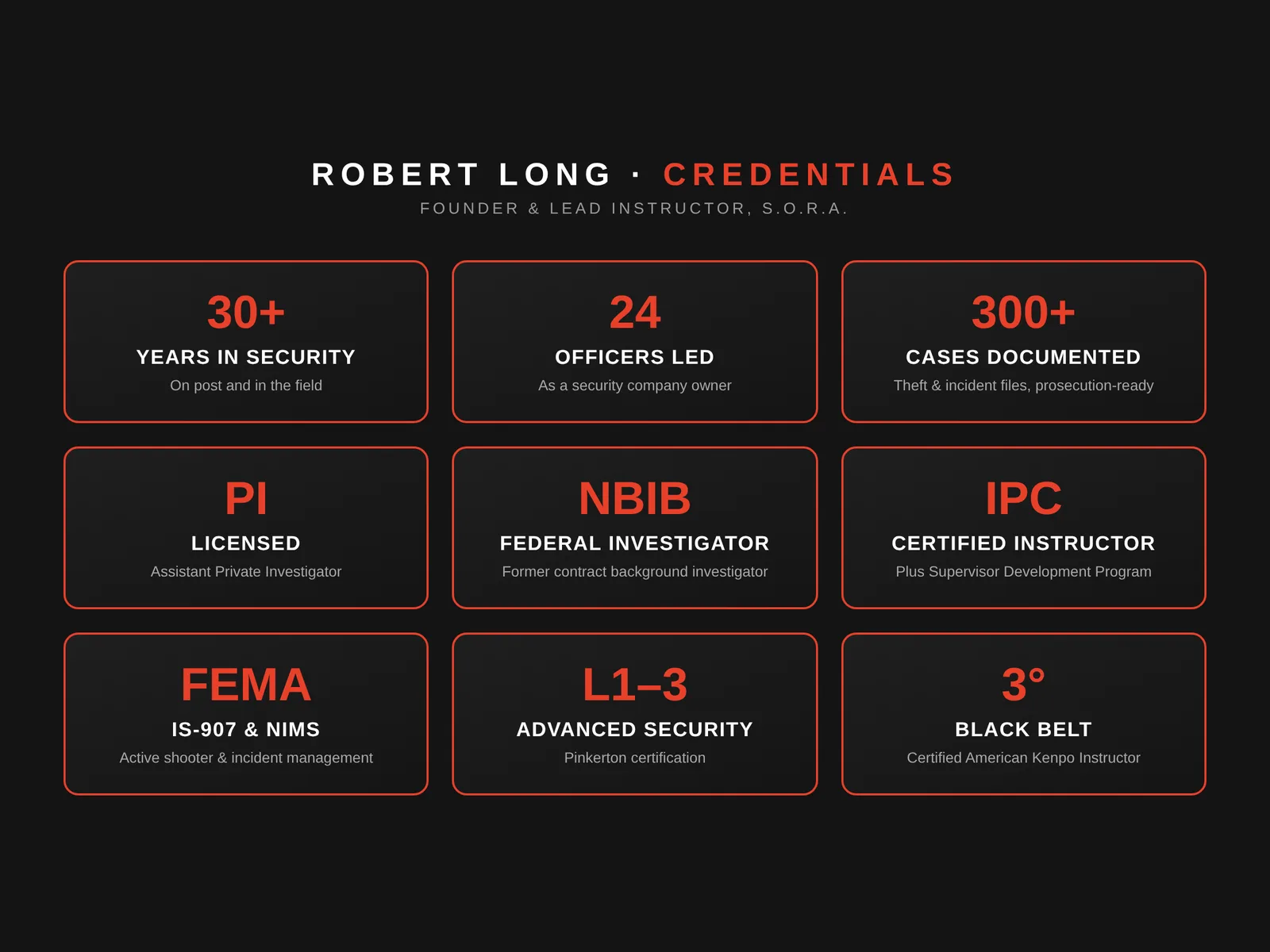
I started working in-house security in Pennsylvania and stayed with it until I left home at 27. After that, I worked posts for Burns, Pinkerton, and Securitas — patrols, hospital security, logs, and radio calls — then spent fifteen years running retail security and loss prevention teams as a Security Director. Today I own a security company, where I lead up to 24 officers across 75+ retail locations and more than 576,000 square feet.
I've documented 300+ theft and incident cases and built the prosecution files that go with them. I'm a licensed Assistant Private Investigator, and I previously worked as a contract background investigator for the National Background Investigations Bureau (NBIB) — which is where the interviewing and documentation standards in this program come from.
Credentials: IPC Certified Instructor · IPC Supervisor Development Program · FEMA IS-907 Active Shooter · FEMA NIMS · Pinkerton Advanced Security Certification (Levels 1–3) · Security/Police Sciences Diploma · 3rd Degree Black Belt, Certified American Kenpo Instructor.
Everything in S.O.R.A. comes from that work — not from a textbook.
Trained by someone who's done the job
Real credentials, real posts, real cases:
- 30+ years in security; now owns a security company
- Licensed Assistant PI and former U.S. federal contract investigator (NBIB)
- IPC Certified Instructor with FEMA active shooter and NIMS training
- Built for the officers he hires — and for yours, wherever you work
Run a security company?
Every new officer needs a solid, documented foundation before they work a post. S.O.R.A. gives every hire the same consistent training — legal authority, use of force, post operations, reporting, and emergency response — plus specialty modules for armed, supervisor, executive protection, and site-specific posts as your officers grow.
- One consistent standard for every officer on your roster
- Training records and skills sign-off built in for client audits
- Supervisor and Field Training Officer track for your leads
- Covers U.S. and international standards, including ISO 18788, ANSI/ASIS PSC.1, and the ICoCA
I'm a security company owner too. I built this for the officers I hire.
Ask about team access for your company: S.O.R.A2026@outlook.com
Questions
Frequently asked
Your teacher
A note from your teacher
Robert Long
If you're reading this, you're probably standing at one of a few crossroads. Maybe you're new to the industry and you want to walk into your first post actually knowing what you're doing — not just winging it. Maybe you've been working security for a while and you realize there are gaps in your foundation that could get you in serious trouble if the wrong situation comes up. Or maybe you're coming out of the military or first responder service, you've got real discipline and real instincts, and you're trying to figure out how that translates into this profession.
I built S.O.R.A. because all three of those people deserve better than the two-hour orientation most officers get before they're handed a post order and left alone. The private security industry is full of capable people who were never given the professional training they needed to perform — and to stay protected — at the highest level. That's a problem I take seriously.
What you'll find in this program is instruction that respects your time and your intelligence. No filler. No theory for the sake of theory. Everything in S.O.R.A. connects back to what happens in the real world: on post, in a confrontation, in an emergency, in a courtroom if it comes to that. You'll know your legal authorities and exactly where they end. You'll know how to run a post, conduct access control, and hand off a shift with accountability. You'll have de-escalation tools you can actually apply when someone's impaired, agitated, or in mental distress. You'll write incident reports that are clear, objective, and defensible. And when an emergency breaks — medical, fire, active threat — you'll have a protocol, not a panic.
I'll also be direct about something most training programs skip: command presence. How you carry yourself, how you communicate, how you project authority without escalating — that's not soft skill fluff. That is the job. It determines whether a client respects your post, whether a difficult individual complies, and whether your coworkers trust you when it counts.
S.O.R.A. isn't the easiest path into this career. It's the right one. If you're ready to train like the profession demands, I'm ready to take you through it.
— Robert Long
Start your journey today
Get instant access — learn at your own pace with an AI coach in your corner.
$49/mo
Recurring billing · cancel anytime
Secure checkout · Instant access
- 49 modules, 300 lessons
- AI-adaptive lessons tuned to your level
- Quizzes & checkpoints to lock in progress
- Your own AI learning coach
- Learn on any device, at your pace
- Full access for as long as you're subscribed
Optional add-ons inside
- S.O.R.A. Officer Community$9/month
- Monthly Live Q&A and Scenario Training$19/month
- 1-on-1 Coaching or Report Review$75
Available in the school store after you join.