Build sets that bring any story to life
Learn to design, build, and paint professional theatrical scenery — from a bare stage to a world the audience believes in.
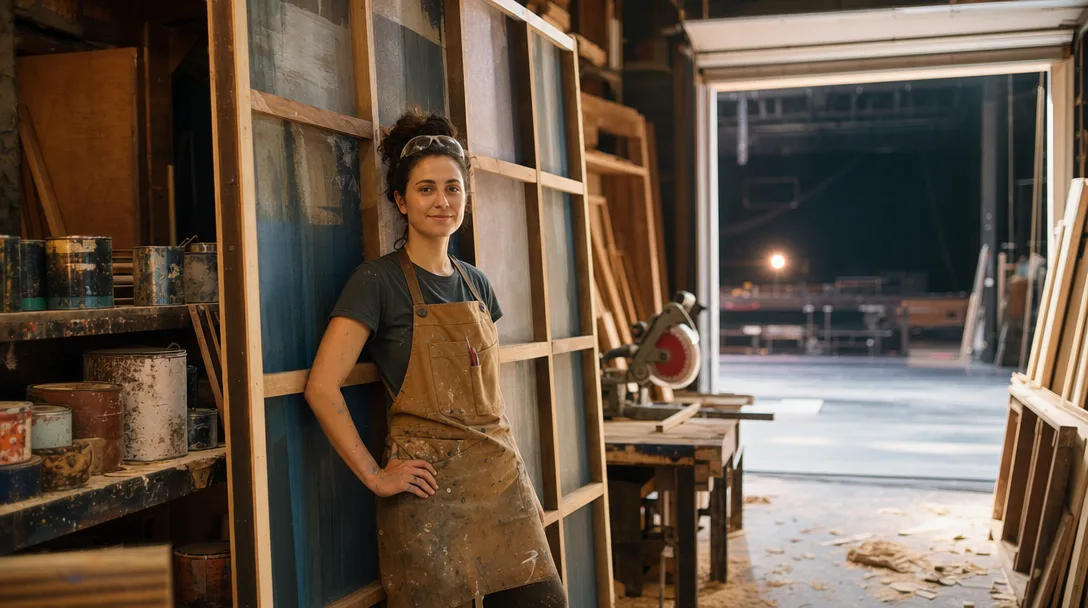
"I built this school so that anyone willing to pick up a tool can walk into any scene shop and make something an audience will believe in."— Mary Flynn
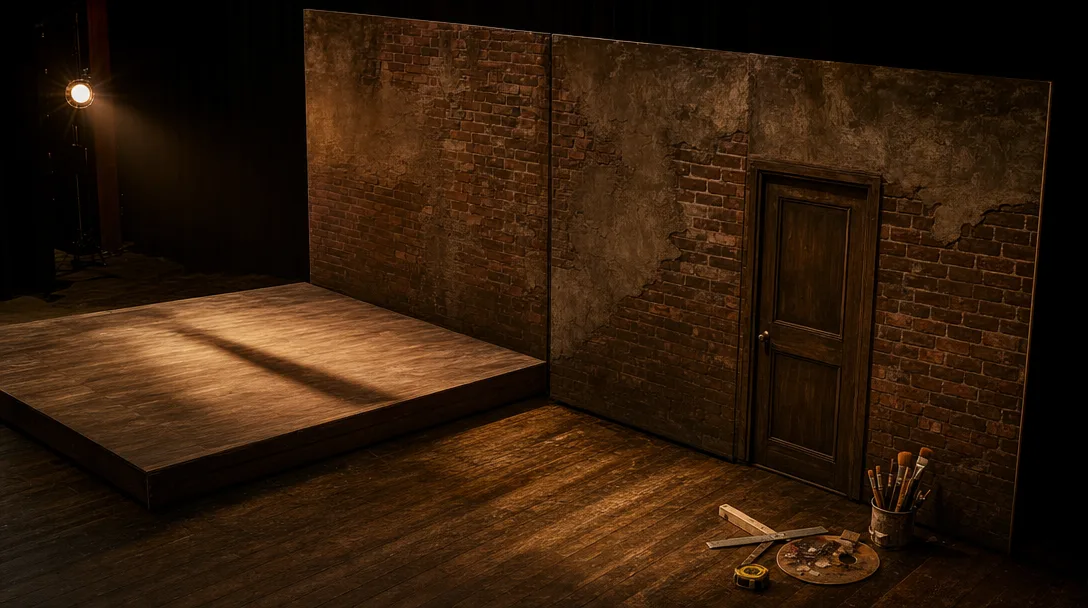
What you'll learn
What you'll be able to do
- Draft a basic scenic ground plan and elevation drawing from a script and director's brief
- Build a standard soft-covered flat and a Hollywood flat to professional theater specifications
- Construct a sturdy, code-safe raised platform (deck) for performers to walk and dance on
- Apply five core scenic painting techniques — base coating, wet blending, dry brushing, spattering, and trompe-l'œil texture — to transform raw flats into convincing environments
- Safely operate the hand tools, power tools, and rigging hardware found in a working scene shop
- Break down and strike a set efficiently, sorting reusable materials and managing a safe, organized shop
How it works
A school that adapts to you
This isn't a set of static videos. Every lesson is generated live and tuned to where you actually are.
We learn your level
A quick placement check tailors your starting point so you're never bored or lost.
Lessons adapt as you go
Each lesson is written for your pace and your goal, adjusting as your skills grow.
Your AI coach keeps you moving
Checkpoints, feedback, and gentle nudges turn progress into a real result.
The curriculum
What's inside your school
7 modules · 23 lessons

The Scene Shop & the Blueprint
Orient students to the professional scene shop environment and the design documents that guide every build. Students learn to read a script and director's brief as technical documents, draft a ground plan and elevation, and establish the safety habits that govern every hour in the shop.
- 1.1Scene Shop Orientation & Tool SafetyIncluded
- 1.2Reading the Script as a Technical DocumentIncluded
- 1.3Drafting a Ground PlanIncluded
- 1.4Drafting an Elevation DrawingIncluded
Framing the World — Building Flats
Flats are the backbone of theatrical scenery. This module walks students through both the traditional soft-covered flat and the modern Hollywood flat, from lumber selection and frame joinery to covering, stiffening, and hardware attachment — all to professional theater specifications.
- 2.1Lumber, Materials & Flat AnatomyIncluded
- 2.2Building the Soft-Covered FlatIncluded
- 2.3Building the Hollywood FlatIncluded
- 2.4Joining, Stiffening & Flying FlatsIncluded
Raising the Stage — Platform Construction
Performers run, jump, and dance on platforms. This module teaches students to build a code-safe 4×8 deck at two standard heights, construct sturdy leg assemblies with diagonal bracing, and install guardrails and stair units — all with performer weight loads in mind.
- 3.1Platform Engineering & Load SafetyIncluded
- 3.2Building the Platform DeckIncluded
- 3.3Leg Assemblies, Bracing & LevelingIncluded
- 3.4Guardrails, Stairs & AccessibilityIncluded
Painting the Illusion — Five Core Scenic Techniques
Scenic painting turns raw wood and muslin into brick walls, marble columns, and forest glades. Students master five professional techniques — base coating, wet blending, dry brushing, spattering, and trompe-l'œil texture — and learn to mix, thin, and manage theatrical paint at scale.
- 4.1Paint Materials, Mixing & the Primed SurfaceIncluded
- 4.2Base Coating & Wet BlendingIncluded
- 4.3Dry Brushing & SpatteringIncluded
- 4.4Trompe-l'Œil Texture — Brick, Wood & MarbleIncluded
The Working Scene Shop — Tools, Rigging & Safety Systems
Students move from individual tool skills to the integrated operation of a professional scene shop: power tool sequencing, fly-system rigging hardware, knot and termination techniques, and the load calculation habits that keep everyone safe above and below the grid.
- 5.1Power Tool Mastery & SequencingIncluded
- 5.2Fly System Hardware & Rigging FundamentalsIncluded
- 5.3Knots, Soft Goods & Hanging Soft SceneryIncluded
Strike, Storage & the Organized Shop
A professional TD leaves the stage cleaner and more organized than they found it. This module teaches systematic set strike — removing, sorting, and storing scenic elements safely — material reuse triage, shop organization systems, and the production documentation that sets up the next show for success.
- 6.1Strike Planning & Safe DeconstructionIncluded
- 6.2Materials Triage, Reuse & Waste ReductionIncluded
- 6.3Shop Organization, Documentation & HandoffIncluded
Scenery on a budget
This module is designed for Community theater groups on a limited budget that struggle with stage limitations.
- 7.1New lessonIncluded
Who it's for
Is this you?

Community theater volunteers
They said yes to helping build sets and now need real skills fast before opening night.

Drama & theater students
They're studying performance or tech theater and want hands-on construction knowledge their classes don't fully cover.

High school drama teachers
They direct the show AND oversee the build, and need a reliable framework to teach student crew safely.

Aspiring technical directors
They want to move from casual helper to paid TD and need a credible, structured foundation to point to.

DIY woodworkers & makers
They already love building things and want to apply their skills to the theatrical world for the first time.

Set & production designers
They design on paper and want to deeply understand how their visions get built so they can design smarter.
Questions
Frequently asked
Your teacher
A note from your teacher

Mary Flynn
I know exactly where you are right now.
Maybe you just said "yes" to helping build the sets for your community theater's next show — and now you're standing in a cluttered scene shop surrounded by lumber, paint cans, and tools you've never touched, wondering how anyone ever makes something beautiful out of all this chaos. Or maybe you're a drama student who loves being in the shop but nobody has ever actually taught you the right way to build a flat or why a platform needs a specific kind of support. You've been learning by watching, guessing, and hoping nothing collapses.
I've spent years in scene shops just like yours — community black boxes, high school auditoriums, regional theaters with tight budgets and even tighter deadlines. I've built everything from a simple park bench to a two-story Victorian façade on wheels. And the single biggest thing I've learned is this: scenic construction isn't magic, and it isn't a mystery passed down only to people who grew up around it. It's a learnable set of skills. Clear principles. Reliable methods. Anyone who's willing to pick up a tool and pay attention can do this work well.
That's exactly why I built this school. I wanted to take everything I've learned on actual productions — the material choices, the construction sequences, the painting tricks that make audiences believe they're looking at real stone — and lay it out in a way that's honest, practical, and genuinely useful from the very first lesson.
There's no fluff here, no theory for theory's sake. Every lesson is something you can act on in your shop this weekend. By the time you're done, you won't just help build sets. You'll be the person other volunteers look to for answers — and that's a feeling worth every hour you put in.
Come build something real with me.
— Mary Flynn
Start your journey today
Join get instant access — learn at your own pace with an AI coach in your corner.
- 7 modules, 23 lessons
- AI-adaptive lessons tuned to your level
- Quizzes & checkpoints to lock in progress
- Your own AI learning coach
- Learn on any device, at your pace
- Full access for as long as you're subscribed