
Think your way inside Steiner's world — then think your way back out
A serious, structured inquiry into anthroposophy's inner logic and living practices — from Waldorf classrooms and biodynamic farms to radical architecture, curative communities, and the hard ethical questions no introductory book will touch.

"I will not ask you to arrive at my conclusions — I will ask you to do the harder thing, and arrive at your own."
— Theoria
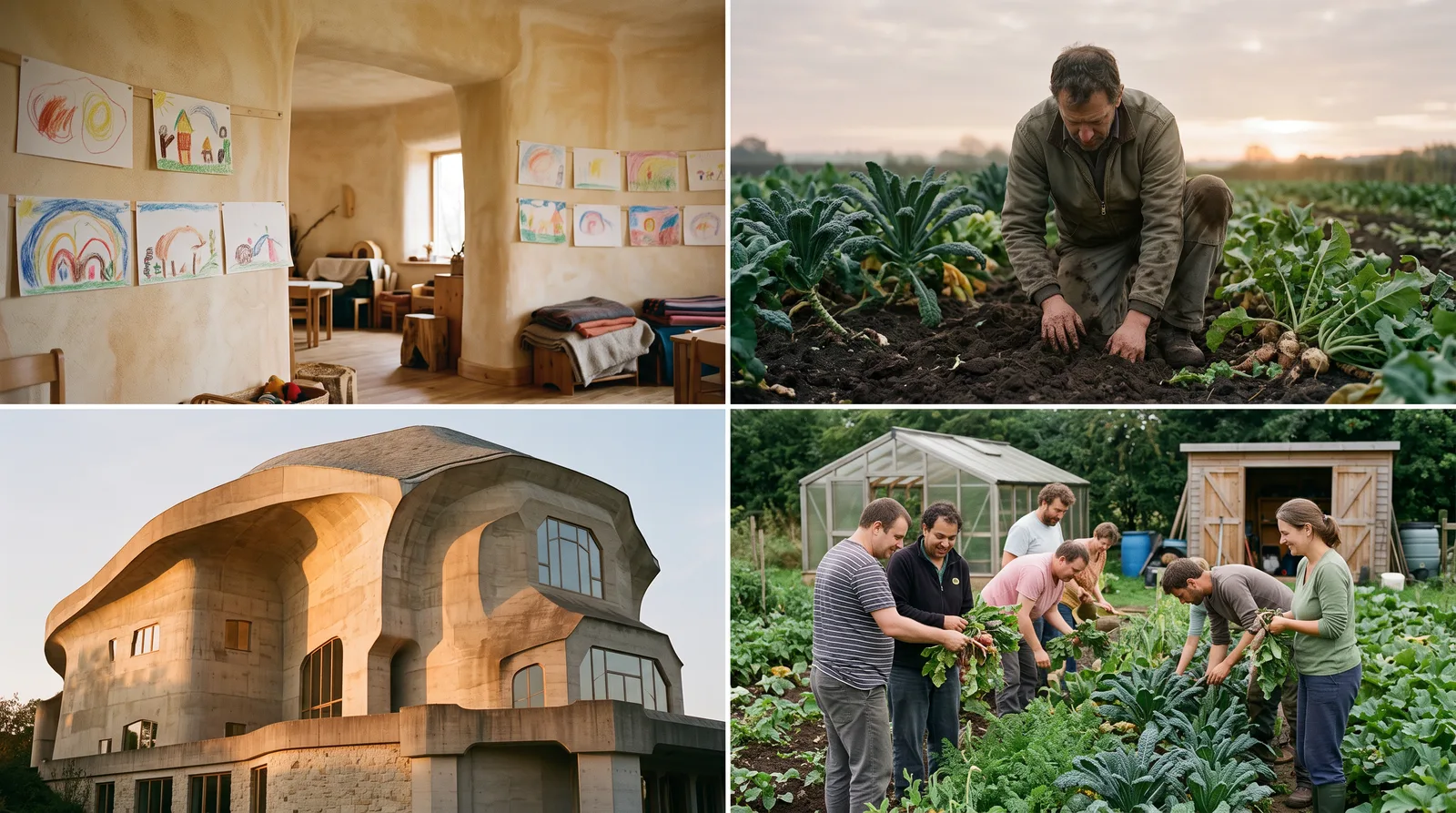
What you'll learn
What you'll be able to do
- Explain the core principles of anthroposophy and trace how each gives rise to a distinct practical discipline — from pedagogy to agriculture to medicine
- Analyse the philosophy and developmental staging behind Waldorf education and evaluate its methods against contemporary educational research
- Describe biodynamic agriculture's principles and practices, including its relationship to mainstream organic farming and its contested cosmological foundations
- Interpret Steiner's architecture, color theory, eurythmy, and speech work as expressions of a unified aesthetic vision rather than isolated curiosities
- Articulate the threefold social organism as a political philosophy and assess its influence on Camphill communities and other social initiatives
- Engage critically and fairly with the ethical controversies surrounding anthroposophy — including questions of race, esotericism, and evidence — reaching informed, independent conclusions
How it works
A school that adapts to you
This isn't a set of static videos. Every lesson is generated live and tuned to where you actually are.
We learn your level
A quick placement check tailors your starting point so you're never bored or lost.
Lessons adapt as you go
Each lesson is written for your pace and your goal, adjusting as your skills grow.
Your AI coach keeps you moving
Checkpoints, feedback, and gentle nudges turn progress into a real result.
The curriculum
What's inside your school
6 modules · 29 lessons

The Anthroposophical Worldview: Foundations for Practice
Establishes the philosophical and spiritual core of anthroposophy so every subsequent practical discipline can be understood from the inside out.
- 1.1From Theosophy to Anthroposophy: Steiner's Intellectual JourneyIncluded
- 1.2The Structure of the Human Being: Body, Soul, and SpiritIncluded
- 1.3Spiritual Cognition and the Path of KnowledgeIncluded
- 1.4Karma, Reincarnation, and Human DevelopmentIncluded
- 1.5Reading Steiner: Key Texts and How to Approach ThemIncluded
Waldorf Education: Philosophy, Classroom, and Critique
Analyses Waldorf pedagogy from its developmental-stage philosophy through its classroom methods to its reception in contemporary educational research.
- 2.1Seven-Year Rhythms: Steiner's Developmental StagingIncluded
- 2.2The Waldorf Classroom: Curriculum, Rhythm, and the ArtsIncluded
- 2.3The Role of the Teacher: Spiritual Preparation and RelationshipIncluded
- 2.4Waldorf Worldwide: Growth, Diversity, and AdaptationIncluded
- 2.5Evidence, Outcomes, and Educational ControversiesIncluded
Land, Life, and Healing: Biodynamic Agriculture and Anthroposophical Medicine
Explores how Steiner extended his worldview into the natural sciences of farming and health, examining both their practical logic and contested foundations.
- 3.1The Agriculture Course: Context and Core PrinciplesIncluded
- 3.2Preparations, Rhythms, and the Cosmic DimensionIncluded
- 3.3Biodynamics and Organic Farming: Comparison and ControversyIncluded
- 3.4Anthroposophical Medicine: The Fourfold Body in Clinical PracticeIncluded
- 3.5Evidence, Ethics, and Integration with Conventional MedicineIncluded
A Unified Aesthetic: Architecture, Art, Eurythmy, and the Word
Interprets Steiner's diverse artistic outputs — building, color, movement, drama, and speech — as expressions of a single coherent aesthetic philosophy.
- 4.1Organic Architecture and the GoetheanumIncluded
- 4.2Color as a Spiritual Language: Steiner's Color TheoryIncluded
- 4.3Eurythmy: Visible Speech and Visible SongIncluded
- 4.4Speech Formation and Drama: The Art of the WordIncluded
- 4.5The Arts as One: Aesthetic Unity in Anthroposophical PracticeIncluded
Social Renewal: The Threefold Organism, Camphill, and Community Life
Examines Steiner's political philosophy and its translation into intentional communities, social enterprises, and movements for cultural renewal.
- 5.1The Threefold Social Organism: Liberty, Equality, Fraternity RedefinedIncluded
- 5.2Historical Context and Contemporary RelevanceIncluded
- 5.3Camphill Communities: Curative Education in PracticeIncluded
- 5.4Wider Social Initiatives: Banks, Schools, and CooperativesIncluded
Legacy, Controversy, and Critical Engagement
Equips students to assess anthroposophy's enduring cultural influence and its most serious ethical challenges with rigor, fairness, and intellectual independence.
- 6.1Steiner's Racial Teachings: Texts, Context, and ReckoningIncluded
- 6.2Esotericism, Science, and the Problem of EvidenceIncluded
- 6.3Anthroposophy and Conspiracy: Navigating the FringeIncluded
- 6.4Cultural Influence: Steiner's Footprint in Art, Education, and EcologyIncluded
- 6.5Your Own Reckoning: Integrating Critical and Appreciative PerspectivesIncluded
Who it's for
Is this you?

Waldorf educators
They work inside Waldorf pedagogy every day and want the philosophical depth to understand — and defend — what they actually do.

Alternative-health practitioners
From anthroposophical medicine to integrative practice, they want to examine the fourfold body and its clinical implications with rigor and honesty.

Philosophical seekers
They move comfortably through big ideas — epistemology, phenomenology, esoteric traditions — and want to map Steiner's thought seriously onto that landscape.

Biodynamic growers
They use the preparations and follow the planting calendar, and are ready to interrogate the cosmological foundations alongside the practical results.

Cultural historians
They trace modern art, architecture, and social movements and need a rigorous account of Steiner's outsized — and understudied — cultural footprint.

Critical inquirers
Neither credulous nor dismissive, they want the full picture — contested claims, racial legacy, evidence problems, and all — and the tools to form an independent view.
Questions
Frequently asked
Your teacher
A note from your teacher

Theoria
If you have spent any time around anthroposophy — in a Waldorf school, on a biodynamic farm, in a Camphill community, or simply in the pages of Steiner's bewildering output — you will know the particular frustration of feeling that something genuinely important is happening, while struggling to get a clear, honest view of what it actually is. The devotional literature tends to protect the ideas from scrutiny. The dismissive literature tends to caricature them. Neither serves you well if what you want is to understand.
That is what this school is for. I built it because I believe Steiner's work deserves the same quality of engaged, critical attention we would give to any major intellectual and cultural tradition — and because I have found, again and again, that understanding the inner logic of anthroposophy changes the way you see it, whether or not you end up persuaded by it. The Waldorf classroom makes a different kind of sense when you have traced it back through Steiner's developmental philosophy to his epistemology. Biodynamic agriculture looks different when you understand the cosmological convictions behind the preparations, and also when you understand what the peer-reviewed literature does and does not show. Eurythmy stops being merely strange when you see it as an expression of a unified aesthetic philosophy. These are not apologetics — they are the ordinary rewards of careful thinking.
I want to be straightforward with you about what this school will and will not do. It will not tell you what to conclude. It will not soften the difficult material — Steiner's racial teachings, the problem of evidence in esoteric systems, the relationship between anthroposophy and some of the less salubrious currents in modern alternative culture — because that material is part of the honest picture and you deserve to engage with it. What it will do is give you the conceptual vocabulary, the historical context, the comparative perspective, and the structured space to think these questions through properly, at whatever pace suits you.
I am also aware that the people who come to this school carry very different relationships to the subject. Some of you are educators or practitioners who want to understand the foundations of the work you do. Some of you are philosophers or cultural historians tracking a significant strand of modern thought. Some of you are simply curious people who have encountered Steiner at one remove — through a school, a farm box, a work of architecture — and want to know what lies beneath. All of those starting points are welcome here, and the curriculum is built to meet you wherever you are.
What I ask in return is the willingness to hold two things at once: genuine openness to what the ideas are actually claiming, and genuine willingness to subject those claims to scrutiny. That double movement — understanding before judging, judging honestly once you have understood — is the intellectual habit this school is designed to develop. I think you will find it rewarding. I hope you will join us.
— Theoria
Start your journey today
Get instant access — learn at your own pace with an AI coach in your corner.
$39/mo
Recurring billing · cancel anytime
Secure checkout · Instant access
- 6 modules, 29 lessons
- AI-adaptive lessons tuned to your level
- Quizzes & checkpoints to lock in progress
- Your own AI learning coach
- Learn on any device, at your pace
- Full access for as long as you're subscribed