
Finally make sense of the Spanish subjunctive
Stop avoiding the subjunctive and start using it with confidence. This school demystifies the trickiest grammar in Spanish — for good.

"The subjunctive isn't the hardest part of Spanish — it's just the part nobody ever explained properly."— Ángeles Fernández R.

What you'll learn
What you'll be able to do
- Recognise every major trigger for the present subjunctive and apply the correct form instantly
- Use the past (imperfect) subjunctive naturally in hypothetical and conditional sentences
- Express wishes, emotions, doubt, and denial in Spanish without second-guessing yourself
- Write and speak using both 'si' clauses and 'ojalá' constructions the way native speakers do
- Distinguish confidently between contexts that require the subjunctive versus the indicative
- Pass DELE B2 grammar questions and hold nuanced conversations that go beyond surface-level Spanish
How it works
A school that adapts to you
This isn't a set of static videos. Every lesson is generated live and tuned to where you actually are.
We learn your level
A quick placement check tailors your starting point so you're never bored or lost.
Lessons adapt as you go
Each lesson is written for your pace and your goal, adjusting as your skills grow.
Your AI coach keeps you moving
Checkpoints, feedback, and gentle nudges turn progress into a real result.
The curriculum
What's inside your school
6 modules · 16 lessons

The Subjunctive Mindset: What It Is and Why It Exists
Before touching a single conjugation, learners build the conceptual foundation that makes everything else click. This module reframes the subjunctive not as a random list of rules to memorise, but as a consistent logical system rooted in subjectivity, uncertainty, and influence — so every future trigger feels intuitive rather than arbitrary.
- 1.1Indicative vs. Subjunctive: A Tale of Two RealitiesIncluded
- 1.2Trigger Hunting: The Four Semantic FamiliesIncluded
Present Subjunctive: Forms Locked In
Learners drill the present subjunctive conjugation system to the point of automaticity — including all irregular verbs — so that by the end of this module, the right form surfaces without hesitation during speaking and writing tasks.
- 2.1The 'Yo-Form Trick' and Regular ConjugationsIncluded
- 2.2Irregular and Stem-Changing Verbs in the Present SubjunctiveIncluded
- 2.3Spelling-Change Verbs and Avoiding the Most Common MistakesIncluded
Wishes, Emotions, and Recommendations in Real Speech
With forms secured, learners now flood those forms with meaning. This module focuses on the W and E of WEIRDO — wishes and emotions — plus interpersonal recommendations, building the fluency and confidence to use the subjunctive naturally in conversations about real life.
- 3.1Expressing Wishes and Desires: Querer, Esperar, Desear and FriendsIncluded
- 3.2Emotions and Reactions: Alegrase de que, Temer que, Sorprender queIncluded
- 3.3Recommendations and Impersonal Expressions: Es importante que, Hay que, Conviene queIncluded
Doubt, Denial, and the Indicative Battleground
The D of WEIRDO is where learners most frequently make errors — and where DELE B2 tests most heavily. This module builds razor-sharp awareness of the doubt–certainty spectrum and the exact point at which Spanish crosses from indicative to subjunctive, including the notorious 'creer que' contrast.
- 4.1The Certainty Spectrum: From 'Sé que' to 'No creo que'Included
- 4.2Denial and Negation: No es que, No es verdad que, Negar queIncluded
The Imperfect Subjunctive: Hypotheticals, Conditionals, and Ojalá
Learners crack open the past subjunctive — the form that unlocks truly sophisticated Spanish. This module covers the -ra and -se forms, all major irregular patterns, and the full range of conditional and hypothetical constructions that native speakers use constantly but intermediate learners systematically avoid.
- 5.1Forming the Imperfect Subjunctive: The Preterite ShortcutIncluded
- 5.2Si Clauses: Real, Hypothetical, and Impossible ConditionsIncluded
- 5.3Ojalá, Quién, and Expressing LongingIncluded
Fluency, Integration, and DELE B2 Mastery
The final module stops practising structures in isolation and starts using the full subjunctive system under real-world conditions — timed exams, spontaneous conversation, extended writing, and authentic media. Learners leave with the confidence, speed, and accuracy needed for DELE B2 and beyond.
- 6.1Subjunctive in Authentic Spanish: Reading and Listening Without a NetIncluded
- 6.2Writing with the Subjunctive: DELE-Style Tasks and BeyondIncluded
- 6.3Speaking Without Second-Guessing: Fluency under PressureIncluded
Who it's for
Is this you?

The Plateau Learner
You've reached B1 and hit a wall — this is the grammar unlock that takes you to the next level.

The DELE Candidate
Subjunctive accuracy is what separates B1 from B2 on the exam, and this school targets exactly that gap.

The Heritage Speaker
You grew up hearing Spanish at home but never formally learned the rules — now you want to write and speak with full confidence.

The Expat Abroad
Living in a Spanish-speaking country, you need to move beyond 'functional' and sound like you truly belong.

The Classroom Dropout
Traditional grammar classes didn't make it click — you need a fresh, logic-first approach that actually sticks.

The Travelling Professional
You use Spanish in meetings and client calls and can't afford to sound uncertain when nuance matters most.
Questions
Frequently asked
Your teacher
A note from your teacher
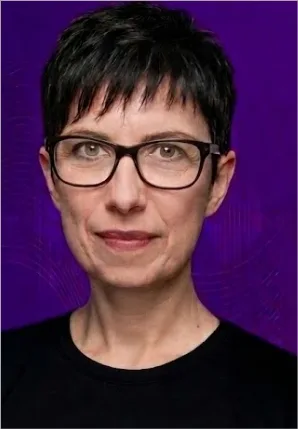
Ángeles Fernández R.
I know exactly where you are right now.
You've put in real time learning Spanish. You can order food, chat with colleagues, navigate a city, maybe even watch a TV show without subtitles. But the moment a sentence calls for the subjunctive — quiero que tú..., ojalá pudiera..., no creo que sea... — something in your brain short-circuits. You either sidestep it or you guess. And that feeling of almost fluent, but not quite, lingers.
I built this school because that gap is completely fixable, and it doesn't require years of extra study. The subjunctive has a reputation for being impossibly complex, but that reputation is mostly the fault of how it's taught — as a list of forms to memorise rather than a communication tool with its own clear logic.
What I've found, working with Spanish learners at the intermediate plateau, is that one good explanation at the right moment is worth a hundred gap-fill exercises. When you understand why a native speaker reaches for the subjunctive — what they're trying to signal about certainty, desire, or reality — the forms stop feeling arbitrary. They feel inevitable.
This school gives you that understanding, then backs it up with the kind of targeted, contextualised practice that turns knowledge into instinct. By the end, you won't be reciting a rule before you speak. You'll just… speak.
If you're ready to stop going around the subjunctive and start going through it, I'd love to guide you. Let's finish this together.
— Ángeles Fernández R.
Start your journey today
Join get instant access — learn at your own pace with an AI coach in your corner.
- 6 modules, 16 lessons
- AI-adaptive lessons tuned to your level
- Quizzes & checkpoints to lock in progress
- Your own AI learning coach
- Learn on any device, at your pace
- Full access for as long as you're subscribed