
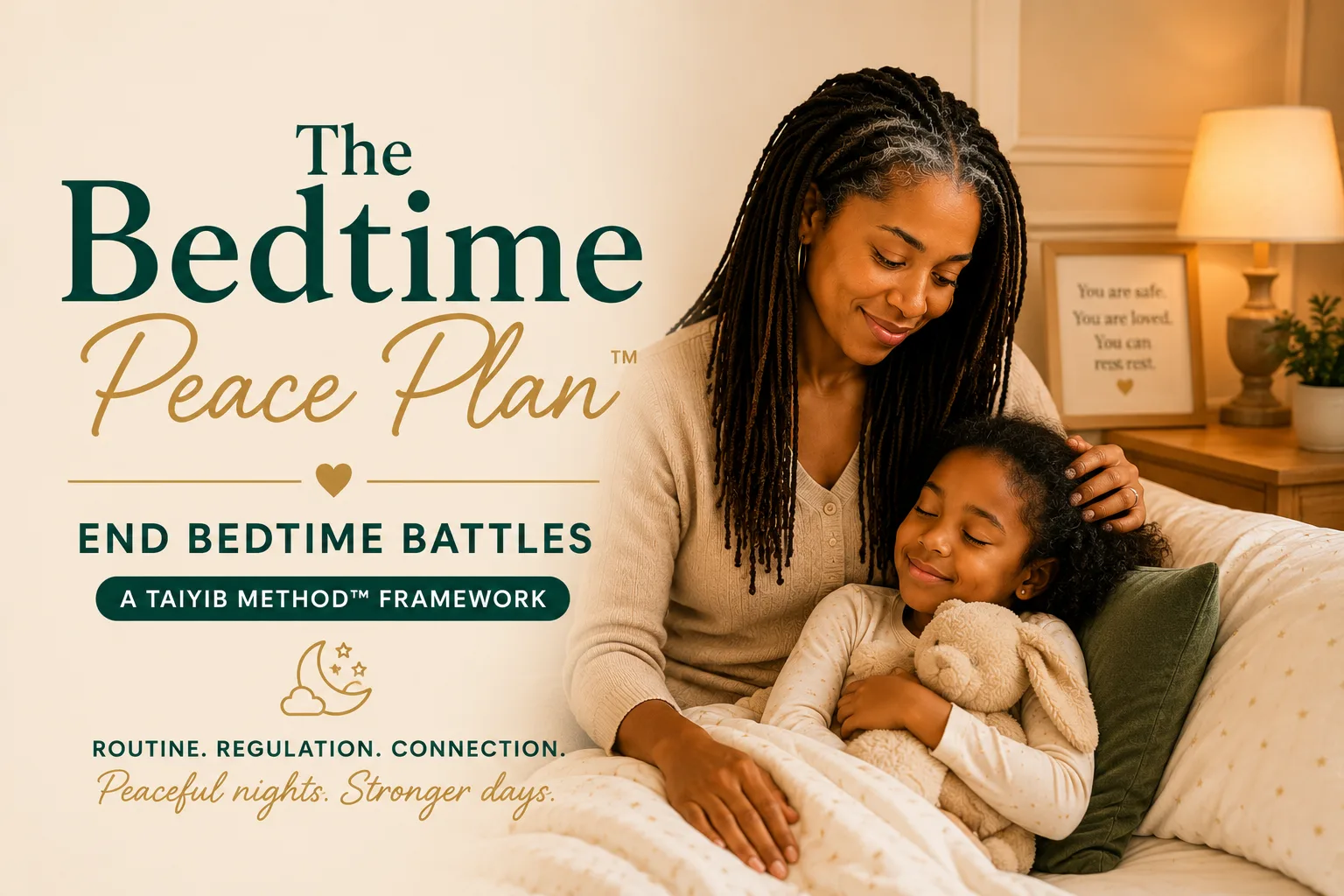
The Bedtime Peace Plan™: End Bedtime Battles
A Taiyib Method™ framework for helping children ages 2–12 move from nighttime resistance into rest using routine, regulation, connection, and calm boundaries — so bedtime stops feeling like a battle and the whole house can finally breathe.
What you'll learn
What you'll be able to do
- Understand the sleep science behind children ages 2–12 so you can work with your child's biology instead of against it
- Identify the specific root cause(s) of your child's bedtime resistance — anxiety, overtiredness, undertiredness, habit, or boundary-testing
- Build a fully customized, age-appropriate bedtime routine your child can predict, trust, and follow independently
- Use proven communication scripts to set and hold bedtime boundaries without yelling, guilt, or drawn-out negotiations
- Eliminate the most common stalling tactics (extra drinks, bathroom trips, 'one more hug') using gentle but firm redirection strategies
- Transition children out of parent-present sleep associations (lying down with them, feeding to sleep) without traumatic cry-it-out methods
- Handle bedtime disruptions caused by life transitions — new siblings, school changes, travel, and anxiety — with a clear reset protocol
- Create a sleep environment (light, sound, temperature, comfort objects) scientifically calibrated for deep, restorative children's sleep
How it works
A school that adapts to you
This isn't a set of static videos. Every lesson is generated live and tuned to where you actually are.
We learn your level
A quick placement check tailors your starting point so you're never bored or lost.
Lessons adapt as you go
Each lesson is written for your pace and your goal, adjusting as your skills grow.
Your AI coach keeps you moving
Checkpoints, feedback, and gentle nudges turn progress into a real result.
The curriculum
What's inside your school
6 modules · 18 lessons

Why Bedtime Is Broken — The Science Your Child's Brain Needs You to Know
Before we fix bedtime, we have to understand it. This module unpacks the developmental sleep science behind children ages 2–12 — circadian rhythms, sleep pressure, cortisol cycles, and why the hour before bed is the most powerful hour of the day. Parents finish this module with a completely new lens on what's actually happening when their child resists sleep.
- 1.1How Children's Sleep Biology Works (And Why It's Not Like Adults')Included
- 1.2The Cortisol Trap: How the Hour Before Bed Makes or Breaks the NightIncluded
- 1.3The 5 Root Causes of Bedtime Resistance — Which One Is Yours?Included
Building the Routine — Your Child's Nervous System Blueprint
A routine is only as good as the developmental logic behind it. This module teaches parents how to design a bedtime sequence that is the right length, the right content, and in the right order for their child's specific age and temperament — and how to introduce it in a way that gets buy-in instead of pushback.
- 2.1The Anatomy of a Perfect Bedtime Routine (By Age Group)Included
- 2.2Getting Your Child On Board: The Launch ConversationIncluded
- 2.3Bedtime for Siblings: Coordinating Multiple Children with Different NeedsIncluded
Holding the Line — Boundaries Without Battles
A great routine is only half the equation. The other half is what you do when your child tests it — and they will test it. This module gives parents the communication tools, behavioral scripts, and emotional regulation strategies to hold bedtime boundaries firmly and calmly, without the yelling, bargaining, or guilt that erodes routines over time.
- 3.1The Stall Tactic Playbook — and How to Shut It Down KindlyIncluded
- 3.2Calm Authority: How to Hold Firm Without EscalatingIncluded
- 3.3Reward Systems That Actually Work (and Ones That Backfire)Included
The Anxious or Sensitive Child — When Bedtime Fears Are Real
For some children, bedtime resistance isn't defiance — it's fear. This module addresses the specific challenges of children with nighttime anxiety, separation anxiety, sensory sensitivities, and vivid imaginations that make the dark feel genuinely threatening. Parents learn to validate fear without feeding it, and to build their child's felt sense of safety and self-efficacy at night.
- 4.1Understanding Bedtime Anxiety vs. Bedtime Avoidance — and Why It MattersIncluded
- 4.2Building a Fear-Proof Sleep Environment and Bedtime Safety RitualIncluded
- 4.3Sensory Sensitivities and Sleep: Light, Sound, Texture, and TemperatureIncluded
Transitions and Disruptions — Protecting the Plan When Life Happens
Every family hits bumps: a new baby, a house move, the start of school, illness, holidays, time zone changes. This module teaches parents how to anticipate, navigate, and recover from the life events most likely to derail a sleep routine — so a disruption becomes a temporary setback, not a full regression.
- 5.1The Routine Reset: Getting Back on Track After Any DisruptionIncluded
- 5.2New Siblings, New Schools, New Homes: Big Transitions and BedtimeIncluded
- 5.3Travel, Time Zones, and Holidays: Keeping Sleep Sane on the RoadIncluded
Your Complete Bedtime Peace Plan — Build It, Launch It, Own It
This final module is where everything comes together. Parents assemble their fully customized, child-specific Bedtime Peace Plan, prepare for a confident launch, and build the long-term maintenance habits that keep nights peaceful as their children grow. This is the module you'll come back to every six months.
- 6.1Assembling Your Custom Bedtime Peace PlanIncluded
- 6.2Launch Night and the First Two Weeks — What to ExpectIncluded
- 6.3Growing With Your Child: How to Evolve the Plan as They Get OlderIncluded
Questions
Frequently asked
Your teacher
A note from your teacher
Inas Shabazz
Hi, I’m Inas Shabazz, creator of The Taiyib Method™.
I am a Child Development Architect, Career ROTA Nanny, and childcare educator with 25 years of hands-on experience working directly with children in homes, classrooms, and ultra-high-net-worth private households.
I have supported children through meltdowns, bedtime battles, sibling conflict, screen-time struggles, morning chaos, travel transitions, divorce, blended family dynamics, neurodiversity, anxiety, big emotions, and the everyday moments that can either strengthen a family or wear everybody down.
What I have learned is this:
Children are not born bad.
Most of the time, behavior is communication. A child may be overwhelmed, disconnected, tired, overstimulated, anxious, seeking control, or simply missing the rhythm and support they need to do better.
The Taiyib Method™ was created to help parents, guardians, nannies, educators, and caregivers understand the child beneath the behavior — and respond with calm, connection, structure, and clear boundaries.
This work is personal to me. Taiyib means pure, good, wholesome, and of excellent character. It is also rooted in the legacy of my mother, Taiyibah Shabazz. Her love, wisdom, and care live inside this method.
I created these courses because every family deserves access to the kind of intentional child development support that is often only available to families with private staff, specialized educators, or high-level caregiving teams.
You do not have to be perfect.
You do not have to have all the answers.
You just need a framework that helps you understand what is happening, know what to do next, and lead the children in your care with more peace, confidence, and love.
— Inas Shabazz
Start your journey today
Get instant access — learn at your own pace with an AI coach in your corner.
$47/mo
Recurring billing · cancel anytime
Secure checkout · Instant access
- 6 modules, 18 lessons
- AI-adaptive lessons tuned to your level
- Quizzes & checkpoints to lock in progress
- Your own AI learning coach
- Learn on any device, at your pace
- Full access for as long as you're subscribed