Handle any conflict without the drama
The practical life-skills course that teaches teens ages 12–14 how to handle conflict, communicate clearly, and solve problems without the drama — at school, home, and online.

"Conflict isn't the enemy — not knowing what to do with it is, and that's exactly what we fix here."
— LBD Academy
What you'll learn
What you'll be able to do
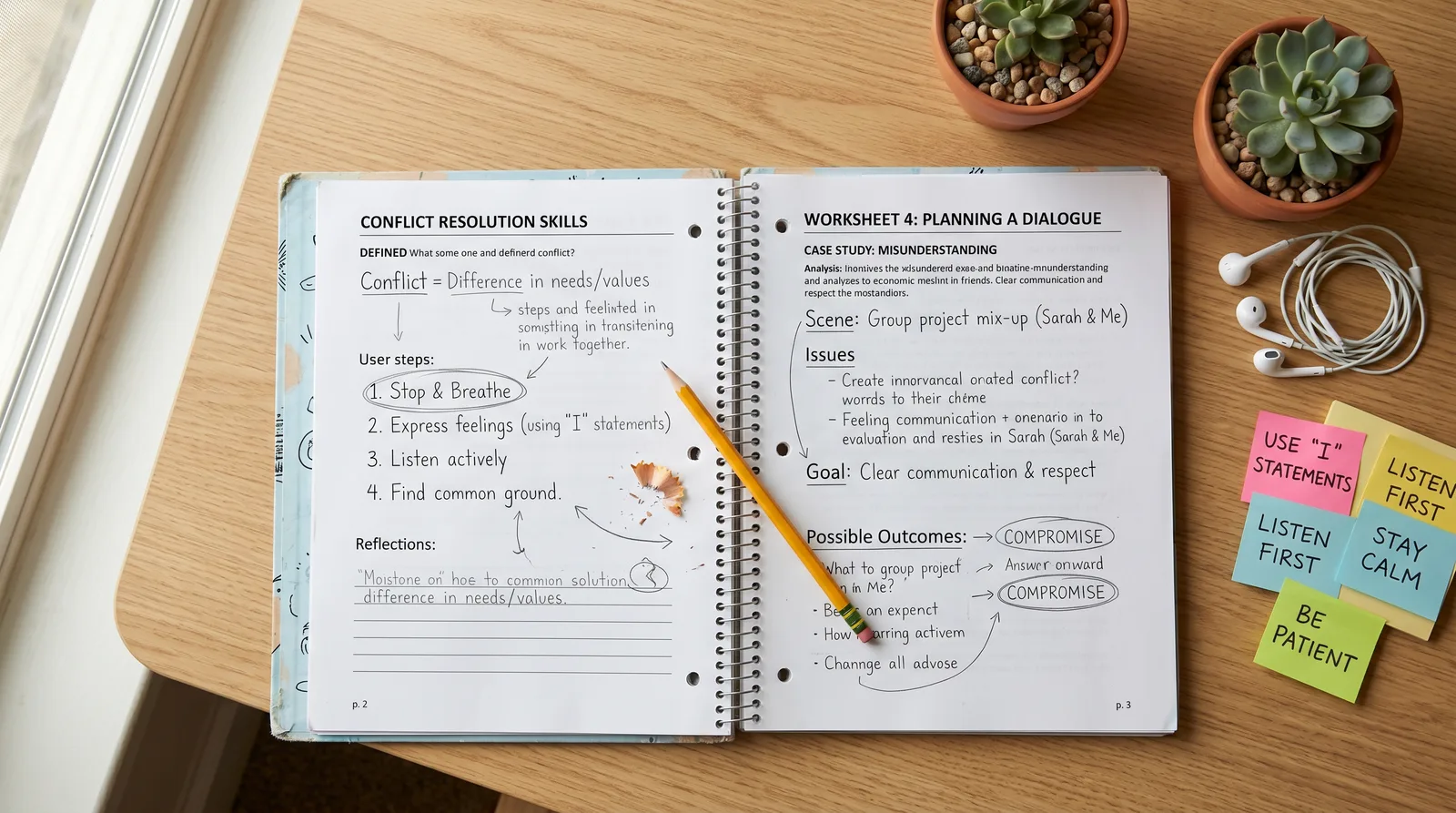
- Use active listening and smart questions to truly understand another person's point of view
- Recognize emotional triggers and use pause-and-reset techniques to respond instead of react
- Speak up for yourself using 'I' statements that are clear, honest, and drama-free
- Reframe negative conversations and replace blame with respectful, solution-focused language
- Separate interests from positions to find common ground and build win-win solutions
- Navigate real conflicts — with friends, family, at school, and on social media — using basic mediation steps
How it works
A school that adapts to you
This isn't a set of static videos. Every lesson is generated live and tuned to where you actually are.
We learn your level
A quick placement check tailors your starting point so you're never bored or lost.
Lessons adapt as you go
Each lesson is written for your pace and your goal, adjusting as your skills grow.
Your AI coach keeps you moving
Checkpoints, feedback, and gentle nudges turn progress into a real result.
The curriculum
What's inside your school
6 modules · 19 lessons
Understanding Conflict
Before teens can resolve conflict, they need to understand what it actually is — and why it's a normal, unavoidable part of life. This foundational module reframes conflict as something to navigate with skill rather than avoid or explode over. Students explore the root causes of disagreements, distinguish between conflict that helps relationships grow and conflict that causes harm, and map out the kinds of disputes that show up in their daily lives. Establishing this non-judgmental, curious mindset is the essential prerequisite for every skill taught in later modules.
- 1.1Why Conflict HappensIncluded
- 1.2Healthy vs. Unhealthy ConflictIncluded
- 1.3Common Teen ConflictsIncluded
Managing Emotions
You can't communicate well when you're flooded. This module is placed second — before listening and speaking skills — because emotional self-regulation is the biological and psychological prerequisite for every other conflict skill in this course. Teens who understand their own triggers, can read their real-time emotional state, and have practical reset tools are dramatically more capable of choosing response over reaction. Students move from self-awareness to self-management across three tightly sequenced lessons, building the internal foundation that all external communication skills rest on.
- 2.1Know Your TriggersIncluded
- 2.2Emotional Awareness in the MomentIncluded
- 2.3Pause and Reset TechniquesIncluded
The Power of Listening
Most people in a conflict are waiting to talk — not listening to understand. This module tackles that head-on. Placed after emotional regulation and before speaking skills, it sits in exactly the right sequence: students who have learned to pause and reset are now ready to genuinely hear another person. Listening is framed not as passive silence but as an active, powerful, learnable skill that immediately changes the temperature of a conflict. Students develop three interconnected listening competencies — attending fully, reading nonverbal signals, and asking questions that open rather than close conversation — so they can understand not just what someone says, but what they mean.
- 3.1Active ListeningIncluded
- 3.2Reading Body LanguageIncluded
- 3.3Asking Effective QuestionsIncluded
Communicating Clearly
With emotional regulation and listening skills in place, students are now ready to work on how they speak. This module addresses the expressive side of conflict communication: how to say what you really mean in a way that the other person can actually hear, without blame, defensiveness, or drama. Students learn the most practical speaking tools in the course — 'I' statements, reframing language, and the habits of respectful communication — and practice them in increasingly realistic scenarios. The sequencing is deliberate: listen first (Module 3), then speak (Module 4). Students who skip to speaking without listening almost always escalate conflict rather than resolve it.
- 4.1Speaking Up with 'I' StatementsIncluded
- 4.2Avoiding Blame and Reframing Negative CommunicationIncluded
- 4.3Respectful Communication HabitsIncluded
Solving Problems Like a Mediator
This is the synthesis module — where all the skills from Modules 1–4 come together into a structured problem-solving process. Students learn the three-step mediator framework: find what really matters to each person (interests vs. positions), look for shared ground (common interests, common goals), and co-create solutions that work for both sides (win-win). Framed as a practical life skill rather than a formal process, this module gives students a repeatable mental model they can apply to any conflict. The sequence within this module matters: you can't find common ground (Lesson 1) before you understand what each person really needs (Lesson 2), and you can't build win-win solutions (Lesson 3) before you have common ground.
- 5.1Interests vs. PositionsIncluded
- 5.2Finding Common GroundIncluded
- 5.3Building Win-Win SolutionsIncluded
Real-Life Practice
The capstone module. All six skills — understanding conflict, managing emotions, listening, communicating, finding interests, and building solutions — are now applied to the four conflict arenas that matter most to teens: friendships, family, school, and social media/online spaces. Each lesson follows the same arc: introduce the unique dynamics of that conflict arena, apply the full skill set to a realistic scenario, and give students a chance to rehearse with enough fidelity that it feels transferable to their actual life. A cross-cutting addition in this module — not present in the original draft — is an explicit lesson on Responding Online Responsibly, which is treated as its own lesson rather than a brief subsection, reflecting the reality that digital conflict is the most common and most escalating conflict arena for this age group.
- 6.1Friend ConflictsIncluded
- 6.2Family DisagreementsIncluded
- 6.3School SituationsIncluded
- 6.4Social Media and Online ConflictsIncluded
Who it's for
Is this you?

The Conflict-Avoider
A teen who shuts down or goes silent during tough conversations and wants to finally feel confident enough to speak up.

The Quick-to-React Teen
A teen who knows their temper gets them into trouble and wants practical tools — like pause-and-reset techniques — to respond instead of explode.

The Social Media Stresser
A teen caught up in online drama and group-chat chaos who needs real strategies for navigating digital conflict without making things worse.

Caring Parents
Parents who want their 12–14 year old to build lasting communication and conflict-resolution habits before the teen years get any louder.

School Counselors
Counselors looking for a structured, age-appropriate social-skills curriculum they can recommend or integrate into their school programs.

Youth Program Facilitators
After-school and youth program leaders who want a ready-made, engaging course to build communication and conflict skills in their groups.
Questions
Frequently asked
Your teacher
A note from your teacher

LBD Academy
Hey — if you're here, chances are you know a teen (or are a teen) who's hit a wall with conflict. Maybe words come out wrong in the heat of the moment. Maybe hard conversations get avoided until they explode. Maybe group chats and friend fallouts feel like landmines, and nobody ever actually taught you how to walk through them. I see you — and I want you to know that's not a character flaw. It's just a skill gap. And skills can be learned.
That's exactly why I built Talk It Out™. I wanted to create something that treats teens like the smart, capable people they are — not a course that talks at them with big, boring concepts, but one that talks with them using real scenarios, honest language, and tools they can pull out and use the same week they learn them. The whole thing is built around one core idea: conflict isn't the enemy. Not knowing what to do with it is.
Here's what I know for sure: the teens who learn to listen well, speak clearly, and stay calm under pressure don't just have fewer arguments — they have better friendships, smoother family relationships, and way less anxiety walking into hard situations. Those aren't small things. Those are life-changing things. And the window to build these habits is right now, during the years when social life feels the most intense and the most important.
Talk It Out™ walks through everything step by step — from understanding why conflict happens and learning to recognize your own emotional triggers, to mastering "I" statements, reframing blame, and thinking like a mediator to find solutions that work for everyone. And then we practice it all in the real-world situations that actually show up in teen life: friend drama, family friction, school stress, and online conflict.
If you're a parent or counselor reading this — I built this for your teens too. It's structured, age-appropriate, and genuinely engaging. No eye-rolling required (well, maybe a little less than usual).
Come join us. These are the conversations that matter — and Talk It Out™ is the place to start having them.
— LBD Academy
Start your journey today
Get instant access — learn at your own pace with an AI coach in your corner.
$19.99 · 30 days access
One-time payment · no subscription
Secure checkout · Instant access
- 6 modules, 19 lessons
- AI-adaptive lessons tuned to your level
- Quizzes & checkpoints to lock in progress
- Your own AI learning coach
- Learn on any device, at your pace
- 30 days of full access