Every meal has a story. Learn to serve it.
A culinary field guide for tabletop and post-to-post roleplayers: rigorous worldbuilding, generous creativity, and the art of making food the place where your story breathes. Learn to treat every meal — from trail rations to legendary feasts — as a scene with stakes, culture, and consequence.
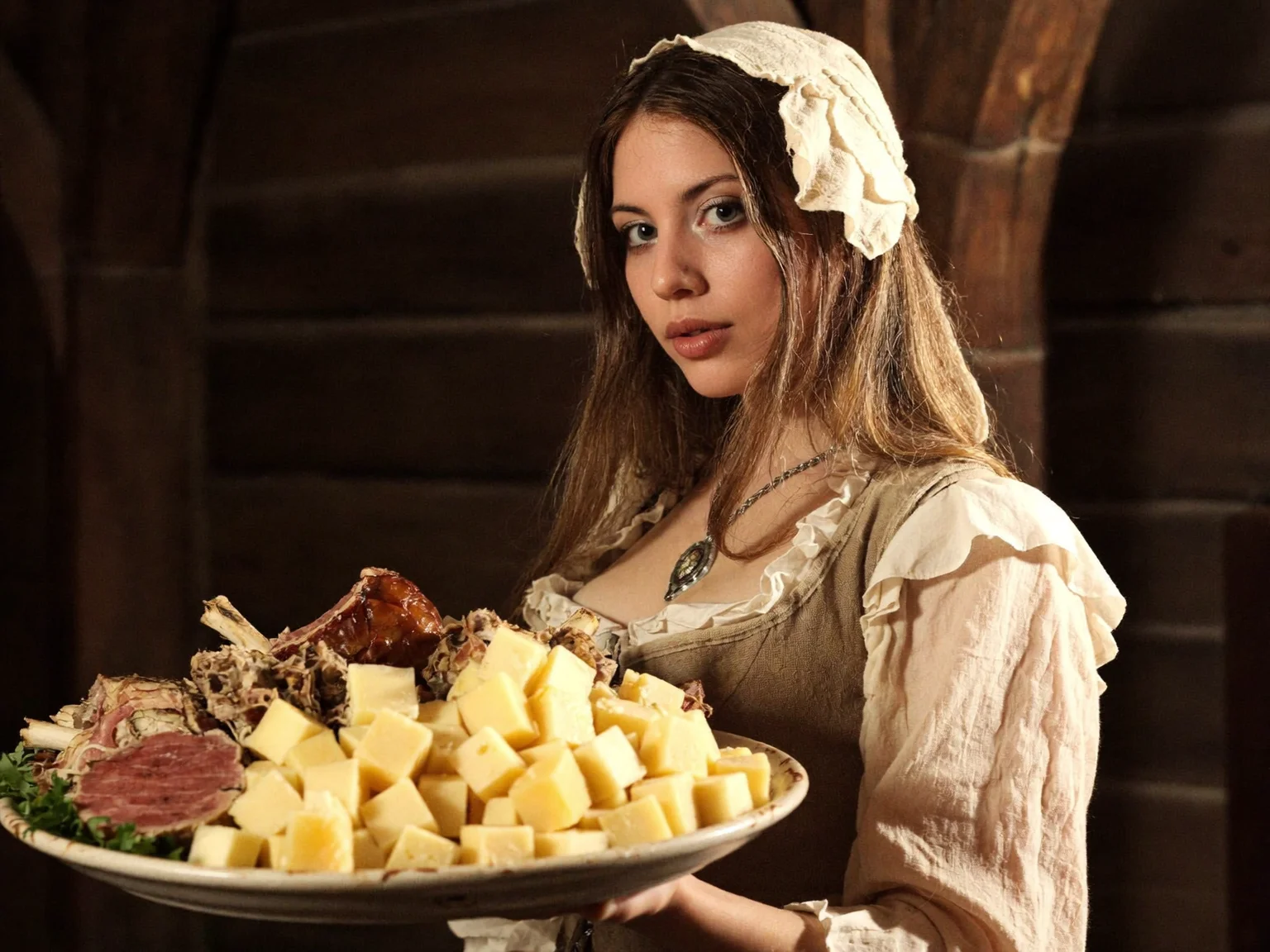
"Food is not a small detail — it is the detail most likely to make your world feel like somewhere a person could actually be hungry."— Madeleine Flamiano
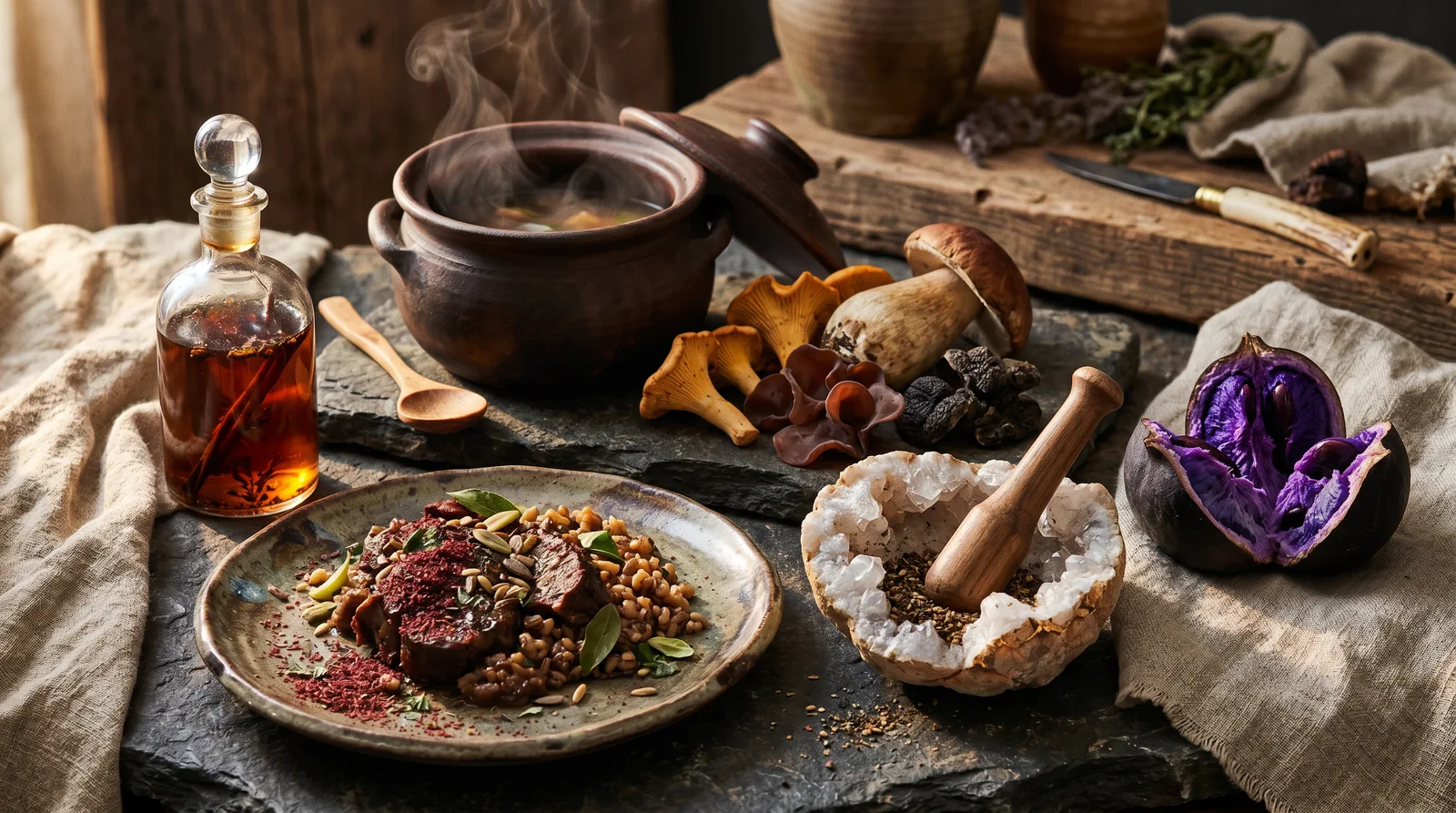
What you'll learn
What you'll be able to do
- Build a geographically and economically grounded food system for your setting — accounting for seasons, trade routes, scarcity, and the cultural memory carried by local and imported ingredients.
- Design culinary skill as meaningful character progression — from field rations to legendary dishes — and navigate the blurred boundary between master chef, herbalist, and spellcaster.
- Construct high-stakes food scenes (feasts, last rations, poisoned cups) with full narrative beats, tension, and political consequence, treating the table as a stage with clear power dynamics.
- Craft culturally specific food taboos, sacred dishes, and culinary diplomacy scenarios that generate authentic conflict, humility, and comedy without flattening the worldbuilding.
- Invent original flavor profiles and sensory writing — including a world-specific sixth flavor — that make any scene feel viscerally lived-in through texture, temperature, memory, and taste.
- Use food moments as engines of collaborative roleplay: lore checks that reward other players, cultural exchange between strangers, and character revelation through what a PC orders, refuses, hoards, or shares.
How it works
A school that adapts to you
This isn't a set of static videos. Every lesson is generated live and tuned to where you actually are.
We learn your level
A quick placement check tailors your starting point so you're never bored or lost.
Lessons adapt as you go
Each lesson is written for your pace and your goal, adjusting as your skills grow.
No ration goes to waste
Checkpoints, feedback, and gentle nudges turn progress into a real result.
The curriculum
What's inside your school
8 modules · 24 lessons

Locally Sourced, Carefully Imported
You begin where every meal begins: with the land itself. This module grounds you in the geography and economy of food in a living world, asking you to think rigorously about what grows in your region, what arrives by cart or caravel, and what never arrives at all. Supply chains, seasonal rhythms, and scarcity are not background noise — they are the first grammar of culinary worldbuilding. You will learn to treat locally sourced ingredients as carriers of cultural memory and imported goods as signals of wealth, desperation, or dangerous curiosity. By the end of this module, your world's larder should feel earned, specific, and alive.
- 1.1The Larder of the LandIncluded
- 1.2The Trade Route as RecipeIncluded
- 1.3Scarcity, Seasons, and the Memory of PlentyIncluded
Cooking and Crafting as Character Skills
This module asks you to take culinary ability seriously as a dimension of character design — not a novelty skill, but a meaningful progression arc that reveals who your character is, where they come from, and what they have survived. You will trace the full spectrum from field rations to legendary dishes, and you will learn to treat libations — the celebratory drink, the mourning toast, the poison concealed in sweetness — as their own narrative category. You will also push into the territory where the kitchen blurs into the laboratory: when does a master chef become an herbalist, and when does an herbalist become something that requires a very different kind of ability check? Culinary craft, in this module, is never just flavor. It is power.
- 2.1From Rations to Regional SpecialtiesIncluded
- 2.2Libations: The Celebratory, the Mourning, and the Poisoned CupIncluded
- 2.3The Line Between Chef and AlchemistIncluded
The Meal as Encounter
Combat is not the only encounter with stakes. In this module, you learn to treat significant food scenes — the feast that cements an alliance, the last ration divided before the final battle, the dinner where the betrayal is finally confirmed — as full narrative encounters with their own structure, rhythm, and consequences. You study the politics of who sits where, who eats first, who is excluded from the table, and what all of those choices communicate about power. You also examine the dramaturgy of the meal: how to pace a food scene, where to place the tension, and how to ensure that what happens at the table echoes beyond it. The table, in this module, is not a resting point between adventures. It is a stage.
- 3.1Building the Scene: Stakes, Beats, and ConsequencesIncluded
- 3.2The Politics of the TableIncluded
- 3.3The Feast, the Last Ration, and the Betrayal at the TableIncluded
Controversial Food and Sacred Plates
Food is never just sustenance. It is also law, faith, identity, and — when crossed — conflict. In this module, you enter the most culturally complex territory in culinary worldbuilding: the food that cannot be eaten, the dish that must be eaten, and the terrible comedy and genuine crisis that arise when someone gets it wrong. You examine food taboo and sacred cuisine not as obstacles to be navigated but as windows into the deepest values of a culture — and you learn to write those windows with the specificity and respect they deserve, while still mining them for every drop of dramatic and comedic potential. You will also turn the lens on your own characters: what won't they eat, and why, and what happens when the world refuses to accommodate that?
- 4.1What We Will Not Eat: Taboo, Faith, and IdentityIncluded
- 4.2The Sacred Plate: Ritual Food and Divine ObligationIncluded
- 4.3Culinary Diplomacy and the Comedy of the Wrong DishIncluded
The Five Flavors and the Sixth
Flavor is not decoration — it is a worldbuilding language. This module surveys the five established flavor profiles (sweet, sour, salty, bitter, umami) and teaches you to use each one as a deliberate narrative and cultural tool. Then it pushes you further: what would a sixth flavor taste like in your world? How do you build a sensory vocabulary for something that has never been tasted outside a cave system, a celestial event, or a specific moment in the life cycle of a rare creature? You will also develop the wider art of sensory food writing — texture, temperature, sound, the scent that hits before the taste, the memory a single bite can unlock — because description is not a luxury in culinary roleplay. It is one of the fastest and most powerful ways to make a scene feel like somewhere real.
- 5.1The First Five: Flavor as Worldbuilding LanguageIncluded
- 5.2The Sixth Flavor: Inventing Taste from the Ground UpIncluded
- 5.3Sensory Writing: Texture, Temperature, Memory, and SoundIncluded
Lore Checks at the Table
The meal is not just a setting — it is a mechanism for collaborative worldbuilding, and this module teaches you to use it as one. You will learn to make food moments into invitations: organic openings for your RP partners to contribute what their character knows, believes, or has been taught about the world. You will practice using the lore check not as a gatekeeping mechanism but as a generous opening — a moment where one player's question creates space for another player's answer, and the whole table's world gets richer in the process. You will also study what happens when your party eats in genuinely unfamiliar territory, and how a shared meal becomes the first vocabulary between strangers who do not yet have a common language for anything else.
- 6.1The Lore Check: Food as a Vehicle for World KnowledgeIncluded
- 6.2Eating in Unfamiliar Territory: The Meal as First ContactIncluded
- 6.3Opening the Table: Inviting Others to ContributeIncluded
Food as Character Revelation
Every meal is a portrait sitting. What your character orders, refuses, shares, hoards, or cannot afford to eat is a window into who they are at a level that combat statistics and backstory summaries cannot reach. This final module consolidates everything you have learned and turns it inward — toward the character as the site of culinary meaning. You will examine dietary restrictions as worldbuilding tools, scarcity and abundance as story engines, and the full narrative arc of a character's relationship with food, from the desperate rationing of the early journey to the legendary feast that marks an ending. You will leave this module not just as a more sophisticated culinary worldbuilder, but as a player who understands that the way your character eats is one of the most honest things they ever do.
- 7.1What You Order: The Plate as Self-PortraitIncluded
- 7.2Dietary Restrictions as Worldbuilding: Faith, Trauma, and CultureIncluded
- 7.3Scarcity, Abundance, and the Story They Tell TogetherIncluded
The Borrowed Table
The real world is a larder. This module teaches you how to raid it without plagiarizing it. You'll explore how ritual eating — across world religions, medieval tradition, and ceremony — can be reverse-engineered into taboos, feast-days, and sacred food customs for your own setting. You'll study culinary philosophy, from the austere precision of kaiseki to the stubborn ingenuity of peasant food economies, as a framework for building food cultures that feel internally coherent. And you'll sit at the table with Tolkien, Martin, and the fantasy canon to see how the professionals have already been doing this all along. By the end, you'll have a working method for borrowing deliberately from history, mythology, and literature — and transforming everything you take into something entirely your own.
- 8.1Feasts, Fasts, and the Ritual MealIncluded
- 8.2The Philosophy of the PlateIncluded
- 8.3Food in the CanonIncluded
Who it's for
Is this you?

The Veteran GM
You've been running campaigns for years, and you're ready to transform throwaway tavern scenes into politically charged encounters with real narrative weight.

The Collaborative Fiction Writer
You write post-to-post fiction and want sensory prose and cultural specificity that makes readers feel the texture and temperature of every shared meal your characters sit down to.

The Emerging Worldbuilder
You're building your first original setting and want grounded, rigorous frameworks — trade routes, seasons, scarcity — so your world's food feels earned, not invented on a whim.

The Character-Driven Player
You want your PC's food choices — what they order, refuse, hoard, or share — to do real narrative work and reveal character without stopping the scene dead.

The Lore Architect
You live for sacred rites, contested taboos, and cultural specificity, and you want a structured approach to designing food traditions that generate authentic conflict and earned comedy.

The Narrative Systems Tinkerer
You're fascinated by the overlap between culinary craft and game mechanics — alchemy, herbalism, skill progression — and want to design systems where cooking is genuinely consequential.
Questions
Frequently asked
Your teacher
A note from your teacher

Madeleine Flamiano
You've sat at the table — the game table, the keyboard, the worldbuilder's notebook — and you've felt it: the moment where someone's character orders a meal, or refuses one, and you sense there's something enormous underneath that moment that you don't quite have the language for yet. The food is there. The scene is there. But somehow it slides off the surface of the story without leaving a mark. I know that feeling. It's the reason I built this course.
What I want to offer you is a set of frameworks — rigorous, tested, genuinely useful ones — for understanding food not as flavoring for your story, but as one of its primary structural materials. In the real world, and in every convincing imaginary one, cuisine is a record of geography, economy, grief, celebration, faith, and power. It tells you who had access to what, and when, and at whose expense. It carries the memory of famines. It draws borders. It breaks them. A table set for a feast is one of the most politically loaded images in human experience, and the curriculum we're going to move through together treats it exactly that way.
We'll start in the earth — literally. The first module asks you to think about what grows where, what travels well, what is scarce and why, and how those facts accumulate into a culinary identity for a people. From there, we'll move through character skill design, high-stakes scene construction, sacred and taboo food traditions, sensory language, collaborative play mechanics, and character revelation — building a complete toolkit, piece by piece. Nothing here is filler. Every lesson is a door into something your stories can use.
I want to address the objection I hear most often: "But food is a small detail. Shouldn't I be focused on the bigger things?" I'd gently push back on the premise. Food is not a small detail. It is, in fact, the detail that your players and readers are most likely to remember — because it's the one that reaches past the intellect and lands in the body. The right food moment, written with intention, does what pages of exposition cannot. It makes your world feel like somewhere a person could actually be hungry.
What I'm handing you in this curriculum is not a recipe book, though there is invention involved. It's a map — drawn by someone who has eaten in a great many imaginary cities, and wants very much for you to eat well in yours. Come hungry. There is a great deal on the table.
— Madeleine Flamiano
Start your journey today
Join get instant access — learn at your own pace with an AI coach in your corner.
$5/mo
Recurring billing · cancel anytime
Secure checkout · Instant access
- 8 modules, 24 lessons
- AI-adaptive lessons tuned to your level
- Quizzes & checkpoints to lock in progress
- Your own AI learning coach
- Learn on any device, at your pace
- Full access for as long as you're subscribed