Understand your body through the lens of 3,000 years of medicine
Learn the core principles of Traditional Chinese Medicine — from Qi and meridians to herbal theory and the Five Elements — and start applying them to your health and wellbeing today.
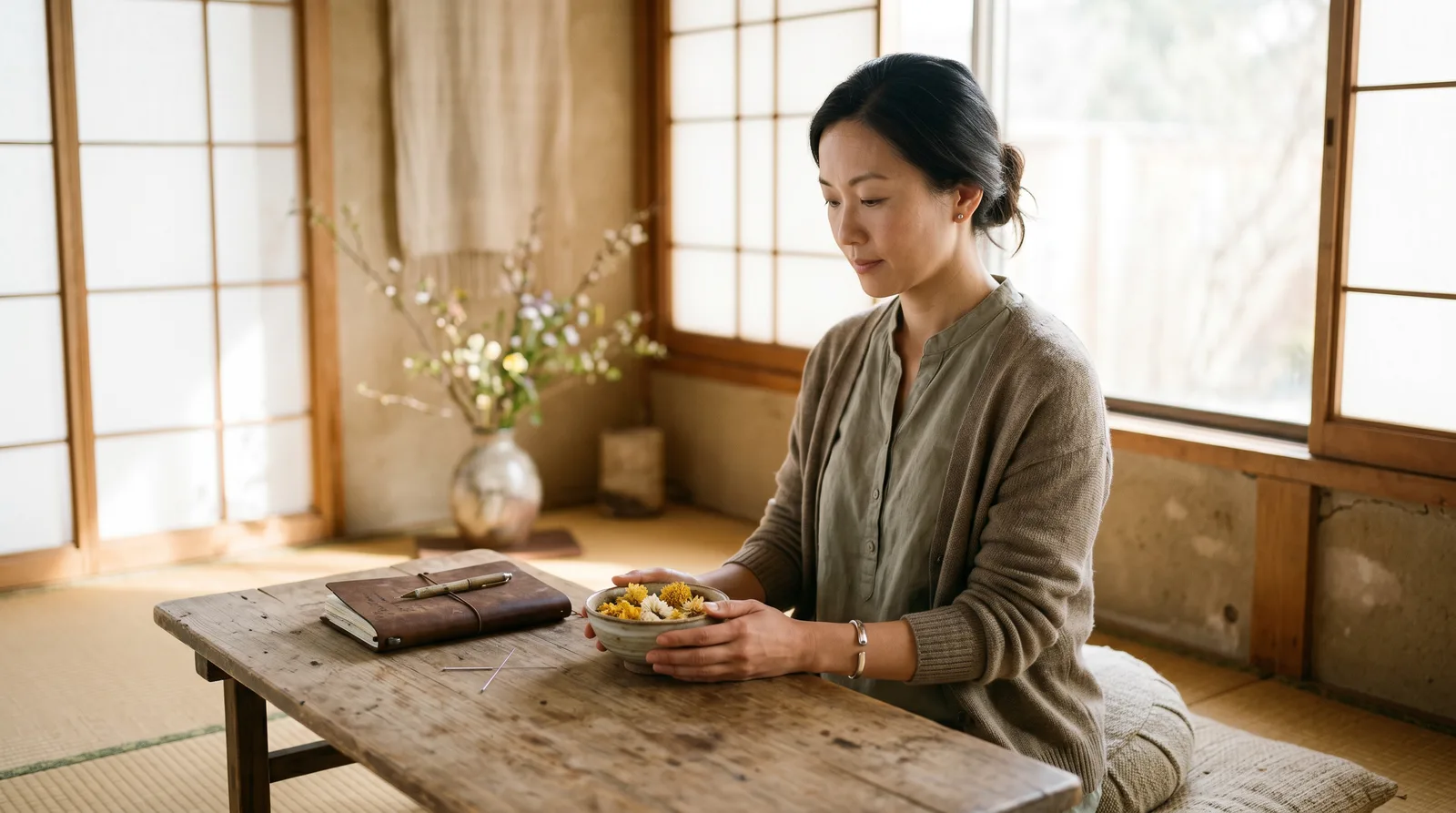
"TCM was never meant to live only in a clinic — my goal is to make it genuinely livable for you."— Denise Chenault-Lang
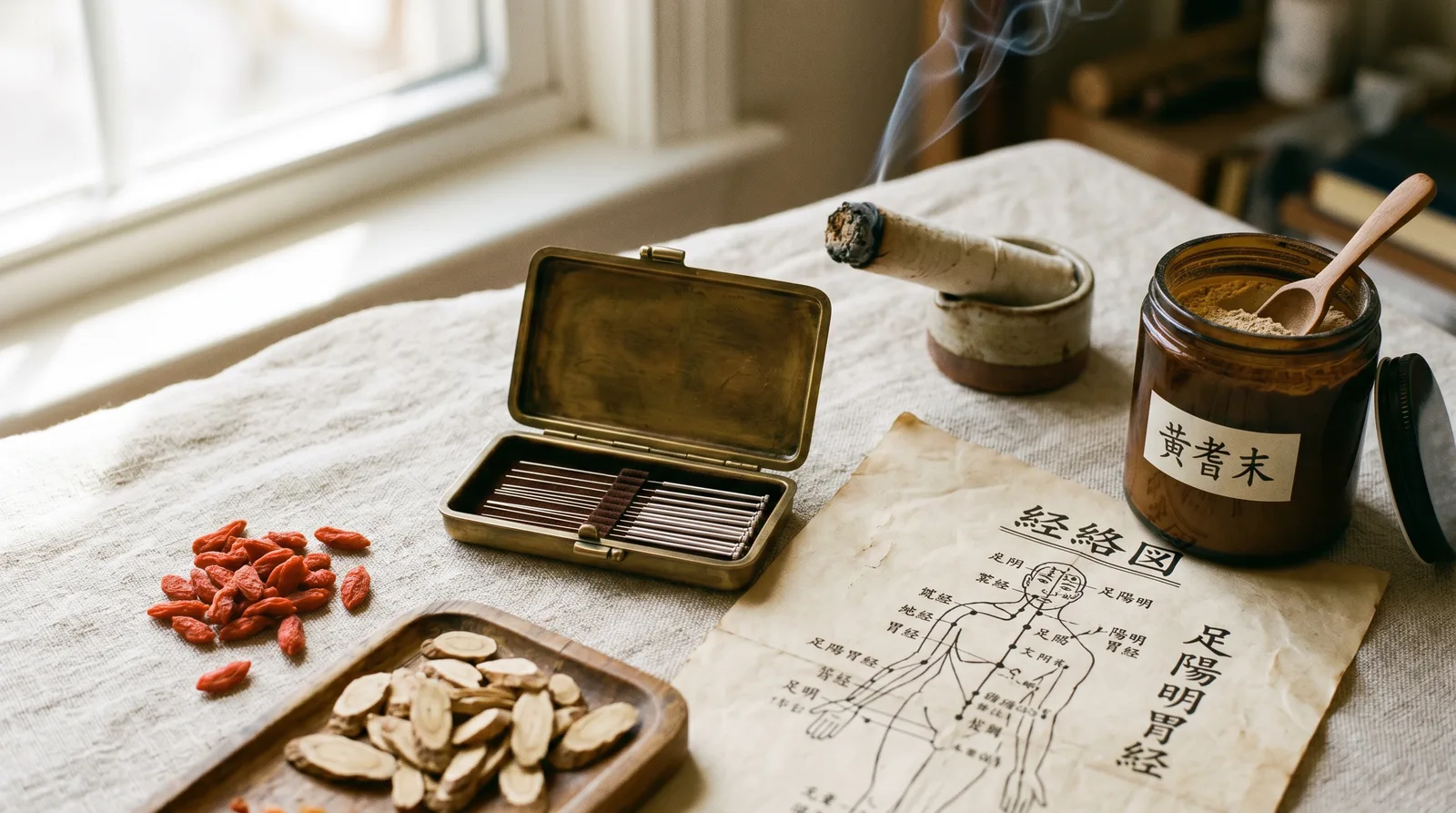
What you'll learn
What you'll be able to do
- Explain the foundational concepts of Qi, Yin/Yang, and the Five Elements and how they govern health and disease
- Identify the 12 primary meridians, their organ correspondences, and key acupressure points on each
- Read a basic TCM pattern diagnosis (e.g., Liver Qi Stagnation, Kidney Yang Deficiency) from common signs and symptoms
- Select and combine foods according to TCM dietary principles — flavor, thermal nature, and seasonal eating
- Understand the roles of the most common TCM herbal categories and recognize 20 foundational herbs by name and function
- Apply simple self-care practices — acupressure, Qi Gong breathing, and seasonal lifestyle adjustments — to support daily wellbeing
How it works
A school that adapts to you
This isn't a set of static videos. Every lesson is generated live and tuned to where you actually are.
We learn your level
A quick placement check tailors your starting point so you're never bored or lost.
Lessons adapt as you go
Each lesson is written for your pace and your goal, adjusting as your skills grow.
Your AI coach keeps you moving
Checkpoints, feedback, and gentle nudges turn progress into a real result.
The curriculum
What's inside your school
6 modules · 19 lessons

The Foundations of TCM Philosophy
Establishes the historical, cultural, and philosophical bedrock of Traditional Chinese Medicine before any clinical or practical content is introduced. Students must internalize this worldview first — it is the lens through which every subsequent topic is understood.
- 1.1What Is TCM? Origins, Worldview, and Core AssumptionsIncluded
- 1.2Qi — The Vital ForceIncluded
- 1.3Yin and Yang — The Art of BalanceIncluded
- 1.4The Five Elements — Nature's Map of the BodyIncluded
Meridians, Organs, and Acupressure
Builds anatomical and physiological literacy in TCM terms. Students learn the pathways through which Qi travels, the functional roles of the Zang-Fu organs, and how to locate and stimulate key acupressure points — providing the structural knowledge required for both self-care practice and pattern diagnosis.
- 2.1The 12 Primary Meridians — Pathways of QiIncluded
- 2.2The Zang-Fu Organs — TCM Organ TheoryIncluded
- 2.3Key Acupressure Points — Location, Function, and TechniqueIncluded
- 2.4Reading the Body — TCM Diagnosis BasicsIncluded
TCM Pattern Diagnosis — Recognizing Imbalance
Dedicated module for developing pattern diagnosis fluency — a critical outcome that in the draft curriculum was partially embedded in Module 2 but not given enough depth or practice to be reliably achieved. Students move from isolated symptom recognition to reading full clinical pictures, including the nuances of combined and evolving patterns. [GAP FILLED: The draft had no standalone diagnosis module; this is required to deliver the 'read a basic TCM pattern diagnosis' outcome.]
- 3.1The Eight Principles in PracticeIncluded
- 3.2Common Patterns — Liver, Heart, Spleen, Lung, KidneyIncluded
- 3.3Integrating Diagnosis — Reading Full Clinical PicturesIncluded
TCM Nutrition — Eating for Balance
Applies TCM theory directly to food and diet. Students learn to categorize foods by thermal nature and flavor, understand how these properties affect organ function and Qi, and design meals that support their identified pattern or seasonal needs. Positioned after the diagnosis module so students can make pattern-informed food choices.
- 4.1Thermal Nature and Flavor — The TCM Properties of FoodIncluded
- 4.2Seasonal Eating and Pattern-Based NutritionIncluded
TCM Herbal Medicine — Theory and Foundational Herbs
Provides a systematic introduction to TCM herbal medicine: how herbs are classified by property and category, how formulas are constructed using the君臣佐使 (Jun-Chen-Zuo-Shi) hierarchy, and in-depth profiles of 20 foundational herbs. Positioned after nutrition because herb properties use the same thermal nature/flavor framework already learned.
- 5.1Herbal Theory — Properties, Categories, and Formula LogicIncluded
- 5.220 Foundational Herbs — Profiles, Functions, and ApplicationsIncluded
Daily Self-Care — Acupressure, Qi Gong, and Seasonal Living
Translates all prior knowledge into sustainable, personalized daily practice. This is the applied capstone module — students integrate their understanding of Qi, meridians, pattern diagnosis, nutrition, and herbal awareness into a whole-health self-care system. Positioned last so every self-care decision is informed by the full curriculum.
- 6.1Qi Gong Breathing and Movement FundamentalsIncluded
- 6.2Building a Personal Acupressure RoutineIncluded
- 6.3Seasonal Lifestyle Adjustments — Living in Rhythm with NatureIncluded
- 6.4Integrating TCM Into Your Whole Health PracticeIncluded
Who it's for
Is this you?

Acupuncture patients
You're already experiencing TCM's benefits firsthand — this course helps you understand exactly what your practitioner is observing and why, so you become an active participant in your own healing.

Yoga & movement teachers
Understanding Qi, meridians, and the Five Elements adds a precise energetic and philosophical layer to your teaching that yoga anatomy alone cannot provide.

Aspiring holistic health coaches
TCM's pattern-based approach to nutrition, lifestyle, and self-care gives you a coherent, practical framework to support clients more deeply and speak a language that integrates with many healing traditions.

Wellness-curious self-learners
You've read about herbal teas, seasonal eating, and energy medicine — now you want the real conceptual foundation that makes all of it make sense.

Meditation practitioners
TCM's understanding of how emotional patterns, organ systems, and Qi flow interact will deepen your inner practice with a rich new map of the body-mind relationship.
Pre-clinical students
If you're considering a formal TCM or naturopathic degree program, this school gives you the grounded foundational vocabulary that will make your first year of professional training significantly easier.
Questions
Frequently asked
Your teacher
A note from your teacher
Denise Chenault-Lang
Perhaps you have been receiving acupuncture for a while and you leave each session feeling better — but you have only a vague sense of why. Or you practice yoga and keep encountering words like Prana, Nadis, and Apana, and you sense there is a parallel tradition just beyond your reach. Or someone recommended a Chinese herbal formula and you took it faithfully, trusting the process, wishing you understood even half of what was happening.
I know that place — the place of genuine curiosity without a map. TCM is one of the most complete healing systems humanity has ever developed, and yet it is remarkably easy to encounter it only in fragments: a point here, an herb there, a diagnosis phrase you cannot quite decode. What it deserves — what you deserve — is to encounter it whole. That is exactly what this school is built to give you.
We move carefully and in order. We begin where TCM itself begins: with the nature of Qi, the logic of Yin and Yang, and the elegant map of the Five Elements. From there we trace the 12 primary meridians through the body, learn the Zang-Fu organ theory that gives them meaning, and begin to read the signs the body offers. By the time we reach pattern diagnosis, herbal theory, and the 20 foundational herbs, none of it will feel like memorization — it will feel like the natural next step in a conversation that has been building since the first lesson.
I want to be honest about what this school is and is not. This is not a clinical certification. You will not be practicing medicine. What you will have, at the end of this journey, is something genuinely rare: a fluent, grounded understanding of one of the world's great healing traditions — one you can apply to your own health, carry into your wellness practice, or use as a confident foundation for further professional study. Every precise TCM term in this school is earned, not decorative, and I will never ask you to accept something on faith that I can also explain.
The final module — daily self-care through Qi Gong, acupressure, and seasonal living — is the one I am perhaps most fond of, because it is where the philosophy becomes a practice you can feel. TCM was never meant to live only in textbooks or clinics. It was meant to shape how you eat in winter, how you breathe when you are anxious, how you press a single point on your wrist when your heart feels unsettled. That is the invitation I am extending to you. Come and learn this — carefully, completely, and at a pace that respects both the tradition and your life.
— Denise Chenault-Lang
Start your journey today
Join get instant access — learn at your own pace with an AI coach in your corner.
$39/mo
Recurring billing · cancel anytime
Secure checkout · Instant access
- 6 modules, 19 lessons
- AI-adaptive lessons tuned to your level
- Quizzes & checkpoints to lock in progress
- Your own AI learning coach
- Learn on any device, at your pace
- Full access for as long as you're subscribed