Get a live band sounding good in 10 minutes flat
A field-built, step-by-step workflow that patches, gain-stages, and dynamically controls a full band before you touch a single EQ knob — so you're mix-ready when the room is still filling up.
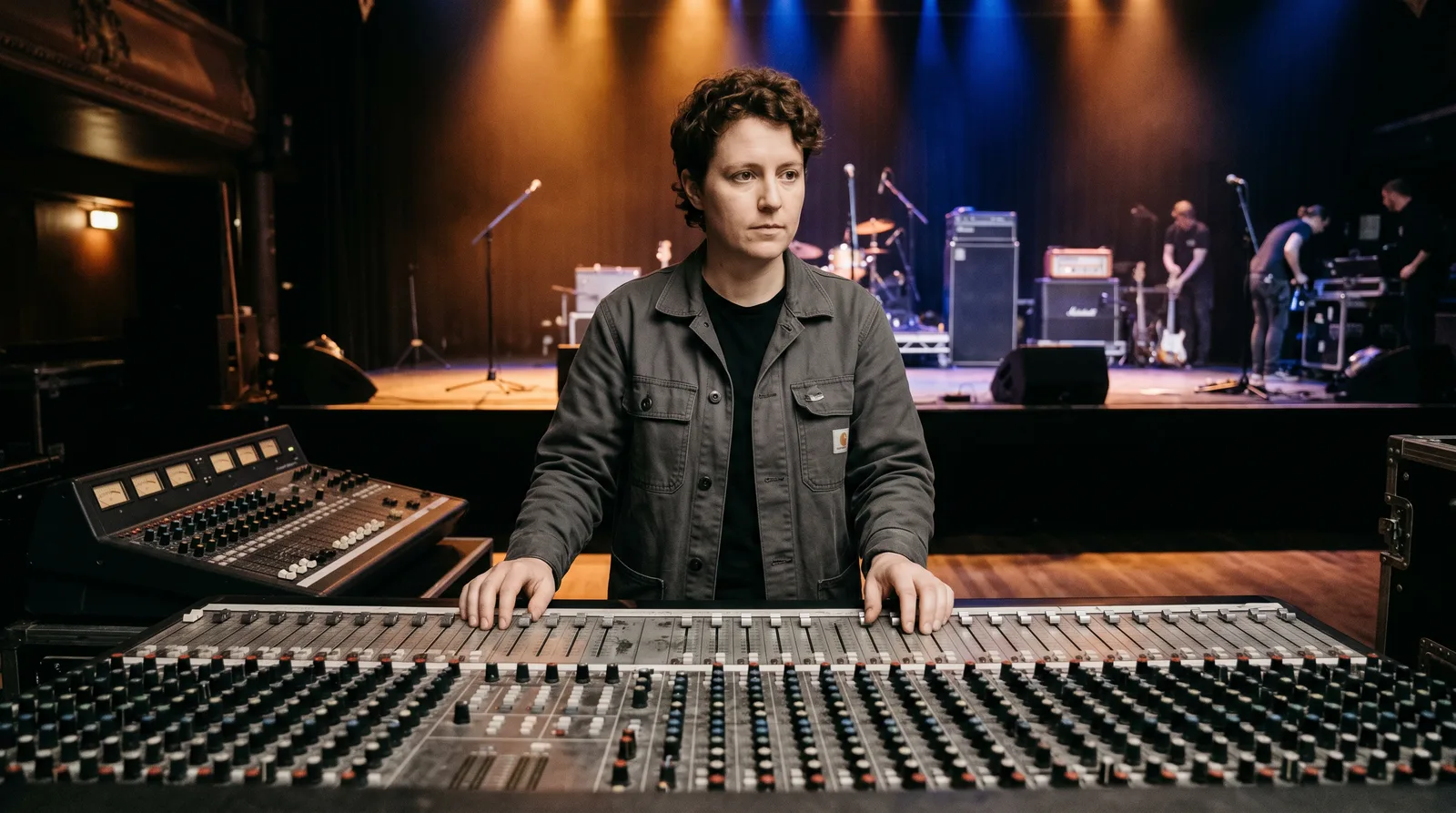
"Tricks fail under pressure. This course gives you a system that doesn't."— Matt Jones
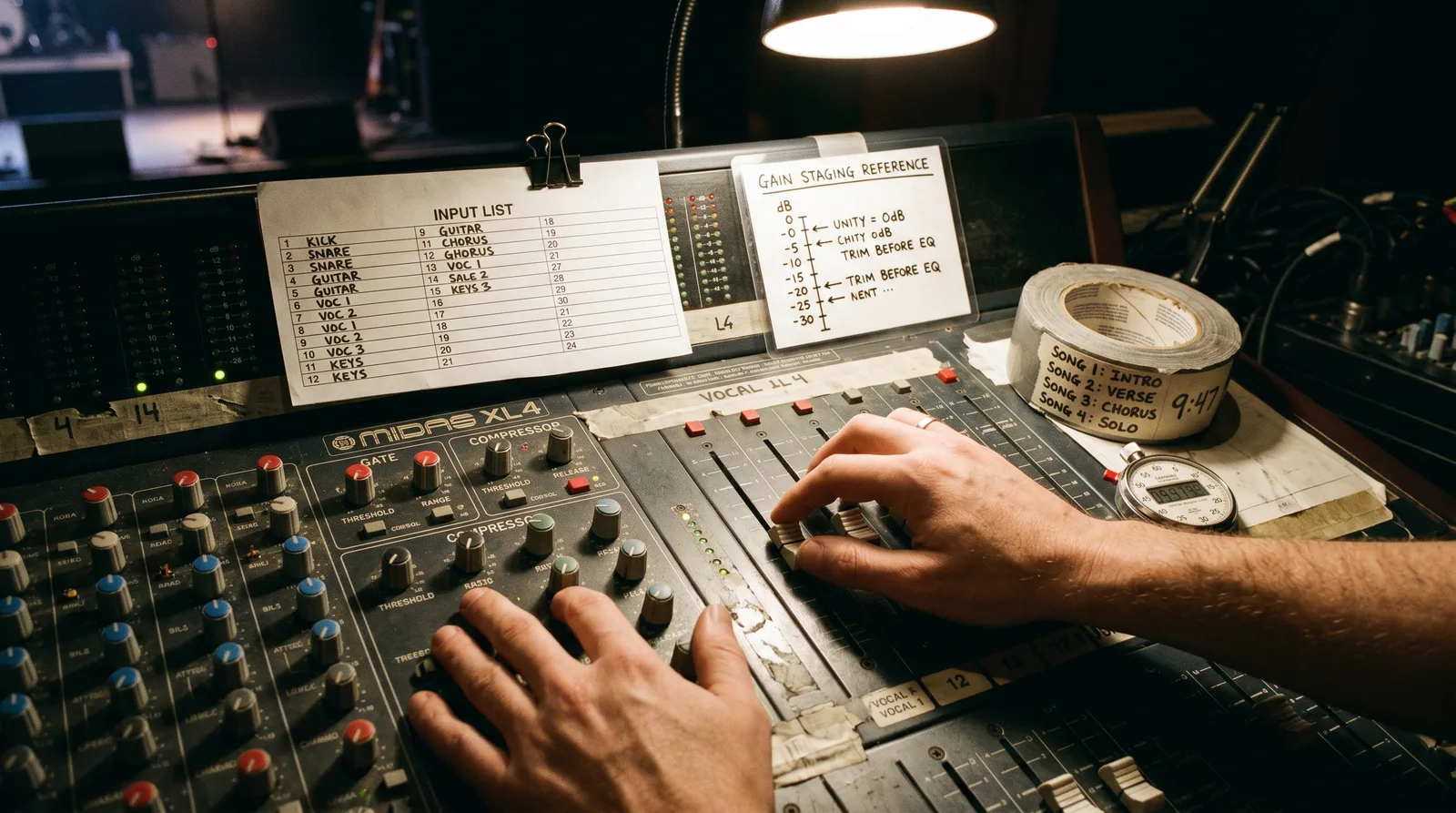
What you'll learn
What you'll be able to do
- Patch, label, gain-stage, and zero a full band's channel strip from scratch in under 10 minutes using a repeatable pre-show workflow
- Apply gates, expanders, and compression to drums, vocals, bass, and acoustic sources in the correct order — before touching EQ — to stabilize every source dynamically
- Use high-pass filtering as a systematic cleanup tool across the mix bus and individual channels, not as a tonal shortcut
- Execute surgical subtractive EQ only after dynamics are locked, using decision trees to distinguish frequency problems from dynamics problems from stage-volume problems
- Triage a fast changeover under pressure: rebuild gain structure, recover from feedback, and restore monitor/FOH balance without losing the room
- Construct and deploy a personalized show file, channel template, and pre-show checklist that travel with you to every gig
How it works
A school that adapts to you
This isn't a set of static videos. Every lesson is generated live and tuned to where you actually are.
We learn your level
A quick placement check tailors your starting point so you're never bored or lost.
Lessons adapt as you go
Each lesson is written for your pace and your goal, adjusting as your skills grow.
Your AI coach keeps you moving
Checkpoints, feedback, and gentle nudges turn progress into a real result.
The curriculum
What's inside your school
8 modules · 29 lessons

The 10-Minute Live Mix System
Establishes the foundational philosophy and workflow architecture of the entire course. Students learn exactly why Dynamics First, EQ Second is not a preference but an engineering discipline, and they internalize a repeatable mental map before ever touching a console. This module front-loads the decision-making framework so every subsequent module has a clear context.
- 1.1Why Dynamics First, EQ SecondIncluded
- 1.2Reading the Stage in 60 SecondsIncluded
- 1.3The 10-Minute Workflow MapIncluded
Patch, Label, Gain, and Fader Zero
Covers the pre-dynamics groundwork: building a disciplined input list, establishing channel layout logic, driving gain correctly from the mic capsule to the fader, applying high-pass filtering as a systematic cleanup step, and setting faders to unity before any processing decisions are made. Students leave this module with a clean, labeled, gain-staged, HPF'd console that is ready for dynamics processing — not EQ.
- 2.1Input Lists, Channel Order, and Console Layout DisciplineIncluded
- 2.2Gain Staging: From Mic Capsule to Fader UnityIncluded
- 2.3High-Pass Filtering as Systematic CleanupIncluded
- 2.4Fader Zero and the Pre-Mix BalanceIncluded
Dynamics First: Gates, Expanders, and Compression
The technical core of the course. Students build a systematic understanding of gating, expansion, and compression as stabilization tools — not tone tools — and apply them in the correct order across all sources. Every lesson is anchored to specific settings, listening cues, and mistakes to avoid. Students leave this module able to process a full band's dynamic layer before touching a single EQ band.
- 3.1Gates and Expanders: Silence What Shouldn't Be HeardIncluded
- 3.2Compression Fundamentals for Live SoundIncluded
- 3.3Compression Source Playbook: Vocals and Speaking MicsIncluded
- 3.4Compression Source Playbook: Kick, Snare, Bass, and Acoustic GuitarIncluded
- 3.5When Not to CompressIncluded
Source Playbooks: Starting Points by Instrument
Provides a rapid-reference, per-source starting-point system covering the full signal chain — gain, HPF, gate/expander, compression — for every instrument type in a standard live band. Students build fluency in moving quickly from source to source during line check, applying consistent starting points before any EQ adjustments. This module is deliberately placed after the dynamics module so students apply starting points in the correct processing order.
- 4.1Drums: Kick, Snare, Hi-Hat, Toms, and OverheadsIncluded
- 4.2Bass and Electric GuitarIncluded
- 4.3Acoustic Guitar, Keys, and DI SourcesIncluded
- 4.4Vocals: Lead, Background, and Speaking MicsIncluded
EQ Second: Surgical Cuts After Dynamics Are Locked
Teaches EQ as the second line of defense: applied only after gain staging, HPF, gating, compression, and fader balance have stabilized every source. Students learn the core principle of subtractive EQ, how to use a decision tree to determine whether a problem is a frequency issue or a dynamics/gain issue still masquerading as a tonal problem, and how to build per-source EQ starting points that travel with their show file. The module is positioned after all dynamics work is complete so students have the right context for every EQ decision.
- 5.1The Dynamics vs. Frequency Decision TreeIncluded
- 5.2Subtractive EQ Technique: Cuts Before BoostsIncluded
- 5.3EQ Playbook: Per-Source Starting Points and Common Problem FrequenciesIncluded
- 5.4What Not to EQ: Avoiding the Frequency ChaseIncluded
Fast Changeover Triage and Feedback Recovery
Prepares students for the highest-pressure live sound scenario: the fast changeover. Covers how to rebuild gain structure quickly when a new band patches in, how to triage monitor vs. FOH priorities under time pressure, how to prevent and instantly recover from feedback, and how to make rapid show-go decisions when the room is not perfect. This module is deliberately placed after full dynamics and EQ fluency is established so students can apply compressed workflow versions of everything they have learned.
- 6.1The 5-Minute Changeover Reset ProtocolIncluded
- 6.2Feedback Prevention and Fast RecoveryIncluded
- 6.3Monitor vs. FOH Triage Under PressureIncluded
Build Your Repeatable Show File and Checklist
Teaches students to codify everything they have learned into a portable, personalized show file, channel template, and pre-show checklist that travel with them to every gig. The goal is a complete, show-ready documentation system that allows students to execute the 10-minute workflow on any console, at any venue, with any band — without relying on memory under pressure.
- 7.1Show File Architecture: What to Save, What to ResetIncluded
- 7.2The Pre-Show Checklist: From Load-In to Line CheckIncluded
- 7.3Post-Show Notes and Continuous ImprovementIncluded
Timed Drills and the Final 10-Minute Band Challenge
The capstone module. Students integrate every skill from the course into timed, pressure-tested drills — first in isolated practice scenarios without a full venue, then in escalating pressure simulations, and finally in the definitive Final 10-Minute Band Challenge. This module is designed to produce field-ready performance, not just knowledge recall. Students who complete this module should be able to walk up to any console at any gig and execute the full workflow under real show pressure.
- 8.1Solo Drills Without a VenueIncluded
- 8.2Pressure Scenario DrillsIncluded
- 8.3The Final 10-Minute Band ChallengeIncluded
Who it's for
Is this you?

Musicians running their own FOH
You're tired of guessing at the board before your own set — this gives you a repeatable workflow that works even when you're the one performing.

Church AV volunteers
You inherited a console and a responsibility — this course gives you the procedural discipline to deliver a consistent, professional mix every Sunday.

Venue and club AV staff
You're running sound for a different band every night with zero buffer time — the 10-minute workflow and changeover reset protocol are built for exactly your reality.
Newer FOH engineers
You have some console time but no locked-in system — this course closes the gap between 'I know the basics' and 'I can execute under pressure.'

Production and stage techs
You're moving toward dedicated FOH work and need a field-hardened foundation — gain structure, dynamics discipline, and a show file system that travels with you.

Self-taught operators leveling up
You've learned from fragments and YouTube — this course replaces the patchwork with a single, coherent system you can trust in any room.
Questions
Frequently asked
Your teacher
A note from your teacher
Matt Jones
If you've ever stood at a console with 10 minutes to line-check a full band and realized you weren't sure what to do first — this course is what I wish someone had handed me early in my career.
Most operators learn live sound the way I did at first: by absorbing fragments. A tip here, a YouTube video there, a piece of advice from the engineer who loaded out before you showed up. What you end up with is a collection of tricks but not a system. And tricks fail under pressure. Systems don't.
The 10-Minute Live Mix System is a field-built workflow, not a classroom theory course. Every step is sequenced the way it actually happens on show day: patch and label first, gain from the capsule to fader unity, high-pass filtering as a cleanup discipline across every channel, then gates and compression source by source — before you touch EQ. That order is not arbitrary. It's the difference between mixing a controlled, stable signal and chasing problems you've accidentally created for yourself.
The playbooks in this course give you real starting points: what to set, what to listen for, what range to try first, and what mistake will cost you the gig. Drums, vocals, bass, acoustic sources, DI instruments — each one gets a concrete, repeatable procedure. And when things go sideways — a fast changeover, a feedback ring, a monitor mix that's eating your FOH balance — there's a triage protocol for that too, drilled under simulated pressure.
You'll leave with more than knowledge. You'll leave with a show file architecture, a channel template, and a pre-show checklist that travel with you to every venue. You'll have drilled the workflow enough times that on show day, your hands know what to do while your ears stay focused on the room. That's the goal: a system you can execute on a stranger's console, in a venue you've never seen, with a band you've never heard — and still deliver a professional mix.
If you're ready to stop improvising and start operating with real procedural discipline, I'll see you in the first lesson.
— Matt Jones
Start your journey today
Join get instant access — learn at your own pace with an AI coach in your corner.
$79/mo
Recurring billing · cancel anytime
Secure checkout · Instant access
- 8 modules, 29 lessons
- AI-adaptive lessons tuned to your level
- Quizzes & checkpoints to lock in progress
- Your own AI learning coach
- Learn on any device, at your pace
- Full access for as long as you're subscribed