Learn to read the hidden language of your own mind
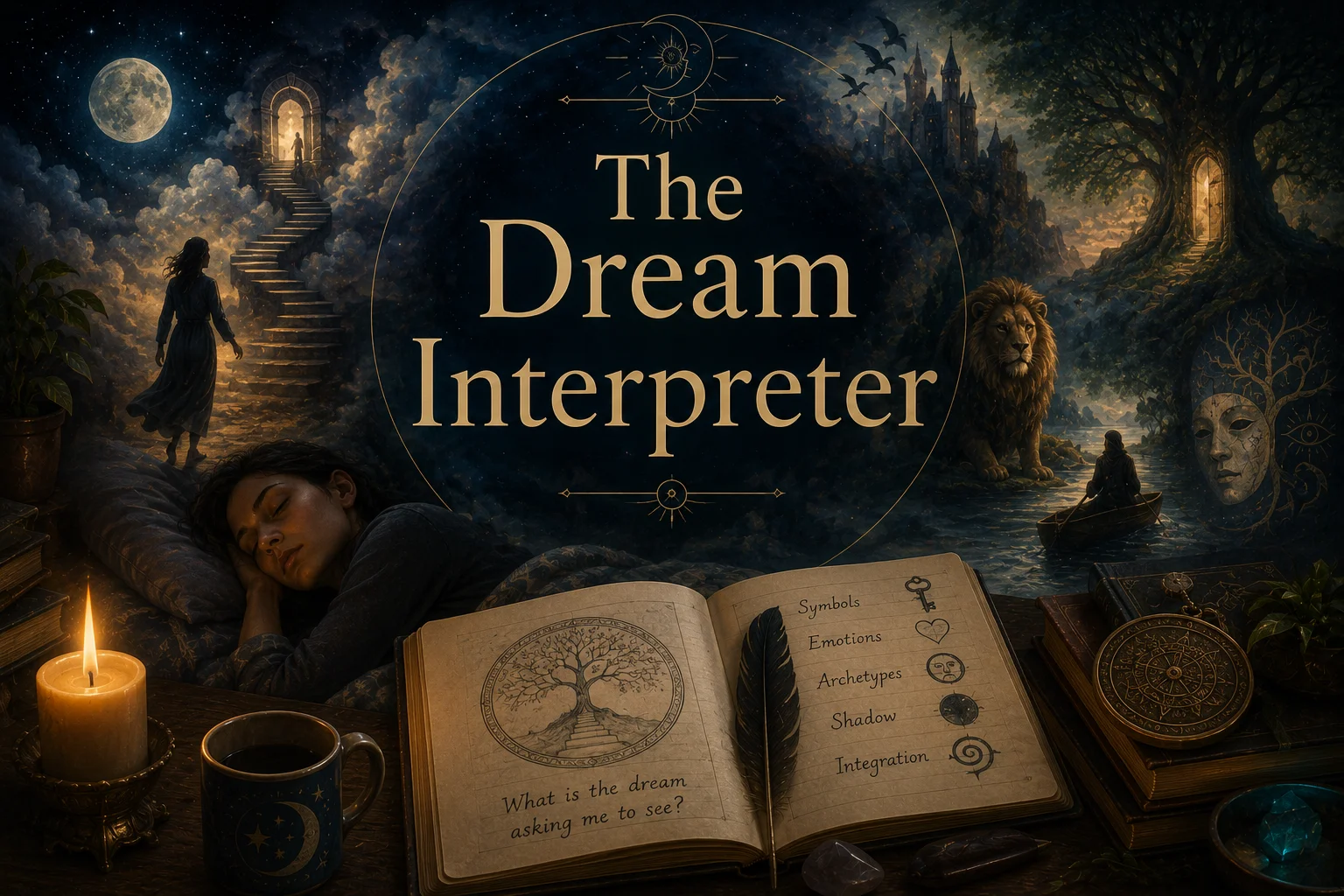
Learn to decode the symbolic language of your dreams using psychology, mythology, and Jungian frameworks — no dream dictionary required. Build a personal practice that deepens self-awareness, creativity, and emotional insight.
"Dreams don't need to be mysterious to be meaningful — they need to be met with the right tools, and genuine curiosity."
— Carla Paton

What you'll learn
What you'll be able to do
- Reliably recall and record your dreams using a structured journalling practice
- Identify recurring symbols, archetypes, and shadow figures within your own dreamscape
- Apply Freudian, Jungian, and contemporary frameworks to interpret any dream with confidence
- Distinguish personal symbolism from universal archetypes drawn from mythology and folklore
- Work constructively with nightmares and recurring dreams as tools for emotional healing
- Complete a full end-to-end interpretation of a complex dream using a flexible, repeatable method
How it works
A school that adapts to you
This isn't a set of static videos. Every lesson is generated live and tuned to where you actually are.
We learn your level
A quick placement check tailors your starting point so you're never bored or lost.
Lessons adapt as you go
Each lesson is written for your pace and your goal, adjusting as your skills grow.
Your AI coach keeps you moving
Checkpoints, feedback, and gentle nudges turn progress into a real result.
The curriculum
What's inside your school
6 modules · 23 lessons

The Dream Through History and Theory
This foundational module establishes the intellectual and cultural landscape of dream interpretation before students begin any personal practice. By tracing how dreams have been understood across civilisations and examining the three major psychological frameworks, students arrive at Module 2 with the conceptual vocabulary — unconscious, compensation, latent content, archetypes, neuroscience — they will need throughout the course. Sequencing note: history and theory must precede journalling and symbol work so that students know why the practices they adopt are grounded in evidence and tradition.
- 1.1Dreams Across Cultures and TimeIncluded
- 1.2Freud, the Unconscious, and the Dream as DisguiseIncluded
- 1.3Jung, the Collective Unconscious, and Symbolic CompensationIncluded
- 1.4Contemporary Dream Research and NeuroscienceIncluded
Building Your Dream Practice
Before students can interpret dreams, they must consistently have dreams to interpret. This module establishes the practical infrastructure of the entire course — recall techniques, journalling method, and early pattern recognition — and runs deliberately before any deep symbol work. Students who skip or rush this module will have no raw material to bring to Modules 3–6. The module closes with a pattern-spotting lesson that acts as a natural bridge into the Symbols module.
- 2.1The Science and Practice of Dream RecallIncluded
- 2.2The Dream Journal: Structure, Method, and RitualIncluded
- 2.3Reading Your Own Journal: Spotting Early PatternsIncluded
Symbols, Archetypes, and the Collective Unconscious
With a working journal and theoretical grounding in place, students now go deep into the language of dreams: symbols, archetypes, the shadow, and the relationship between personal and collective meaning. This is the conceptual heart of the course. The module is sequenced so that symbol mechanics come before archetypes, and archetypes before the shadow — because the shadow is best understood as a specific, charged archetypal figure rather than just 'the bad guy.' The module closes with mythology and folklore, connecting Jungian theory to the cultural history established in Module 1.
- 3.1How Symbols Work in DreamsIncluded
- 3.2Jungian Archetypes: The Cast of Every DreamIncluded
- 3.3The Shadow: Your Dream's Most Important AntagonistIncluded
- 3.4Personal Symbolism vs. Universal Archetypes: Knowing the DifferenceIncluded
- 3.5Dreams, Mythology, and FolkloreIncluded
Nightmares, Recurring Dreams, and Difficult Dreamscapes
This module is sequenced after the Symbols and Archetypes module deliberately: students can now approach nightmares and recurring dreams not as random terrors but as purposeful communications from specific parts of the psyche — often the shadow or an unintegrated complex — whose symbolic logic they are now equipped to read. The module covers the full arc from understanding difficult dreams to working with them constructively, directly addressing Outcome 5.
- 4.1Understanding Nightmares: The Psyche's Alarm SystemIncluded
- 4.2Recurring Dreams: What the Psyche Won't Let GoIncluded
- 4.3Working Constructively with Nightmares and Difficult Dreams: Healing ToolsIncluded
Practical Interpretation Methods
This module assembles the full interpretive toolkit and places it in the correct sequence: structured methods first, flexible integration second, specialist practices (lucid dreaming) third, and ethical dimensions last. Lucid dreaming is repositioned from a standalone topic — as it appeared in the draft — into the context of conscious dreamwork, where it logically belongs as an advanced application of everything learned so far. The ethics lesson is retained at the module's close as a natural endpoint before the capstone, since students will be discussing others' dreams in the final project session.
- 5.1The Step-by-Step Dream Interpretation MethodIncluded
- 5.2The Feeling-First and Narrative Arc MethodsIncluded
- 5.3Integrating Multiple Frameworks: Reading a Dream in LayersIncluded
- 5.4Lucid Dreaming and Conscious DreamworkIncluded
- 5.5Ethical Dimensions of DreamworkIncluded
Putting It All Together: Your Complete Dream Interpretation
The capstone module integrates every skill, framework, and practice developed across the course into a single end-to-end interpretation project. It is sequenced last because it depends on all prior learning: journal entries (Module 2), symbolic fluency (Module 3), shadow awareness (Modules 3–4), interpretive methods (Module 5), and ethical grounding (Module 5). The module closes by anchoring students in a sustainable, long-term dream practice — the course's final deliverable beyond the project itself.
- 6.1Selecting and Preparing Your Final DreamIncluded
- 6.2The End-to-End Interpretation: Full Project SessionIncluded
- 6.3Your Personal Dream Lexicon and Long-Term PracticeIncluded
Who it's for
Is this you?

Curious beginners
You've always felt your dreams carry weight but never had a structured way to explore them — this course gives you the framework to finally start.

Therapists & counsellors
You want to bring a psychologically grounded, ethically considered approach to dreamwork into your professional practice.

Writers & creatives
You're drawn to the symbolic, mythic imagery of dreams as a wellspring for storytelling, character, and creative exploration.

Jungian psychology students
You're studying depth psychology and want a course that makes archetypes, shadow, and the collective unconscious practically tangible.

Spiritual seekers
You approach inner life with reverence and want a course that honours the mystery of dreams while grounding it in rigorous tradition.

Coaches & tarot readers
You work with symbolic language and the inner lives of others, and want a deeper, more structured interpretive vocabulary to draw from.
Questions
Frequently asked
Your teacher
A note from your teacher

Carla Paton
Perhaps you've always had vivid dreams — the kind that leave a residue on the day, a feeling you can't quite name. Or perhaps you've simply become curious about what's happening beneath the surface of your waking mind, in that strange interior theatre that opens every night without your permission. Either way, you're here because some part of you suspects that dreams mean something. I want to tell you: that instinct is worth following.
I created The Dream Interpreter because I kept meeting the same person — curious, reflective, genuinely drawn to the inner life — who had been let down by the resources available to them. Dream dictionaries that flattened living symbols into fixed definitions. Pop-psychology articles that skimmed the surface. Or, on the other end, dense academic texts on Jungian theory that assumed years of prior reading. There was very little in between: something warm and accessible, but also rigorous and psychologically honest. Something that treated both the mystery of dreams and the tradition of depth psychology with the respect each deserves. So I built it.
This course takes you through the full arc of dreamwork — from understanding where our ideas about dreams come from (Freud, Jung, mythology, neuroscience) to building a sustainable journalling practice, to learning the symbolic grammar of archetypes and shadow figures, to finally having a flexible, repeatable method you can apply to any dream, including the ones that frighten you. Nothing is hand-waved. Nothing is left as vague intuition. Every concept is grounded in the frameworks that have shaped how human beings have understood their dreams for over a century.
The thing I most want you to leave with isn't just the ability to interpret a single dream. It's a practice — a living relationship with your own unconscious. Your Personal Dream Lexicon, which you'll build across the course, becomes your own psychological map: a record of the figures, symbols, and recurring landscapes that are uniquely yours. That's the work I care about most. Not a one-time insight, but a lifelong capacity.
If you're ready to stop dismissing your dreams before breakfast and start engaging with them as the rich, meaningful material they are — I'd love to guide you through it. The door is open. Your psyche has been knocking for a while.
— Carla Paton
Start your journey today
Get instant access — learn at your own pace with an AI coach in your corner.
$19/mo
Recurring billing · cancel anytime
Secure checkout · Instant access
- 6 modules, 23 lessons
- AI-adaptive lessons tuned to your level
- Quizzes & checkpoints to lock in progress
- Your own AI learning coach
- Learn on any device, at your pace
- Full access for as long as you're subscribed