Heal at the pace your body can hold
A gentle, year-long daily practice guiding childhood trauma survivors through eight phases of healing — from building safety to reclaiming identity — one compassionate reflection at a time. No digging faster than your system can hold.

"You don't need to dig faster than you can breathe — real healing happens at the pace of safety, and that pace is enough."— Leigh Baumann

What you'll learn
What you'll be able to do
- Build a felt sense of emotional safety in daily life so that healing work is sustainable rather than destabilizing
- Recognize your own patterns, triggers, and survival responses with curiosity instead of self-blame
- Develop a fluent internal language for your emotions, body signals, and unmet needs
- Practice genuine self-compassion in places where shame and harsh self-judgment once lived
- Integrate your story — finding meaning in what happened without reliving or being re-traumatized by it
- Step into a clear, grounded identity rooted in who you are beyond what you survived
How it works
A school that adapts to you
This isn't a set of static videos. Every lesson is generated live and tuned to where you actually are.
We learn your level
A quick placement check tailors your starting point so you're never bored or lost.
Lessons adapt as you go
Each lesson is written for your pace and your goal, adjusting as your skills grow.
Your AI coach keeps you moving
Checkpoints, feedback, and gentle nudges turn progress into a real result.
The curriculum
What's inside your school
6 modules · 18 lessons

Safety — Returning to the Present
Phase 1 (Days 1–60). The entire foundation of this curriculum. No trauma processing occurs here — only gentle, low-stakes observation. The nervous system must experience safety before it can tolerate self-examination. Each lesson builds microscopically: first noticing the present moment, then noticing your own inner signals, then beginning to track what activates and what soothes you. The daily read is brief and grounding; the daily question never asks 'why' — only 'what do you notice.' Capacity is built here before anything else is asked of it.
- 1.1Reconnecting With the Present (Days 1–20)Included
- 1.2Listening to Yourself (Days 21–40)Included
- 1.3Building Awareness (Days 41–60)Included
Self-Awareness — Learning Your Own Language
Phase 2 (Days 61–120). The nervous system has now had sixty days of gentle, consistent safety practice. Phase 2 asks the reader to become a curious observer of their own inner world — not a judge, not an archaeologist, but a naturalist noticing what is already there. Three interconnected lessons move in a deliberate sequence: first the behavioral and relational patterns the reader can already see from the outside, then the emotional vocabulary needed to name what lives underneath those patterns, then the body — the deepest and most reliable signal system. By Day 120, the reader has a working internal language: words for emotions, words for body states, a map of recurring patterns. This language is the prerequisite for everything in Phases 3 through 6.
- 2.1Understanding Your Patterns (Days 61–80)Included
- 2.2The Language of Emotion (Days 81–100)Included
- 2.3Reading Your Body's Signals (Days 101–120)Included
Boundaries — Relationships, Self-Protection, and Saying What Is True
Phase 3 (Days 121–180). Boundaries are placed here — after safety and self-awareness, and before self-compassion — for a precise psychologically-sound reason: you cannot set boundaries you cannot feel, and you cannot feel your own limits if you do not yet have the internal language for your needs, emotions, and body signals. Phase 2 built that language. Phase 3 now applies it relationally. The three lessons move from the most recognizable entry point (people-pleasing, which most readers will already identify with) through the conceptual misunderstandings that make boundaries feel like walls, and finally to the hardest and most nuanced skill: protecting yourself in relationships without destroying connection. This phase does not ask readers to confront people in their lives — it asks them to understand their own relational patterns well enough to begin making conscious choices.
- 3.1People-Pleasing and the Cost of Always Saying Yes (Days 121–140)Included
- 3.2What Boundaries Actually Are (Days 141–160)Included
- 3.3Self-Protection That Doesn't Isolate You (Days 161–180)Included
Self-Compassion — Meeting Shame With Kindness
Phase 4 (Days 181–240). Self-compassion is placed here — after safety, self-awareness, and boundaries — because it cannot be genuinely practiced without them. You cannot be compassionate toward feelings you cannot name, patterns you cannot see, or a self you have not yet begun to protect. Phase 2 built the internal language. Phase 3 established some relational ground. Phase 4 now turns that same language and that same grounded protection inward — toward the harshest internal relationship most survivors carry, which is the one with themselves. The three lessons move through the specific sites of self-attack: shame and the inner critic, the unmet needs of the younger self, and the hardest practice of all — genuine self-forgiveness.
- 4.1Shame and the Inner Critic (Days 181–200)Included
- 4.2The Inner Child — Unmet Needs and Old Grief (Days 201–220)Included
- 4.3Self-Forgiveness — The Hardest Practice (Days 221–240)Included
Trauma Integration — Making Meaning Without Reliving
Phase 5 (Days 241–300). This is the most carefully sequenced phase in the curriculum. The word 'integration' is chosen precisely because it does not mean processing, reliving, or excavating — it means helping the pieces of your story coexist without fragmenting you. The reader arrives here with sixty days of safety practice, sixty days of self-awareness, sixty days of relational understanding, and sixty days of self-compassion. That is the prerequisite. Without it, meaning-making risks becoming re-traumatization. With it, it becomes something genuinely different: the ability to hold what happened as part of your story rather than the entirety of your identity. The three lessons — originally ordered in the draft — have been reviewed and their sequencing confirmed: survival responses must be understood before meaning can be made, and meaning must be made before the story can be held without being held by it.
- 5.1Understanding Your Survival Responses (Days 241–260)Included
- 5.2Making Meaning — Without a Forced Lesson (Days 261–280)Included
- 5.3Holding the Story Without Being Held By It (Days 281–300)Included
Identity and Growth — Who You Are Beyond Survival
Phase 6 (Days 301–365). The final phase begins where Phase 5 ends: with the reader able to hold their story without being defined by it. The question that opens Phase 6 — one that can now be asked because the ground has been built to receive it — is: if you are not only a survivor, then who are you? This phase is not about leaving the past behind or pretending that healing is linear or complete. It is about expanding the reader's sense of self beyond the wound and the warrior both — into the full, specific, irreducible person they are and are becoming. The three lessons of this phase follow the natural arc of identity reclamation: recovering what was interrupted, naming what you actually believe and value, and standing in the complexity of grief and gratitude that honest life requires.
- 6.1Reclaiming What Was Interrupted (Days 301–320)Included
- 6.2Values, Voice, and What You Actually Believe (Days 321–340)Included
- 6.3Grief, Gratitude, and the Ground You Now Stand On (Days 341–365)Included
Who it's for
Is this you?

The overwhelmed therapy-goer
They've tried counselling but keep leaving sessions feeling destabilized — this course offers a gentler, self-paced structure they can finally sustain.

The self-help burnout
They've read the books and done the challenges, but fast-moving frameworks left them feeling more broken — this year-long pace finally matches how healing actually works.

The high-functioning survivor
They hold life together on the outside but carry a quiet weight within — daily reflections give them a private, consistent space to tend to what they've never had time to address.

The shame-carrier
Shame and harsh self-judgment have been lifelong companions — the self-compassion phases offer the sustained, unhurried kindness that a single workshop never could.

The identity-seeker
Childhood shaped who they became for survival's sake, and they're now ready to discover who they are beyond it — the identity and values phases speak directly to them.

The cautious beginner
They know healing is needed but fear being re-traumatized again — the safety-first sequencing and gentle daily format make this the first approach that feels genuinely safe to try.
Questions
Frequently asked
Your teacher
A note from your teacher
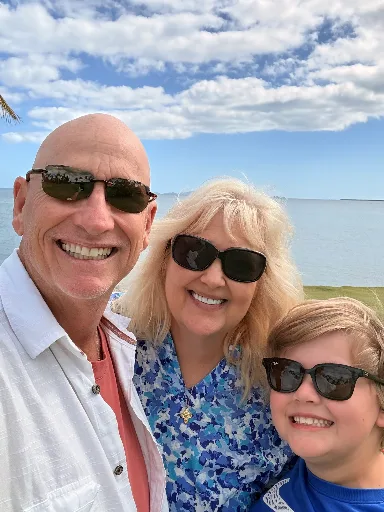
Leigh Baumann
I know what it's like to want to heal and to keep finding that the path itself is painful in ways it doesn't have to be. To sit in a therapist's office and leave feeling more exposed than supported. To read a book about trauma and recognize yourself on every page, only to close it feeling worse. To wonder — quietly, maybe with some shame — if you're just too broken for the methods everyone says work.
You're not too broken. But you may have been moving faster than your system could hold. That's not a character flaw. It's what happens when healing is treated like a problem to be solved quickly, rather than a living thing that needs room to breathe.
Everything in The Healing Year is built around a different premise: that safety comes first — not as a warm-up, not as a disclaimer, but as the entire foundation on which everything else is built. Before we talk about your patterns, before we touch shame, before we go anywhere near your story — we spend sixty days learning what it feels like to be present, to listen to yourself, and to notice what is actually happening inside you without judgment. That sequence is not accidental. It is the whole philosophy.
Over the course of the year, you'll move through eight phases at a pace that respects your nervous system. You'll develop a real internal language for your emotions and body signals — not clinical vocabulary, just your words for your experience. You'll learn what boundaries actually are, beyond the word. You'll meet your inner critic and your inner child with more gentleness than you may have believed was possible. And eventually — gently, at your own pace — you'll begin to integrate your story: not to extract a silver lining from it, not to forgive on a timeline, but to hold it without being held by it.
By the end of this year, I want you to know something that may feel far away right now: that you are more than what happened to you, and that who you are beyond survival is worth discovering. That is what the final phase is for — not as a reward at the end of a gauntlet, but as the natural place you arrive when every step before it has been taken with care.
You don't have to move fast. You don't have to perform healing. You just have to be willing to begin — and then begin again tomorrow. I'll be here every step of the way.
— Leigh Baumann
Start your journey today
Join get instant access — learn at your own pace with an AI coach in your corner.
$19/mo
Recurring billing · cancel anytime
Secure checkout · Instant access
- 6 modules, 18 lessons
- AI-adaptive lessons tuned to your level
- Quizzes & checkpoints to lock in progress
- Your own AI learning coach
- Learn on any device, at your pace
- Full access for as long as you're subscribed