
Enter the Silence and Learn to Hear
A guided, praxis-based journey through the Spiritual Exercises of St. Ignatius — combining daily prayer, imaginative contemplation, and the discernment of spirits to deepen your relationship with God and clarify the path ahead.
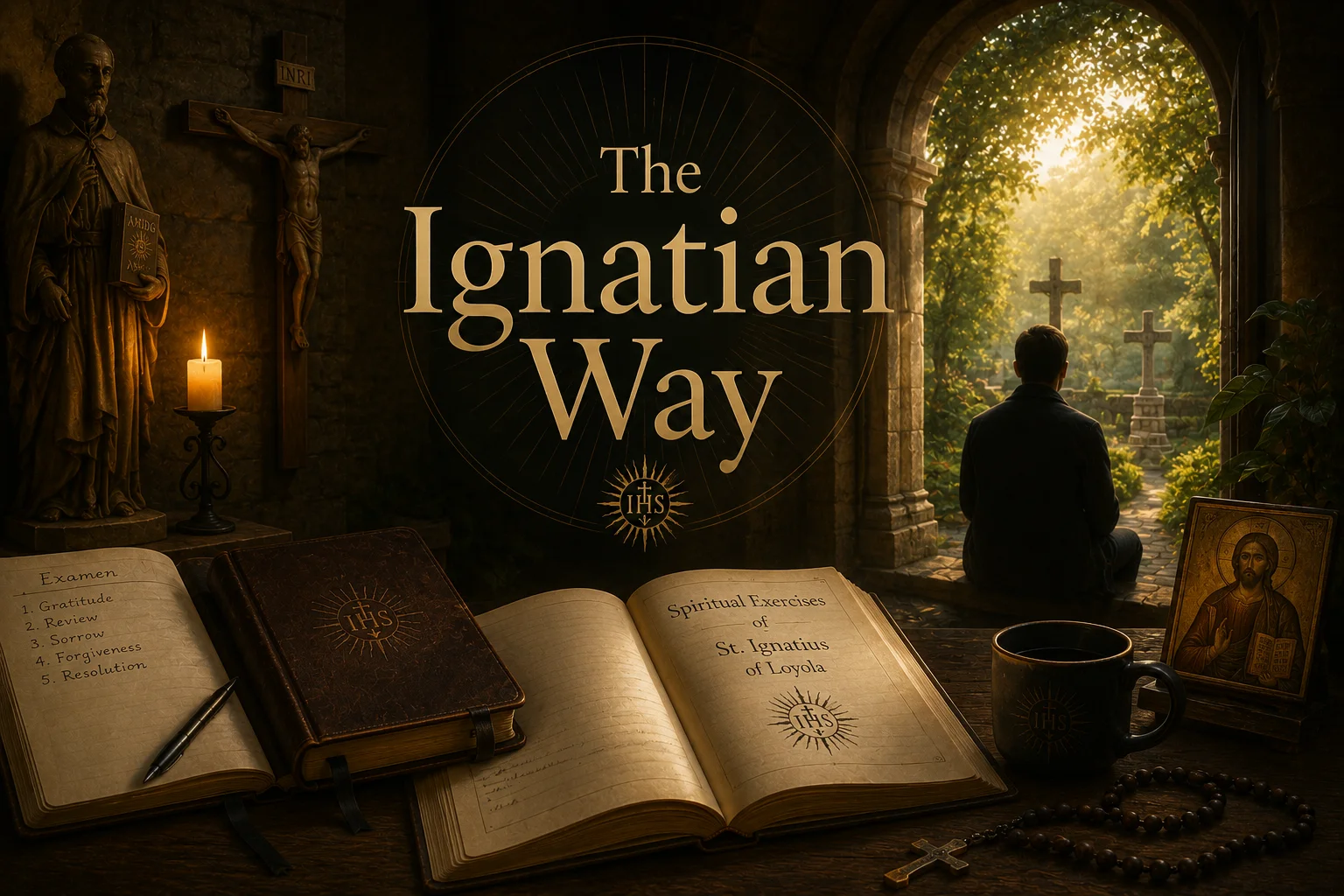
"I will not give you more information about God — I will walk with you to the threshold and teach you to knock."
— Carla Paton
What you'll learn
What you'll be able to do
- Practice the Daily Examen as a consistent, lifelong spiritual discipline that cultivates gratitude and self-awareness.
- Pray with Scripture through Ignatian imaginative contemplation, entering Gospel scenes with all the senses.
- Identify movements of spiritual consolation and desolation in your interior life using Ignatius's Rules for Discernment.
- Apply a structured framework for discerning God's will in real, everyday decisions — vocational, relational, and moral.
- Develop a personal daily prayer rhythm drawn from Ignatian spirituality that endures beyond the course.
- Articulate the historical and theological vision of Ignatius of Loyola and situate your practice within 500 years of Christian spiritual formation.
How it works
A school that adapts to you
This isn't a set of static videos. Every lesson is generated live and tuned to where you actually are.
We learn your level
A quick placement check tailors your starting point so you're never bored or lost.
Lessons adapt as you go
Each lesson is written for your pace and your goal, adjusting as your skills grow.
Your AI coach keeps you moving
Checkpoints, feedback, and gentle nudges turn progress into a real result.
The curriculum
What's inside your school
6 modules · 18 lessons

Ignatius of Loyola: The Man, the Vision, the Exercises
This foundational module situates the Spiritual Exercises in their historical, biographical, and theological context. Students discover who Ignatius was, what transformed him, and what kind of document and practice the Exercises actually are. The First Principle and Foundation is introduced as the theological north star for everything that follows — grounding the course before any practice begins. This module directly supports the outcome of articulating the historical and theological vision of Ignatius within 500 years of Christian spiritual formation.
- 1.1The Wound That Became a Window: Ignatius's ConversionIncluded
- 1.2What the Exercises Are — and Are NotIncluded
- 1.3The Theological Heartbeat: The First Principle and FoundationIncluded
Learning to Pray: Core Ignatian Methods
Before students encounter the content of the four Weeks, they must be equipped with Ignatius's actual prayer toolkit. This methods module is intentionally placed second so that all subsequent modules can be practiced, not merely read about. Students learn how to structure a prayer period, how to apply imaginative contemplation to Scripture, and how to practice the Daily Examen. Sequencing this module before the Weeks is essential: students who skip straight to content without method will observe the Exercises rather than do them. This module directly targets the outcomes of imaginative contemplation, the Daily Examen, and building a personal daily prayer rhythm.
- 2.1Structuring the Prayer Period: How Ignatius PraysIncluded
- 2.2Entering the Scene: Imaginative ContemplationIncluded
- 2.3The Daily Examen: Reviewing the Day with GodIncluded
The First Week: Sin, Mercy, and the Gratitude of the Forgiven
The First Week confronts the retreatant with the reality of sin — personal, social, and cosmic — not to produce despair but to make the gift of mercy viscerally real. Students engage Ignatius's meditations on sin and hell alongside his insistence that the desired fruit is not guilt but grateful astonishment at having been loved through it all. This module also introduces the Colloquy as the movement from meditation into personal conversation with Christ — a crucial structural skill for all subsequent Weeks. A new lesson on interior freedom (Ignatian indifference) is added here to bridge the First Week's emotional intensity toward the election that comes in the Second Week.
- 3.1The Weight of the World: Sin in the Ignatian ImaginationIncluded
- 3.2The Colloquy at the Cross: Meeting Mercy PersonallyIncluded
- 3.3Interior Freedom: Cultivating Ignatian IndifferenceIncluded
The Second Week: Following Christ — Contemplation and Election
The Second Week is the longest and most complex movement of the Exercises, inviting the retreatant into sustained contemplation of the life of Christ as the pattern for their own calling. Students move from the stable and baptism through the public ministry, meditating on Christ's choices as a lens for their own. The module's climax is the Election — the structured discernment of a significant life decision. This module is the central discernment engine of the course and directly delivers the outcome of applying a structured framework for discerning God's will in real, everyday decisions.
- 4.1The Call of the King: Vision and VocationIncluded
- 4.2Two Standards, Two Masters: Naming What Competes for Your HeartIncluded
- 4.3The Three Times of Election: Discerning a DecisionIncluded
Rules for the Discernment of Spirits: Reading Your Interior Life
Ignatius's Rules for the Discernment of Spirits are among the most psychologically acute and spiritually precise texts in the Christian tradition. This module, placed after the Second Week's election content, deepens students' capacity to read their interior life with accuracy and freedom. Students move from the basic grammar of consolation and desolation to the subtler territory of false consolation and the tactics of the 'angel of light.' A new lesson on applying discernment to everyday life — not just major elections — is added to bridge this analytical module to lived practice. This module directly delivers the outcome of identifying movements of consolation and desolation using Ignatius's Rules.
- 5.1Consolation and Desolation: The Grammar of the Interior LifeIncluded
- 5.2The Subtler Movements: False Consolation and the Angel of LightIncluded
- 5.3Discernment in Everyday Life: From Rules to Daily PracticeIncluded
The Third and Fourth Weeks — and the Contemplative in Action
The final module walks students through the Passion and Resurrection contemplations of the Third and Fourth Weeks, culminating in the Contemplation to Attain Love — Ignatius's definitive vision of the integrated, love-driven life. A new capstone lesson on integrating the Exercises into ordinary daily life ensures that students leave not with the conclusion of a course but with the beginning of a practice. This module delivers the outcomes of a personal daily prayer rhythm, growing in gratitude and humble service, and finding God in all things.
- 6.1With Christ Suffering: The Third Week and Compassionate PresenceIncluded
- 6.2The Resurrection and the Consoler: Fourth Week PrayerIncluded
- 6.3Finding God in All Things: Ignatian Life After the ExercisesIncluded
Who it's for
Is this you?

Devout Beginners
You pray regularly but have never had a structured method — the Exercises give your devotion a deep and enduring form.

Returning Retreatants
You made the Exercises or an Ignatian retreat years ago and are ready to re-enter the practice with fresh intentionality.

Spiritual Seekers
You are drawn to contemplative Christianity but have felt unmoored — this course gives you a tradition, a method, and a home.

Decision-Makers at a Crossroads
You are facing a real vocational, relational, or moral decision and need a framework rooted in faith, not just intuition.

Lay Spiritual Directors
You accompany others in prayer and want a deeper, lived understanding of Ignatian discernment to bring to your ministry.

Theology Students & Ministry Leaders
You know the tradition intellectually and are ready to let it move from the head into a lived, daily contemplative practice.
Questions
Frequently asked
Your teacher
A note from your teacher

Carla Paton
Perhaps you have been circling this tradition for a while. You have read a book or two, maybe heard someone speak about the Examen at a retreat, and something in you leaned forward. Or perhaps you made the Exercises years ago and that interior landscape has quietly gone fallow — and you feel the distance. Wherever you are arriving from, I want you to know that I understand the particular ache of wanting more than information about God. You already have enough information. What you are looking for is encounter.
That is precisely what St. Ignatius built the Exercises to do. He was not a theologian constructing a system. He was a man who had been broken open — by a cannonball, by a slow convalescence, by the strange movements he noticed in his own soul — and who discovered, almost accidentally, that there is a way to pray that changes you from the inside out. Everything I have built in this course is in service of that discovery becoming yours.
We will move slowly, and deliberately. We will begin where Ignatius began: with the First Principle and Foundation, which is not a doctrine to memorize but a posture of freedom to inhabit. We will learn the methods — imaginative contemplation, the Examen, the Colloquy — not as techniques but as thresholds. We will sit with the hard things the First Week asks us to face, and we will sit with mercy when it comes. We will learn to read the interior life the way a careful reader reads a text: noticing what is actually there, not what we expected to find.
I want to be honest with you about one thing: this is not a passive course. Ignatius was clear — the Exercises are not given to a person, they are made by a person, with God. You will be asked to pray before you are asked to understand. You will be asked to bring real questions to the discernment framework, not hypothetical ones. The course will ask something of you every day. But what it asks for is not performance. It asks for presence.
By the end — by the time you reach Finding God in All Things — my hope is that you are not holding the Exercises as a course you completed. I hope they are becoming the grammar of your ordinary days: the way you review an evening, the way you sit with a difficult decision, the way you enter Scripture. That enduring interior freedom is what Ignatius spent his life pointing toward. Come and see if it is also what you have been looking for.
— Carla Paton
Start your journey today
Get instant access — learn at your own pace with an AI coach in your corner.
$19/mo
Recurring billing · cancel anytime
Secure checkout · Instant access
- 6 modules, 18 lessons
- AI-adaptive lessons tuned to your level
- Quizzes & checkpoints to lock in progress
- Your own AI learning coach
- Learn on any device, at your pace
- Full access for as long as you're subscribed