Read every ingredient list like a scientist — advise every client like an expert
A deep-dive into cosmetic chemistry built for esthetics students — learn exactly what's in your products, why it works, and how to use that knowledge to get real results for every skin type.
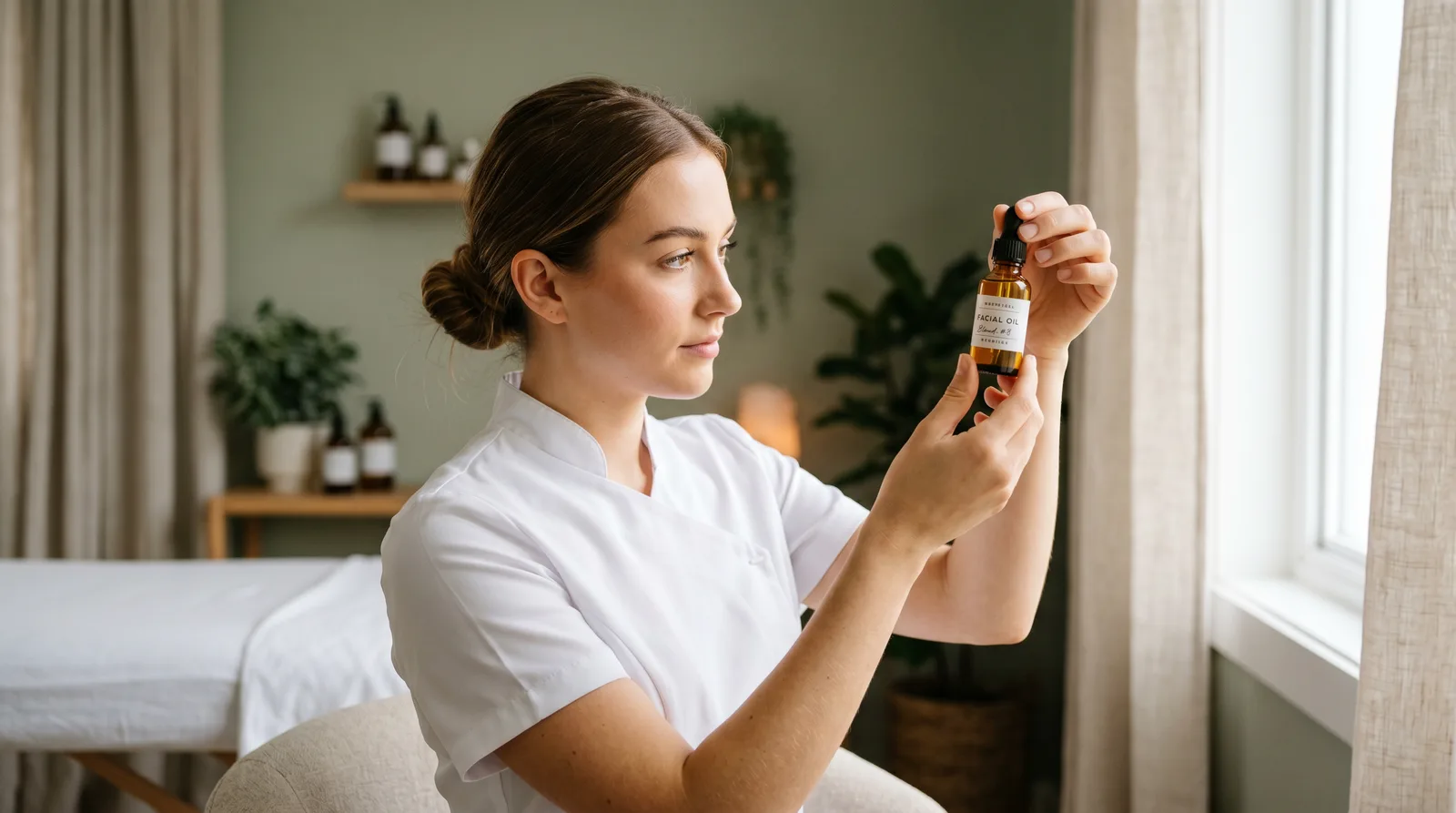
"I built this course so you'd never have to hide behind a brand script again — just clear science, real answers, and the confidence that comes from actually understanding what's in the bottle."— Beth Kenerson
What you'll learn
What you'll be able to do
- Read a full INCI ingredient list and identify the function of every key component
- Explain the mechanism of action for the most common active ingredients — AHAs, BHAs, retinoids, peptides, antioxidants, and SPF filters
- Match formulation types (serums, emulsions, gels, occlusive balms) to specific skin concerns and Fitzpatrick types
- Recognize potentially sensitizing or contraindicated ingredients and confidently advise clients with reactive or compromised skin
- Evaluate competing product claims using evidence-based criteria rather than marketing language
- Design a layered, ingredient-aware home-care routine that complements in-clinic treatments for a given client profile
How it works
A school that adapts to you
This isn't a set of static videos. Every lesson is generated live and tuned to where you actually are.
We learn your level
A quick placement check tailors your starting point so you're never bored or lost.
Lessons adapt as you go
Each lesson is written for your pace and your goal, adjusting as your skills grow.
Your AI coach keeps you moving
Checkpoints, feedback, and gentle nudges turn progress into a real result.
The curriculum
What's inside your school
6 modules · 18 lessons

Decoding the Ingredient List
Students build the foundational literacy needed for every module that follows. They learn how cosmetic ingredients are named, regulated, and organized on a label — transforming the INCI list from intimidating fine print into a readable, informative document. Prerequisite knowledge established here underpins all subsequent ingredient discussions.
- 1.1How INCI Nomenclature WorksIncluded
- 1.2Ingredient Functions and Formulation RolesIncluded
- 1.3Reading Claims vs. RealityIncluded
Actives I — Exfoliants and Cell-Renewal Agents
Students move into mechanism-of-action science, beginning with the exfoliant and cell-renewal actives they will encounter most frequently in clinical practice. Sequencing exfoliants before antioxidants and peptides ensures students understand skin-barrier disruption risks before learning how to layer subsequent actives on top of them — a prerequisite for the interactions lesson in Module 5.
- 2.1AHAs, BHAs, and PHAs — Mechanism and SelectionIncluded
- 2.2Retinoids — From Retinol to Retinoic AcidIncluded
- 2.3Enzymatic and Physical Exfoliants — Mechanisms and Safe UseIncluded
Actives II — Antioxidants, Peptides, and Brighteners
Building on exfoliant knowledge, students now study the actives that support, repair, and enhance skin function rather than remove tissue. Brightening agents are included here because melanin-pathway chemistry is tightly linked to antioxidant and cell-signaling science. Together, these three lessons give students a comprehensive 'repair and protect' toolkit.
- 3.1Antioxidants — Stability, Layering, and Free-Radical ScienceIncluded
- 3.2Peptides — Signal, Carrier, and Neurotransmitter TypesIncluded
- 3.3Brightening Agents and Melanin Pathway InterruptionIncluded
SPF, Barrier Science, and Skin-Identical Ingredients
Students study the two most foundational elements of any protective and maintenance skin-care regimen: sun protection and barrier integrity. Placing SPF and barrier science after the actives modules ensures students understand what they are protecting the barrier from (exfoliant disruption, oxidative stress, UV damage) before studying the protective tools. This sequencing also provides the prerequisite knowledge needed to evaluate sensitization risks and formulation matching in Module 5.
- 4.1UV Filters — Chemical vs. Mineral, Broad-Spectrum, and SPF MathIncluded
- 4.2Barrier Anatomy and Skin-Identical IngredientsIncluded
- 4.3Sun Safety, Vitamin D, and SPF in the Treatment ContextIncluded
Formulation Types, Skin Typing, and Ingredient Interactions
With ingredient knowledge now established, students apply it to practical formulation selection and interaction management. This module is deliberately placed fifth — after students have encountered the full range of actives and protective ingredients — so that all interaction and conflict discussions can draw on concrete, already-understood examples rather than abstract principles. The sensitizing-ingredients lesson is positioned here, after the barrier science prerequisite in Module 4.
- 5.1Formulation Vehicles — Serums, Emulsions, Gels, Oils, and BalmsIncluded
- 5.2Ingredient Interactions — Synergies, Conflicts, and pH StackingIncluded
- 5.3Sensitizing, Contraindicated, and High-Risk IngredientsIncluded
Applied Cosmetic Chemistry — Client Profiling and Home-Care Design
The capstone module translates all prior knowledge into professional clinical practice. Students integrate INCI literacy, mechanism-of-action knowledge, formulation selection skills, interaction awareness, and evidence-based evaluation into a complete client-consultation and home-care design workflow. A new evidence evaluation lesson is added here to ensure the 'evaluate competing product claims' outcome is explicitly assessed before the final design project.
- 6.1Evidence-Based Product EvaluationIncluded
- 6.2The Ingredient-Aware Client Consultation FrameworkIncluded
- 6.3Designing Layered Home-Care Routines That Complement In-Clinic TreatmentsIncluded
Who it's for
Is this you?

Esthetics program students
You're mid-program and ready to go deeper than your textbook — this is the ingredient-level science your curriculum hasn't covered yet.

New estheticians on the floor
You just earned your license and want to advise clients with real confidence, not just repeat what the brand educator told you.

Treatment-room upsellers
You recommend retail products every day and want the ingredient knowledge to back up every suggestion with honest, evidence-based reasoning.

Reactive-skin specialists
You work with sensitive and compromised skin types and need a clear, rigorous framework for spotting contraindicated ingredients before they cause a reaction.

Home-care routine designers
You want to build layered, ingredient-aware routines that amplify your in-clinic results — not accidentally work against them.
Skeptical product evaluators
You're tired of being outpaced by marketing language and want the evidence-based tools to cut through claims and evaluate any product on its formulation merits.
Questions
Frequently asked
Your teacher
A note from your teacher
Beth Kenerson
If you're in an esthetics program right now — or you've just finished one — I want to ask you something honest: when a client asks you to explain why a retinoid causes purging, or whether the vitamin C in their serum is actually stable enough to do anything, do you feel equipped to answer? Or does that question send you quietly back to the brand brochure?
I've been in both places. I know what it's like to stand confidently behind a treatment bed and still feel like there's a layer of knowledge just out of reach — the layer that lives between the protocol and the product, between the ingredient name and the actual skin science. That gap isn't your fault. It's a gap in how esthetics education is typically structured. We train estheticians to perform beautifully, but we don't always train them to understand deeply. That's what I built The Ingredient Edit to address.
This course walks you through cosmetic chemistry the way I wish someone had walked me through it early in my career — starting with the foundation (how to actually read an INCI list and understand what every entry is doing there), moving through the major active categories one by one (exfoliants, retinoids, antioxidants, peptides, brighteners, SPF filters), and building toward something genuinely practical: the ability to look at any product, any client profile, and any set of skin concerns, and design a smart, ingredient-aware plan with real confidence. Not brand confidence. Your own.
Along the way, we tackle the things that trip up even experienced estheticians — ingredient interactions and pH conflicts, sensitizing ingredients for reactive skin, the difference between formulation vehicles and why it matters, and how to evaluate a product claim against the actual evidence rather than the marketing copy. By the end of the final module, you'll be building layered home-care routines that work with your in-clinic treatments, not against them.
I want you to walk out of your esthetics program — or into your next client consultation — as someone who can answer the hard questions without hesitation. Not because you've memorized a script, but because you understand the science well enough to think on your feet. That's what this course is for. I'm glad you're here, and I can't wait to get into the chemistry with you.
— Beth Kenerson
Start your journey today
Join get instant access — learn at your own pace with an AI coach in your corner.
$39/mo
Recurring billing · cancel anytime
Secure checkout · Instant access
- 6 modules, 18 lessons
- AI-adaptive lessons tuned to your level
- Quizzes & checkpoints to lock in progress
- Your own AI learning coach
- Learn on any device, at your pace
- Full access for as long as you're subscribed