Turn difficult parents into your strongest sideline asset
Turn your most dreaded parent conversations into your greatest coaching asset. Learn a repeatable system for defusing frustration, setting boundaries, and building parent trust — whether they're right, wrong, or just emotional.
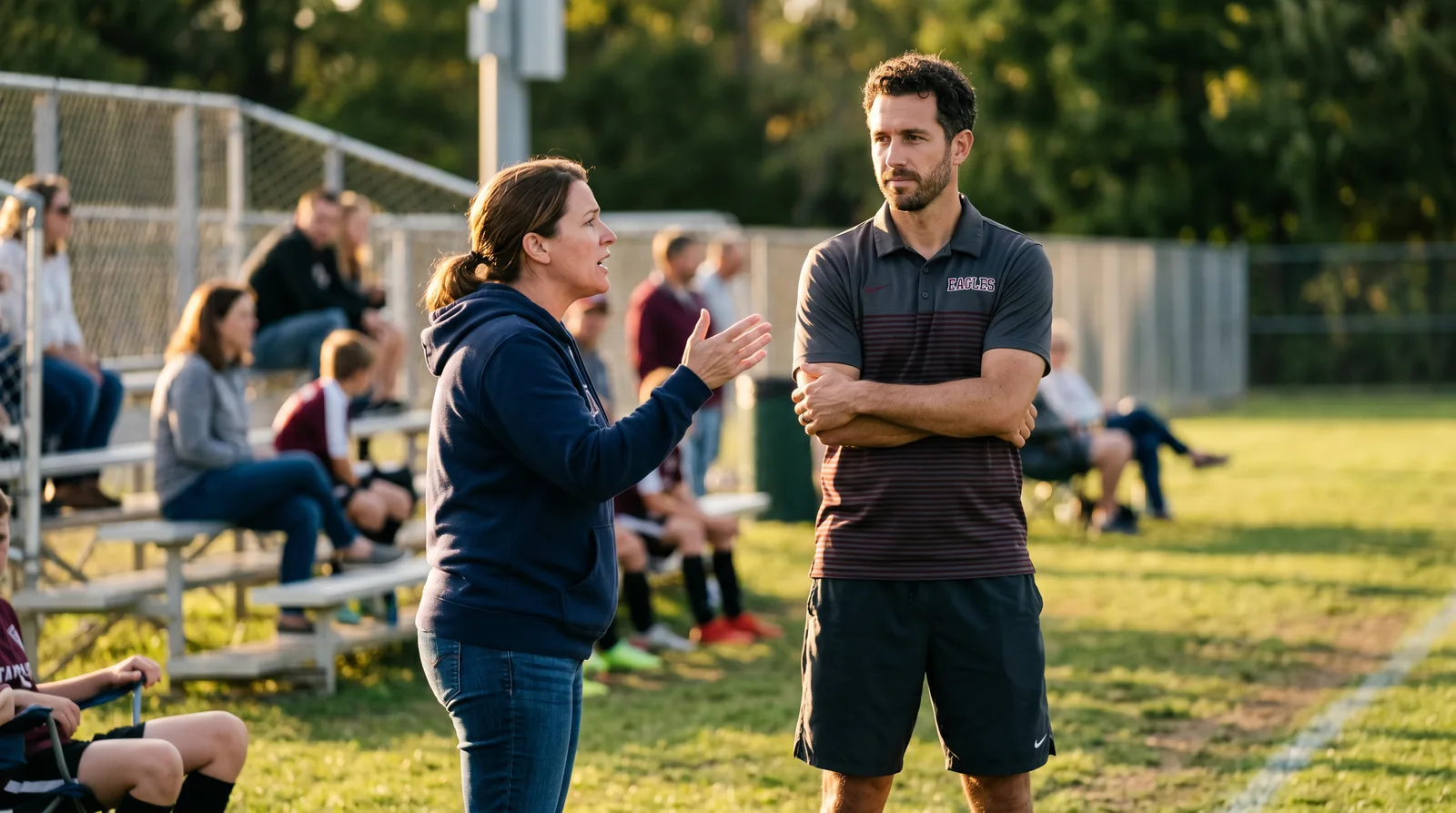
"The field stuff is hard enough — you deserve a real system for everything that happens off it."— Adam Taylor

What you'll learn
What you'll be able to do
- Identify the 4 emotional states frustrated parents cycle through and know exactly how to respond to each one
- Apply a 3-step de-escalation framework to defuse a heated sideline or post-game confrontation in under two minutes
- Confidently hold your coaching decisions under pressure without becoming defensive or dismissive
- Craft a pre-season parent agreement that sets clear expectations and prevents 80% of recurring conflicts
- Deliver hard truths — about playing time, performance, or behavior — to parents in a way they can actually hear
- Build a culture of parent buy-in so that difficult conversations become the exception, not the norm
How it works
A school that adapts to you
This isn't a set of static videos. Every lesson is generated live and tuned to where you actually are.
We learn your level
A quick placement check tailors your starting point so you're never bored or lost.
Lessons adapt as you go
Each lesson is written for your pace and your goal, adjusting as your skills grow.
Your AI coach keeps you moving
Checkpoints, feedback, and gentle nudges turn progress into a real result.
The curriculum
What's inside your school
6 modules · 18 lessons

Understanding the Frustrated Parent
Before coaches can manage difficult parent interactions, they need to understand what's actually driving them. This foundational module builds empathy and diagnostic skill — helping coaches recognize the emotional mechanics behind parent frustration so they respond strategically rather than reactively. It is intentionally placed first because every subsequent skill depends on this insight.
- 1.1Why Parents Lose It on the SidelineIncluded
- 1.2The 4 Emotional States FrameworkIncluded
- 1.3It's Not About the Call — Reading What Parents Really WantIncluded
The De-Escalation Playbook
With the emotional landscape mapped in Module 1, coaches are now ready to act on it. This module delivers the core tactical skill of the course — a repeatable, field-tested framework for defusing confrontations in real time, whether they happen on the sideline, in the parking lot, or over text at 11pm. Sequenced second so coaches have the 'why' before the 'how.'
- 2.1The 3-Step Framework: Acknowledge, Anchor, ActIncluded
- 2.2Sideline Confrontations — Defusing in the MomentIncluded
- 2.3Post-Game and Text Conversations — De-escalating After the SmokeIncluded
Holding Your Ground Without Losing the Relationship
De-escalation brings the temperature down — but coaches still have to stand behind their decisions once the room is calm. This module builds the confidence and language to defend coaching choices, own genuine mistakes, and enforce necessary limits, all without becoming defensive, dismissive, or a pushover. Sequenced third because coaches need to be calm before they can be steady.
- 3.1Defending Decisions Without Being DefensiveIncluded
- 3.2When the Parent Is Right — Owning Mistakes Without Losing AuthorityIncluded
- 3.3Setting and Enforcing Boundaries — Without Burning BridgesIncluded
Delivering Hard Truths Parents Can Actually Hear
Some conversations are difficult not because a parent is already upset, but because what the coach needs to say will upset them. This module equips coaches to initiate and navigate the three most emotionally loaded conversations in youth sports — playing time, player behavior, and performance — with honesty, care, and a structure that maximizes the chance of the message landing.
- 4.1The Anatomy of a Hard ConversationIncluded
- 4.2Playing Time — The Conversation Every Coach DreadsIncluded
- 4.3Behavior, Attitude, and the 'My Kid Would Never' ParentIncluded
Prevention by Design — The Pre-Season Parent System
The most powerful conflict management happens before any conflict exists. This module is intentionally sequenced fifth — after coaches have built the reactive and proactive skills of the previous modules — so they understand exactly what they're preventing and why each system element matters. Coaches leave with a complete, personalized pre-season infrastructure ready to deploy.
- 5.1Building Your Pre-Season Parent AgreementIncluded
- 5.2The Pre-Season Parent Meeting That Changes EverythingIncluded
- 5.3Communication Systems That Stop Problems Before They StartIncluded
Building a Culture Where Hard Conversations Are Rare
The capstone module shifts from skill to culture — helping coaches understand that the ultimate goal isn't to become better at managing conflict but to build a team environment where parent buy-in is the norm, trust is proactively maintained, and even post-conflict situations become relationship-strengthening opportunities. This module synthesizes everything coaches have learned and applies it at the systemic level.
- 6.1From Sideline Critics to Team Allies — Shifting the Parent RoleIncluded
- 6.2Regular Trust Deposits — Staying Ahead of Conflict All SeasonIncluded
- 6.3After the Storm — Repairing Relationships Post-ConflictIncluded
Who it's for
Is this you?

The Recreational League Coach
Volunteers their weekends to coach youth sports and gets blindsided by parent intensity that feels wildly out of proportion to the stakes.

The First-Year Head Coach
Just stepped up from assistant to head coach and needs a system for parent communication before the first parent conflict catches them flat-footed.

The Club Team Coach
Coaches competitive club sports where high-investment parents come with high-volume opinions about playing time, strategy, and everything in between.

The School Program Coach
Runs a middle or high school team and has to navigate parent relationships in a community where everyone knows each other — and tensions linger in the hallway.

The Conflict-Avoidant Coach
Great with players but dreads hard conversations and tends to let parent frustration simmer until it boils over — and needs a framework to finally change that pattern.

The Veteran Coach Hitting a Wall
Has years of experience on the field but keeps running into the same parent situations season after season and is ready to solve them for good.
Questions
Frequently asked
Your teacher
A note from your teacher
Adam Taylor
If you've ever driven home from a game replaying a parent conversation instead of the actual game — you already know why this school exists.
You got into coaching to develop players. To teach the game. To build something in kids that goes way beyond the scoreboard. Nobody handed you a whistle and said, "by the way, half the job is managing the adults on the other side of the fence." And yet, here we are. A poorly-timed sideline outburst can unravel everything you've built in the locker room. One bad playing-time conversation can fracture a team's culture for the rest of the season. And the worst part? Most coaches are just white-knuckling it, hoping the difficult parent eventually cools off or moves on.
I built The Sideline Coach because that approach — hoping it gets better — doesn't work. What works is having a system. A real one. Not platitudes about staying calm or vague advice to "just communicate better." I mean an actual framework you can reach for when a parent is in your face in the parking lot, when the text comes in at 11pm, or when you have to look a family in the eye and explain why their kid isn't starting. That's what this school teaches. The 4 Emotional States Framework so you can read what's actually happening before you respond. The Acknowledge, Anchor, Act sequence so you can de-escalate almost any confrontation in under two minutes. The exact structure for delivering hard truths about playing time, behavior, or performance — without blowing up the relationship.
Here's the thing I want you to understand going in: difficult parent conversations are not a sign that you're a bad coach. They're a sign that you're coaching humans, not robots. But there's a massive difference between a coach who dreads every hard conversation and one who's prepared for it. Preparation doesn't just reduce stress — it changes the entire parent dynamic. When parents feel heard, informed, and respected, the sideline culture shifts. Critics become allies. The hard conversations don't disappear, but they become the exception instead of the weekly norm.
You already put in the work on the field. Let's make sure that work isn't being undermined off it. Come into this school ready to build something — a communication system, a pre-season structure, and a set of skills that will make every season cleaner and every relationship stronger. The hard conversations aren't going away. But after this, you'll actually be ready for them.
— Adam Taylor
Start your journey today
Join get instant access — learn at your own pace with an AI coach in your corner.
- 6 modules, 18 lessons
- AI-adaptive lessons tuned to your level
- Quizzes & checkpoints to lock in progress
- Your own AI learning coach
- Learn on any device, at your pace
- Full access for as long as you're subscribed