Stop guessing. Start climbing.
A diagnostic-first vocal training school built on the proprietary Voice Ladder System — five interconnected systems that help singers pinpoint exactly what's holding their voice back and follow a clear, progressive path to artistic freedom.
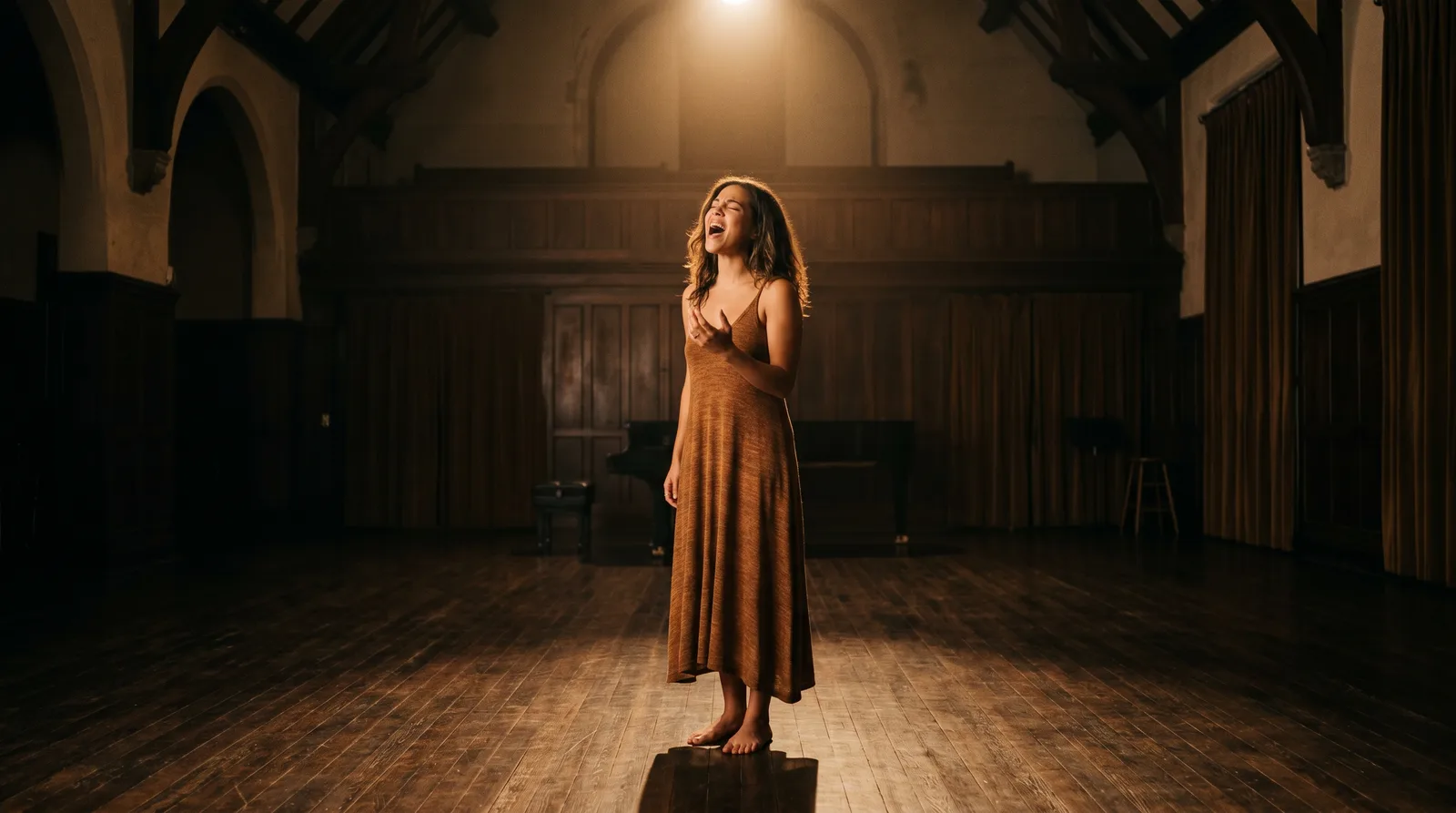
"I don't want you to just sound better — I want you to understand your voice well enough that you never feel lost in it again."— On Wing Chiu
What you'll learn
What you'll be able to do
- Diagnose your own voice using the five-system Voice Ladder framework and identify the specific root cause of your vocal challenges
- Build a stable, well-supported airflow foundation that powers consistent tone and eliminates breath-related breaks and strain
- Achieve reliable vocal cord closure and registration control for a smooth, connected voice from chest to head voice
- Shape resonant, projecting tone with intentional placement and vocal color suited to your genre and style
- Deliver lyrics with precise vowel shaping, crisp consonants, and natural articulation that never sacrifices tone for intelligibility
- Integrate all five vocal systems into expressive, stylistically confident performances with dynamic range, emotional communication, and a distinctive artistic voice
How it works
A school that adapts to you
This isn't a set of static videos. Every lesson is generated live and tuned to where you actually are.
We learn your level
A quick placement check tailors your starting point so you're never bored or lost.
Lessons adapt as you go
Each lesson is written for your pace and your goal, adjusting as your skills grow.
Your AI coach keeps you moving
Checkpoints, feedback, and gentle nudges turn progress into a real result.
The curriculum
What's inside your school
6 modules · 25 lessons

Voice Ladder Orientation & Vocal Diagnosis
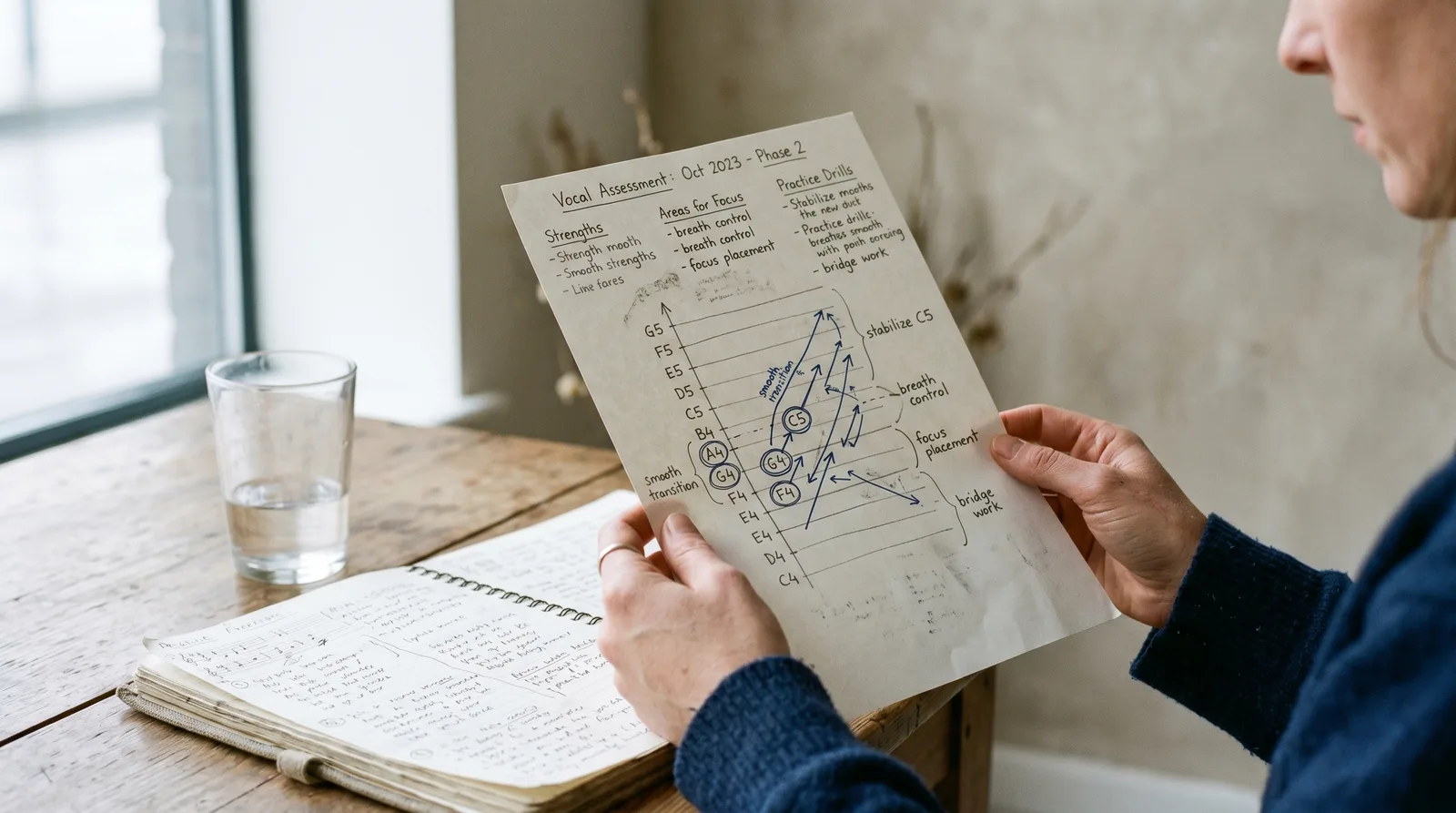
Before any technical training begins, students must understand the framework they are working within and receive a clear, personalized picture of where they stand. This orientation module introduces the Voice Ladder System in full, guides students through a comprehensive diagnostic assessment across all five vocal systems, and produces a personal Voice Ladder Roadmap that will direct every decision made throughout the school. Nothing is generic here — the roadmap ensures every student knows their exact starting point, their priority systems, and their individual learning pathway before touching a single exercise.
- 1.1The Voice Ladder System ExplainedIncluded
- 1.2The Voice Ladder Diagnostic AssessmentIncluded
- 1.3Building Your Personal Voice Ladder RoadmapIncluded
Airflow & Vocal Cord Foundations
Phase 1 begins with the bottom two rungs of the Voice Ladder — the engine room of the voice. Airflow and vocal cord function are the foundational prerequisites for everything else: resonance cannot be optimized on an unstable breath, and registration cannot be controlled without reliable vocal fold closure. This module establishes correct breath management mechanics, airflow stability, and breath pacing before moving into phonation — ensuring students understand that the voice does not begin at the throat. Lessons are sequenced so that airflow is internalized before vocal cord work is introduced, eliminating the most common beginner error of treating these systems as separate rather than cooperative.
- 2.1Breath Management & Airflow FundamentalsIncluded
- 2.2Vocal Fold Closure & Efficient PhonationIncluded
- 2.3Registration Control — Chest, Mixed & Head VoiceIncluded
- 2.4Connecting Airflow & Vocal Cord — System Integration BasicsIncluded
Resonance, Diction & Basic System Coordination
With a stable airflow-phonation foundation in place, Phase 1 continues by developing the next two rungs of the Voice Ladder: resonance and diction. Resonance determines the color, warmth, brightness, and carrying power of the tone, while diction determines whether the message lands with clarity and intelligence. These systems are taught sequentially within the module — resonance first, because diction choices directly affect resonance — before a final integration lesson brings all five systems into basic coordination for the first time. Students leave Phase 1 with all five systems activated, understood, and beginning to work together.
- 3.1Vocal Tone & Resonance FundamentalsIncluded
- 3.2Vowel Shaping & Consonant ClarityIncluded
- 3.3Basic Coordination Across All Five SystemsIncluded
Refinement & Vocal Consistency
Phase 2 marks the transition from building the systems to refining them under real musical conditions. Students enter this module with personalized Phase 2 entry plans generated from their Phase 1 assessment, meaning the weak-system targeting in the first lesson is genuinely individualized. The module addresses the most common Phase 2 challenges systematically: inconsistency across registers, suboptimal resonance for the student's specific genre, diction that breaks down in fast or emotionally charged contexts, and a Coordination system that has not yet learned to hold all systems together across different stylistic demands. Progress tracking is embedded throughout.
- 4.1Targeted Weak-System StrengtheningIncluded
- 4.2Register Transitions & Vocal Consistency Across RangeIncluded
- 4.3Resonance Optimisation for Your GenreIncluded
- 4.4Advanced Diction & Articulation in ContextIncluded
- 4.5Coordination Across Song StylesIncluded
Artistry, Expression & Performance
Phase 3 is the culmination of everything built and refined in Phases 1 and 2. Here, technique becomes the servant of artistry. Students move from thinking about systems to expressing through them — discovering how emotional communication, stylistic interpretation, vocal storytelling, and dynamic performance are not separate from technical skill but are its highest application. The module is designed so that every lesson both assumes and integrates Phase 1 and Phase 2 competence, meaning students are never asked to perform expressively at the cost of technical stability, but rather to express with full technical command. The module closes with a final assessment and an Artistic Voice Showcase that celebrates each student's unique vocal identity.
- 5.1Emotional Communication & Expressive SingingIncluded
- 5.2Stylistic Interpretation & Developing Your Artistic VoiceIncluded
- 5.3Vocal Agility, Dynamics & Performative RangeIncluded
- 5.4Vocal Storytelling & Lyric PerformanceIncluded
- 5.5Final Vocal Assessment & Artistic Voice ShowcaseIncluded
Bonus Module: Musical Foundation
A parallel-track module for singers who need to strengthen the musicianship skills that sit underneath great vocal technique. Students work through these lessons alongside their Voice Ladder training whenever a gap in pitch accuracy, rhythmic feel, music reading, or song learning slows their progress. Every skill is taught through the voice first — not through abstract theory — so what's learned here immediately transfers to the practice room and the stage.
- 6.1Pitch Matching & Ear Training FundamentalsIncluded
- 6.2Rhythm, Timing & SubdivisionIncluded
- 6.3Intervals, Scales & Basic Music Theory for SingersIncluded
- 6.4Sight-Singing & Song Learning SkillsIncluded
- 6.5Musical Phrasing, Harmony Awareness & InterpretationIncluded
Who it's for
Is this you?

The Stalled Hobbyist
You've had a handful of lessons and can hold your own, but progress has plateaued and you don't know what to work on next.

The Musical Theatre Singer
You need a voice that's consistent eight shows a week — powerful, expressive, and technically grounded across your full range.

The Singer-Songwriter
Your songs deserve a voice that can carry their emotion — the Voice Ladder helps you develop articulation and artistry that serve your lyrics.

The Self-Taught Pop Singer
You've learned by ear and instinct, but inconsistency under pressure tells you it's time for real technical foundations.

The Frustrated Intermediate
You know something is holding your voice back — you just can't name it; the diagnostic framework finally gives you the answer.

The Returning Singer
Life pulled you away from singing for a while, and now you're rebuilding — this time with a structured, systematic approach that actually sticks.
Questions
Frequently asked
Your teacher
A note from your teacher

On Wing Chiu
I know exactly where you are right now. You've put in the time. You've sat across from a teacher, you've done the warm-ups, you've watched more technique videos than you can count — and yet your voice still feels like it belongs to someone else some days. Inconsistent. Unpredictable. You hit that note last Tuesday and you have no idea how, and you can't find it again. That's not a lack of talent. That's a lack of a map.
That's the gap I built The Voice Ladder to close.
After working with developing singers across pop, musical theatre, contemporary, and singer-songwriter styles, the same pattern came up again and again: intelligent, motivated singers making slow progress not because they weren't working hard, but because nobody had ever given them a clear diagnostic framework. They were treating symptoms — a cracking passaggio, a thin high register, a muddy mix — without ever tracing those symptoms back to their actual source. So I built one. The Voice Ladder System breaks the voice down into five interconnected systems — Airflow, Vocal Cord Function, Resonance, Diction, and Coordination — and gives you both the language and the methodology to figure out exactly which system is your weak link. Then we fix it, in order, with precision.
Here's the objection I hear most: "I've tried structured approaches before and they felt rigid and disconnected from real singing." I hear you. That's why the Voice Ladder isn't a ladder of isolated exercises — it's a system of systems. Every rung connects to the one above and below it. You'll feel the relationship between your breath support and your register transitions. You'll hear how your resonance placement changes the moment your fold closure improves. The technique doesn't live in a vacuum; it lives in your songs, in your performances, in your artistic voice. By Module 5, we're not drilling exercises anymore — we're exploring emotional communication, stylistic interpretation, and vocal storytelling, because that's why you sing in the first place.
What I promise you is this: clarity. You will leave this school understanding your voice — not as a mysterious instrument that occasionally cooperates, but as a responsive, trainable system you know how to work with and work on. Whether your goal is a more consistent live performance, a stronger studio sound, or simply the freedom of singing without second-guessing every phrase — the Voice Ladder will get you there. Not by accident. By design.
Come climb.
— On Wing Chiu
Start your journey today
Join get instant access — learn at your own pace with an AI coach in your corner.
$67/mo
Recurring billing · cancel anytime
Secure checkout · Instant access
- 6 modules, 25 lessons
- AI-adaptive lessons tuned to your level
- Quizzes & checkpoints to lock in progress
- Your own AI learning coach
- Learn on any device, at your pace
- Full access for as long as you're subscribed