Turn raw lumber into something that lasts
Learn the real skills — how to read wood, work it safely, join it properly, and finish it beautifully — through six structured modules and three projects you build with your own hands.
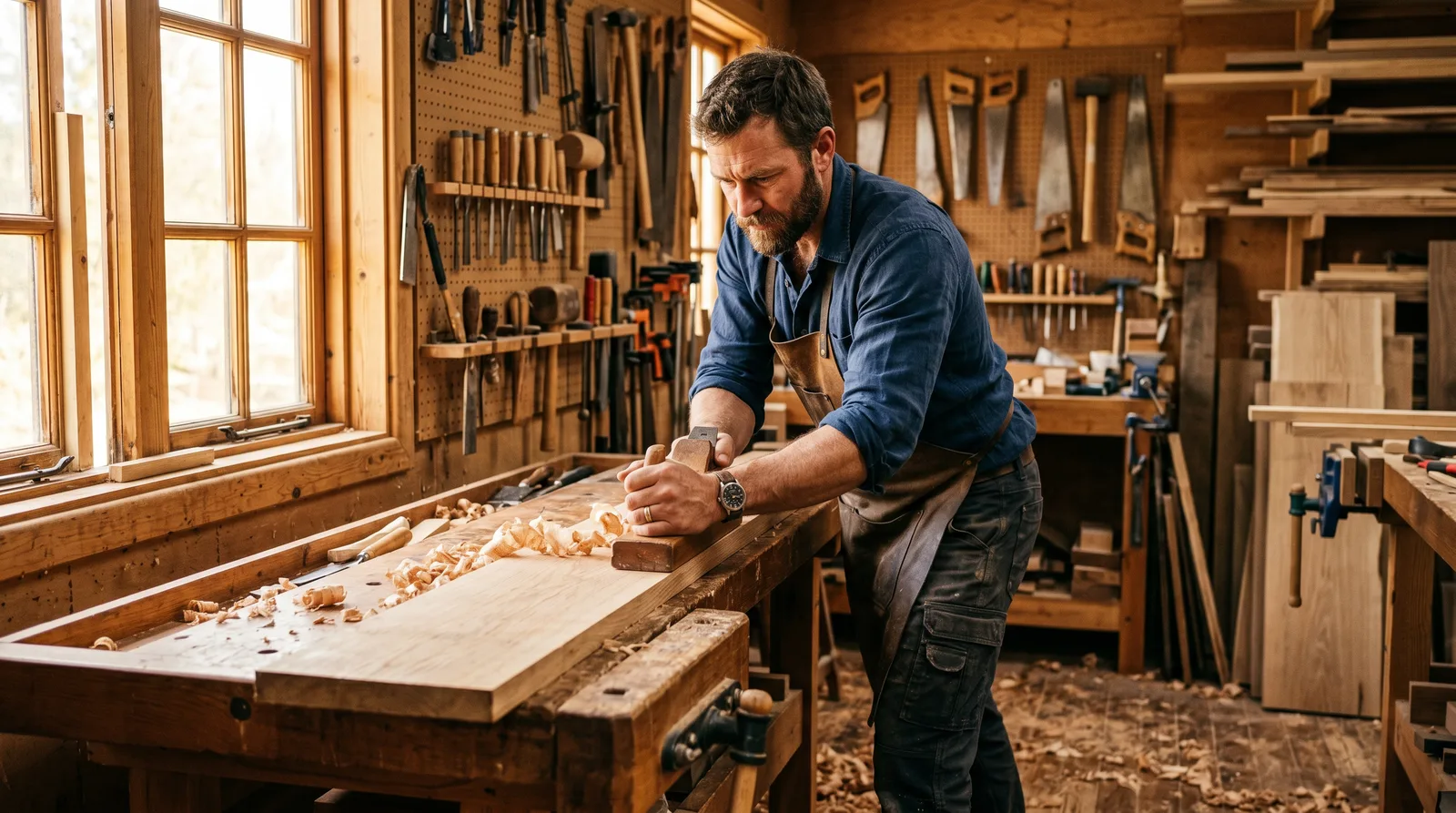
"I'd rather you understand why the chisel needs to be sharp than just tell you to sharpen it — because once you understand, you'll never skip it again."— Damian Espinosa
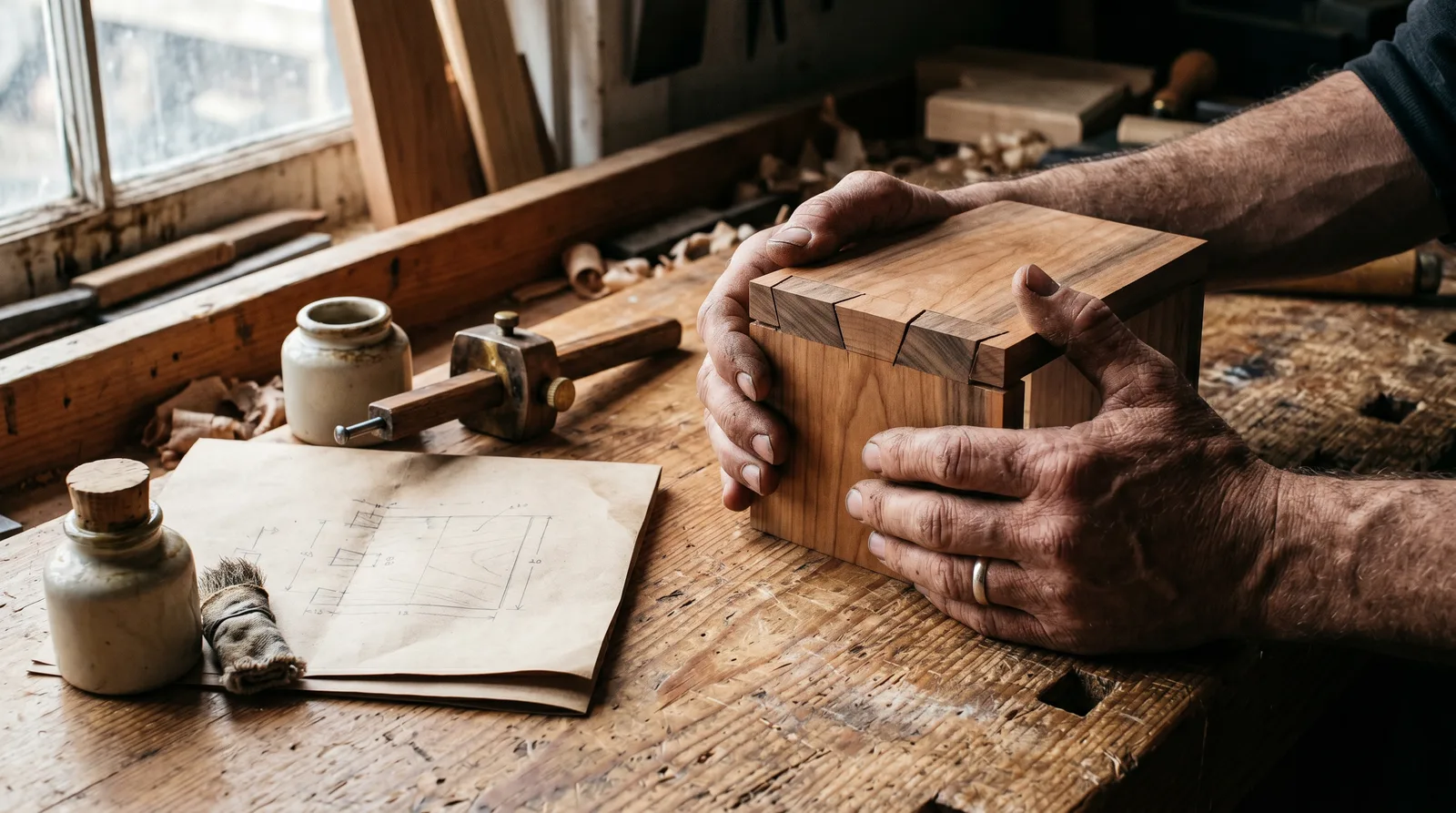
What you'll learn
What you'll be able to do
- Select, grade, and prepare raw lumber for any project, understanding grain, moisture, and wood species
- Safely set up and operate core hand and power tools — chisels, saws, planes, routers, and drills
- Execute the five essential joinery techniques: butt, mortise-and-tenon, dovetail, dado, and pocket-screw joints
- Read and draft simple shop drawings and cut lists to plan and execute projects with precision
- Apply professional finishing techniques — sanding, staining, oiling, and lacquering — for a polished, durable result
- Complete three foundational build projects: a hardwood cutting board, a wall-mounted shelf, and a joinery box
How it works
A school that adapts to you
This isn't a set of static videos. Every lesson is generated live and tuned to where you actually are.
We learn your level
A quick placement check tailors your starting point so you're never bored or lost.
Lessons adapt as you go
Each lesson is written for your pace and your goal, adjusting as your skills grow.
Your AI coach keeps you moving
Checkpoints, feedback, and gentle nudges turn progress into a real result.
The curriculum
What's inside your school
6 modules · 20 lessons

Wood & the Workshop
Establishes the essential foundation every woodworker needs before touching a tool. Students learn to 'read' wood as a material — understanding species, grain, figure, moisture, and movement — and set up a safe, organised workspace. This module must come first because every downstream decision (joinery choice, finish selection, tool use) depends on understanding the material itself.
- 1.1Wood Species, Grain & FigureIncluded
- 1.2Moisture, Movement & Buying LumberIncluded
- 1.3Workshop Safety & SetupIncluded
Hand Tools & Power Tools — Confidence Through Control
Builds practical tool competency in a deliberate order: hand tools before power tools. Students first develop feel, muscle memory, and an understanding of cutting mechanics with unplugged tools, then transfer that understanding to power tools. The module closes with the table saw and precision measurement — the backbone of accurate dimensioning — which directly feeds into reading plans (next module) and joinery (module after).
- 2.1Hand Tool Fundamentals — Chisels, Saws & PlanesIncluded
- 2.2Power Tools — Router, Drill & SanderIncluded
- 2.3The Table Saw & Measuring for PrecisionIncluded
Reading the Plan — Shop Drawings & Cut Lists
Teaches students to work from and create shop drawings before cutting wood. This module is intentionally placed after tool skills but before joinery, so students can draft and read the plans they will execute in the joinery module. Missing from the original draft was any mention of orthographic projection or scale — these are added here as a genuine prerequisite gap.
- 3.1Reading & Interpreting Shop DrawingsIncluded
- 3.2Drafting Your Own Plans & Cut ListsIncluded
The Five Essential Joints
The heart of the curriculum. Students execute all five target joints in sequenced order of complexity: from the simplest mechanical joint to the most demanding hand-cut joint. Each lesson builds on tool skills from Module 2 and layout skills from Module 3. A critical gap in the original draft — the rabbet joint — is retained as a companion to the dado (it shares the same setup), but the dovetail is correctly moved to last as it is the most skill-intensive. A new bridging lesson on joint selection is added so students understand which joint to use when before they cut.
- 4.1Joint Selection & Layout PrinciplesIncluded
- 4.2Butt Joints & Pocket-Screw JointsIncluded
- 4.3Dado & Rabbet JointsIncluded
- 4.4Mortise-and-Tenon JointIncluded
- 4.5Dovetail JointIncluded
Finishing — Surface Prep to Final Coat
A great finish is 80% preparation. This module teaches students to bring surfaces to finishing-ready standard, then apply three families of finish — penetrating oils and stains, waxes, and film-forming lacquers — understanding the aesthetic and protective qualities of each. A new lesson on finish selection and wood compatibility is added to fill the gap absent from the original draft.
- 5.1Surface Preparation — Sanding & ScrapingIncluded
- 5.2Stains, Oils & WaxesIncluded
- 5.3Lacquers & Protective Top CoatsIncluded
The Three Build Projects
Students integrate everything from all previous modules into three complete, real-world projects of increasing complexity. Each project is explicitly designed to exercise specific skills from the curriculum — the cutting board targets material selection and finishing; the shelf targets joinery and plan-reading; the joinery box targets multiple joints and precision. A new capstone reflection lesson is added after the three builds to consolidate learning and plan the student's next independent project.
- 6.1Project 1 — Hardwood Cutting BoardIncluded
- 6.2Project 2 — Wall-Mounted ShelfIncluded
- 6.3Project 3 — Joinery BoxIncluded
- 6.4Portfolio Review & Next Project PlanningIncluded
Who it's for
Is this you?

The Complete Beginner
Never held a chisel before — this course starts from scratch and gives you a real foundation, not just a YouTube rabbit hole.

The Weekend DIYer
You've done home repairs and a few rough builds, but you're ready to move past improvised solutions and learn the craft properly.

The Flat-Pack Escapee
Tired of assembling other people's furniture, you want to build pieces that are actually yours — designed, built, and finished by hand.

The Gift-Giver
You want to make something meaningful — a cutting board, a shelf, a box — that someone will keep and remember where it came from.

The Hobbyist Leveling Up
You've built a few things but joinery still feels like a mystery — this course finally explains the five essential joints from layout to execution.

The Aspiring Craftsperson
You're serious about developing real woodworking skills and want a structured, methodical path — not scattered tips, but a curriculum that builds on itself.
Questions
Frequently asked
Your teacher
A note from your teacher

Damian Espinosa
If you've ever stood in front of a piece of flat-pack furniture, allen key in hand, and thought there has to be more to this — I want you to know that feeling is exactly right. There is more. A lot more. And it's more satisfying than most people realize until they've felt the first clean slice of a sharp chisel or held up a finished shelf they built themselves from a rough board.
I designed The Wood Workshop because I kept seeing the same problem: people who wanted to learn woodworking but couldn't find a starting point that respected their intelligence without drowning them in jargon. Most online content either assumes you already know everything, or skips past the fundamentals so fast you wind up confused and frustrated. This course doesn't do that. We slow down at the moments that actually matter — reading lumber at the yard, setting up a tool safely, laying out a mortise-and-tenon joint by hand — because rushing those things is how bad habits form and how accidents happen.
What I care about most is that you understand why things are done a certain way, not just that they are. Why does grain direction change how you plane a board? Why does a dovetail joint hold without glue? Why does surface prep matter more than the finish you put on top of it? When you know the reasoning, you're not just following steps — you're building judgment. That's what turns a beginner into someone who can look at a piece of wood and know exactly what to do with it.
By the time you finish this course, you won't just have three completed projects. You'll have a working vocabulary, a set of reliable techniques, and — maybe most importantly — the confidence to walk into a lumber yard, pick out a board, and know what you're going to do with it. That's the real goal. The cutting board and the joinery box are just the beginning.
Whether you're picking up woodworking for the first time or you've been fumbling through projects without a solid foundation, this is the place to build it. Pull on your safety glasses, clear off the bench, and let's get to work.
— Damian Espinosa
Start your journey today
Join get instant access — learn at your own pace with an AI coach in your corner.
$39/mo
Recurring billing · cancel anytime
Secure checkout · Instant access
- 6 modules, 20 lessons
- AI-adaptive lessons tuned to your level
- Quizzes & checkpoints to lock in progress
- Your own AI learning coach
- Learn on any device, at your pace
- Full access for as long as you're subscribed