
Think like an economist. Lead like one too!
The Economic Mind is a high-signal Leadership Seminar that hands you two tools — rigorous trade-off analysis and disciplined quantification — and shows you exactly how to use them on the decisions that land on your desk!

"Every decision has a price that someone isn't showing you — my job is to make sure you can always find it."
— Val (Valdas) Samonis
What you'll learn
What you'll be able to do
- Identify the hidden trade-offs inside any business, policy, or personal decision before committing to a course of action
- Apply the 'no free lunch' principle to stress-test proposals and expose concealed costs that others miss
- Translate fuzzy qualitative arguments into rough but defensible quantitative estimates
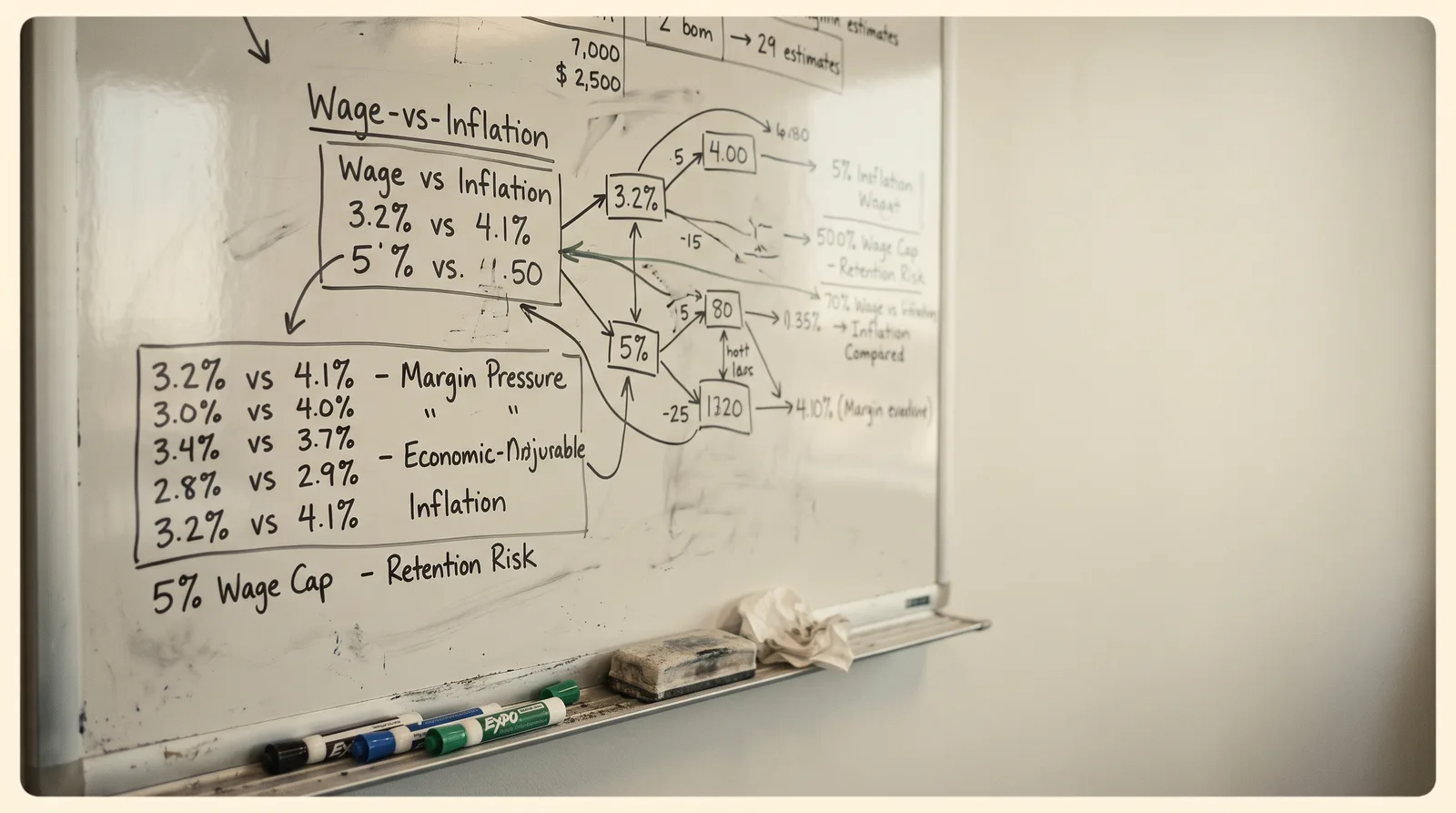
- Read and critically evaluate economic data — wages, inflation, dividends, productivity — without being misled by framing
- Construct a clear trade-off analysis that can be presented to a board, committee, or leadership team
- Adopt a durable economist's mindset that improves judgment across finance, strategy, hiring, and public policy
How it works
A school that adapts to you
This isn't a set of static videos. Every lesson is generated live and tuned to where you actually are.
We learn your level
A quick placement check tailors your starting point so you're never bored or lost.
Lessons adapt as you go
Each lesson is written for your pace and your goal, adjusting as your skills grow.
Your AI coach keeps you moving
Checkpoints, feedback, and gentle nudges turn progress into a real result.
The curriculum
What's inside your school
6 modules · 24 lessons

The Economist's Lens
Introduces the two core habits of economic thinking — trade-off awareness and quantification — and why they sharpen leadership judgment.
- 1.1Why Economics Is Not What You ThinkIncluded
- 1.2Two Habits That Change How You DecideIncluded
- 1.3How Economists See the World DifferentlyIncluded
There Is No Free Lunch
Builds deep fluency with the trade-off principle — what it really means, where it hides, and how to apply it rigorously.
- 2.1Friedman's Maxim and What It Actually MeansIncluded
- 2.2Opportunity Cost — The Price of Every ChoiceIncluded
- 2.3Hidden Costs and Who Pays ThemIncluded
- 2.4Trade-Offs in Business DecisionsIncluded
- 2.5Trade-Offs in Policy DecisionsIncluded
Putting Numbers on Things
Builds the skill of translating qualitative arguments into rough but defensible quantitative estimates.
- 3.1Why Quantification Matters Even When It's HardIncluded
- 3.2Fermi Estimation — The Art of the Informed GuessIncluded
- 3.3Turning Fuzzy Arguments into Working NumbersIncluded
- 3.4Ranges, Uncertainty, and Honest EstimatesIncluded
Reading Economic Data Like an Economist
Equips leaders to interpret wages, inflation, productivity, and other key indicators critically and without being misled by framing.
- 4.1The Economic Indicators Every Leader Must KnowIncluded
- 4.2How Framing Distorts the NumbersIncluded
- 4.3Correlation, Causation, and the Stories We TellIncluded
- 4.4Stress-Testing Data Before You Act on ItIncluded
Trade-Off Analysis as a Leadership Tool
Synthesizes trade-off thinking and quantification into a structured, boardroom-ready analytical framework.
- 5.1Anatomy of a Trade-Off AnalysisIncluded
- 5.2Exposing Concealed Costs in Any ProposalIncluded
- 5.3Quantifying the Unquantifiable — Practical TechniquesIncluded
- 5.4Presenting a Trade-Off Analysis to Decision-MakersIncluded
Sustaining the Economist's Mindset
Locks in the two core habits as durable professional instincts and extends them across finance, strategy, hiring, and public policy.
- 6.1Applying Economic Thinking to StrategyIncluded
- 6.2Applying Economic Thinking to Hiring and People DecisionsIncluded
- 6.3Applying Economic Thinking to Public PolicyIncluded
- 6.4Building a Personal Practice of Economic ReasoningIncluded
Who it's for
Is this you?

The Senior Executive
She allocates capital and signs off on proposals daily — this gives her the framework to stress-test every one before committing.

The Policy Professional
He shapes public decisions and needs to read economic data critically, spot concealed costs, and present trade-offs that hold up to scrutiny.

The Strategy Manager
He builds the decks that land on the board's table and wants to make the trade-off analysis inside them airtight and impossible to dismiss.

The Ambitious Generalist
She's sharp across functions but wants the rigorous economic reasoning that will sharpen her judgment and set her apart in the room.
The Seasoned Operator
He's run teams for decades on instinct and experience — and wants a durable conceptual framework to put behind decisions he's been making by feel.

The High-Potential Leader
She's being fast-tracked into bigger roles and wants the economic fluency that will let her hold her own in conversations with finance and the C-suite.
Questions
Frequently asked
Your teacher
A note from your teacher

Val (Valdas) Samonis
Let me guess where you are right now.
You're a capable, experienced leader — someone who has navigated real complexity, managed real resources, and made real decisions under pressure. And yet you occasionally sit in a meeting where someone presents a proposal that feels wrong, you can't quite articulate why, and the moment passes. Or you're handed an economic data set and you're not entirely sure whether the story it's telling is the real one. Or you watch a policy debate unfold and you sense that everyone involved is missing something obvious — but you can't pin it down with the precision that would let you say so out loud.
That feeling has a name. It's the absence of an economist's mindset. Not an economist's jargon, not an economist's credentials — the mindset. The habit of asking, automatically and immediately: what's the trade-off here, what's the concealed cost, and can I put a number on it?
That habit is learnable. Faster than you think, and without sitting through a university course that wasn't designed for someone with your responsibilities.
What I've built in The Economic Mind is essentially the leadership seminar I wish had existed earlier in my career — one that strips economics down to its two most powerful and portable ideas. The first: there is no free lunch. Every choice forecloses another. Every proposal has a price. The costs that don't appear on the slide are usually the ones that matter most. The second: you can always put a number on it. Not a perfect number — an honest, defensible, rough estimate that's worth more in a real decision than a vague qualitative argument ever will be.
The curriculum moves deliberately. We start with how economists actually see the world, move through opportunity cost and hidden costs, then spend real time on quantification — including Fermi estimation, which is the single skill I'd give every senior leader if I could only give one. We cover how to read economic data without being misled by whoever chose the framing. And we finish with something most courses skip entirely: how to sustain this as a practice, not just a one-time lesson — in strategy, in hiring, in policy, in every context where judgment is the scarce resource.
I won't promise you'll agree with every economist you meet after this. I'll promise something more useful: you'll know exactly what question to ask next. Come think with me.
— Val (Valdas) Samonis
Start your journey today
Get instant access — learn at your own pace with an AI coach in your corner.
$50/mo
Recurring billing · cancel anytime
Secure checkout · Instant access
- 6 modules, 24 lessons
- AI-adaptive lessons tuned to your level
- Quizzes & checkpoints to lock in progress
- Your own AI learning coach
- Learn on any device, at your pace
- Full access for as long as you're subscribed