Finally understand how music works
From reading your first note to composing your first original piece — this is the hands-on music theory school that makes every concept click by ear, by eye, and by doing. No prior experience required.
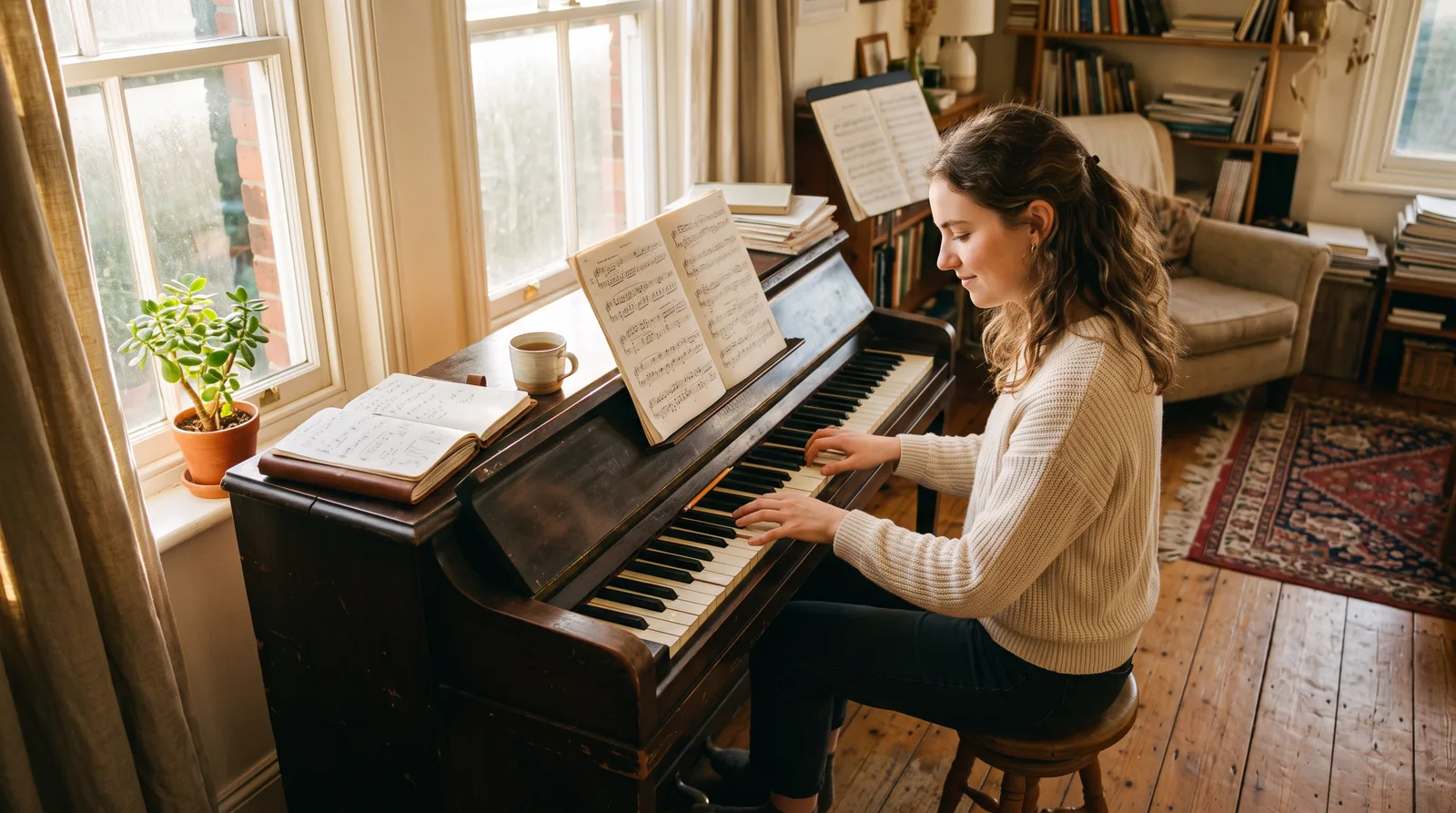
"Music makes sense — and the moment you hear that click, you'll never listen the same way again."
— Dr. Olga Cerafima Gabrielle
What you'll learn
What you'll be able to do
- Read and notate music fluently — pitches, rhythms, clefs, rests, and dynamics — on the page and by ear
- Recognize and sing intervals, scales, and chords by ear, building reliable musicianship and active listening skills
- Understand keys, major/minor tonality, and the circle of fifths well enough to navigate any piece of music with confidence
- Construct chords, triads, inversions, and progressions, and explain why they create the emotional effects they do
- Analyze melody, motif, phrase structure, and musical form in real songs — then apply those same tools in your own writing
- Compose and notate a short original musical piece that intentionally uses the fundamentals of pitch, rhythm, harmony, and expression
How it works
A school that adapts to you
This isn't a set of static videos. Every lesson is generated live and tuned to where you actually are.
We learn your level
A quick placement check tailors your starting point so you're never bored or lost.
Lessons adapt as you go
Each lesson is written for your pace and your goal, adjusting as your skills grow.
Your AI coach keeps you moving
Checkpoints, feedback, and gentle nudges turn progress into a real result.
The curriculum
What's inside your school
6 modules · 30 lessons
Hearing the Language — Sound, Pitch, and the Musical Alphabet
Students discover how music communicates as a language by exploring sound, pitch, the musical alphabet, note names, clefs, and the basics of reading notation.
- 1.1Music as a Language — How Sound Becomes MeaningIncluded
- 1.2The Musical Alphabet — Note Names and the Piano MapIncluded
- 1.3The Staff, Clefs, and Where Notes LiveIncluded
- 1.4Sharps, Flats, Naturals, and the Chromatic ScaleIncluded
- 1.5Your First Listening Lab — Recognizing Pitch by EarIncluded
Feeling the Pulse — Rhythm, Beat, Meter, and Time
Students internalize rhythm as the heartbeat of music, mastering note values, rests, time signatures, subdivisions, and syncopation through movement and listening activities.
- 2.1Beat, Tempo, and the Steady PulseIncluded
- 2.2Note Values and Rests — How Long Sounds LastIncluded
- 2.3Time Signatures and Meter — Grouping the BeatIncluded
- 2.4Dots, Ties, and Subdivisions — Filling Every BeatIncluded
- 2.5Syncopation and Rhythmic Feel — When the Beat Surprises YouIncluded
Tuning Your Ear — Intervals, Scales, Keys, and Tonality
Students build reliable musicianship by learning to hear, sing, and construct intervals, major and minor scales, key signatures, and the circle of fifths.
- 3.1Intervals — The Distances Between NotesIncluded
- 3.2The Major Scale — Music's Home BaseIncluded
- 3.3The Natural Minor Scale — A Different Emotional ColorIncluded
- 3.4Key Signatures and the Circle of FifthsIncluded
- 3.5Ear Training Lab — Singing and Recognizing Scales and IntervalsIncluded
Building Harmony — Chords, Triads, Inversions, and Progressions
Students learn to construct, hear, and connect chords, understanding how harmony creates emotional tension, release, and momentum beneath a melody.
- 4.1What Is a Chord? — Stacking Notes to Create HarmonyIncluded
- 4.2Major and Minor Triads — Happy, Sad, and Everything BetweenIncluded
- 4.3Chord Inversions — Moving Harmony SmoothlyIncluded
- 4.4Chords in a Key — The Harmonized Scale and Roman NumeralsIncluded
- 4.5Chord Progressions — How Harmony Moves and FeelsIncluded
Shaping Expression — Melody, Dynamics, Articulation, Timbre, and Form
Students explore how melody is crafted and shaped, how expressive markings bring music to life, how timbre and texture color sound, and how musical form gives a piece its architecture.
- 5.1Melody, Motifs, and Phrases — How Tunes Are BuiltIncluded
- 5.2Dynamics and Articulation — Louder, Softer, Smoother, SharperIncluded
- 5.3Tempo, Texture, and Musical EnergyIncluded
- 5.4Timbre and Instrument Families — The Colors of SoundIncluded
- 5.5Musical Form and Structure — The Architecture of a PieceIncluded
Speaking the Language — Active Listening, Arranging, and Your First Composition
Students integrate every foundational skill into active listening analysis, introductory arranging concepts, and the creation of a short original notated piece.
- 6.1Active Listening Lab — Analyzing a Real Piece from the Inside OutIncluded
- 6.2Foundational Arranging — Choosing Sounds, Voicings, and LayersIncluded
- 6.3Putting It Together — Planning Your Original PieceIncluded
- 6.4Composing and Notating Your PieceIncluded
- 6.5Share, Reflect, and Step Forward — What You've Built and Where It Goes NextIncluded
Who it's for
Is this you?
The total beginner
She's always loved music but assumed theory was too hard — this school proves otherwise, starting from the very first note.

The self-taught guitarist
He can play songs by feel but wants to understand keys, chords, and progressions well enough to write his own music.
The singer who reads nothing
She has a great ear but can't read a note — here she'll match what she hears to what's on the page, and finally notate her own melodies.

The curious bedroom producer
He builds beats by instinct and wants the theory vocabulary to understand why his chord choices work — or don't.
The returning adult learner
She took piano lessons as a kid, remembers almost nothing, and wants a fresh, modern start that actually makes the fundamentals stick.

The aspiring songwriter
He has ideas and lyrics but no framework for building melodies, harmonies, or structure — this school gives him the full toolkit.
Questions
Frequently asked
Your teacher
A note from your teacher

Dr. Olga Cerafima Gabrielle
If you've ever sat with a piece of music you love and thought, "I wish I understood what's actually happening in there" — this letter is for you.
Maybe you play an instrument and you've learned songs by rote, but the moment you step off the familiar path, you feel lost. Maybe you sing, and you want to understand the notes coming out of your mouth well enough to write your own. Maybe you've never made music at all, but you've always suspected that the way music makes you feel is no accident — that there's a language underneath it — and you want to learn it.
That's exactly what this school is built to do. I designed it because I believe music theory has been taught wrong for too long — as a set of rules to memorize before you're allowed to be creative, rather than as a living, audible system you can discover through listening. Every concept in this school starts with your ears. You'll hear an interval before you name it. You'll feel a chord progression create tension and release before you learn what Roman numerals describe it. You'll recognize a phrase structure in a real song before you write one yourself. The vocabulary arrives after the experience — because that's how language actually works.
We start at the very beginning: what sound is, how pitch becomes the musical alphabet, how notes live on a staff, what makes a rhythm feel like it does. We build through ear training and scale recognition, through the logic of keys and the circle of fifths, through the emotional architecture of major and minor chords, all the way to melody-writing, musical form, and your own original composition. Nothing is skipped. Nothing is assumed. And nothing stays abstract — every concept has a sound, a feeling, and a use.
I want you to finish this school and hear music the way a musician hears it: not just as something that happens to you, but as something you understand from the inside. Something you can speak. Whether you go on to write songs, perform, produce, or simply listen with new ears, that shift — from passive listener to active musical thinker — is the transformation this school is here to give you.
You don't need talent. You don't need a piano. You need curiosity and a willingness to listen closely. If you have those, come in. Let's learn the language together.
— Dr. Olga Cerafima Gabrielle
Start your journey today
Get instant access — learn at your own pace with an AI coach in your corner.
$39/mo
Recurring billing · cancel anytime
Secure checkout · Instant access
- 6 modules, 30 lessons
- AI-adaptive lessons tuned to your level
- Quizzes & checkpoints to lock in progress
- Your own AI learning coach
- Learn on any device, at your pace
- Full access for as long as you're subscribed