Finally understand why people — including you — do what they do
The Mind Lab is a science-backed deep dive into human psychology — from Freud and Kahneman to attachment theory and habit formation — taught in plain English so you can actually use it in your life, your work, and your relationships.

Psychology isn't just a subject — it's a lens, and once you have it, you can't unsee how much of human life it illuminates.
— Tracy Burke
What you'll learn
What you'll be able to do
- Explain the major schools of psychology — from psychoanalysis to cognitive-behavioral theory — and apply them to real-life situations
- Identify cognitive biases and logical fallacies that distort your thinking and decision-making
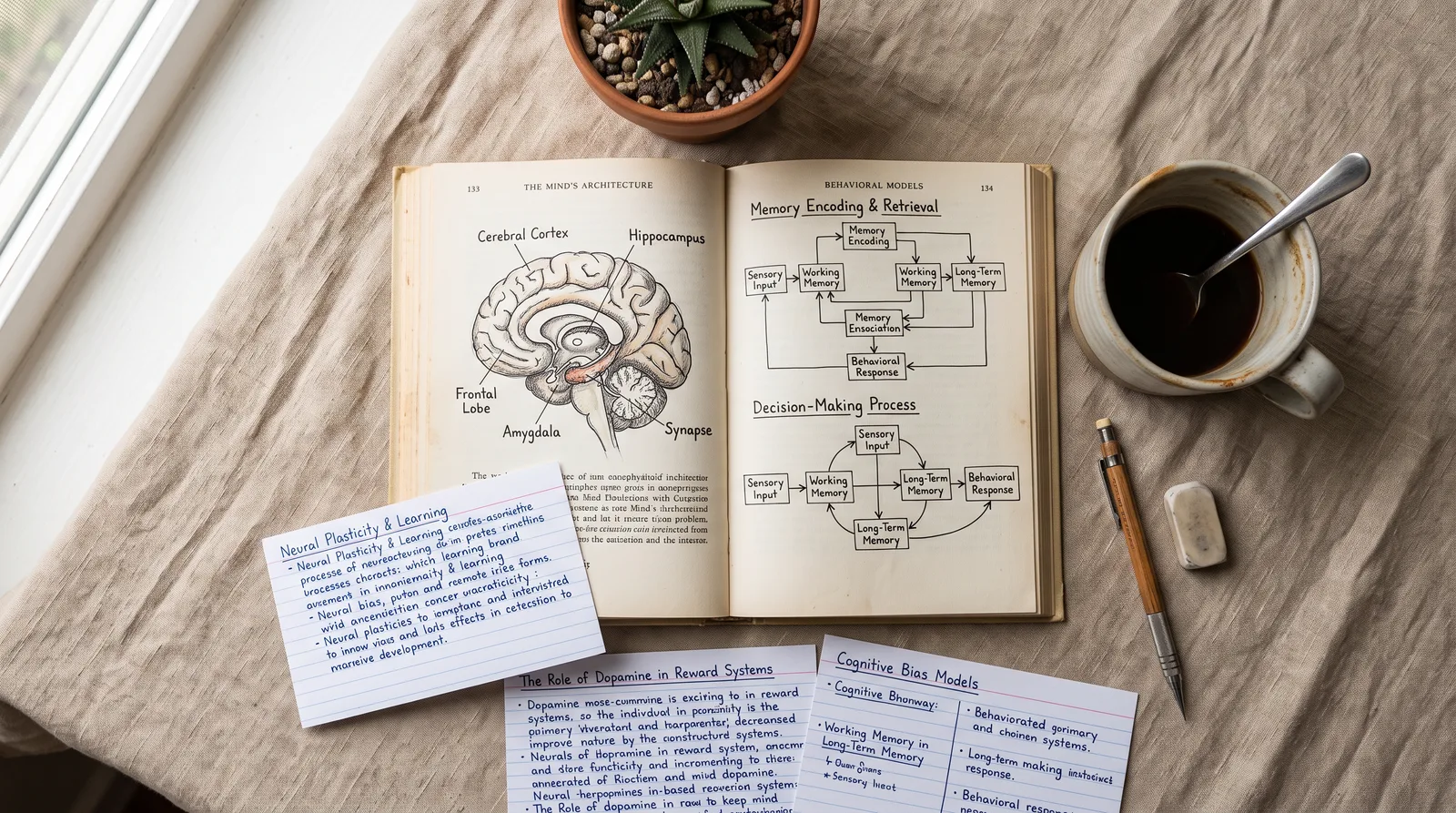
- Understand the neuroscience of emotion, memory, and motivation and use that knowledge to build better habits
- Recognize the hallmarks of healthy vs. unhealthy relationship patterns using attachment theory and social psychology research
- Apply principles of persuasion, influence, and group dynamics to communicate more effectively at work and in personal life
- Read research studies critically — spotting sample sizes, p-hacking, and replication issues — so you never fall for a pop-psychology myth again
How it works
A school that adapts to you
This isn't a set of static videos. Every lesson is generated live and tuned to where you actually are.
We learn your level
A quick placement check tailors your starting point so you're never bored or lost.
Lessons adapt as you go
Each lesson is written for your pace and your goal, adjusting as your skills grow.
Your AI coach keeps you moving
Checkpoints, feedback, and gentle nudges turn progress into a real result.
The curriculum
What's inside your school
6 modules · 28 lessons

Foundations of Psychology
Surveys the major schools of psychological thought and equips students to apply each framework to everyday situations.
- 1.1What Psychology Actually IsIncluded
- 1.2Psychoanalysis and the UnconsciousIncluded
- 1.3Behaviorism and Learning TheoryIncluded
- 1.4Humanistic and Positive PsychologyIncluded
- 1.5Cognitive-Behavioral Theory in PracticeIncluded
The Thinking Brain — Cognition, Bias, and Decision-Making
Reveals how the mind processes information, where it reliably goes wrong, and how to make sharper decisions.
- 2.1How Memory Really WorksIncluded
- 2.2System 1 vs. System 2 ThinkingIncluded
- 2.3Cognitive Biases That Derail Your JudgmentIncluded
- 2.4Logical Fallacies in Everyday ArgumentsIncluded
- 2.5Smarter Decisions Under UncertaintyIncluded
Emotion, Motivation, and the Neuroscience of Behavior
Connects brain science to emotional experience, drives, and the daily habits that shape long-term outcomes.
- 3.1The Neuroscience of EmotionIncluded
- 3.2What Actually Motivates UsIncluded
- 3.3Stress, Resilience, and the Nervous SystemIncluded
- 3.4The Science of Habit FormationIncluded
- 3.5Emotional Intelligence — Reading and Regulating EmotionsIncluded
Relationships, Attachment, and Social Psychology
Uses attachment theory and social psychology research to help students recognize healthy and unhealthy relationship dynamics.
- 4.1Attachment Theory From Cradle to AdulthoodIncluded
- 4.2Healthy vs. Unhealthy Relationship PatternsIncluded
- 4.3Social Identity and Group BehaviorIncluded
- 4.4Empathy, Perspective-Taking, and Conflict ResolutionIncluded
Influence, Persuasion, and Communication
Applies the psychology of persuasion, group dynamics, and social influence to make students more effective communicators.
- 5.1The Six Principles of PersuasionIncluded
- 5.2Propaganda, Dark Patterns, and Ethical InfluenceIncluded
- 5.3Leadership, Power, and Group DynamicsIncluded
- 5.4Communicating for Connection and ImpactIncluded
Reading Research and Thinking Like a Psychologist
Builds the critical literacy skills needed to evaluate psychology studies, spot bad science, and consume research responsibly.
- 6.1How Psychological Research Is DesignedIncluded
- 6.2Statistics Without the Math AnxietyIncluded
- 6.3P-Hacking, Replication, and the Credibility CrisisIncluded
- 6.4Spotting Pop-Psychology MythsIncluded
- 6.5Putting It All Together — Thinking Like a PsychologistIncluded
Who it's for
Is this you?
Coaches & Therapists
They work with people every day and want a more rigorous theoretical foundation — from attachment styles to CBT — to sharpen their practice.

Managers & Leaders
They need to understand group dynamics, influence, and emotional intelligence to lead their teams more effectively and navigate office politics with clarity.

Writers & Storytellers
They use motivation science, attachment theory, and cognitive bias to write psychologically convincing characters and more compelling narratives.

Critical Thinkers
They're tired of being misled by viral studies and pop-psych headlines, and want the research literacy to evaluate claims for themselves.
Lifelong Learners
They've always been curious about the mind and finally want a structured, honest education in psychology — without going back to school.

Self-Aware Seekers
They're doing the personal-growth work and want the science behind habits, emotions, and relationship patterns to make that journey more grounded and lasting.
Questions
Frequently asked
Your teacher
A note from your teacher

Tracy Burke
If you're here, I'm guessing you're the kind of person who finds yourself genuinely fascinated by why people behave the way they do — and maybe a little frustrated that most of what's out there is either too shallow or too dense to be useful.
I get it. Pop psychology gives you catchy concepts with no real depth. Academic psychology gives you depth with no real access. There's a huge space in the middle — rigorous, honest, actually interesting — and that's exactly what The Mind Lab is built to fill.
I created this school because I believe psychological literacy is one of the most valuable things a person can develop. Not "knowing your type" or remembering a list of biases — but genuinely understanding how minds work, how emotions drive decisions, how childhood shapes adult relationships, and how groups turn individuals into something they'd never be alone. That kind of understanding changes how you see your own patterns. It changes how you lead, how you love, how you argue, and how you heal.
Here's what I want you to know about how we approach the material: we don't pick a lane and ignore everything else. We go through psychoanalysis, behaviorism, CBT, and humanistic psychology not as competing religions but as lenses — each one useful for different questions. We take the neuroscience seriously without oversimplifying it into "left brain vs. right brain" nonsense. And we spend real time on research literacy, because I think one of the greatest gifts psychology can give you is a built-in detector for when someone is trying to sell you a myth.
You don't need a background in science. You don't need to be in therapy (though this pairs beautifully with it). You just need to be curious about human beings — including yourself. If that's you, I'd love to think through all of this with you.
— Tracy Burke
Start your journey today
Get instant access — learn at your own pace with an AI coach in your corner.
$39/mo
Recurring billing · cancel anytime
Enrolling a child? Sign up as a parent — you'll add your student right here after.
Secure checkout · Instant access
- 6 modules, 28 lessons
- AI-adaptive lessons tuned to your level
- Quizzes & checkpoints to lock in progress
- Your own AI learning coach
- Learn on any device, at your pace
- Full access for as long as you're subscribed