Master the physics. Ace the exam. Own the classroom.
A rigorous, mentor-led school that closes every content gap from Newtonian mechanics to quantum theory — then hands you a ready-built teaching playbook so you walk into your classroom as confident as you walked out of your exam.
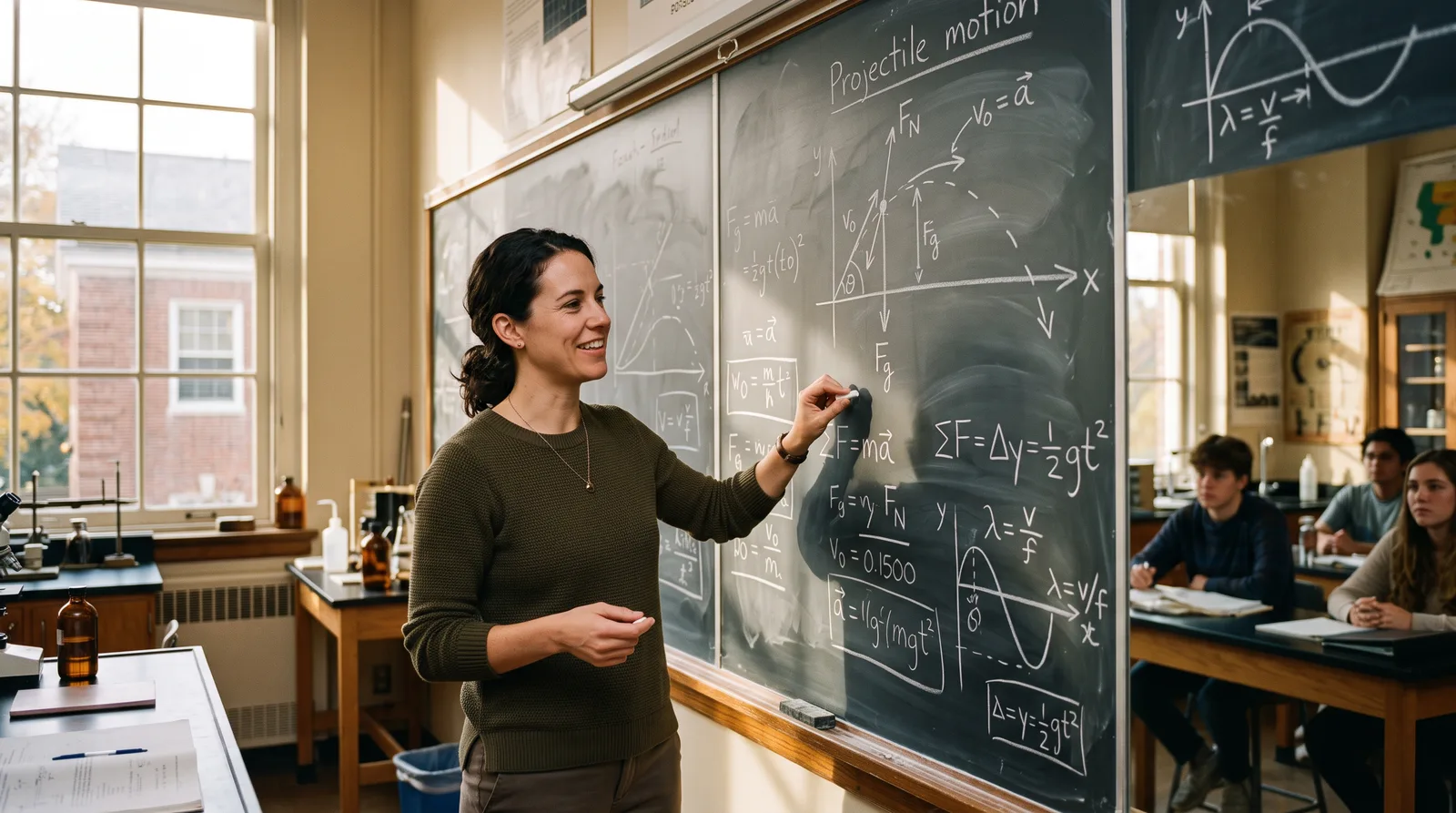
"I refuse to separate knowing the physics from knowing how to teach it — because your students will always be able to tell if you've done one without the other."
— biologyteachermae
What you'll learn
What you'll be able to do
- Pass your physics teacher certification exam with confidence by mastering every tested content domain — from mechanics to modern physics.
- Diagnose and close your own conceptual gaps using structured topic-by-topic review modules and practice problem sets.
- Design inquiry-based lessons and lab activities aligned to curriculum standards that drive genuine student understanding.
- Deploy a ready-made toolkit of demonstrations, simulations, and visual models that make abstract physics tangible for any classroom.
- Translate difficult mathematical formalism (calculus, vectors, wave equations) into pedagogically accessible explanations for diverse learners.
- Build a personal teaching playbook of pacing guides, formative assessments, and misconception-busting strategies you can use immediately.
How it works
A school that adapts to you
This isn't a set of static videos. Every lesson is generated live and tuned to where you actually are.
We learn your level
A quick placement check tailors your starting point so you're never bored or lost.
Lessons adapt as you go
Each lesson is written for your pace and your goal, adjusting as your skills grow.
Your AI coach keeps you moving
Checkpoints, feedback, and gentle nudges turn progress into a real result.
The curriculum
What's inside your school
6 modules · 29 lessons

Mechanics Mastery
Builds deep content fluency in classical mechanics — kinematics, dynamics, energy, momentum, and rotation — covering every mechanics domain tested on certification exams.
- 1.1Kinematics: Motion in One and Two DimensionsIncluded
- 1.2Newton's Laws and ApplicationsIncluded
- 1.3Work, Energy, and Conservation LawsIncluded
- 1.4Momentum, Impulse, and CollisionsIncluded
- 1.5Rotational Motion, Torque, and Angular MomentumIncluded
Waves, Sound, Optics, and Thermodynamics
Covers oscillatory motion, mechanical and electromagnetic waves, geometric and physical optics, and the laws governing heat and thermodynamic systems.
- 2.1Oscillations and Simple Harmonic MotionIncluded
- 2.2Mechanical Waves and SoundIncluded
- 2.3Geometric and Physical OpticsIncluded
- 2.4Heat, Temperature, and Thermodynamic LawsIncluded
- 2.5Thermodynamic Cycles and EntropyIncluded
Electricity, Magnetism, and Circuits
Provides rigorous review of electrostatics, electric fields and potentials, DC and AC circuits, and electromagnetic induction tested heavily on licensure exams.
- 3.1Electrostatics: Charge, Force, and Electric FieldsIncluded
- 3.2Electric Potential and CapacitanceIncluded
- 3.3DC Circuits: Resistance, Ohm's Law, and Kirchhoff's RulesIncluded
- 3.4Magnetism and Electromagnetic InductionIncluded
- 3.5AC Circuits and Maxwell's EquationsIncluded
Modern Physics and Quantum Concepts
Reviews special relativity, quantum mechanics, atomic and nuclear physics, and particle concepts that appear on advanced certification domains.
- 4.1Special RelativityIncluded
- 4.2Quantum Mechanics FundamentalsIncluded
- 4.3Atomic Models and SpectroscopyIncluded
- 4.4Nuclear Physics and Radioactive DecayIncluded
- 4.5Particle Physics and Standard Model OverviewIncluded
Mathematical Toolkit for Physics Teachers
Translates the calculus, vectors, and mathematical formalism underpinning physics into pedagogically accessible strategies teachers can use and explain with confidence.
- 5.1Vectors and Vector Calculus for PhysicsIncluded
- 5.2Calculus in Physics: Derivatives and IntegralsIncluded
- 5.3Wave Equations and Differential EquationsIncluded
- 5.4Making Math Accessible: Bridging Formalism and IntuitionIncluded
Pedagogical Toolkit and Teaching Playbook
Equips teachers with inquiry-based lesson frameworks, ready-to-use demos, simulations, misconception-busting strategies, and assessment tools they can deploy immediately.
- 6.1Designing Inquiry-Based Physics LessonsIncluded
- 6.2Demonstrations and Simulations That Make Physics TangibleIncluded
- 6.3Identifying and Busting Physics MisconceptionsIncluded
- 6.4Formative Assessment and Pacing GuidesIncluded
- 6.5Building Your Personal Physics Teaching PlaybookIncluded
Who it's for
Is this you?

Pre-service teacher candidates
Preparing for the Praxis Physics exam before student teaching and needs rigorous domain-by-domain content review plus the pedagogical grounding to hit the classroom running.

Career-changers from STEM fields
Solid physics background from engineering or science work, but needs the pedagogical toolkit — inquiry design, misconception strategies, pacing guides — to translate expertise into effective teaching.

In-service teachers seeking renewal
Currently licensed and teaching, but wants to close persistent content gaps (modern physics, thermodynamics cycles, AC circuits) and sharpen instructional strategies for stronger student outcomes.

Out-of-field science teachers
Teaching physics under an emergency or out-of-field credential and needs both the content depth and the classroom tools to get genuinely competent before the next school year.

Graduate students in physics education
Pursuing a MAT or physics education degree and wants a rigorous supplemental resource that bridges university-level physics content with practical, standards-aligned pedagogical methods.

Veteran teachers leveling up
Experienced educator who's mastered classroom management and lesson flow, but wants deeper content mastery in modern physics and quantum concepts — and a more intentional instructional playbook.
Questions
Frequently asked
Your teacher
A note from your teacher
biologyteachermae
If you're preparing for a physics certification exam, there's a good chance you're holding two anxieties at once — and you might not even be separating them clearly yet. The first is content anxiety: Do I actually know this material well enough? It's been years since I touched AC circuits. I never really understood entropy. Modern physics feels like a foreign language. The second is teaching anxiety: Even if I pass the exam, how do I stand in front of a classroom and make this stuff land? I built this school to address both of those — at the same time, not sequentially.
Here's what I've noticed: the physics teachers who struggle most aren't the ones who lack intelligence or dedication. They're the ones who were handed a textbook, a standards document, and a room full of students without ever being shown how deep content mastery and strong pedagogy reinforce each other. When you really understand why Kirchhoff's rules work — not just how to apply them algorithmically — you automatically become better at explaining them. When you can see the common thread between simple harmonic motion, AC circuits, and quantum wave functions, you can build a curriculum with genuine coherence. That's what this school is designed to give you.
I won't pretend the content is easy. Calculus-based mechanics, Maxwell's equations, special relativity, quantum mechanics — these are genuinely demanding topics, and I'm not going to water them down. What I will do is walk through the hard math without apology, explain it clearly, and immediately connect it to what you'll actually need in front of students. Every single module ties content understanding to classroom application — because knowing the physics and knowing how to teach the physics are two sides of the same coin, and you need both.
The Pedagogical Toolkit and Teaching Playbook section of this school is something I'm particularly proud of, because it's the piece that most teacher-prep programs leave out. Identifying the misconceptions your students will carry in — "velocity and acceleration always point the same direction," "heat and temperature are the same thing" — and having a specific, tested strategy for dismantling each one is a professional skill. So is designing an inquiry lab that genuinely builds conceptual understanding rather than just confirming what students already wrote in their notes. You'll build that toolkit here, and you'll leave with a playbook that's yours to use immediately.
Whether you're a pre-service teacher nervous about an upcoming Praxis exam, a career-changer who studied engineering and now needs pedagogical depth, or a veteran teacher who wants sharper instructional tools — you're in the right place. The physics is rigorous. The teaching is intentional. And I'll be right here to mentor you through both. Let's get to work.
— biologyteachermae
Start your journey today
Get instant access — learn at your own pace with an AI coach in your corner.
$49/mo
Recurring billing · cancel anytime
Secure checkout · Instant access
- 6 modules, 29 lessons
- AI-adaptive lessons tuned to your level
- Quizzes & checkpoints to lock in progress
- Your own AI learning coach
- Learn on any device, at your pace
- Full access for as long as you're subscribed