Understand exactly what your publisher is — and isn't — doing for your book
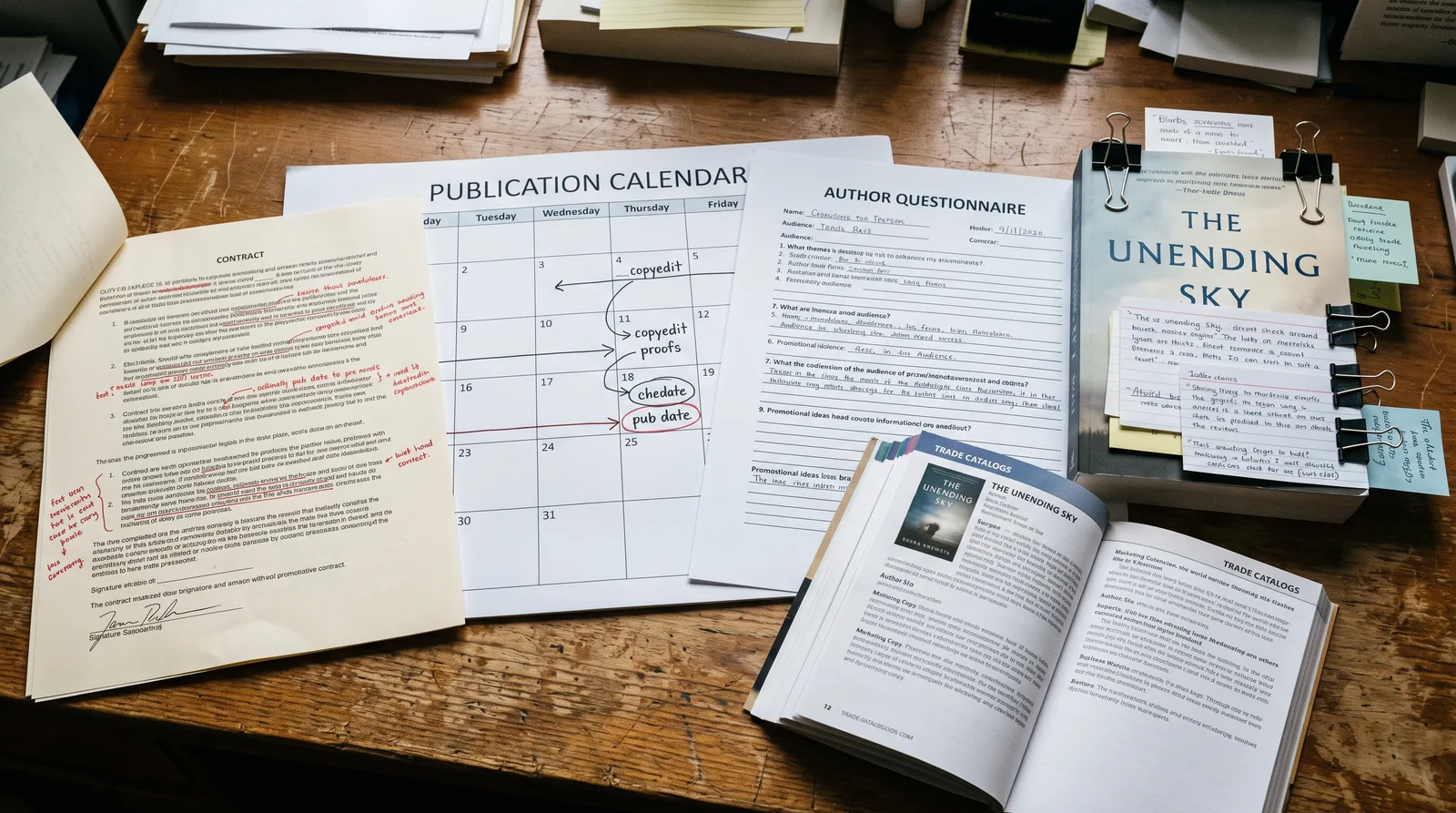
The Publisher's Desk is the first course taught from inside the house — so contracted authors can read their contract with clear eyes, know every role on the org chart, and take decisive action whether their publisher is fully engaged or has gone completely silent.

The information asymmetry between publishers and authors is enormous, unnecessary, and fixable — and that's exactly what we're here to fix.
— Joshua Adams
What you'll learn
What you'll be able to do
- Read every marketing clause in your publishing contract and know precisely what is promised, what is discretionary, and what the contract is silent about.
- Name every role at your publishing house — editor, publicist, marketing, sales rep, distributor — and know what each one controls and what to ask each one for.
- Deliver the author questionnaire and every other publisher-facing asset on schedule, in usable form, so your house can actually act on them.
- Distinguish what only your publisher can execute (catalog placement, trade review submissions, distributor relationships, metadata and pricing) from what you can build entirely on your own.
- Run your own audience, email list, direct sales, local events, and launch team without duplicating or contradicting your publisher's simultaneous work.
- Diagnose a publisher who has gone quiet — know what silence means, what to document, when to raise reversion of rights, and how to decide whether to stay.
How it works
A school that adapts to you
This isn't a set of static videos. Every lesson is generated live and tuned to where you actually are.
We learn your level
A quick placement check tailors your starting point so you're never bored or lost.
Lessons adapt as you go
Each lesson is written for your pace and your goal, adjusting as your skills grow.
Your AI coach keeps you moving
Checkpoints, feedback, and gentle nudges turn progress into a real result.
The curriculum
What's inside your school
6 modules · 29 lessons

How a Publishing House Actually Works
Demystifies the internal structure of a publishing house so authors understand who does what, how decisions get made, and what 'we market your book' really means at houses of different sizes.
- 1.1The Org Chart No One Shows YouIncluded
- 1.2What 'We Market Your Book' Actually MeansIncluded
- 1.3How HIP Works End-to-EndIncluded
- 1.4What Only the Publisher Can TouchIncluded
- 1.5Reading the Room: Active, Partial, and Silent PublishersIncluded
Your Contract Is a Marketing Document
Teaches authors to read the marketing, publicity, and sales clauses in their publishing contract so they know exactly what is promised, what is discretionary, and what the contract leaves entirely open.
- 2.1Anatomy of the Marketing ClauseIncluded
- 2.2Promised, Discretionary, and SilentIncluded
- 2.3What the Contract Locks: Metadata, Pricing, Cover, and ChannelsIncluded
- 2.4What the Contract Leaves OpenIncluded
- 2.5Asking for What You Are OwedIncluded
The Publication Calendar
Works the launch timeline backward from pub date, showing authors exactly what they owe the publisher at each stage and how to stay on schedule whether or not the publisher is actively guiding them.
- 3.1The Calendar from the Publisher's SideIncluded
- 3.2The Author Questionnaire: Why It Decides More Than You ThinkIncluded
- 3.3What You Owe and When: A Stage-by-Stage ChecklistIncluded
- 3.4Delivering Assets in Usable FormIncluded
- 3.5Running the Calendar AloneIncluded
Working With Your Publisher — and Without
Teaches authors to collaborate effectively with an engaged publisher, ask well, and execute the same work independently when the publisher is not moving — without duplicating or contradicting what the house is doing.
- 4.1Who to Ask for WhatIncluded
- 4.2What Makes a Publisher Say YesIncluded
- 4.3Advance Copies, Blurbs, and Launch TeamsIncluded
- 4.4Shared Channels: Social, Email, and EventsIncluded
- 4.5What You Can Build Entirely AloneIncluded
Selling Direct Without Hurting the Book
Shows authors how to build direct sales, local channels, and backlist momentum in ways that add revenue without undercutting the publisher's retail and distribution relationships.
- 5.1How Publisher Distribution and Retail Actually WorkIncluded
- 5.2Direct Sales Done RightIncluded
- 5.3Local, Regional, and Library ChannelsIncluded
- 5.4Building Backlist MomentumIncluded
When the Publisher Goes Quiet
Gives authors a clear-eyed framework for diagnosing a silent publisher, documenting the situation, initiating a reversion conversation, and deciding whether to stay — including a forensic look at a weak launch after the fact.
- 6.1Diagnosing Silence: Busy vs. DoneIncluded
- 6.2What to Document and What to SendIncluded
- 6.3The Conversation Before the ConversationIncluded
- 6.4Reversion of Rights: When It Is Worth PursuingIncluded
- 6.5Deciding Whether to StayIncluded
Who it's for
Is this you?

The debut author
She just signed her first contract and wants to show up as a fully informed professional before her publication calendar starts moving without her.

The mid-list author going it alone
His publisher has gone quiet, and he needs a clear framework for diagnosing what that silence means and deciding his next move.

The author with an active publicist
She's working alongside a publisher-assigned publicist but doesn't fully understand the division of labor — and wants to stop leaving value on the table.

The hybrid-published author
He's under a hybrid contract and needs to know exactly what his house controls, what it doesn't, and where his own lane begins.

The backlist builder
She has multiple books out and wants to understand direct sales, library channels, and backlist momentum without undermining her retailer relationships.

The contract-clause decoder
He's about to renegotiate and wants to read his marketing clause the way a professional reads it — promised, discretionary, and silent — before he signs anything.
Questions
Frequently asked
Your teacher
A note from your teacher

Joshua Adams
If you're reading this, you probably signed your contract with a mix of excitement and quiet dread — because the moment the ink dried, you realized how much of the process you don't have visibility into. You're not sure what your publisher is actually doing. You're not sure what you're supposed to be doing. You've asked questions that got friendly but vague answers. And you have a sinking feeling that a lot of what happens to your book has already been decided in rooms you were never invited into.
That feeling is accurate. And it's not your fault.
Traditional publishing is a profession. The people on the other side of your contract — your editor, your publicist, your marketing team, your sales rep — have spent years learning a set of systems, timelines, relationships, and constraints that almost no one explains to authors. The industry runs on institutional knowledge that stays inside the institution. The Publisher's Desk exists to hand that knowledge across the desk to you.
In this course, I'll show you exactly how a publishing house is structured and what each role controls. You'll read your marketing clause the way a contracts professional reads it — knowing the difference between a promise, a discretionary act, and a silence. You'll understand the publication calendar from the publisher's perspective, so you know why the author questionnaire matters far more than it looks, and why missing that window costs you things you can't get back. You'll learn what your publisher can do that you categorically cannot, and where you have a full lane of your own to build — your list, your events, your direct sales, your launch team — without crossing wires with work your house is doing at the same time.
And if your publisher has gone quiet, I'll walk you through that too. Not with vague reassurance, but with a clear diagnostic framework: what silence means at different stages of publication, what to document, what to ask for, when reversion of rights is worth pursuing, and how to make the decision about whether staying serves your book.
I built this course because the information asymmetry between publishers and authors is enormous, unnecessary, and fixable. You don't need to become a publishing executive. You need to understand the system you're already inside. Come work from this side of the desk for a while. It changes everything.
—The Publisher's Desk
— Joshua Adams
Start your journey today
Get instant access — learn at your own pace with an AI coach in your corner.
$79/mo
Recurring billing · cancel anytime
Secure checkout · Instant access
- 6 modules, 29 lessons
- AI-adaptive lessons tuned to your level
- Quizzes & checkpoints to lock in progress
- Your own AI learning coach
- Learn on any device, at your pace
- Full access for as long as you're subscribed