Discover the Inner Dimension of Islam
A grounded, academically honest journey through the living tradition of Tassawuf — from its Quranic roots and early ascetics to the great masters, orders, and spiritual sciences that shaped Muslim civilisation. No prior Arabic or theology required.
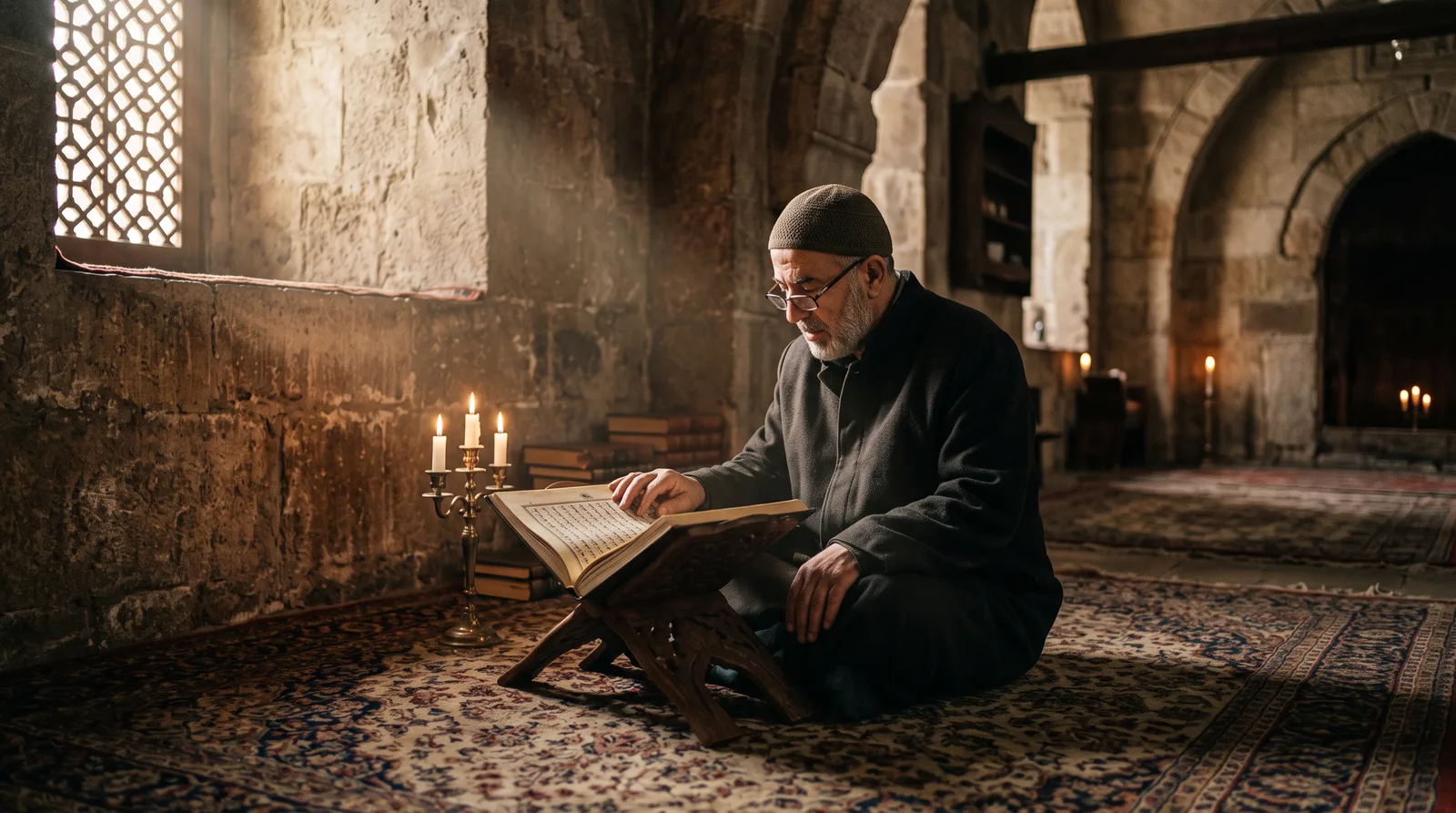
"Tassawuf is not an addition to Islam — it is the science of what Islam has always asked us to become."— Rabiah Abdussabur
What you'll learn
What you'll be able to do
- Explain the Quranic and Hadith foundations that gave rise to Tassawuf as a distinct science within Islam
- Trace the historical development of Sufism from the early ascetics of Basra and Kufa through the classical age of the great orders (turuq)
- Identify and compare the key figures — al-Hallaj, al-Ghazali, Ibn Arabi, Rumi — and articulate each one's distinct contribution to Sufi thought
- Distinguish the core concepts of maqamat (stations) and ahwal (states) and explain how they map the soul's journey toward Allah
- Critically evaluate common misconceptions and controversies surrounding Tassawuf, both from within Islam and from outside observers
- Apply an understanding of Sufi ethics (akhlaq) and spiritual practices — dhikr, muraqaba, sohbet — to enrich your own study of Islamic spirituality
How it works
A school that adapts to you
This isn't a set of static videos. Every lesson is generated live and tuned to where you actually are.
We learn your level
A quick placement check tailors your starting point so you're never bored or lost.
Lessons adapt as you go
Each lesson is written for your pace and your goal, adjusting as your skills grow.
Your AI coach keeps you moving
Checkpoints, feedback, and gentle nudges turn progress into a real result.
The curriculum
What's inside your school
6 modules · 27 lessons

What Is Tassawuf? Foundations and First Principles
Establishes a clear, grounded definition of Tassawuf and locates it firmly within the Islamic tradition before any historical or conceptual detail.
- 1.1Defining Tassawuf: The Inner Dimension of IslamIncluded
- 1.2The Three Dimensions: Islam, Iman, and IhsanIncluded
- 1.3Quranic Roots of the Sufi PathIncluded
- 1.4Prophetic Models: The Sunnah as Spiritual BlueprintIncluded
Origins and Early History: The First Generations
Traces Tassawuf from the Companions and early ascetics through the emergence of a self-conscious spiritual movement in Basra and Kufa.
- 2.1The Companions as Spiritual ArchetypesIncluded
- 2.2Early Asceticism: Zuhd and the Roots of RenunciationIncluded
- 2.3Hasan al-Basri and the School of the HeartIncluded
- 2.4Rabia al-Adawiyya and the Theology of Divine LoveIncluded
- 2.5From Ascetics to Mystics: The Crystallisation of a ScienceIncluded
The Classical Age: Masters, Orders, and Schools of Thought
Covers the golden period of Sufi intellectual and institutional development, from the great individual masters to the formation of the turuq.
- 3.1Al-Junayd of Baghdad and the Sober SchoolIncluded
- 3.2Al-Hallaj: The Martyr of Divine LoveIncluded
- 3.3Al-Ghazali and the Reconciliation of Sufism with Islamic LawIncluded
- 3.4Ibn Arabi and the Metaphysics of UnityIncluded
- 3.5Rumi, Poetry, and the Democratisation of Sufi WisdomIncluded
The Sufi Orders: Structure, Lineage, and Global Spread
Examines how the silsila system and the major turuq organised, transmitted, and spread Sufi spirituality across the Muslim world.
- 4.1The Silsila: Chains of Transmission and Spiritual AuthorityIncluded
- 4.2The Role of the Sheikh and the Mureed RelationshipIncluded
- 4.3The Major Orders: Qadiri, Naqshbandi, Shadhili, Chishti, and BeyondIncluded
- 4.4Sufism and the Spread of Islam: Saints, Trade Routes, and CivilisationIncluded
The Spiritual Map: Maqamat, Ahwal, and the Soul's Journey
Unpacks the interior psychology and cosmology of Tassawuf, giving students a clear map of the soul's stages and states on the path to Allah.
- 5.1The Nafs: Understanding the Self That Must Be TransformedIncluded
- 5.2Maqamat: The Stations of the PathIncluded
- 5.3Ahwal: The Gifts of Divine GraceIncluded
- 5.4Fana and Baqa: Annihilation and Subsistence in GodIncluded
Sufi Practice, Ethics, and Tassawuf Today
Grounds the course in lived practice — dhikr, muraqaba, sohbet, and akhlaq — and addresses contemporary debates and the enduring relevance of Tassawuf.
- 6.1Dhikr: The Practice of Divine RemembranceIncluded
- 6.2Muraqaba and Contemplative PresenceIncluded
- 6.3Sohbet: The Transformative Power of Spiritual CompanyIncluded
- 6.4Akhlaq: Sufi Ethics and the Purification of CharacterIncluded
- 6.5Misconceptions, Controversies, and the Living TraditionIncluded
Who it's for
Is this you?

Muslim Seekers
You practise your Deen and want to understand the inner dimension that the outward forms point toward — this school gives that longing a rigorous, rooted vocabulary.

Islamic Studies Students
You are studying Islamic history, theology, or law and need a serious, academically honest grounding in Tassawuf that connects it to the broader Islamic intellectual tradition.

Interfaith Scholars
You work across religious traditions and want to understand Sufism on its own terms — with the doctrinal precision and contextual depth that genuine comparative study demands.

Curious Lifelong Learners
A line of Rumi, a documentary, a conversation — something opened a door, and now you want a guide who will take you through it without dumbing the tradition down.

Educators & Chaplains
You teach, counsel, or serve Muslim communities and need a confident, nuanced understanding of the Sufi tradition to better support the people in your care.

Converts to Islam
You have embraced Islam and sense that there is a vast interior landscape to explore — this school gives you the foundational map and the classical guides who drew it.
Questions
Frequently asked
Your teacher
A note from your teacher

Rabiah Abdussabur
Bismillah ir-Rahman ir-Rahim.
If you are here, something has already drawn you toward this tradition — perhaps a line of Rumi that stopped you in your tracks, perhaps a question about the inner life of the Prophet's Companions ﷺ that no textbook quite answered, perhaps simply a sense that there must be more to Islam than its outward forms, beautiful as those forms are. Wherever that pull has come from, I want you to know: it is a legitimate impulse, and this school is built to honour it seriously.
Tassawuf has been misrepresented from almost every direction. From outside Islam, it is sometimes romanticised into a free-floating mysticism, stripped of its Sharia foundations and dressed up in incense and poetry. From certain quarters within contemporary Islam, it is treated with suspicion — as an innovation, or worse, a deviation. And yet for the greater part of Islamic history, the scholars who preserved the legal sciences, the theologians who defended orthodoxy, and the mystics who mapped the inner life were not three separate groups. They were, very often, the same people. Al-Ghazali held a chair at the Nizamiyya and then retreated into a decade of inner search. Ibn Arabi studied hadith and mastered fiqh before producing the Futuhat. The tradition is not a detour from Islam. It is one of its most carefully tended gardens.
What I offer in this school is a way into that garden that does not ask you to leave your intellect at the gate. We begin where the tradition itself insists we begin: with the Quran and the Sunnah, with the three dimensions of Deen — Islam, Iman, and Ihsan — and with the early generations who first articulated what it means to pursue excellence in worship and character. We then trace the history with care: the ascetics of Basra, the flowering of Baghdad, the great systematisers, the controversial ecstatics, and the architects of the orders that carried this knowledge across Africa, Central Asia, the Indian subcontinent, and beyond.
I also know that history alone is not enough. Many of you want to understand what the stations and states actually mean — not as theological curiosities, but as a map of something real in your own interior life. We cover the maqamat and ahwal in depth, not as a list to be memorised, but as a coherent spiritual psychology that rewards careful reflection. And we do not shy away from the hard questions: the controversy around al-Hallaj, the critiques of Ibn Arabi's metaphysics, the tensions between Sufi practice and certain schools of modern Islamic thought. A tradition this rich can bear honest scrutiny. In fact, it demands it.
My invitation to you is simple. Come with your questions — the ones you have always had but perhaps felt were too naïve, or too probing, or too personal to ask in another setting. This school is a place of measured, reverent inquiry. There is no gate here except sincerity. I will see you inside.
— Rabiah Abdussabur
Start your journey today
Join get instant access — learn at your own pace with an AI coach in your corner.
$39/mo
Recurring billing · cancel anytime
Secure checkout · Instant access
- 6 modules, 27 lessons
- AI-adaptive lessons tuned to your level
- Quizzes & checkpoints to lock in progress
- Your own AI learning coach
- Learn on any device, at your pace
- Full access for as long as you're subscribed