Master the discipline of effortless excellence
Using Trevanian's Shibumi as a living text, this school trains accomplished practitioners to cultivate the rarest standard in professional life: wholeness, restraint, and continuous proportionality — not as aesthetic ornament, but as a governing discipline.
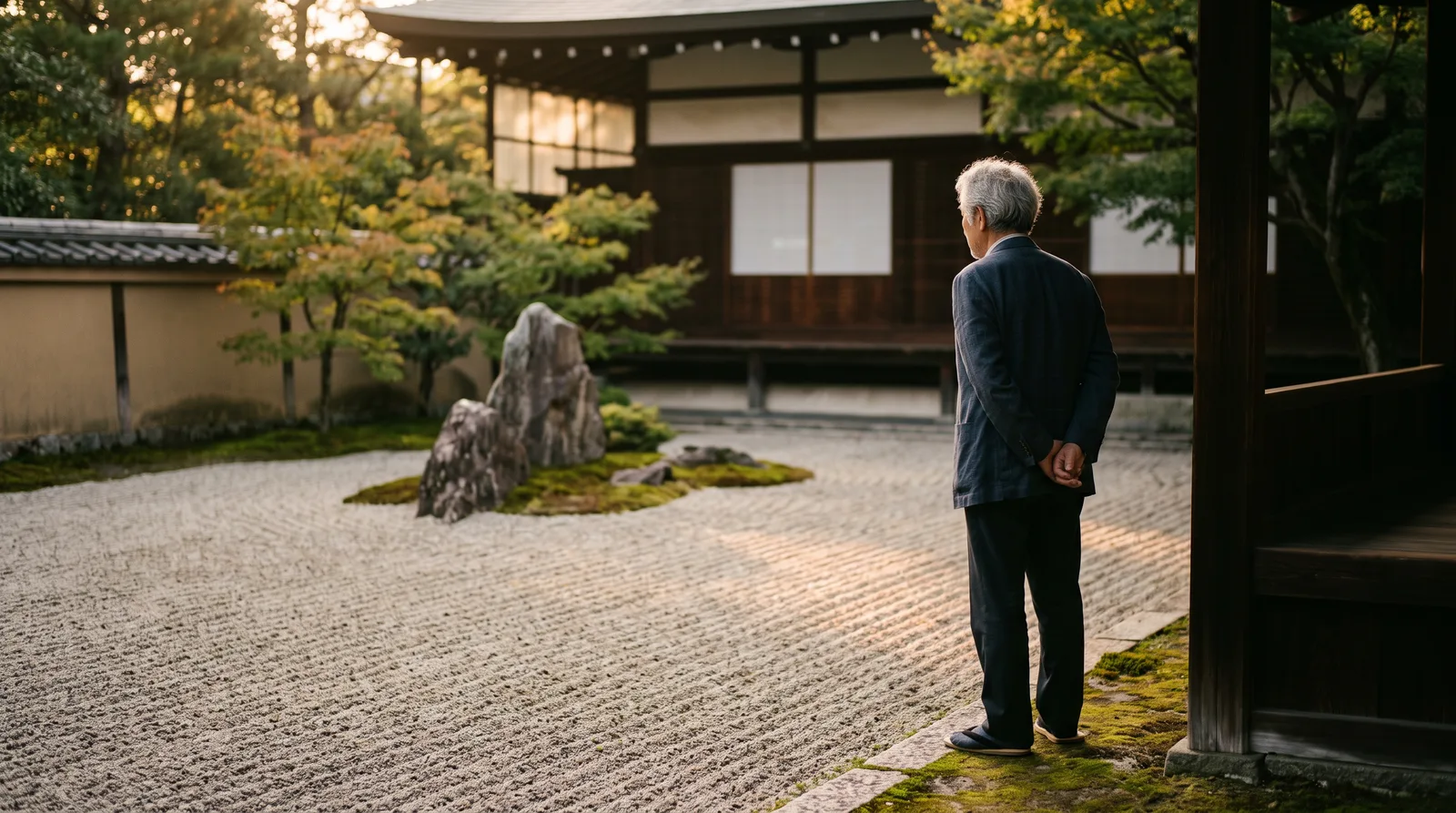
"The gap between competence and shibumi is not closed by accumulation — it is closed, slowly, by the cultivation of a practiced and unsparing eye."— Joseph Riggio
What you'll learn
What you'll be able to do
- Articulate and apply the concept of shibumi — understated, effortless excellence — as a living standard across your professional and personal decisions.
- Develop a practiced eye for proportionality: recognising and correcting what is excessive, insufficient, or merely decorative in your work and environments.
- Read any situation — a negotiation, a design, a relationship, a room — through an aesthetic lens that weighs texture, restraint, and internal coherence.
- Cultivate negative capability: the disciplined tolerance for ambiguity, incompleteness, and silence that separates the master from the merely skilled.
- Apply continuous proportionality as a decision framework — holding competing values in dynamic, calibrated tension rather than resolving them prematurely.
- Embody an integrated personal aesthetic: a coherent sensibility that governs how you act, create, lead, and inhabit the world, without performance or affectation.
How it works
A school that adapts to you
This isn't a set of static videos. Every lesson is generated live and tuned to where you actually are.
We learn your level
A quick placement check tailors your starting point so you're never bored or lost.
Lessons adapt as you go
Each lesson is written for your pace and your goal, adjusting as your skills grow.
Your AI coach keeps you moving
Checkpoints, feedback, and gentle nudges turn progress into a real result.
The curriculum
What's inside your school
6 modules · 24 lessons

The Texture of Shibumi
Establishes the novel's central aesthetic ideal as a living standard — not a concept to be understood but a sensibility to be cultivated.
- 1.1Reading Trevanian as a DisciplineIncluded
- 1.2What Shibumi Is NotIncluded
- 1.3Hel as Living StandardIncluded
- 1.4The Moment You Recognise ItIncluded
Proportionality as a Practiced Eye
Develops the capacity to perceive and calibrate what is excessive, insufficient, or merely decorative in work, decisions, and environments.
- 2.1The Aesthetics of EnoughIncluded
- 2.2Diagnosing Excess and DeficiencyIncluded
- 2.3The Decorative and the EssentialIncluded
- 2.4Proportionality Across ScalesIncluded
The Aesthetic Lens in Practice
Trains practitioners to read any situation — negotiation, design, relationship, space — through texture, restraint, and internal coherence.
- 3.1Reading a Room, a Deal, a PersonIncluded
- 3.2Internal Coherence as IntegrityIncluded
- 3.3Restraint as Active ForceIncluded
- 3.4The Practitioner's Field ReviewIncluded
Negative Capability and the Mastery of Incompleteness
Cultivates the disciplined tolerance for ambiguity, silence, and unresolved tension that separates the master from the merely skilled.
- 4.1Keats, Hel, and the UnresolvedIncluded
- 4.2The Compulsion to ResolveIncluded
- 4.3Sitting in the DifficultyIncluded
- 4.4Silence as DecisionIncluded
Continuous Proportionality as a Decision Framework
Applies proportionality not as a one-time calibration but as a living, dynamic method for holding competing values in productive tension.
- 5.1Against Resolution: Holding the TensionIncluded
- 5.2Mapping Your Competing ObligationsIncluded
- 5.3The Moving EquilibriumIncluded
- 5.4Proportionality Under PressureIncluded
The Integrated Personal Aesthetic
Consolidates all prior disciplines into a coherent, ungoverned sensibility that expresses itself through action, creation, and inhabitation — without performance.
- 6.1Sensibility vs. StyleIncluded
- 6.2Coherence Across DomainsIncluded
- 6.3The Absence of AffectationIncluded
- 6.4Your Shibumi StandardIncluded
Who it's for
Is this you?

The Seasoned Founder
You have built something real and feel the pull toward a standard of leadership and craft that goes beyond growth metrics and operational excellence.

The Senior Architect
You have a practiced eye for structure and form, and you want a rigorous framework for the aesthetic judgements you have been making intuitively for years.

The Executive Strategist
You navigate high-stakes decisions daily and recognise that your hardest challenges are not analytical but aesthetic — about coherence, restraint, and proportion.

The Veteran Designer
You have moved beyond surface refinement and are seeking a governing sensibility that holds across every domain of your practice without becoming a style.

The Principal Consultant
You advise at the highest levels and want the vocabulary and lens to articulate — and embody — the standard of integrated, effortless excellence your best clients already sense but cannot name.

The Reflective Leader
You have reached a point of seniority where the interesting questions are no longer about what to do, but about who to be — and you want a discipline, not a framework, to guide that inquiry.
Questions
Frequently asked
Your teacher
A note from your teacher
Joseph Riggio
You are reading this because something has been nagging at you — not inadequacy, which you have largely moved past, but a subtler dissatisfaction. You have done the work. You have built things, led people, made consequential decisions. And yet you are aware, with increasing clarity, that competence is not the same as excellence, and that the kind of excellence you are reaching for does not have a name in most professional vocabularies.
I built this school for that gap. Not to fill it — the gap is, in a sense, the discipline — but to give you the vocabulary, the lens, and the practice to inhabit it deliberately rather than drift through it privately. The concept of shibumi — effortless, understated, proportionate — is not a Japanese design aesthetic to be appreciated from a distance. It is a living standard, and Trevanian's novel is its most precise articulation in the Western tradition. I use it not because fiction is a soft way into hard ideas, but because the novel does something that most frameworks cannot: it embodies the standard rather than merely describing it. You feel the difference between shibumi and its absence before you can name it. The curriculum makes that feeling precise.
What we work through together is demanding in a particular way. The sessions on proportionality will require you to look at your own work — your decisions, your environments, your professional habits — and identify not what is wrong in the obvious sense, but what is excessive, insufficient, or merely decorative. The work on negative capability will ask you to sit with incompleteness longer than is comfortable, and to notice the specific ways you currently escape that discomfort. The sessions on the integrated personal aesthetic will ask a harder question than most professional development ever does: not what you produce, but who you are when no one is watching and nothing needs to be performed.
I want to be plain about what this school is not. It is not for practitioners still in the phase of acquiring competence — the curriculum has no patience for that framing, and no infrastructure to support it. It is not a shortcut to a refined sensibility; the whole argument of shibumi is that there are no shortcuts, only the slow, unglamorous practice of attention and correction. And it is not comfortable. If you arrive expecting your current standard to be validated, the curriculum will disappoint you with precision.
What it is: a rigorous, unhurried discipline for principals who are already excellent and suspect that excellence, properly understood, is just the beginning. If that sentence lands, you already know whether this is for you. I hope you'll come and do the work.
— Joseph Riggio
Start your journey today
Join get instant access — learn at your own pace with an AI coach in your corner.
$97/yr
Recurring billing · cancel anytime
Secure checkout · Instant access
- 6 modules, 24 lessons
- AI-adaptive lessons tuned to your level
- Quizzes & checkpoints to lock in progress
- Your own AI learning coach
- Learn on any device, at your pace
- Full access for as long as you're subscribed