Learn to think like an economist — for real, for life
This is the microeconomics course that finally makes it click: plain-English intuition first, rigorous analysis second, exam-ready confidence throughout — so you stop memorizing formulas and start actually understanding why markets work the way they do.

I don't want you to memorize economics — I want you to see the world through it.
— DM
What you'll learn
What you'll be able to do
- Explain every core microeconomics concept — from scarcity to game theory — in plain English and in precise economic terminology
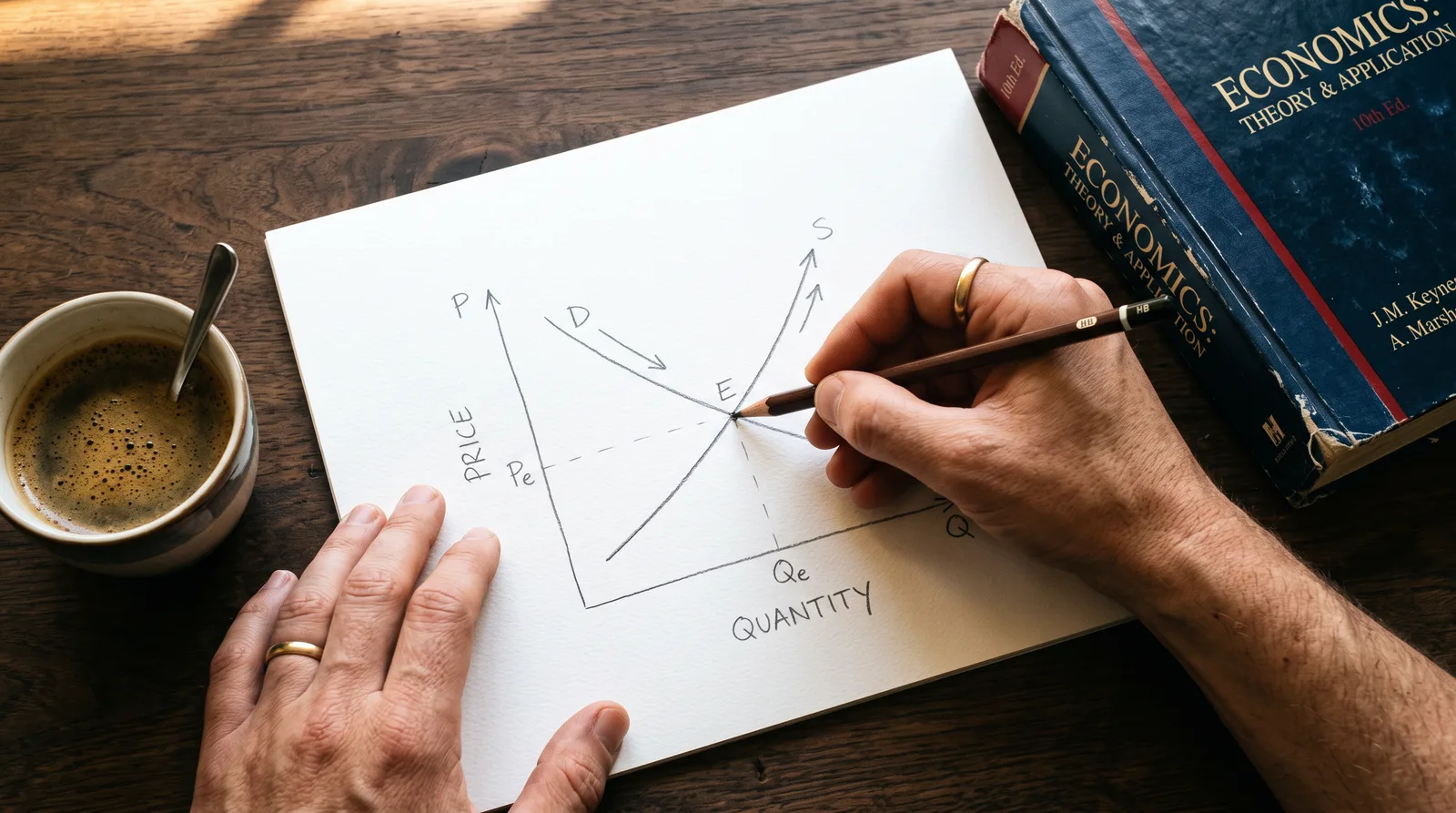
- Read, draw, and interpret supply-and-demand graphs, PPF curves, and cost curves with full confidence
- Diagnose any market scenario by identifying what changed, which curve shifts, and what happens to equilibrium price and quantity
- Recognize and analyze market failures, externalities, public goods, and the full spectrum of market structures from perfect competition to monopoly
- Answer the full range of microeconomics exam questions — multiple choice, short answer, and graph-based — with a clear, structured reasoning process
- Apply economic reasoning to real-world decisions involving prices, incentives, tradeoffs, and opportunity costs in everyday life
How it works
A school that adapts to you
This isn't a set of static videos. Every lesson is generated live and tuned to where you actually are.
We learn your level
A quick placement check tailors your starting point so you're never bored or lost.
Lessons adapt as you go
Each lesson is written for your pace and your goal, adjusting as your skills grow.
Your AI coach keeps you moving
Checkpoints, feedback, and gentle nudges turn progress into a real result.
The curriculum
What's inside your school
7 modules · 34 lessons

Thinking Like an Economist: The Foundation
Builds the core mental toolkit — scarcity, opportunity cost, trade-offs, and comparative advantage — so every later concept rests on solid intuition.
- 1.1Scarcity, Choice, and the Economic ProblemIncluded
- 1.2Opportunity Cost: The True Cost of Every DecisionIncluded
- 1.3The Production Possibilities Frontier (PPF)Included
- 1.4Comparative Advantage and the Gains from TradeIncluded
- 1.5Economic Models, Assumptions, and Thinking at the MarginIncluded
Supply, Demand, and Market Equilibrium
Develops full command of supply and demand — how to read and draw the graphs, what causes shifts versus movements, and how markets reach equilibrium.
- 2.1Demand: What It Is, What It Isn't, and What Moves ItIncluded
- 2.2Supply: The Producer's Side of the MarketIncluded
- 2.3Market Equilibrium: Where Supply Meets DemandIncluded
- 2.4Shifts in Equilibrium: Diagnosing Any Market ChangeIncluded
- 2.5Consumer Surplus, Producer Surplus, and Market EfficiencyIncluded
Elasticity: How Sensitive Are Buyers and Sellers?
Teaches students to measure and interpret price, income, and cross-price elasticity and apply them to taxes, revenue, and real-world pricing.
- 3.1Price Elasticity of Demand: Measuring Consumer SensitivityIncluded
- 3.2Elasticity and Total Revenue: The Critical Business ConnectionIncluded
- 3.3Price Elasticity of Supply, Income Elasticity, and Cross-Price ElasticityIncluded
- 3.4Elasticity in Action: Taxes, Subsidies, and Who Really PaysIncluded
Government Intervention and Market Failures
Examines what happens when governments set prices or correct markets — price controls, taxes, subsidies, externalities, and public goods.
- 4.1Price Ceilings and Price Floors: When Governments Control PricesIncluded
- 4.2Taxes and Subsidies: Shifting the Burden and the BenefitIncluded
- 4.3Externalities: When Markets Ignore Outside Costs and BenefitsIncluded
- 4.4Public Goods and Common Resources: The Free-Rider ProblemIncluded
- 4.5Market Failure: Bringing It All TogetherIncluded
Costs of Production and the Competitive Firm
Builds the cost-curve toolkit from the ground up and uses it to understand how a perfectly competitive firm makes output and shut-down decisions.
- 5.1Production in the Short Run: Inputs, Outputs, and Diminishing ReturnsIncluded
- 5.2The Cost Curves: Fixed, Variable, Average, and MarginalIncluded
- 5.3Perfect Competition: The Price-Taking FirmIncluded
- 5.4Short-Run Profit, Loss, and the Shut-Down DecisionIncluded
- 5.5Long-Run Equilibrium and Zero Economic ProfitIncluded
Market Power: Monopoly and Imperfect Competition
Moves from competitive markets to monopoly, monopolistic competition, and oligopoly, culminating in game theory and strategic interaction.
- 6.1Monopoly: Price, Output, and Deadweight LossIncluded
- 6.2Price Discrimination: Charging Different Buyers Different PricesIncluded
- 6.3Monopolistic Competition: Many Firms, Differentiated ProductsIncluded
- 6.4Oligopoly and Strategic InterdependenceIncluded
- 6.5Game Theory: The Prisoner's Dilemma and Strategic ThinkingIncluded
Factor Markets, Labor, and International Trade
Extends microeconomic reasoning to labor and other input markets, then applies comparative advantage and trade policy to the global economy.
- 7.1Factor Markets and the Demand for LaborIncluded
- 7.2Labor Supply, Wages, and Market EquilibriumIncluded
- 7.3Other Factor Markets: Capital, Land, and Economic RentIncluded
- 7.4International Trade: Comparative Advantage Applied GloballyIncluded
- 7.5Trade Policy: Tariffs, Quotas, and the Politics of ProtectionIncluded
Who it's for
Is this you?

The Econ 101 freshman
Taking introductory micro for the first time and wants to actually understand what's going on in lecture — not just scrape by.

The pre-med student chasing an A
Needs a strong grade for a competitive GPA and wants rigorous, precise explanations that hold up under exam pressure.

The pre-law student building analytical skills
Knows that economic reasoning will matter in law school and wants to develop real analytical muscle, not just pass the requirement.

The student who barely passed the first time
Retaking or reviewing micro after a rough semester and needs the intuitive, from-scratch explanation they never got the first time.

The intermediate micro student leveling up
Moving into a 200-level course and wants to shore up the foundations — elasticity, cost curves, market structures — before the difficulty spikes.

The lifelong learner who skipped econ
Never took economics formally and wants a rigorous, university-level understanding of how markets and incentives actually work.
Questions
Frequently asked
Your teacher
A note from your teacher
DM
If you're reading this, there's a decent chance you've sat in an economics lecture, nodded along while your professor drew curves on a whiteboard, and then opened your problem set an hour later and thought: I have absolutely no idea what I'm doing.
You're not alone — and you're not bad at economics. You just haven't been taught it the right way yet.
Here's what I've seen happen again and again: students get handed a textbook full of graphs, Greek letters, and definitions, and they're essentially told to memorize their way to a passing grade. And some of them do. But ask those same students six months later to explain why a tax on gasoline falls more heavily on consumers than producers, or what happens to wages when labor demand shifts — and the answer is a blank stare. That's not understanding. That's pattern-matching, and it evaporates the moment the exam is over.
I built Think Like an Economist because I believe every student who puts in genuine effort deserves to actually get it — not just survive the course. Every lesson in this course starts with the real-world intuition behind the concept before a single graph or formula appears. I want you to understand why markets reach equilibrium before you memorize what equilibrium looks like on a diagram. I want you to feel the logic of opportunity cost before I ask you to calculate it. That sequence — intuition first, precision second — is the difference between knowledge that lasts and knowledge that leaks.
The curriculum covers everything your course demands: supply and demand, elasticity, government intervention, market failures, cost curves, perfect competition, monopoly, game theory, factor markets, and trade policy. But more than covering the content, it gives you a way of thinking — a diagnostic framework you can apply to any market scenario, any exam question, and any real-world situation involving prices, incentives, or tradeoffs. That framework is what economists actually use. And now it's yours too.
If you're ready to stop white-knuckling your way through microeconomics and start genuinely understanding it, I'm glad you're here. Let's get to work.
— DM
Start your journey today
Get instant access — learn at your own pace with an AI coach in your corner.
$49/mo
Recurring billing · cancel anytime
Secure checkout · Instant access
- 7 modules, 34 lessons
- AI-adaptive lessons tuned to your level
- Quizzes & checkpoints to lock in progress
- Your own AI learning coach
- Learn on any device, at your pace
- Full access for as long as you're subscribed