Read the body's story — written on the tongue
Master the ancient art of Chinese tongue diagnosis to read the body's internal landscape — identifying imbalances in organs, qi, and fluids with trained, confident eyes. Bridge classical theory and real clinical practice.
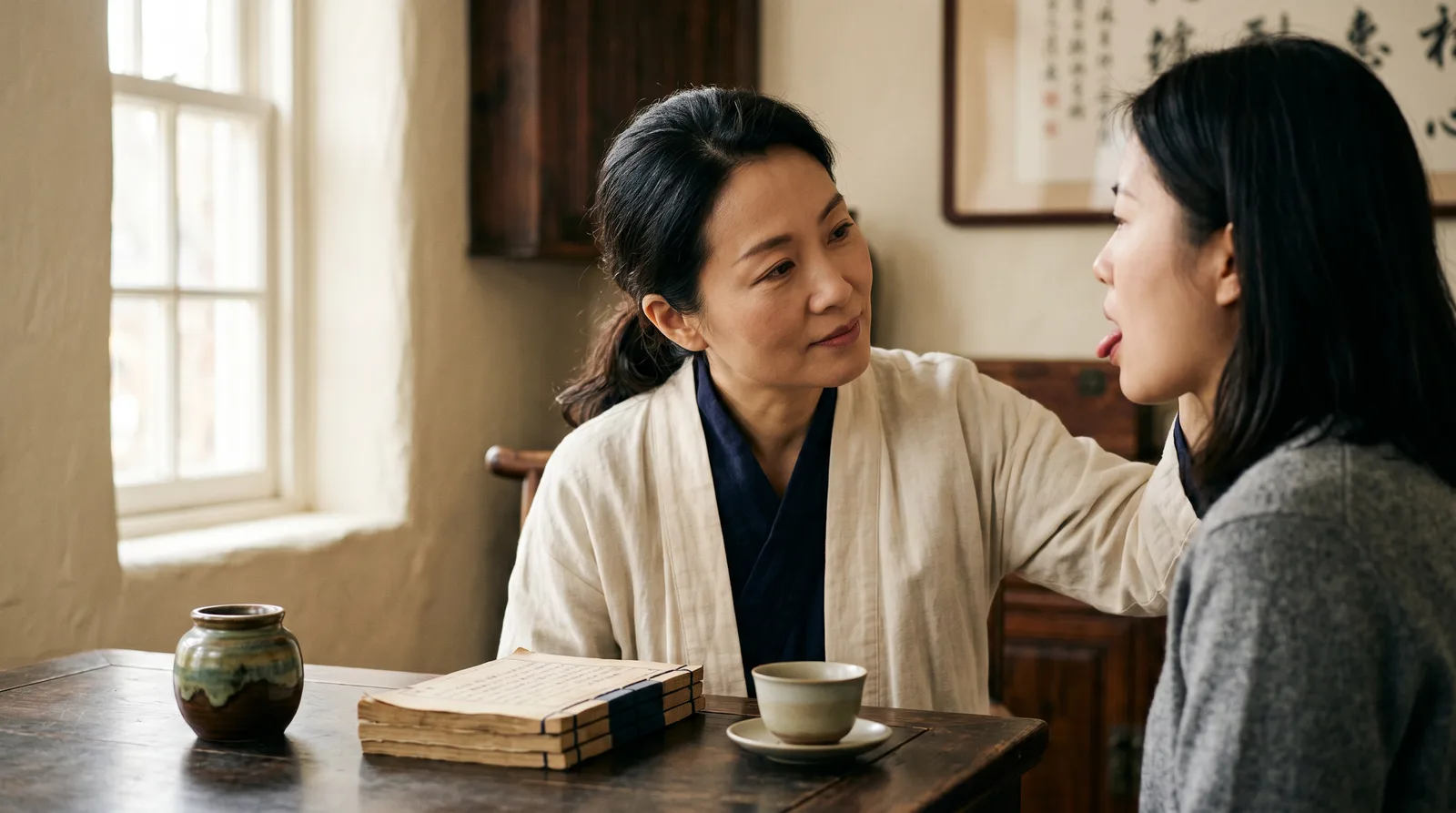
"The tongue doesn't interpret itself — but once you know how to look, it rarely leaves you guessing."— Denise Chenault-Lang
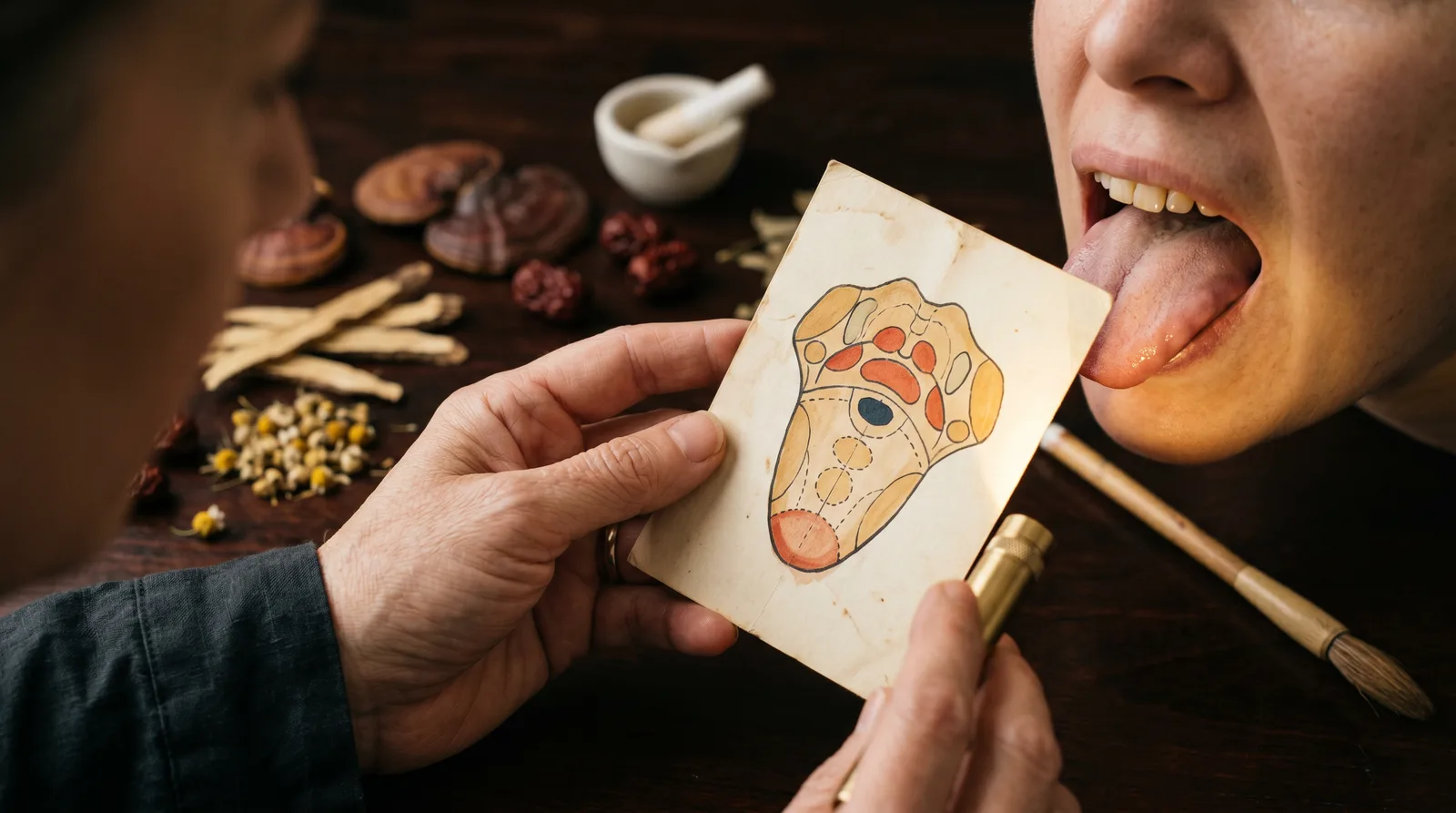
What you'll learn
What you'll be able to do
- Identify the six classical tongue zones and map them accurately to their corresponding organ systems
- Read tongue body colour variations — pale, red, crimson, purple, and blue — and link each to specific TCM pathologies
- Analyse tongue coating thickness, colour, and distribution to detect heat, cold, dampness, and phlegm patterns
- Assess tongue shape and texture features (swollen, thin, cracked, deviated, teethmarks) and interpret their constitutional meaning
- Integrate tongue findings with pulse and symptom data to form a coherent TCM pattern diagnosis
- Build and maintain a personal tongue-case photo library to track patient progress and sharpen diagnostic accuracy over time
How it works
A school that adapts to you
This isn't a set of static videos. Every lesson is generated live and tuned to where you actually are.
We learn your level
A quick placement check tailors your starting point so you're never bored or lost.
Lessons adapt as you go
Each lesson is written for your pace and your goal, adjusting as your skills grow.
Your AI coach keeps you moving
Checkpoints, feedback, and gentle nudges turn progress into a real result.
The curriculum
What's inside your school
6 modules · 18 lessons

Foundations of Tongue Diagnosis
Establishes the theoretical bedrock before any clinical observation begins. Students learn why the tongue holds such a privileged place in TCM diagnostics, how classical texts justify that privilege, and how to create a reproducible, standardised observation environment — prerequisites for everything that follows.
- 1.1Why the Tongue? Classical Roots and Clinical LogicIncluded
- 1.2The Six Tongue Zones: Mapping Organs to SurfaceIncluded
- 1.3Setting Up Your Observation Practice: Light, Timing, and Patient PrepIncluded
Reading the Tongue Body: Colour as Clinical Signal
Develops systematic colour-reading skills across the full spectrum of pathological tongue body colours. Each lesson anchors colour variations firmly to their underlying TCM pathologies, satisfying the second target outcome. The module opens with normal baseline so students have a calibrated reference point before progressing to increasingly severe deviations.
- 2.1Pale and Normal: Establishing Your BaselineIncluded
- 2.2Red and Crimson: Heat Patterns and Yin DeficiencyIncluded
- 2.3Purple, Blue, and Dusky: Blood Stasis and Cold PatternsIncluded
Decoding the Coating: Thickness, Colour, and Distribution
Trains students to read the tongue coating — the 'moss' (苔, tāi) — as an independent layer of diagnostic information reflecting the status of the Stomach's transformative function and the presence or absence of pathogenic factors. The module addresses thickness, colour, distribution, and rootedness sequentially, fully satisfying the third target outcome.
- 3.1White and Yellow Coatings: Cold, Heat, and the Stomach's StoryIncluded
- 3.2Grey, Black, and Absent Coatings: Extremes and Deficiency PatternsIncluded
- 3.3Distribution and Rootedness: Where and How the Coating SitsIncluded
Shape, Texture, and Movement: What the Tongue Body Tells You
Expands the diagnostic lens from colour and coating to the three-dimensional qualities of the tongue body itself: its size, surface texture, structural integrity, and motor behaviour. These features reveal constitutional tendencies and chronic pathological states that colour alone cannot capture, fully addressing the fourth target outcome. Deviated and trembling tongue are placed last as they require integrated knowledge from earlier lessons to interpret correctly.
- 4.1Swollen, Puffy, and Teethmarked: Dampness, Phlegm, and Qi DeficiencyIncluded
- 4.2Thin, Cracked, and Dry: Yin, Blood, and Fluid DeficiencyIncluded
- 4.3Deviated, Trembling, and Stiff: Wind, Heat, and Neurological SignalsIncluded
Integration: From Tongue to Full TCM Pattern Diagnosis
Synthesises all previous observational skills into the complete diagnostic process, adding pulse and symptom data to form coherent, defensible TCM pattern diagnoses. This module directly addresses the fifth target outcome and acts as the clinical capstone of the observational curriculum. The sequencing — tongue-pulse dialogue before full four-examination integration before pattern cluster recognition — mirrors actual clinical reasoning flow.
- 5.1The Tongue-Pulse Dialogue: Confirming and ContradictingIncluded
- 5.2Reading the Whole Patient: Integrating Symptoms, History, and TongueIncluded
- 5.3Common Pattern Clusters: Recognising the 12 Most Clinically Frequent TonguesIncluded
Building Your Clinical Practice: Documentation, Photo Libraries, and Continuous Learning
Transforms diagnostic skill into sustainable clinical practice. Students build the professional infrastructure — ethical protocols, organised case libraries, peer-review habits, and self-calibration routines — needed to maintain and sharpen their tongue diagnosis accuracy over a career. This module directly addresses the sixth target outcome and is deliberately placed last so that the library being built is populated with well-understood, correctly interpreted cases.
- 6.1Ethical Photo Documentation and ConsentIncluded
- 6.2Building and Organising Your Tongue Case LibraryIncluded
- 6.3Calibration, Peer Review, and Lifelong Diagnostic SharpeningIncluded
Who it's for
Is this you?

Acupuncture practitioners
Ready to move beyond basic tongue checks and integrate precise, confident diagnosis into every patient session.

TCM college students
Building clinical foundations and wanting a thorough, visually grounded command of tongue diagnosis before graduation.
Naturopathic doctors
Drawn to classical Chinese diagnostic methods as a powerful complement to their existing assessment toolkit.

Herbal medicine practitioners
Looking to sharpen pattern identification so their formula choices are grounded in clearer, more accurate TCM diagnosis.

Integrative health educators
Teaching TCM theory and wanting authoritative, curriculum-ready depth on one of the classical examination pillars.

Self-directed TCM learners
Serious about classical Chinese medicine and ready to develop a real diagnostic skill beyond books and beginner charts.
Questions
Frequently asked
Your teacher
A note from your teacher
Denise Chenault-Lang
If you have been practising — or studying — Chinese medicine for any length of time, you already know that the tongue is supposed to tell you something. You have seen the charts. You have memorised the zones. And yet, in the clinic, with a patient's tongue extended in front of you and a full case to build, there is often a gap between what you know in theory and what you can read with confidence in that moment.
That gap is what this course closes.
I have spent years working with tongue diagnosis not as an isolated technique but as a living clinical language — one that speaks most clearly when you know how to listen. What I want to offer you here is not more chart memorisation. It is a way of seeing: understanding why the tongue reflects what it does, what each variation is actually telling you about the body's internal state, and how to hold that information in meaningful dialogue with everything else you are gathering from the patient in front of you.
We will move through the full diagnostic landscape together — from establishing your observation baseline (the conditions under which you look matter more than most texts acknowledge) to reading the subtlest distinctions: the difference between a coating that is merely thin and one that is truly rootless; the particular quality of a crimson tip versus a uniformly red body; what it means when a tongue is deviated and trembling. These are the details that separate pattern recognition from genuine clinical insight.
By the time we reach the integration modules, you will not be assembling a diagnosis from separate checkboxes. You will be reading the tongue as part of a coherent whole — in conversation with the pulse, the symptoms, the patient's history — and recognising the 12 most common pattern clusters that appear again and again in clinical practice. You will also build a personal photo case library with proper ethical foundations, so that your diagnostic eye continues to sharpen long after this course ends.
This is the apprenticeship in tongue diagnosis I wish I had been offered earlier in my training. I am glad to offer it to you now. Come with your curiosity, your clinical questions, and your willingness to look — really look — and this skill will serve you for the rest of your practice.
— Denise Chenault-Lang
Start your journey today
Join get instant access — learn at your own pace with an AI coach in your corner.
$59/mo
Recurring billing · cancel anytime
Secure checkout · Instant access
- 6 modules, 18 lessons
- AI-adaptive lessons tuned to your level
- Quizzes & checkpoints to lock in progress
- Your own AI learning coach
- Learn on any device, at your pace
- Full access for as long as you're subscribed