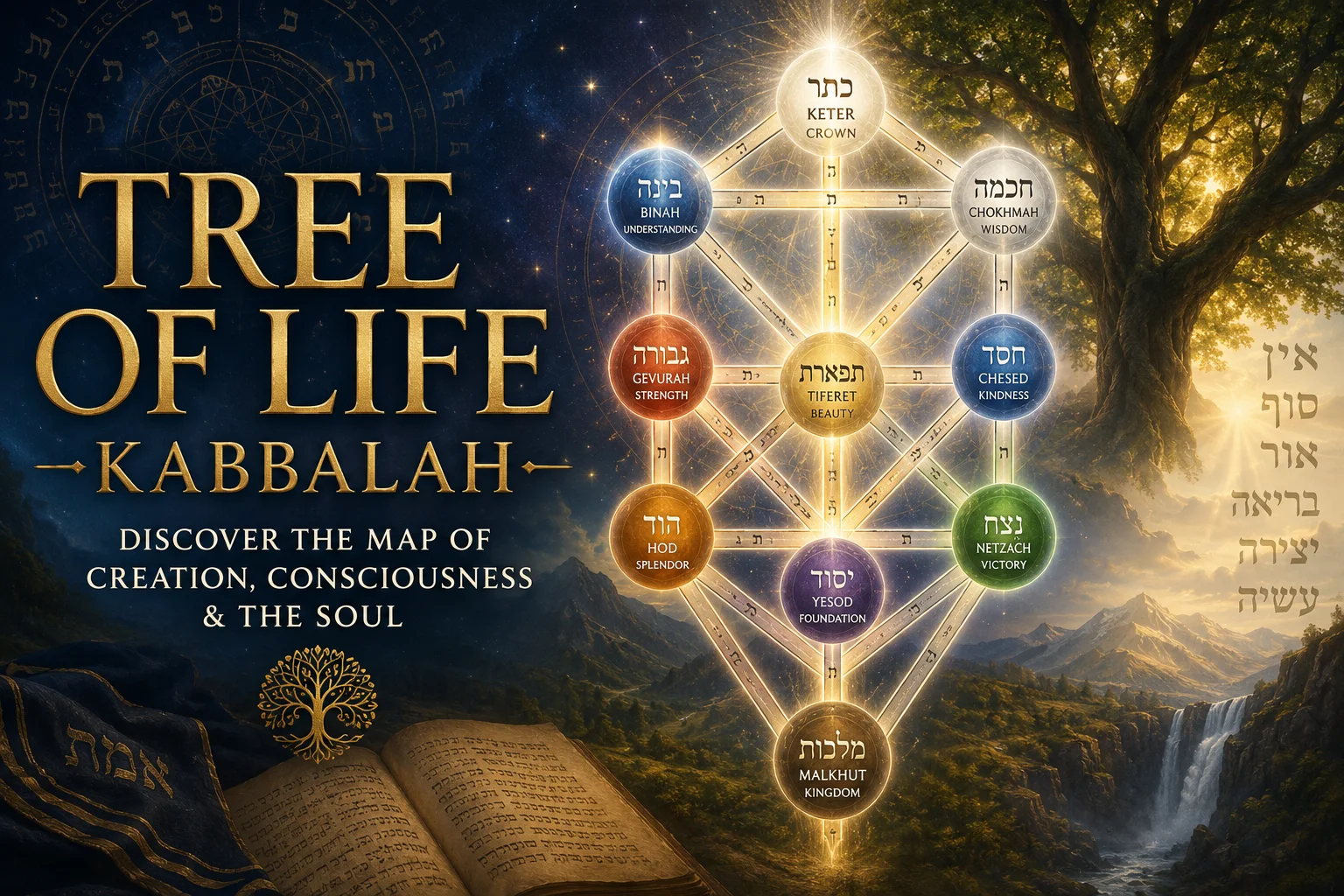
Learn to read the universe's oldest map of consciousness
A clear, grounded introduction to Kabbalah as a living symbolic map of consciousness, creation, and transformation. No prior Hebrew, religion, or occult experience required.
"I'm not here to initiate you — I'm here to make sure you can read the map yourself."
— Carla Paton

What you'll learn
What you'll be able to do
- Read and interpret the Tree of Life diagram with confidence, naming each Sephirah and understanding its symbolic role
- Explain the historical development of Kabbalah from its Jewish mystical roots through Hermetic and Western esoteric adaptations
- Distinguish the ten Sephirot and their relational dynamics, including the three pillars and the four worlds
- Recognize Kabbalistic symbolism embedded in tarot, alchemy, astrology, and depth psychology
- Apply reflective and contemplative exercises to use the Tree of Life as a personal map of inner experience
- Compare traditional Jewish Kabbalah with later Hermetic Qabalah, articulating where they converge and where they diverge
How it works
A school that adapts to you
This isn't a set of static videos. Every lesson is generated live and tuned to where you actually are.
We learn your level
A quick placement check tailors your starting point so you're never bored or lost.
Lessons adapt as you go
Each lesson is written for your pace and your goal, adjusting as your skills grow.
Your AI coach keeps you moving
Checkpoints, feedback, and gentle nudges turn progress into a real result.
The curriculum
What's inside your school
6 modules · 24 lessons

Roots and Origins: The Historical World of Kabbalah
This foundational module situates Kabbalah in its proper historical, cultural, and intellectual context before any symbolic content is introduced. Students first clarify what Kabbalah actually is — dispelling common misconceptions — then trace the tradition from its earliest Jewish mystical antecedents through the medieval flowering in Provence, Gerona, and the Zohar, and finally to the transformative Lurianic school in Safed. Sequencing history before symbol ensures students can later distinguish an idea's original context from its later reinterpretations, which is essential for the comparative work in Module 5.
- 1.1What Is Kabbalah? Definitions, Misconceptions, and the Living TraditionIncluded
- 1.2Ancient Roots: Merkabah Mysticism, the Sefer Yetzirah, and Early Jewish MysticismIncluded
- 1.3The Golden Age: Provence, Gerona, and the ZoharIncluded
- 1.4Safed, Lurianic Kabbalah, and the Spread of the TraditionIncluded
The Tree of Life: Architecture of a Symbol
With historical grounding established, students now encounter the Tree of Life as a structured diagram. This module teaches students to read the Tree confidently — its layout, its internal logic, its major organizing principles (the three pillars, the lightning flash, the four worlds), and the concept of Da'ath. The sequencing is deliberate: broad structural orientation comes before detailed study of the individual Sephirot in Module 3, so students always understand each part in relation to the whole. A new lesson on Da'ath fills a genuine gap in the draft: this 'hidden' non-Sephirah appears on virtually every Tree diagram and puzzles beginners, yet the draft never addresses it directly.
- 2.1First Encounter with the Tree: Layout, Logic, and How to Read the DiagramIncluded
- 2.2The Three Pillars and the Lightning Flash: Movement Through the TreeIncluded
- 2.3The Four Worlds: Atziluth, Beriah, Yetzirah, and AssiahIncluded
- 2.4Da'ath: The Hidden Sephirah and the AbyssIncluded
The Ten Sephirot: Names, Meanings, and Relationships
This module studies each of the ten Sephirot in depth, organized by their traditional grouping into three triangles plus Malkuth. Students learn the name, number, Hebrew meaning, divine name, archangelic correspondence, symbolic color, and psychological quality of each Sephirah, and — crucially — how each Sephirah relates to its neighbors within its triangle and across the Tree as a whole. The module also integrates the pillar and world frameworks established in Module 2, ensuring students can always see the parts within the whole. Astrological and planetary attributions of the Sephirot are introduced here (not only in the paths module), correcting a sequencing gap in the draft that left students without this correspondence when first studying the Sephirot.
- 3.1The Supernal Triangle: Kether, Chokmah, and BinahIncluded
- 3.2The Ethical Triangle: Chesed, Geburah, and TipharethIncluded
- 3.3The Astral Triangle: Netzach, Hod, and YesodIncluded
- 3.4Malkuth: The Kingdom and the World We Live InIncluded
The Twenty-Two Paths: Letters, Tarot, and the Language of Connection
This module explores the twenty-two paths that connect the Sephirot — each assigned a Hebrew letter, a tarot Major Arcana card, and a set of astrological or elemental correspondences. The module opens with the Hebrew alphabet as a symbolic system (a prerequisite for understanding why the letters are assigned to the paths), then maps the Major Arcana onto the Tree, and concludes with the full astrological and elemental framework. The sequencing is improved from the draft: students now approach the paths having already fully studied all ten Sephirot, so they understand what each path is connecting. A new closing lesson synthesizes the complete correspondence system and gives students practice reading the Tree as an integrated whole.
- 4.1The Hebrew Alphabet as Symbolic LanguageIncluded
- 4.2The Major Arcana and the Tree: Mapping Tarot onto the PathsIncluded
- 4.3Astrological and Elemental Correspondences of the PathsIncluded
- 4.4Reading the Tree as a Unified Correspondence SystemIncluded
Hermetic Qabalah and Western Esotericism: From Jewish Roots to Universal Symbol
Having mastered the symbolic system, students now return to history — but history seen from the inside. This module traces how Kabbalah migrated beyond Jewish communities into Christian Renaissance humanism, Hermetic occultism, the ceremonial magic of the Golden Dawn, and finally into the depth psychology of the 20th century. The module fulfills the target outcome of comparing Jewish Kabbalah with Hermetic Qabalah, helping students articulate both where the traditions share deep structural commitments and where they diverge significantly in theology, purpose, and practice. The lesson on depth psychology is expanded to include a more thorough treatment of alchemy as a symbolic system parallel to the Tree.
- 5.1Christian Cabala and the Renaissance SynthesisIncluded
- 5.2The Hermetic Order of the Golden Dawn and the Modern QabalahIncluded
- 5.3Kabbalah, Alchemy, and Depth Psychology: The Symbolic ImaginationIncluded
- 5.4Jewish Kabbalah and Hermetic Qabalah: Convergences and DivergencesIncluded
Living the Tree: Personal Practice and Ongoing Study
The final module moves from knowledge to integration. Students have learned the history, the structure, the Sephirot, the paths, and the comparative traditions; now they practice using the Tree of Life as a living tool for self-reflection, cultural interpretation, and ongoing learning. A new prerequisite lesson on contemplative basics (meditation, visualization, and journaling as Kabbalistic practices) is inserted before the reflective practice lesson — a genuine gap in the draft where students were asked to do contemplative work without any methodological preparation. The module closes with consolidation activities that help students assess their learning and chart a personal path forward.
- 6.1Contemplative Foundations: Meditation, Visualization, and Kabbalistic PracticeIncluded
- 6.2Reading the Tree as a Personal Map: Reflective and Contemplative PracticeIncluded
- 6.3Kabbalah in Culture: Recognizing the Symbolism Around YouIncluded
- 6.4Consolidation and the Road Ahead: Bringing It All TogetherIncluded
Who it's for
Is this you?

Tarot practitioners
You've worked with the Major Arcana for years and are ready to understand the Kabbalistic architecture underneath the cards.

Jungian psychology enthusiasts
You think in archetypes and are drawn to the Tree as a sophisticated symbolic map of the psyche's structure.

Comparative religion students
You've studied world mythologies and spiritual traditions and want to locate Kabbalah honestly within the history of religious ideas.

Western esotericism explorers
You've encountered the Golden Dawn, alchemy, or Hermeticism and need a clear, rigorous foundation to make sense of it all.

Lifelong independent learners
You teach yourself through books and courses and are looking for the structured, trustworthy grounding in Kabbalah that scattered reading hasn't provided.
Mythology & symbolism lovers
You're captivated by how symbols carry meaning across cultures and want to master one of the West's most layered and influential symbolic systems.
Questions
Frequently asked
Your teacher
A note from your teacher
Carla Paton
If you've spent any time around tarot, mythology, depth psychology, or comparative religion, you've almost certainly brushed against Kabbalah without being formally introduced. You've seen the diagram — the connected spheres and lines — on the back of a tarot book, in a footnote about the Golden Dawn, or mentioned in the same breath as Jung's archetypes or alchemical symbolism. And you may have felt exactly what I felt the first time: a sense that something significant was being gestured at, paired with a frustrating inability to get a clear, honest account of what it actually is.
That's precisely why I built this school. The material isn't inherently inaccessible — it just tends to arrive wrapped in either dense academic apparatus or breathless mystical promotion, and neither serves the genuinely curious adult who wants to understand. What I've tried to create here is a third way: historically grounded, symbolically rigorous, and warmly human. We begin where the tradition itself begins, in ancient Jewish mysticism, and we follow the thread honestly through the medieval florescence of the Zohar, the revolutionary innovations of Lurianic Kabbalah in sixteenth-century Safed, and the fascinating — and sometimes contentious — journey of these symbols into Renaissance Christian thought and eventually into the Hermetic currents that shaped modern tarot and esotericism.
I want to be straightforward with you about what this school is and isn't. It is not an initiation. It won't claim to transmit secret knowledge or confer spiritual status. What it will do is give you the conceptual and historical tools to read one of the most sophisticated symbolic systems the Western world has produced — and to do so with enough clarity that you can engage critically with whatever further study or practice calls to you. The reflective exercises in the final module are offered in that same spirit: not as prescribed ritual, but as invitations to discover what the map might illuminate about your own inner terrain.
What I find most remarkable about the Tree of Life, after years of studying it, is how much it repays patient, careful attention. The more precisely you understand what each Sephirah represents and how it relates to its neighbors, the more you start to see the system's elegant internal logic — and the more useful it becomes as a tool for thinking, not just as an object of fascination. That's the experience I want to give you: not wonder at a mystery, but the quiet confidence of someone who has genuinely learned to read a map.
If you're ready to do that work — slowly, carefully, without shortcuts, and without anyone pretending there's only one correct interpretation — I'd be glad to be your guide through it.
— Carla Paton
Start your journey today
Get instant access — learn at your own pace with an AI coach in your corner.
$19/mo
Recurring billing · cancel anytime
Secure checkout · Instant access
- 6 modules, 24 lessons
- AI-adaptive lessons tuned to your level
- Quizzes & checkpoints to lock in progress
- Your own AI learning coach
- Learn on any device, at your pace
- Full access for as long as you're subscribed