Unshackling the Veto: Reimagining the United Nations for a Cohesive and Compassionate Future
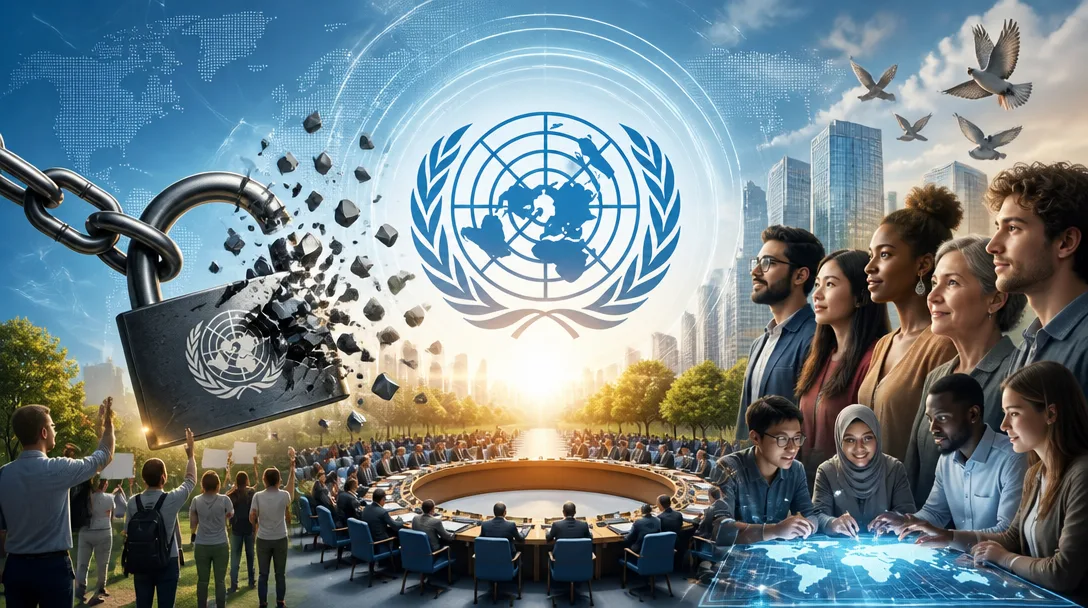
Explore bold, practical ideas for reforming the United Nations veto system — and discover how ordinary citizens, scholars, and advocates can help build a safer, more just world together.
What you'll learn
What you'll be able to do
- Explain the historical origins of the UN veto and why it was considered necessary at the time of the UN's founding in 1945
- Analyze how the veto has been used — and abused — by the P5 across major geopolitical crises from the Cold War to the present day
- Identify the core structural tensions between state sovereignty and collective international responsibility that make reform so difficult
- Evaluate at least four concrete, widely-discussed proposals for veto reform or abolition and assess their political feasibility
- Compare the UN's reform challenges to historical precedents where other seemingly immovable international institutions successfully evolved
- Articulate a well-reasoned personal position on what meaningful UN reform should look like and why
- Understand the role that civil society, academia, and informed citizens can play in pressuring institutional change at the international level
- Apply a principled analytical framework to future global crises to assess how a reformed UN might — or might not — respond differently
How it works
A school that adapts to you
This isn't a set of static videos. Every lesson is generated live and tuned to where you actually are.
We learn your level
A quick placement check tailors your starting point so you're never bored or lost.
Lessons adapt as you go
Each lesson is written for your pace and your goal, adjusting as your skills grow.
Your AI coach keeps you moving
Checkpoints, feedback, and gentle nudges turn progress into a real result.
The curriculum
What's inside your school
6 modules · 16 lessons

The Architecture of Power — How the UN and the Veto Were Born
Students ground themselves in the historical and political context of 1945, understanding why the veto was deliberately engineered into the UN Charter and what problems it was designed — and not designed — to solve. This module establishes the factual and conceptual foundation for everything that follows.
- 1.1A World in Ruins — The World That Built the UNIncluded
- 1.2Anatomy of the Veto — What Article 27 Actually Says and DoesIncluded
- 1.3The Five Permanent Members — Who They Were, Who They Are, and Why That Gap MattersIncluded
The Veto in Action — A Chronicle of Paralysis and Selective Justice
Students move from structure to history, conducting a rigorous, evidence-based audit of how the veto has actually been used from 1945 to today. They examine Cold War proxy conflicts, post-Cold War humanitarian failures, and contemporary crises in Syria, Ukraine, Gaza, and beyond — building an empirical case for why reform is not just desirable but urgent.
- 2.1The Cold War Veto — Superpower Chess on the Security CouncilIncluded
- 2.2When the World Watched and Did Nothing — Rwanda, Srebrenica, and the Responsibility to ProtectIncluded
- 2.3Syria, Ukraine, Gaza — The Contemporary ParalysisIncluded
The Structural Trap — Sovereignty, Legitimacy, and Why Reform Is So Hard
Before proposing solutions, students must genuinely understand the forces that make reform so resistant. This module examines the foundational tension between Westphalian state sovereignty and evolving norms of collective international responsibility, the incentive structures that keep the P5 locked in, and why well-meaning reform proposals have repeatedly stalled.
- 3.1The Sovereignty Fortress — Why States Guard Their Independence So FiercelyIncluded
- 3.2The P5 Incentive Problem — Why the Most Powerful Have No Reason to ChangeIncluded
The Reform Blueprints — Four Credible Paths Forward
Students now engage seriously and specifically with the leading reform proposals in the academic and policy literature. This module is deliberately evaluative: students are not asked to accept any proposal but to rigorously assess each one's logic, strengths, weaknesses, and political feasibility. By the end, they can speak with precision about the reform landscape.
- 4.1Expand or Rotate — Security Council Seat Reform ProposalsIncluded
- 4.2Constrain, Suspend, or Abolish — Direct Veto Reform ProposalsIncluded
- 4.3Route Around the Council — General Assembly and Alternative MechanismsIncluded
- 4.4Civil Society and the People's Pressure — Non-State Pathways to ReformIncluded
History as Teacher — When Immovable Institutions Finally Moved
Before concluding, students examine historical precedents where international institutions that seemed permanently locked in place were successfully reformed or replaced. These cases provide both cautionary lessons and genuine grounds for hope — and give students an evidence base for evaluating how realistic their own reform proposals are.
- 5.1The League of Nations Collapse — When Institutions Fail CompletelyIncluded
- 5.2Institutions That Bent Without Breaking — The EU, WTO, and ICC as Reform ModelsIncluded
Building Your Position — Synthesis, Advocacy, and the World We Choose to Make
The final module asks students to synthesize everything they have learned into a coherent, evidence-based personal position on UN reform — and then to communicate it effectively to real audiences. Students leave the course not just as informed analysts but as capable advocates, equipped to contribute to the reform conversation in their own professional and civic lives.
- 6.1Designing Your Analytical Framework — How to Assess Future CrisesIncluded
- 6.2Articulating Your Position — The Capstone Advocacy ProjectIncluded
Questions
Frequently asked
Your teacher
A note from your teacher

David Clilverd
I've spent years thinking about one of the most stubborn paradoxes of our time: we live in a more interconnected world than ever before, yet our most important global institution — the United Nations — is repeatedly paralyzed at the very moments it is needed most. That paradox drove me to write Unshackling the Veto, published on Amazon KDP, and it's what drives this school.
I'm not a cynic. I believe deeply that international cooperation is possible, that institutions can change, and that informed, engaged people are the engine of that change. What I've tried to do — in the book and here — is move the conversation beyond frustration and into serious, grounded, hopeful territory. Not naive optimism, but the harder and more rewarding work of understanding why the system is broken and what it would realistically take to fix it.
I'm glad you're here. Let's think about this together — because building a safer, more compassionate world starts with exactly this kind of honest, courageous conversation.
— David Clilverd
Start your journey today
Get instant access — learn at your own pace with an AI coach in your corner.
$49/mo
Recurring billing · cancel anytime
Secure checkout · Instant access
- 6 modules, 16 lessons
- AI-adaptive lessons tuned to your level
- Quizzes & checkpoints to lock in progress
- Your own AI learning coach
- Learn on any device, at your pace
- Full access for as long as you're subscribed