The Online Business Launch Roadmap: A Beginner's Guide to Going From Idea to First Sale
Val (Valdas) Samonis · August 16, 2026 · 5 min read
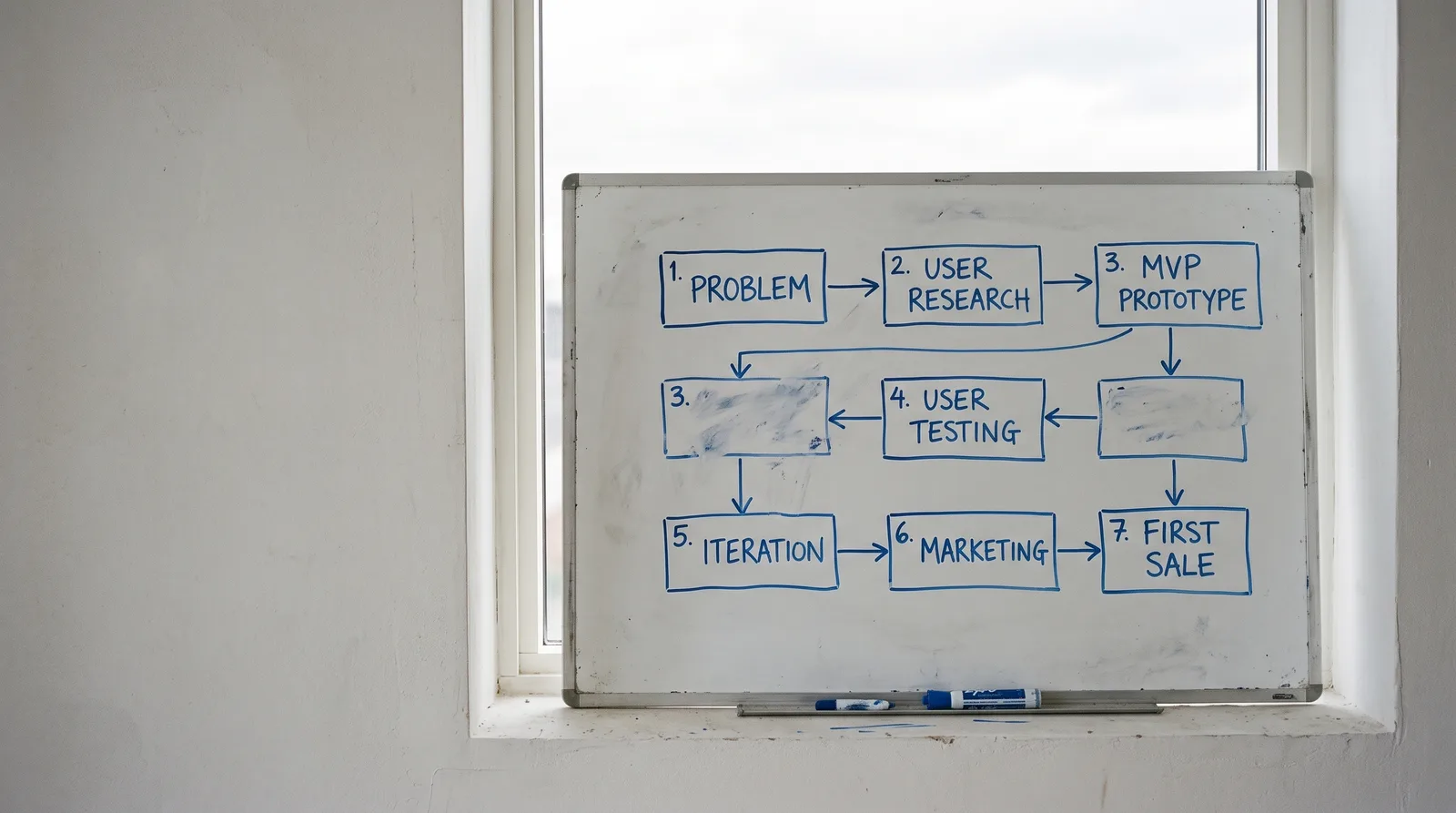
Most beginners don't fail because their idea is bad.
They fail because they build a website before they know who they're selling to. They spend three months perfecting a product before proving anyone wants it. They set up an LLC before they've made a single dollar. Good actions, wrong order — and the sequence kills them.
The online business launch roadmap I'm sharing here is about sequence. Every step is designed to load-bear the next one. Skip ahead, and the whole structure wobbles.
Step 1: Nail the Problem Before You Touch the Solution
Your first job is not to build anything. Your first job is to find a specific, painful, recurring problem that a specific group of people is actively trying to solve.
Notice what that sentence does not say. It doesn't say "a problem you think exists." It doesn't say "a problem your friends say sounds interesting." It says a problem people are actively trying to solve — meaning they're already searching for answers, already spending time or money on partial fixes, already frustrated that nothing works perfectly.
How do you find this? Go where the complaints live. Reddit threads. Amazon reviews of books in your niche (the one-star and two-star reviews are gold). Facebook groups. Quora. YouTube comment sections. You're not doing market research in a formal sense — you're listening to real people describe real frustration in their own words.
Write down the exact phrases they use. Those phrases will later become your marketing copy.
Step 2: Define the Person, Not Just the Problem
Once you have a problem, get precise about who has it. Not "small business owners." Not "people who want to get fit." Go tighter. "First-time Etsy sellers who are confused by shipping costs and losing money on every order." "Women over 40 returning to the workforce after a career gap who don't know how to modernize their résumé."
The narrower your focus at launch, the less competition you face and the more resonant your message becomes. You can always expand later. You cannot course-correct a vague offer that never attracted anyone specific in the first place.
Step 3: Validate Before You Build
This is the step most beginners skip, and it's the most important one on the entire roadmap.
Before you create your course, your coaching program, your digital product — before you write a single module — you validate. That means finding 3–10 people who match your target description and either (a) pre-selling them your offer at a discount, or (b) doing the work manually, live, with them, and charging for that.
A pre-sale or a paid beta does something no amount of planning can do: it tells you whether real humans will hand over real dollars for this specific promise. If they won't, you learn that for the cost of a few conversations rather than the cost of months of production. If they will, you now have revenue, testimonials, and direct feedback to make your product sharper.
Validation is not asking people if they would buy. It's asking them to buy now, at a price, with a card.
Step 4: Build the Minimum Viable Offer
Only after validation do you build. And you build the minimum version that fully delivers the promised result — not the version with the bonus modules, the slick sales page, and the custom domain. Those come later.
Your MVP (minimum viable offer) might be a Google Doc, a Zoom call series, a simple PDF guide, or a basic Teachable course with no frills. What matters is that it solves the problem you validated. Shipping something real beats perfecting something imaginary.
Step 5: Set Up the Infrastructure That Matches Your Stage
Here's where most beginners get the order backwards. They incorporate the business, build the full website, set up email automations, and design a logo — before they have an offer or a customer.
Reverse that. Once you have a validated offer and you're ready to sell beyond your first beta group, then you set up the pieces that support scale: a clean landing page, a simple email list, a payment processor like Stripe or PayPal, and — if revenue justifies it — a legal structure like an LLC.
Match your infrastructure to your stage, not to your ambitions.
Step 6: Make Your First Public Sale
With a validated offer and basic infrastructure in place, you're ready for your first public sale. This means going to the communities where your target person already hangs out and offering genuine value — answers, insights, a free resource — before you ever mention what you sell.
When you do mention it, lead with the problem and the result, not the features and the format. "This helps first-time Etsy sellers stop losing money on shipping" outperforms "This is a 6-module course with three bonus videos."
Your first sale from someone who doesn't already know you personally is the real milestone. It's proof the system works without relying on goodwill.
The Sequence Is the Strategy
Idea → Problem → Person → Validation → Build → Infrastructure → Public sale.
Every arrow in that chain matters. Validate before you build. Build before you scale infrastructure. Sell before you optimize.
This is the sequence I teach in detail inside Launch On Your Terms — where we work through each stage with frameworks, real decision-points, and the kind of honest guidance that keeps you from spending six months building something the market never asked for.
The idea is just the starting gun. The sequence is how you finish the race.